Last updated October 2026
A home addition in the Des Moines metro runs about $150 to $200 per square foot for a plain finished room and about $300 to $750 or more with a kitchen or bathroom. Those are planning ranges before site-specific extras such as engineering or major tie-in work. This guide shows what that means for a 200, 300 or 400 square foot addition, which factors push the number up, what Des Moines charges for permits, and how to read an addition estimate.
TLDR: Plan on about $150 to $200 per square foot for a plain room addition in Des Moines, so a 300 square foot room runs about $45,000 to $60,000. A kitchen or bathroom moves the range to about $300 to $750 or more per square foot. Second stories, structural work and tying into an older house push the number higher. Des Moines charges $257.50 for an addition permit plus $77.25 per trade permit in 2026. Keep a 10 to 15 percent contingency.
You want more room without moving. The first question is always the same: what will it cost? Online answers swing widely, and many of them come from national data that ignores Iowa’s frost line and local permit rules.
This guide sticks to the Des Moines metro and Central Iowa. We start with the per-square-foot math, then walk through what moves it, line by line.
Additions are a big share of our work. Busy Builders completes more than 100 projects a year, and most of them are additions, full remodels and basement finishes.
How Much Does a Home Addition Cost in Des Moines?
Plan on about $150 to $200 per square foot for a plain finished room and about $300 to $750 or more per square foot for an addition with a kitchen or bathroom. Those are planning ranges, not quotes. All prices vary with scope, pre-existing conditions and material choice.
Here is what those ranges look like by size.
| Addition size | Plain room, about $150 to $200 per sq ft | With a kitchen or bathroom, from about $300 per sq ft | Typical use |
|---|---|---|---|
| 150 sq ft | $22,500 to $30,000 | From about $45,000 | Small office or nursery |
| 200 sq ft | $30,000 to $40,000 | From about $60,000 | Bedroom with a closet |
| 300 sq ft | $45,000 to $60,000 | From about $90,000 | Family room or primary bedroom |
| 400 sq ft | $60,000 to $80,000 | From about $120,000 | Primary suite or large family room |
| 600 sq ft | $90,000 to $120,000 | From about $180,000 | Two rooms, or a suite with a bath |
The takeaway: size sets the baseline, and the factors in the next section decide how far above it you land.
So what is the average cost to add a room to a house in Iowa? There is no honest single average. A 200 square foot bedroom and a 400 square foot suite with a bathroom are different projects. Use the size table, then adjust for the factors below.
Pro Tip 1: Measure the room you actually need, then price it. Additions often grow on paper, and every extra square foot costs real money.
Pro Tip 2: Ask every contractor for a per-square-foot starting point before you share your budget. It keeps the first number honest.
What Factors Affect the Cost of a Home Addition in Central Iowa?
Seven factors explain most of the spread between addition estimates. Some are your choices. Others come with your lot and your house.
| Factor | Why it matters | Effect on price |
|---|---|---|
| Plumbing | A bathroom or wet bar adds drains, venting and tile | Large |
| Foundation type | Slab, crawlspace or full basement under the addition | Medium to large |
| Second story | Engineering and reinforcing the existing walls and footings | Large |
| Tie-in to the house | Roofline, exterior match, HVAC, electrical panel | Medium |
| Finish level | Flooring, trim, windows, fixtures | Medium |
| Lot and access | Setbacks, slope, equipment access, utilities | Small to large |
| Permits and inspections | City fees and required inspections | Small |
The takeaway: plumbing, structure and tie-in move a budget more than finishes do.
Every addition footing in Iowa must reach below the frost line, at least 42 inches deep. That is deeper than many warmer-state cost guides assume. Iowa’s state building code adopted the 2024 International Residential Code under Iowa Administrative Code 481-301.8, effective September 10, 2025. Many cities adopt their own edition, so ask which one applies to your address.
Tie-in is the factor most people miss. The addition has to meet your roofline, match your exterior and connect to your heating, cooling and electrical. An older furnace or a small electrical panel may need an upgrade to carry the new space.
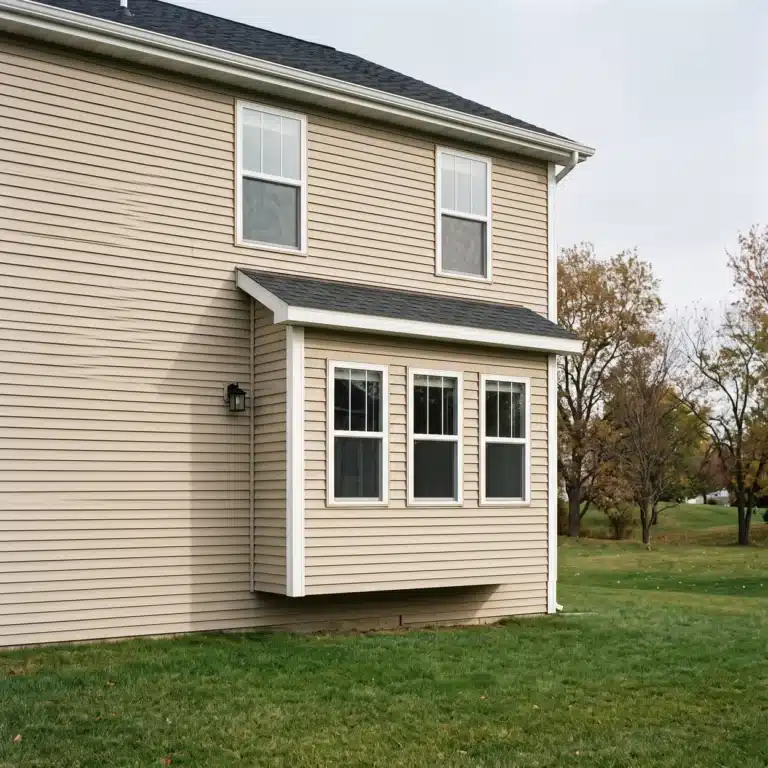
On a two-story addition we finished on an Iowa home, the exterior finishes were matched to the original house. That match is what makes an addition look like it was always there.
Pro Tip 3: Ask for a heating and cooling load check before you set the addition size. It is cheaper to plan a new zone than to discover the furnace cannot keep up.
Pro Tip 4: Check setbacks and easements before you fall in love with a floor plan. They decide where an addition can go.
Wondering what this would run at your place? Call or text 844-435-9800. Most of the time we can give you a ballpark on that first call. Nobody has to come out first.
How Does the Type of Addition Change the Price?
The type of addition matters as much as its size. Rooms with plumbing, rooms built up instead of out, and rooms that work as separate living space all cost more per square foot.
| Addition type | What drives the cost | Where it lands in the planning ranges |
|---|---|---|
| Bedroom or family room | Foundation, framing, roof tie-in | Plain-room range |
| Four-season room | Insulation, windows, heating and cooling | Above the plain-room range |
| Primary suite with bath | Plumbing, tile, ventilation | Kitchen and bath range |
| In-law suite or ADU | Kitchen, bath, separate entry, possibly utilities | Kitchen and bath range |
| Second story | Engineering, reinforcement, roof removal | No single range; structure decides |
| Attached garage | Slab, door, fire separation from the house | Varies with finish |
The takeaway: if your plan includes a bathroom or goes up a floor, budget well above the plain-room range.
We also build storm shelters, safe rooms and attached garages as part of additions work when a homeowner asks. Those are priced to the spec of the job.
For a deeper look at building up, read our guide to whether a second-story addition is worth it in Iowa. If you are comparing a basement and an addition, see basement addition vs second-story addition in Ankeny.
Pro Tip 5: Decide early whether the new space needs a bathroom. It is the single choice that moves an addition budget most.
Pro Tip 6: If you are planning an in-law suite, check your city’s ADU rules before design. Iowa’s SF 592 changed what cities can require.
What Should an Addition Estimate Include?
A complete estimate lists every part of the job. When one bid is far below the others, it usually left something out.
| Line item | Ask this |
|---|---|
| Foundation and footings | Are footings below 42 inches? Slab, crawlspace or basement? |
| Framing and roof tie-in | How will the new roof meet the old one? |
| Exterior match | Which materials, and how close is the match? |
| Windows and doors | Included, with what grade? |
| Electrical, plumbing, HVAC | Done by licensed trades? Panel or furnace upgrades included? |
| Insulation and drywall | Included through paint? |
| Flooring and trim | Allowance amounts spelled out? |
| Permits and inspections | Pulled and scheduled by the contractor? |
| Engineering | Included if structure changes? |
| Contingency | How are surprises priced? |
The takeaway: compare bids by these lines, not by the total at the bottom.
Pro Tip 7: Keep 10 to 15 percent of the budget as a contingency. Additions connect to older houses, and older houses hide things.
Pro Tip 8: Ask how change orders are written and priced before you sign. A clear process prevents most budget fights.
What Do Permits Cost for an Addition in Des Moines?
Permits are a small slice of an addition budget, but they are required. The City of Des Moines permit fee schedule, effective January 1, 2026, lists $257.50 for a building permit on an addition to a home. Electrical, mechanical and plumbing permits for additions are $77.25 each.
| Des Moines permit | 2026 fee |
|---|---|
| Building permit, addition to a home | $257.50 |
| Electrical, for additions | $77.25 |
| Mechanical, for additions | $77.25 |
| Plumbing, for additions | $77.25 |
The takeaway: an addition with all three trades carries about $490 in Des Moines permit fees. Suburbs set their own fees.
Des Moines also runs a residential combination inspection program for additions, where one inspector handles the trade inspections. Our guide to home addition permits in Iowa covers the process city by city.
Pro Tip 9: Keep every permit and inspection sign-off in one folder. Buyers, appraisers and insurers may ask for them.
Does a Home Addition Add Value?
An addition adds living space that appraisers count. Under Fannie Mae’s appraisal guidance, above-grade finished space counts in gross living area, while basement space is reported separately. That gives an above-grade addition an edge over a basement finish of the same size.
Return on the money is a different question. National data in the Cost vs. Value report shows additions typically recover only part of their cost at resale. The value usually comes from staying in a house and neighborhood you already like.
An Iowa certified appraiser and a local agent can tell you how comparable homes with additions have sold. Ask before you build if you plan to sell soon.
Illustrative scenario: An Ankeny family adds a 200 square foot bedroom with a closet to a ranch. No plumbing, slab foundation below the frost line, matched exterior. The planning range is about $30,000 to $40,000, built over about three months.
Illustrative scenario: A Waukee couple adds a 300 square foot primary suite with a walk-in shower and a separate heating and cooling zone. The bathroom pushes the project to $105,000 to $125,000 over about four months.
Illustrative scenario: A Des Moines family adds a 400 square foot family room on a crawlspace and upgrades the electrical panel to carry it. The project runs $125,000 to $140,000 over about four months.
Pro Tip 10: Get your financing lined up before you finalize size. Knowing your real ceiling keeps the scope from drifting.
Pro Tip 11: Plan the foundation work for a season when the ground is workable. Frozen ground slows footings and can add cost.
Pro Tip 12: Ask your contractor who designs the addition and when the drawings are final. Starting before the design is settled is how change orders multiply.
Frequently Asked Questions
Q1: How much does a home addition cost in Iowa? In the Des Moines metro, plan on about $150 to $200 per square foot for a plain room and about $300 to $750 or more with a kitchen or bathroom. A 200 square foot bedroom runs about $30,000 to $40,000, and a 400 square foot suite with a bathroom starts around $120,000. Second stories and structural work push the cost higher. Get an itemized estimate after a site visit.
Q2: What is the average cost to add a room to a house in Iowa? There is no meaningful single average, because size and plumbing change the job so much. A simple bedroom with no bathroom runs about $150 to $200 per square foot. A room with a kitchen or bathroom runs about $300 to $750 or more. Price your actual room size against those ranges.
Q3: What is the cost per square foot for a home addition in Iowa? About $150 to $200 for a plain finished room and about $300 to $750 or more with a kitchen or bathroom. Second stories depend on the structure. Smaller towns can differ with travel and local trades. Treat any online figure as a starting point only.
Q4: What factors affect the cost of a home addition? Plumbing, foundation type, building up versus out, tie-in to the existing house, finish level, lot access and permits. In Iowa, footings must go at least 42 inches deep. An older electrical panel or furnace may need an upgrade. Ask each contractor to price these lines separately.
Q5: Do I need a permit for a home addition in Des Moines? Yes. Des Moines lists $257.50 for an addition building permit in 2026, plus $77.25 each for electrical, mechanical and plumbing permits. Your contractor should pull them and schedule the inspections. Suburbs have their own fees and rules.
Q6: How long does a home addition take? It depends on size, design and season. Simple rooms move faster than suites or second stories, and permit review adds time up front. Our guide on how long a home addition takes in Iowa walks through each stage. Ask for a written schedule with your estimate.
Key Takeaways
Starting point:
- About $150 to $200 per square foot for a plain room and $300 to $750 or more with a kitchen or bathroom, as planning ranges.
- A 300 square foot plain room runs about $45,000 to $60,000.
What pushes it up:
- Bathrooms, second stories, structural work and tie-in to an older house.
- Footings must reach at least 42 inches deep in Iowa.
Permits:
- Des Moines lists $257.50 for an addition permit plus $77.25 per trade permit.
Budget habits:
- Keep a 10 to 15 percent contingency.
- Compare bids line by line, not by the total.
Plan Your Addition With Busy Builders
Busy Builders is a registered and insured Iowa contractor with 1,285+ completed projects across Central Iowa since 2020. Plumbing, electrical and HVAC work on our additions goes to licensed trades we coordinate. Free consultation and an itemized estimate. Written 5-year warranty on workmanship (details provided in your contract).
See our home additions services, or start with your city: Des Moines, Ankeny or Waukee.
Call: 844-435-9800
Disclaimer: This article is for general information and is not project-specific advice. Costs are planning estimates that vary by scope, materials, site conditions and current pricing. Permit fees and code requirements vary by city and change over time; verify them with your local building department. Structural changes require evaluation by a qualified professional. Resale comments are not financial advice, and actual returns vary by market and project quality. Electrical, plumbing and mechanical work is done by licensed trades. No specific outcome is promised. Consult a registered contractor about your project.
Busy Builders | Full-Service Construction and Remodeling | Serving Central Iowa Since 2020