If you are planning a basement bedroom in Central Iowa, one detail changes everything: the egress window. Skip it or size it wrong, and the room cannot legally be called a bedroom for appraisals, MLS listings, or resale. Get it right, and you add a legal bedroom that can meaningfully increase your home’s value. This guide walks you through the exact Iowa code numbers, real 2026 Central Iowa cost guidance on window types, and the mistakes that cost homeowners thousands.
TLDR: Iowa requires egress windows in every basement bedroom under the 2024 IRC. Below-grade basement windows require at least 5.0 square feet of net clear opening, while above-grade windows require 5.7 square feet. Installation in Central Iowa typically runs $2,500 to $5,000, including the window, well, excavation, and permits. A code-compliant egress window makes a basement room a legal bedroom, which typically increases home value. Read on for the full Iowa picture.
Last updated September 2026.
Most Iowa homeowners plan a basement bedroom without realizing how much it depends on one window. Inspectors measure the actual open space, not the frame. Appraisers won’t count a basement room as a bedroom without code-compliant egress. Buyers and their home inspectors quickly find non-compliant windows. The stakes are real, but the rules are knowable. Here is what you need to plan a compliant, well-priced egress window in 2026.
What Is an Egress Window and Why Does Iowa Require It
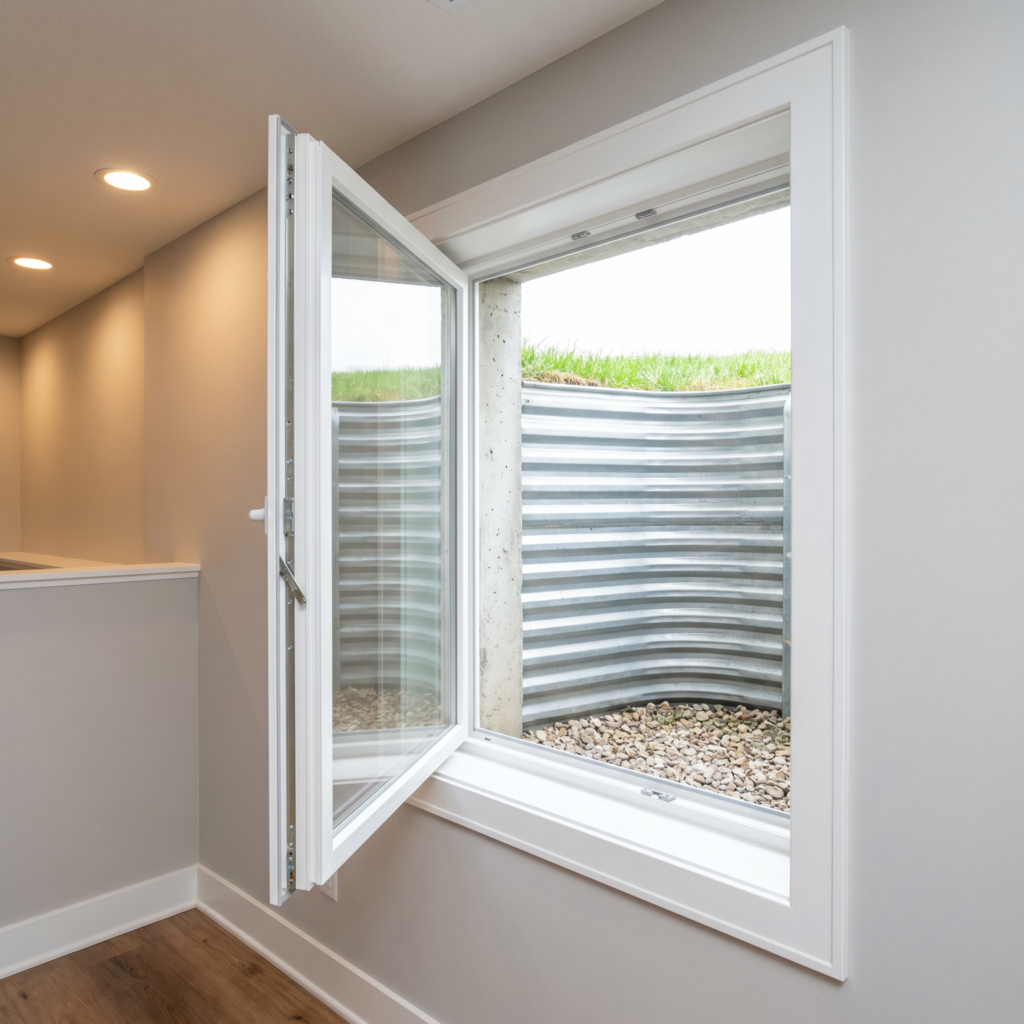
An egress window is an emergency escape opening large enough for an occupant to climb out and a first responder to climb in. The International Residential Code Section R310 requires egress windows in every bedroom, including basement bedrooms. Iowa follows the 2024 IRC statewide under Iowa Administrative Code 481-301.
Without a compliant egress window, a basement room cannot legally be marketed as a bedroom for appraisal, MLS listings, or mortgage qualification purposes. This is not a technicality. It directly affects how appraisers count bedrooms and what your home sells for.
Illustrative scenario: A Johnston family finished their basement with two rooms meant as bedrooms, but installed standard-size windows. When they listed the home, the appraiser counted only the original upper-level bedrooms. The basement rooms were listed as bonus rooms, which typically reduces the estimated home value by thousands of dollars.
Pro Tip 1: Confirm egress code compliance with your contractor before framing any basement wall, and fixing the mistake after drywall is up costs significantly more than getting it right the first time.
Iowa Egress Window Code Requirements: Exact Numbers
Iowa code has two opening-size standards, and the difference matters. Below-grade basement windows use one number, and above-grade contexts use another. Most basement windows fall into the below-grade category.
| Requirement | Below-Grade Basement | Above-Grade / Standard |
|---|---|---|
| Minimum net clear opening | 5.0 square feet | 5.7 square feet |
| Minimum opening width | 20 inches | 20 inches |
| Minimum opening height | 24 inches | 24 inches |
| Maximum sill height from floor | 44 inches | 44 inches |
Both numbers come directly from Iowa’s adopted 2024 IRC. Your contractor should know which applies to your project.
The phrase “net clear opening” is where most homeowners get tripped up. It means the actual open space when the window is fully opened, not the frame size or the glass size. A 36-inch-by-36-inch window frame does not provide 9 square feet of net clear opening. After accounting for the frame and sash, the net clear opening on that size window is typically only 4.5 to 5.0 square feet.
Also note: meeting the minimum 20-inch width and 24-inch height alone does not satisfy the area rule. The opening must also meet the 5.0- or 5.7-square-foot area threshold. And the window has to open normally from the inside. No keys, no tools.
Pro Tip 2: Measure net clear opening, never frame size. This is the single most common cause of failed egress inspections in Iowa.
Window Well Requirements
Any below-grade egress window needs a window well. Window wells let an occupant safely climb out and help prevent water intrusion.
| Requirement | Minimum | Notes |
|---|---|---|
| Horizontal clear area | 9 square feet | Measured when the window is open |
| Width | 36 inches | Projection fromthe wall |
| Maximum depth without a ladder | 36 inches | Minimum |
| Ladder projection from the wall | 44 inches | Ladder required beyond this |
| Ladder inside width | 12 inches | Minimum |
| Ladder rung spacing | 18 inches on center | Maximum |
| Ladder projection from wall | 3 inches | Minimum |
| Grate or cover | Removable without tools | Required for covered wells |
Every dimension in the table is enforced at inspection. Missing one can mean re-excavation, which adds cost no one wants.
Pro Tip 3: Casement windows hinge outward into the well and consume some of that 9-square-foot area when open. Your contractor must size the well to keep 9 square feet clear with the window fully opened.
Illustrative scenario: A Norwalk family installed an egress window with a 48-inch deep well but skipped the required ladder. The rough-in inspection failed, and adding a permanent ladder after the well was finished cost several hundred dollars more than including it in the original plan.
Pro Tip 4: If your well depth will exceed 44 inches, have the permanent ladder planned and priced before excavation. Add-on ladders always cost more than built-in ones.
Window Type Matters: Which One to Choose
The window you choose affects both code compliance and cost. Casement windows are the strongest choice for basement egress because the entire sash opens outward, delivering the largest net clear opening. Double-hung windows, by contrast, open only halfway because each sash only covers 50 percent of the frame. A large double-hung frame often fails code.
| Window Type | Typical Size | Net Clear Opening | Best For |
|---|---|---|---|
| Casement (hinges outward) | 30″ x 48″ | 5.7 to 6.2 sq ft | Best for basements, largest opening |
| Sliding | 40″ x 36″ | 5.5 to 6.0 sq ft | Space-saving, modern look |
| Double-hung | 30″ x 52″ | 5.2 to 5.7 sq ft | Traditional, often fails code |
| In-swing | 24″ x 36″+ | 5.0 to 5.7 sq ft | Limited exterior space |
Casement windows are the safest choice for Iowa basements. Net clear opening varies widely by brand and size, so verify the manufacturer’s specifications on any window before purchasing. If your contractor recommends something other than a casement, ask them to show you the net clear opening calculation before you agree.
Illustrative scenario: An Ankeny homeowner ordered a 30-inch-by-48-inch double-hung window, assuming it would meet code. At inspection, the net clear opening measured only 4.8 square feet. Replacing the window with a casement added roughly $1,800 to the project.
Pro Tip 5: When in doubt, choose casement. It rarely fails inspection and gives you the biggest escape opening in a real emergency.
Egress Window Installation Costs in Central Iowa (2026)
Real 2026 Central Iowa pricing falls into four bands depending on project complexity.
| Project Type | Cost Range | What Is Included |
|---|---|---|
| Standard basement (below-grade) | $2,500 to $5,000 | Window, well, excavation, concrete cutting, permits |
| Above-ground basement (minimal excavation) | $880 to $3,500 | Window, minimal excavation |
| Complex / structural reinforcement | $5,000 to $8,500 | Custom sizing, foundation repair |
| Premium / high-end materials | $8,500 to $12,000+ | Architectural integration, upgraded materials |
Central Iowa pricing lines up with or slightly below national averages thanks to lower labor rates in the region.
Here is what drives the cost on a standard install. Concrete cutting through a typical 8- to 10-inch foundation wall is the biggest labor line item. Clay soil in Central Iowa makes excavation slower than sandy soils. Window wells range from about $150 to $500 for materials alone. A drainage system adds $500 to $2,000 but prevents water damage that would cost far more later. The window unit itself runs $200 to $800. Permits vary by Iowa city but typically run $100 to $500, so confirm the exact fee with your local building department.
Pro Tip 6: Always include drainage in your quote. Skipping a $500 to $2,000 drainage system to save money up front can cost $5,000 to $10,000 in water damage and mold remediation within a few years.
Pro Tip 7: Ask for an itemized estimate. Lump-sum bids obscure where the money goes and make it hard to spot an estimate that omits drainage or permits.
What Happens Without a Compliant Egress Window
A basement room without a code-compliant egress window cannot be marketed, listed, or appraised as a bedroom. Appraisers list it as a bonus room or recreation room. MLS rules prohibit calling it a bedroom. Buyers lose access to mortgage products that price bedrooms. And home inspectors find non-compliant egress quickly, which often means buyers demand $3,000 to $8,000 in price reductions or walk away.
Adding a legal basement bedroom to a 2-bedroom home typically adds 7 to 8 percent to home value because it moves the home into a higher bedroom-count search bracket on MLS platforms. These figures reflect typical Iowa market patterns, and individual results may vary by neighborhood and market conditions.
Illustrative scenario: A West Des Moines family installed a code-compliant egress window and legally listed their finished basement as a third bedroom. The home sold for meaningfully more than comparable 2-bedroom listings in the area. Consult a local real estate agent about likely outcomes in your specific neighborhood.
For a deeper look at how appraisers and buyers value finished basements, see our guide on basement finishing in Central Iowa.
Pro Tip 8: Keep a clean permit and inspection record for every egress window you install. Future buyers, appraisers, and insurance companies may all ask to see it.
Iowa Permits and the Inspection Process
Every egress window installation in Iowa requires a building permit. Two inspections are the norm across Central Iowa cities.
First is the rough-in inspection. This happens when the opening is cut in the exterior wall. The inspector confirms location, size, sill height, window well dimensions, and drainage.
Second is the final inspection. This happens after the window is fully installed, before the room is put into use. This is where a Certificate of Occupancy may be issued for the finished space.
One Iowa nuance surprises many homeowners. The 2024 IRC code requires egress in basement sleeping rooms. However, several Central Iowa cities, including Johnston, Ankeny, and Pleasant Hill, require egress windows in any newly finished habitable basement space, even without a bedroom. Rules vary by municipality, so confirm requirements with your local building department before planning.
Iowa requires contractors earning $2,000 or more per year to register with the Iowa Department of Inspections, Appeals, and Licensing (DIAL). Always use a registered Iowa contractor for egress window installation. The concrete cutting, structural work, and permitted installation require proper trades. Electricians and plumbers on related work hold separate state licenses.
For a full walkthrough, see our guide to navigating Iowa home building permits.
Pro Tip 9: Ask for your contractor’s DIAL registration number in writing before signing. Verifying registration up front protects you from unpermitted work that can void your insurance and derail resale.
Common Mistakes Iowa Homeowners Make
Most egress window problems come down to a short list of repeatable mistakes. Avoiding these five saves time, money, and stress.
First, measuring frame size instead of net clear opening. A 36-inch-by-36-inch frame typically provides only 4.5 to 5.0 square feet of actual opening.
Second, choosing a double-hung window. These open only halfway and frequently fail inspection even at large frame sizes.
Third, skipping the drainage system. Water pools in the well after rain and seeps into finished walls, leading to mold and structural damage within a few years.
Fourth, cutting into structural supports. Foundation walls carry real loads. Always have a registered contractor assess load paths before cutting.
Fifth, skipping permits entirely. Unpermitted work is discovered during a home inspection. Buyers typically demand price reductions of $3,000 to $8,000 or walk away.
For more on what to address before you finish any basement project, see our guide to basement problems to fix before you finish.
Pro Tip 10: Never let anyone cut your foundation without first confirming load paths. Structural damage from a bad cut can cost $10,000 or more to repair.
Pro Tip 11: Clay soil across Central Iowa adds excavation time and effort. Build a small contingency into your egress budget for site conditions.
Pro Tip 12: Schedule your rough-in inspection as soon as the opening is cut and the well is dug. Catching problems at rough-in is dramatically cheaper than after finishing work.
Frequently Asked Questions
What is the minimum egress window size in Iowa?
Iowa follows the 2024 IRC. Below-grade basement windows require a minimum net clear opening of 5.0 square feet. Above-grade or standard contexts require 5.7 square feet. Minimum width is 20 inches and minimum height is 24 inches, with sill no higher than 44 inches from the finished floor. “Net clear opening” means the actual open space when fully open, not frame size.
How much does an egress window cost in Iowa?
A standard below-grade basement egress window installation in Central Iowa typically runs $2,500 to $5,000. This includes the window, well, excavation, concrete cutting, and permits. Complex projects with structural reinforcement run $5,000 to $8,500. Always budget separately for drainage, which runs $500 to $2,000 and is not optional if you want the installation to last.
Do I need an egress window if my basement does not have a bedroom?
Iowa’s base 2024 IRC code requires egress in basement sleeping rooms. However, several Central Iowa cities, including Johnston, Ankeny, and Pleasant Hill, require egress windows in any newly finished habitable basement space. Always confirm with your local building department before planning.
Can I call a basement room a bedroom without an egress window?
No. Without a code-compliant egress window, the room cannot legally be marketed as a bedroom for appraisal, MLS listing, or mortgage qualification purposes. Appraisers classify the room as a bonus room or recreation room. This directly affects how your home is valued and listed.
What window type is best for basement egress in Iowa?
Casement windows are the best choice. The entire sash opens outward, delivering the largest net clear opening. Double-hung windows open only halfway and frequently fail inspection, even with large frames. Sliding windows also work well when a casement is not a fit. When in doubt, choose casement.
How long does an egress window installation take?
Most egress window projects take about 4 to 6 weeks from start to finish. Design and planning typically take 1 to 2 weeks. Permit review takes 1 to 2 weeks, depending on your city. Actual installation takes 3 to 7 days on-site. Expect some variance based on site conditions and the permit office’s workload.
Key Takeaways
Iowa Code Requirements
- Below-grade basement windows: 5.0 sq ft net clear opening minimum
- Above-grade contexts: 5.7 sq ft minimum
- 20 inches minimum width, 24 inches minimum height
- 44 inches maximum sill height from finished floor
Window Well Requirements
- 9 square feet minimum horizontal clear area
- 36 inches minimum width and projection
- Permanent ladder required if depth exceeds 44 inches
- Removable cover or grate required on covered wells
Costs in Central Iowa
- Standard installation: $2,500 to $5,000
- Complex with structural work: $5,000 to $8,500
- Drainage system: $500 to $2,000 (never skip this)
- Permits: $100 to $500, depending on the city
Critical Mistakes to Avoid
- Measuring frame size instead of net clear opening
- Installing double-hung windows for basement egress
- Skipping drainage to save money upfront
- Working without a permit
Ready to Plan Your Egress Window with Busy Builders
You now have the Iowa code requirements, real Central Iowa costs, and the most common mistakes to avoid. The next step is a conversation with a contractor who handles permits, passes inspections the first time, and installs egress windows that protect your home’s value.
Busy Builders has completed 1,285+ projects across Central Iowa since 2020. We bring transparency and honest pricing to every egress window and basement project. Here is what we offer:
- Free on-site consultation and itemized estimates
- Full permit and inspection management
- Registered Iowa contractors and licensed trades
- Drainage systems designed for Central Iowa clay soils
- Casement window recommendations sized to pass inspection
- Written warranty on artistry (details provided in your contract)
We serve Des Moines, West Des Moines, Ankeny, Waukee, Urbandale, Johnston, Grimes, Ames, and communities across Central Iowa.
Call: 844-435-9800 Website: https://busybuildersiowa.com/
The code requirements, cost figures, and resale value information in this post are based on Iowa’s adopted 2024 IRC building codes, official municipal guidelines, and publicly available sources as of 2026. Building code requirements vary by municipality, so always verify egress requirements with your local building department before starting any project. Individual installation costs will vary based on site conditions, foundation type, window size, and local contractor rates. Resale value estimates reflect typical market patterns and do not guarantee specific financial outcomes. This content is for general educational purposes only and does not constitute legal or building code advice. Consult your local building department, an Iowa certified appraiser, and a registered Iowa contractor before beginning any egress window project. Busy Builders is a registered Iowa contractor. All egress window installations require permits and inspections.
Busy Builders | Full-Service Construction and Remodeling | Serving Central Iowa Since 2020