Last updated October 2026
Iowa’s statewide home building code is the 2024 International Residential Code, in force since September 10, 2025. It is not the only code on your job. This guide sorts out the 2012 energy code and the 2023 electrical code as changed by House File 2800. It also covers plumbing and mechanical codes, local city editions, the radon law and basement finishing permits.
TLDR: Iowa adopted the 2024 IRC effective September 10, 2025, and keeps the 2012 IECC as its residential energy code. Plumbing and mechanical work follow 2024 codes. Electrical follows the 2023 NEC as changed by House File 2800 in June 2026. Cities can pick their own building code edition, so Des Moines, Clive and Ankeny list 2024 while Urbandale lists 2018. Confirm your city’s edition first.
You are planning a new home, an addition or a basement, and someone says “that is not to code.” Which code? Iowa has a state building code, separate electrical, plumbing and energy rules, and cities that adopt their own editions on their own schedules.
This guide lays out the whole stack in plain English. Permit steps, review times and fees live in our companion guide, Iowa Home Building Permits: Steps, Fees and Inspections. You will see which edition covers each part of the house and why the city next door can use a different book. You will also see this summer’s electrical changes, where the radon law stands and what a basement finish needs before drywall.
Which home building codes apply in Iowa?
Five code families touch a new Iowa house, and a sixth covers work on existing homes. The 2024 International Residential Code covers the structure. The 2012 International Energy Conservation Code covers insulation and air sealing, and the 2023 National Electrical Code covers wiring. Plumbing follows the 2024 Uniform Plumbing Code, and mechanical work follows the 2024 International Mechanical Code.
The state building code rule, Iowa Administrative Code chapter 481-301, adopts the 2024 IRC with Iowa amendments in rule 481-301.8. It replaces the IRC’s energy chapter with the state energy rule and points plumbing, mechanical and electrical work to their own state codes.
The table below lists each code, the edition Iowa uses for houses, and the rule that adopts it.
| Code family | Edition for one- and two-family homes | State rule | In effect since |
|---|---|---|---|
| Residential building | 2024 International Residential Code, Iowa amendments | IAC 481-301.8 | September 10, 2025 |
| Residential energy | 2012 IECC residential provisions, Iowa amendments | IAC 481-301.24 | Readopted September 10, 2025; amended August 12, 2026 |
| Electrical | 2023 National Electrical Code, as changed by HF 2800 | Iowa Code chapter 103 | June 2, 2026 changes |
| Plumbing | 2024 Uniform Plumbing Code | IAC 481-425 | March 26, 2025 |
| Mechanical | 2024 International Mechanical Code | IAC 481-426 | March 26, 2025 |
| Existing buildings | 2024 International Existing Building Code | IAC 481-301.7 | September 10, 2025 |
The building code moved to 2024, but the energy code still sits on its 2012 edition. That gap is easy to miss when you read a plan set.
Iowa also built in a grace period. Under rule 481-301.10, a project that commences within 12 months after new standards take effect may follow either the new or the previous standards. For the 2024 IRC, that window ran to September 2026.
Pro Tip 1: Ask your designer which code edition the plans were drawn to, and write it on the cover sheet. Plan reviewers check against the edition your city enforces, not the one in the designer’s software.
Pro Tip 2: If your plans were drawn before September 2025, have them checked against the 2024 IRC. The transition window has closed, so a new submittal under the state code faces the 2024 edition.
Can Iowa cities use a different home building code edition?
Yes, for the building code. Iowa Code chapter 103A lets a city adopt its own building regulations or accept the state building code by ordinance. Plumbing, mechanical and electrical work are different: cities cannot swap in another code edition.
The rules sit in Iowa Code chapter 103A. Section 103A.10 applies the state building code where a city accepts it by ordinance. It also applies in any city over 15,000 people without a local code substantially in accord with a national model code. Section 103A.22 says a city that accepts the state code cannot make it more restrictive, except for energy rules.
The trade codes are tighter. Cities cannot adopt other plumbing or mechanical codes, though they may add stricter amendments. Under House File 2800, a city also may not adopt a local electrical code more restrictive than the state’s version of the NEC.
The table below shows what metro cities and one county list as their adopted residential codes, checked on each government’s own site in October 2026.
| Jurisdiction | Residential building code listed | Energy code listed | Ground snow load listed |
|---|---|---|---|
| Des Moines | 2024 IRC, effective January 1, 2026 | 2015 IECC | 33 psf |
| Clive | 2024 IRC | 2012 IECC per state requirements | – |
| Ankeny | 2024 Residential Code | 2012 Energy Code, state code | 33 psf minimum |
| Urbandale | 2018 IRC | 2012 IECC, state code | 30 psf |
| Waukee | 2024 International Building and Fire Code (IRC edition not stated) | – | – |
| Unincorporated Polk County | 2021 International Codes | State energy code | 30 psf |
Five jurisdictions in one metro list three different residential editions and two snow loads. Confirm the edition for your exact address before a design is final.
Des Moines posts its list and local design criteria, including a 42-inch frost depth, on its construction codes page.
Snow load is a good example of why editions matter. Ankeny tells builders that 2024 IRC snow loads increased based on historical data. It says to expect a local residential ground snow load of at least 33 psf. Urbandale and unincorporated Polk County still list 30 psf.
Pro Tip 3: Get the edition and design criteria from the city page or permit office for your exact address. Snow load, frost depth and wind speed all come from that local table.
Pro Tip 4: If you are comparing bids across two suburbs, ask each builder which edition they priced. A truss package designed for 30 psf may not pass in a city that requires 33.
Illustrative scenario: A family in Urbandale plans a 400-square-foot family room addition while friends in Des Moines plan a similar one. The Urbandale plans go in under the 2018 IRC and the Des Moines plans under the 2024 IRC, with different roof snow loads. Each addition lands near $120,000 to $150,000 at planning prices of about $300 per square foot and up, over four to six months.
What changed in Iowa’s electrical code in 2026?
House File 2800, signed June 2, 2026, took effect immediately. Iowa now enforces the 2023 National Electrical Code without the old state amendments, plus a short list of changes written into the law itself. The biggest change for houses: arc-fault breakers are no longer required in one- and two-family homes and townhouses.
The Iowa Department of Inspections, Appeals and Licensing explains it on its electrical permits and inspections page. The law removed the state amendments that had been in IAC 481-404.3, and those standards remain the minimum until the 2026 NEC is adopted. The law also requires a cost analysis before Iowa adopts that 2026 edition.
The table below compares the 2023 NEC as published with Iowa’s version after House File 2800 on the items homeowners notice most.
| Item | 2023 NEC as published | Iowa after House File 2800 |
|---|---|---|
| Arc-fault protection in dwellings | Required on many circuits | Not required in one- and two-family homes or townhouses |
| GFCI in kitchens | Required for kitchen receptacles | Required only for receptacles serving countertops |
| GFCI in basements | Required in basements | Applies to unfinished basement areas, not finished rooms |
| Sump pump and refrigerator outlets | GFCI where the location requires it | GFCI not required |
| Kitchen island receptacle | Required rules for islands and peninsulas | A receptacle or provision for one at islands 24 inches or longer |
| Surge protection at the service | Required | Section 230.67 excluded |
| Local amendments | Set by each adopting body | Cities may not be more restrictive |
These changes lower some minimums, but they do not ban the protection. You can still ask for arc-fault breakers or surge protection; the code just no longer requires them.
On our jobs, plumbing, electrical and HVAC work is done by licensed subcontractors we coordinate. That matters here, because some city handouts were written before June 2026. Your licensed electrician should confirm which protection your city inspector will look for.
Pro Tip 5: Decide on arc-fault and surge protection as an owner choice, not a code question. Both are now optional for houses, so ask your electrician to price them and decide with the numbers in hand.
Pro Tip 6: Ask your electrician to note on the permit which GFCI locations they are protecting. It saves a debate at the rough-in inspection.
What does Iowa’s energy code require for a new home?
For new houses, Iowa uses the 2012 IECC residential provisions with state amendments in rule 481-301.24. Central Iowa sits in climate zone 5. A new house there needs about R-49 in the ceiling, R-20 walls or R-13 plus R-5 continuous, and windows at U-0.32 or better. A blower-door test must show 4 air changes per hour or less.
The U.S. Department of Energy’s county climate guide places Polk, Dallas, Story, Boone, Marshall, Warren, Jasper, Madison, Marion and Guthrie counties in zone 5A.
The table below lists the main climate zone 5 requirements from Iowa’s version of Table R402.1.1 and the testing amendments.
| Component | Climate zone 5 requirement in Iowa |
|---|---|
| Ceiling | R-49 |
| Wood frame wall | R-20 cavity, or R-13 cavity plus R-5 continuous |
| Basement wall | R-15 continuous or R-19 cavity |
| Floor over unconditioned space | R-30, or enough to fill the cavity at R-19 minimum |
| Slab edge | R-10, 2 feet deep |
| Windows | U-factor 0.32 or lower |
| Air leakage | 4 air changes per hour or less at 50 pascals |
| Duct leakage | Tested unless ducts and air handler sit fully inside the envelope |
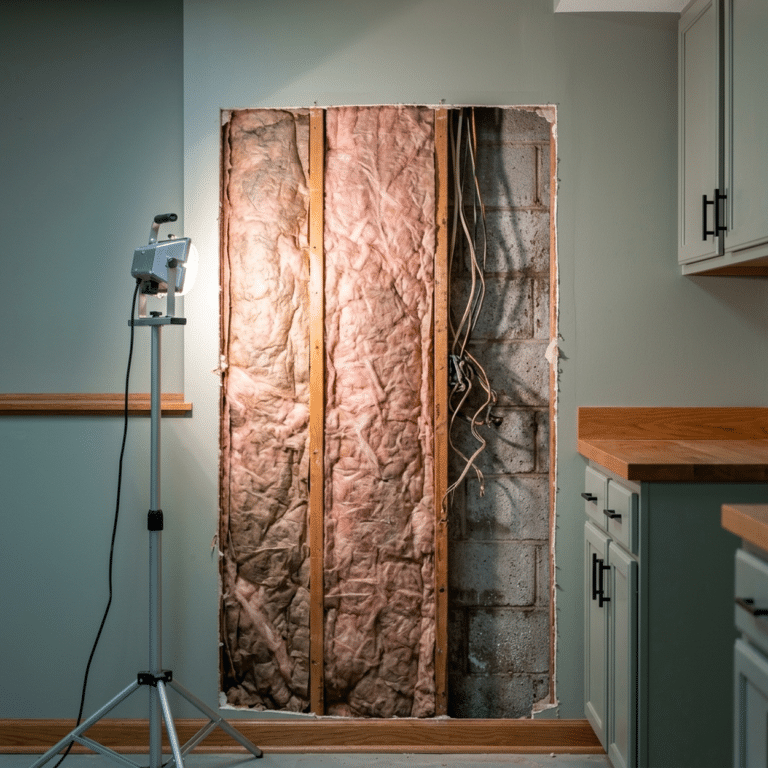
Insulation levels are set on paper, but air leakage and duct leakage are measured on site. Plan the blower-door test before drywall goes up, while leaks are still easy to reach.
One scope rule matters for remodels. Iowa’s energy rule states that remodeling or renovation of one- and two-family homes is not within the scope of the residential energy code. Ask your city how it handles insulation on a remodel or basement finish.
Pro Tip 7: Schedule a pre-drywall air-sealing walk with your builder. Fixing a leak at the rim joist takes minutes before drywall and hours after.
Pro Tip 8: Keep ductwork inside the conditioned space when you can. Iowa’s rule skips the duct leakage test when ducts and the air handler sit entirely inside the building envelope.
Does Iowa’s radon law change the code for new homes?
Yes, once it is adopted. House File 2297 was signed May 19, 2026 and took effect July 1, 2026. It directs the State Building Code Commissioner to require a passive radon system in new one- and two-family homes. The requirement applies to construction that starts after the Commissioner adopts it.
The enrolled law points to the passive methods listed in Appendix AF of the 2021 IRC. It also adds radon to the short list of state code provisions that apply to all new one- and two-family homes statewide. As of the September 30, 2026 printing of IAC chapter 481-301, the requirement had not yet been written into the rule.
Iowa HHS notes that, according to the EPA, the entire state is considered high risk for radon. Radon is very common on our basement jobs in the Des Moines area, and we treat mitigation as part of the finish, not an add-on. Our post on what HF 2297 means for a 2027 build covers cost and timing.
Pro Tip 9: Build the passive radon pipe into any new house now, even before the rule is adopted. Running it during framing is simple; retrofitting a finished basement is not.
Do you need a permit to finish a basement in Iowa?
Yes, in the metro cities we checked. Clive requires a permit, fee and inspections for every basement finish. Ankeny lists basement-finish inspections for under-floor plumbing, rough framing and trades, and a final. Expect egress, smoke and carbon monoxide alarm, and electrical checks.
Clive’s residential construction and permits page spells out what the inspector looks for. Bedrooms need an emergency escape opening, and Clive counts any room of 70 square feet or more with a closet as a bedroom. Smoke alarms go in bedrooms and outside them, hardwired and interconnected, with carbon monoxide alarms outside bedroom doors.
The table below lists Clive’s egress minimums, which follow the egress section Iowa adopted (Iowa IAC 481-301.8 / R319). It adds Ankeny’s basement permit math.
| Basement item | Requirement or figure |
|---|---|
| Egress net clear opening | 5.7 sq ft (5.0 sq ft for grade-floor openings) |
| Minimum opening height and width | 24 inches high, 20 inches wide |
| Maximum sill height | 44 inches, or a fixed platform 36 by 18 inches and no more than 24 inches tall |
| Window well | At least 9 sq ft, 36 inches of projection and width |
| Well deeper than 44 inches | Permanent ladder required |
| Ankeny valuation for finishing an existing basement | $31.50 per sq ft (fee schedule effective July 1, 2026) |
| Ankeny building permit on a 1,000 sq ft finish | About $331, plus trade permits |
The permit fee on a basement finish is small; the egress window and well are where the code costs real money. Plan the bedroom count first, because each bedroom needs its own escape opening.
Our guide to egress window codes and costs covers sizing and wells in more detail.
Busy Builders is a registered Iowa contractor (DIAL registration C140184), based in West Des Moines. On our basement finishing jobs, we pull the permit and schedule each inspection.
Pro Tip 10: Label every room on the basement plan by its real use. An office with a closet over 70 square feet is a bedroom to the inspector in Clive, and it needs egress.
Pro Tip 11: Ask for battery backup on the sump pump. Clive recommends it because all basements are prone to flooding.
Pro Tip 12: Keep the electrical permit and the building permit on the same schedule. The rough-in electrical inspection has to pass before insulation and drywall cover the walls.
Illustrative scenario: A couple in Clive finishes 900 square feet with a bedroom, a three-quarter bath and a family room. The plan adds one egress window and well, smoke and carbon monoxide alarms, and a passive radon fan-ready pipe. The planning estimate runs about $55,000 to $75,000 over eight to ten weeks, with three inspections.
Frequently Asked Questions
Q1: What home building code does Iowa use in 2026? The state uses the 2024 International Residential Code with Iowa amendments, effective September 10, 2025, under IAC 481-301.8. The residential energy code is still the 2012 IECC with state amendments. Your city may enforce a different building code edition, since Iowa cities can adopt their own. Check your city’s adopted codes page or call the permit office before you finalize plans.
Q2: Why is my city on a different code than the state? Iowa Code chapter 103A lets cities adopt their own building regulations or accept the state code by ordinance. Des Moines, Clive and Ankeny list 2024 residential codes, while Urbandale lists the 2018 IRC. Plumbing, mechanical and electrical are different, because cities cannot replace those state codes. Ask the permit office which edition applies to your address.
Q3: Does Iowa still require arc-fault breakers in new homes? Not under state law. House File 2800, signed June 2, 2026, removed the arc-fault requirement for one- and two-family homes and townhouses. Cities also cannot adopt a more restrictive electrical code. You can still choose to install them. Ask your licensed electrician to price both options.
Q4: What insulation does Iowa’s energy code require for a new house? Climate zone 5 covers the Central Iowa counties we serve. There, Iowa’s table calls for R-49 ceilings, R-20 walls or R-13 plus R-5 continuous, and R-15 or R-19 basement walls. Windows must be U-0.32 or better, and the house must test at 4 air changes per hour or less. Ask your builder when the blower-door test is scheduled.
Q5: Is the radon mitigation law in effect for new homes? House File 2297 took effect July 1, 2026. The passive radon requirement applies to construction that starts after the State Building Code Commissioner adopts it. As of the September 30, 2026 code printing, it had not been added to the rule. Plan for a passive system anyway, since the requirement is coming. Ask your builder to include it in the base price.
Q6: Do I need a permit to finish my basement in Iowa? In the metro cities we checked, yes. Clive requires a permit, fee and inspections for all basement finishes, and Ankeny’s fee schedule values an existing-basement finish at $31.50 per square foot. A 1,000-square-foot finish in Ankeny carries a building permit of about $331 plus trade permits. Call your city before you frame the first wall.
Key Takeaways
- Statewide floor: Iowa adopted the 2024 IRC effective September 10, 2025, but kept the 2012 IECC for residential energy.
- City editions vary: Des Moines, Clive and Ankeny list 2024 residential codes, while Urbandale lists 2018 and unincorporated Polk County lists 2021.
- Electrical changed in June: House File 2800 put Iowa on the unamended 2023 NEC plus its own changes, including no arc-fault requirement in houses.
- Radon is pending: House File 2297 is law, but the passive system requirement starts once the Commissioner adopts it.
- Basement finishes need permits: Expect egress, alarm and electrical inspections, and plan one escape opening per bedroom.
Build to the Right Code With a Registered Contractor
Busy Builders is a registered Iowa contractor with 1,285+ completed projects across Central Iowa since 2020. We confirm the code edition for your address, coordinate licensed trades and meet every inspector on our home building projects. Free consultation and estimate, and a written warranty on workmanship (details provided in your contract).
Call: 844-435-9800
Disclaimer: This article is for general information and is not project-specific advice. Code editions, amendments and adoption dates change, and city adoptions vary; the editions cited were checked on government sites in October 2026. Permit requirements vary by city and jurisdiction, so verify current requirements with your local building authority before starting any project. Cost figures are planning estimates that vary by scope, materials, site conditions and current pricing.
Structural design values such as snow loads require evaluation by a qualified professional. Radon levels vary by home; test before and after any basement work. No specific outcomes are guaranteed. Consult a registered contractor for guidance specific to your project; electrical, plumbing and mechanical work is performed by licensed subcontractors.
Busy Builders | Full-Service Construction and Remodeling | Serving Central Iowa Since 2020