Home building in Waukee usually starts with a lot in a platted subdivision, and that lot comes with paperwork most buyers never read. This guide covers what a Waukee lot includes, what recorded covenants control, and the city’s 2026 fees for a new house. Every fee here comes from the city’s own schedule.
TLDR: A Waukee subdivision lot comes with city utility stubs, a recorded plat and usually covenants. Covenants can require plan approval, a minimum house size, sod, a front-yard tree and a public sidewalk. The 2026 building permit is based on the city’s valuation, plus flat fees for trades, energy code, erosion control and the water meter. Read the lot’s documents before you buy, then design to them.
Waukee keeps growing. The city counted 23,940 residents in the 2020 Census, and it issued 34 single-family permits in August 2026 alone.
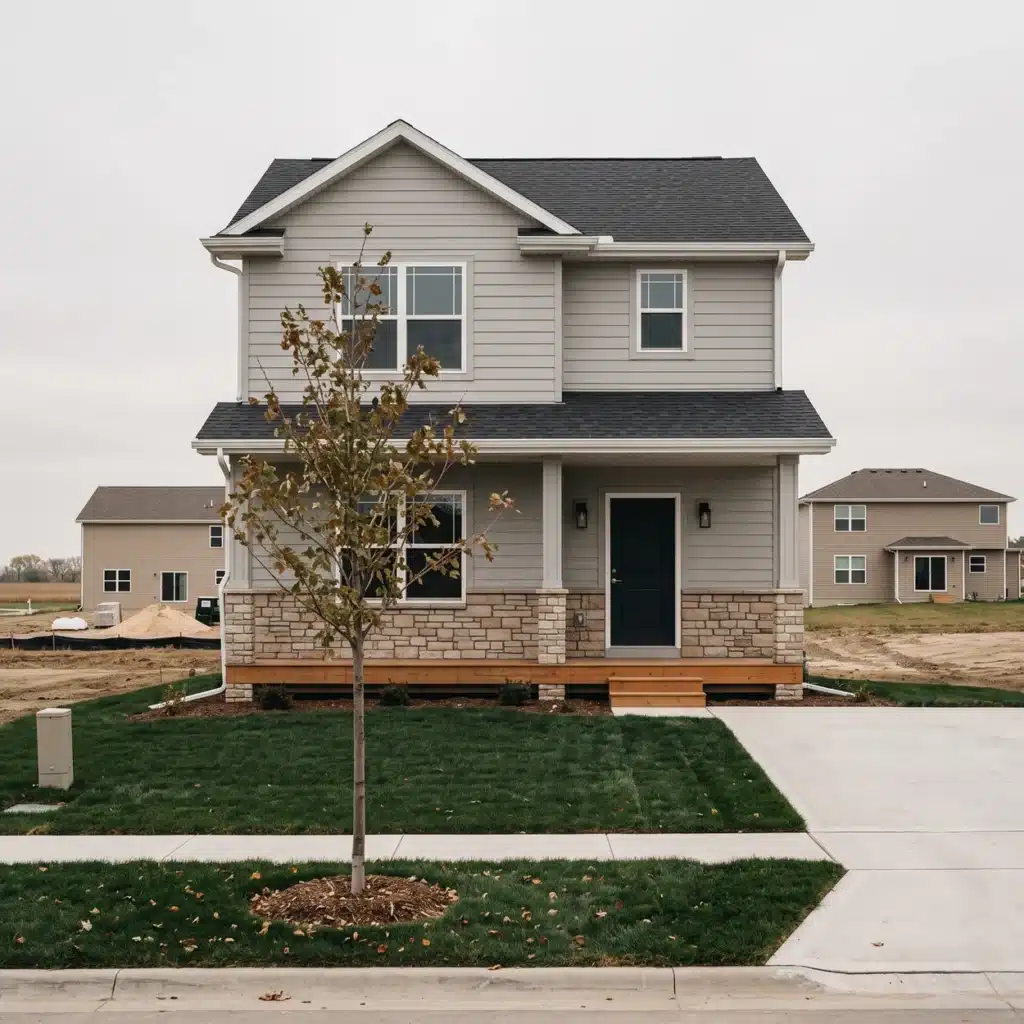
On a platted lot, the city and the developer already made many decisions for you. Some save money, like sewer and water stubs at the lot line. Others cost money, like a sidewalk you must build.
What Does a Platted Lot Give You for Home Building in Waukee?
A platted Waukee lot gives you city utilities at the lot line, recorded grades and set building lines. Waukee’s Standard Specifications for Public Improvements, dated May 2025, require developers to give every subdivision lot water, sanitary sewer and sump pump drain service lines.
The sewer stub runs 10 feet inside the lot line. Water and the sump drain stub to the lot line, and the sump line outlets to a public storm sewer.
The table below compares a platted Waukee lot with an acreage lot, the other common choice for a Dallas County build.
| Item | Platted Waukee lot | Acreage lot outside town |
|---|---|---|
| Water | City stub at the lot line | Usually a private well |
| Sewer | City stub 10 feet inside the lot | Usually a septic system |
| Sump discharge | Drain line stubbed to the lot | Planned on site |
| Design rules | Zoning plus covenants | Mostly county zoning |
The money a platted lot saves on a well and septic often shows up later as covenant and site costs.
Read the plat, too. Waukee plats use M.O.E. for minimum opening elevation, and some list one for each lot. It limits how low a walkout door or basement window can sit.
Pro Tip 1: Pull the plat, covenants and any elevation exhibit from Waukee’s plats and covenants page before you make an offer.
Pro Tip 2: Place the mechanical room near the utility stubs to keep pipe runs short.
What Do Waukee Covenants Control Before You Build?
Covenants control what you can build and how it looks, and they bind you from the day you close. They are recorded private rules that sit on top of city zoning. One covenant set posted on the city’s plats page requires approval of the plan, materials, colors and house location.
Here is what that set requires. Yours may differ, so read every line.
| Covenant item | What it requires | What it means for you |
|---|---|---|
| Plan approval | Developer, later the HOA board, approves the plan | Put approval time in the schedule |
| Minimum size | 1,200 sq ft finished for a one-story; 1,400 for a two-story | A very small ranch may not qualify |
| Basement floor | Must meet any minimum elevation on the plat | Affects foundation and walkout design |
| Yard | A front-yard tree within 120 days of move-in, plus sod | Landscaping belongs in the budget |
| Public sidewalk | Owner builds the 5-foot walk when the house goes up | A site cost many buyers miss |
The sidewalk, sod and tree lines land after the house budget is spent. The same set also requires a two-car garage, a hard-surfaced driveway, and seeding the lot if building has not started within six months of purchase.
Pro Tip 3: Ask who runs plan approval today, the developer or the association board, and how long it takes.
Pro Tip 4: Check the minimum opening elevation against your plan before it is final. A walkout set too low means a redesign.
Wondering what this would run at your place? Call or text 844-435-9800. Most of the time we can give you a ballpark on that first call. Nobody has to come out first.
What Are Waukee’s 2026 Permit Fees for a New Home?
Waukee’s 2026 fee schedule, adopted April 6, 2026, bases the building permit on the home’s valuation. It adds flat fees for trades, energy code, erosion control and the water meter. The city tells the builder the total at permit issuance.
Valuation is not your contract price. The city pairs its fee calculator with the International Code Council’s valuation chart, which multiplies floor area by an average cost per square foot.
Here are the 2026 fee lines most new homes pay.
| 2026 Waukee fee line | Amount | Notes |
|---|---|---|
| Building permit, $100,001 to $500,000 valuation | $726.93 plus $4.09 per $1,000 over $100,000 | City valuation |
| Inclusive trade permit, new home | $225 | One trade line |
| Energy code review and inspection | $500 | Per unit |
| COSESCO erosion control | $250 | One time, per lot |
| 3/4-inch water meter | $524 | Labor billed on top |
| Right-of-way permit | $150 | Sidewalk or driveway approach work |
At a $400,000 city valuation, the building permit line is $726.93 plus 300 times $4.09, or about $1,954. Ask for the full total before you lock the budget.
Pro Tip 5: Run the city’s residential fee calculator during design. It shows how added square footage moves the fee.
Pro Tip 6: Waukee lists a separate temporary heat permit. If drywall and paint land in January, plan for it.
What Does the State Code Add to a New Waukee Home?
Iowa’s residential energy code adds pass-or-fail tests to every new house in the state. It is the 2012 International Energy Conservation Code with Iowa amendments, in Iowa’s state building code rules at 481-301.24.
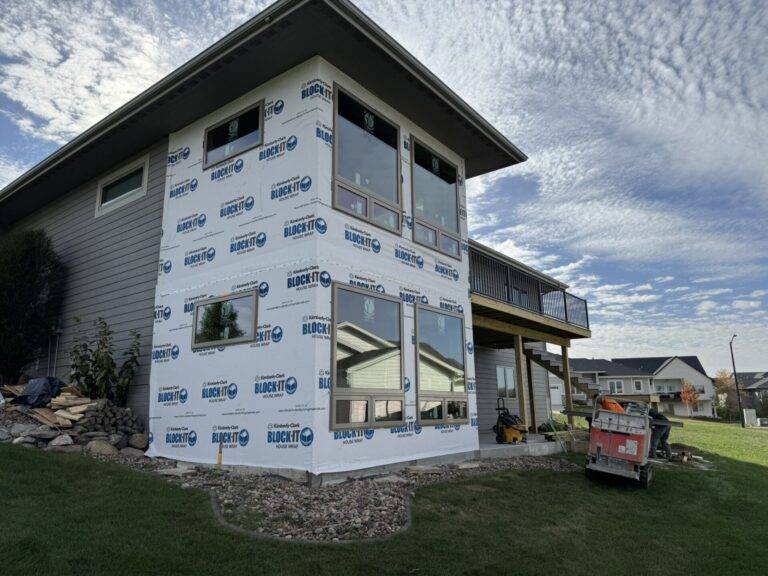
Our job photos from a Central Iowa build show a new home under construction with house wrap and windows installed. That dry-in stage is when air sealing gets done, before drywall hides the gaps.
Here is what Iowa’s amended energy code tests on a new home.
| Test | Iowa requirement | When it happens |
|---|---|---|
| Blower door | No more than 4 air changes per hour at 50 pascals | After every envelope hole is cut |
| Duct leakage | 4 cfm per 100 sq ft to outdoors, or 6 cfm total | After completion |
| Duct exception | No test if ducts sit fully inside the envelope and no cavities serve as returns | Design stage |
A blower door test uses a fan in an outside door to measure how much air the house leaks.
Pro Tip 7: Keep the furnace and ducts inside the insulated space. If no cavities serve as returns, Iowa’s code waives the duct test.
Radon is the next rule coming. HF 2297, signed May 19, 2026, directs the state to require a passive radon system in new one- and two-family homes. It applies to homes started after the State Building Code Commissioner adopts it.
Pro Tip 8: Plan a radon pipe route now. It is simpler before framing than after drywall.
In What Order Should You Plan a Waukee Build?
Read the lot’s documents first, then design, get covenant approval, and only then file with the city. That order keeps you from paying for plans twice.
| Step | What to have ready | Who handles it |
|---|---|---|
| 1. Lot review | Plat, covenants, school boundaries | You and your builder |
| 2. Design | Plan meeting size and elevation rules | Designer and builder |
| 3. Covenant approval | Plans, materials, colors | Developer or HOA board |
| 4. City permit | Plans and COSESCO application | Builder, via the city portal |
| 5. Build and inspect | Energy tests, trade inspections | Builder and licensed subcontractors |
Steps 1 to 3 are where Waukee builds go wrong.
Pro Tip 9: Check school assignment before you buy. Waukee Community School District redrew boundaries as Waterford Elementary opened in fall 2024 and North Middle School in fall 2025.
What Does Home Building in Waukee Cost?
Busy Builders home building starts at about $150 per square foot for the house, before the lot, city fees and site work. Final costs vary by scope, materials, complexity and location within our service area.
What it costs to build a house in Iowa is the question Central Iowa homeowners search most before they call about a new build. Our Iowa custom home cost breakdown covers the house itself.
Illustrative scenario: A Waukee couple builds a 2,200-square-foot two-story on a platted lot. The house runs about $380,000 to $440,000, plus city fees near $3,500. Sod, a tree, the sidewalk and a concrete driveway add about $15,000 to $22,000. Permit to move-in takes about 10 months.
Illustrative scenario: A family near Adel compares an acreage with a Waukee subdivision lot and a $420,000 house budget. The acreage needs its own well and septic system. The Waukee lot requires a two-car garage. They pick Waukee for the smaller site budget.
Illustrative scenario: A Waukee buyer finds a minimum opening elevation on a walkout lot’s plat. The designer raises the walkout door 8 inches and regrades the yard. Caught in design, the fix runs about $4,000 instead of a full redesign.
Pro Tip 10: Give sidewalk, sod, tree and driveway their own budget line.
Pro Tip 11: Get a written scope that names who pays each city fee and covenant item.
Pro Tip 12: Keep the covenant approval letter with the permit set so every trade builds the approved plan.
Busy Builders has completed more than 1,285 projects across Central Iowa since 2020. Our new home construction services start with the lot review above.
Frequently Asked Questions
Q1: What does home building cost in Waukee? Busy Builders home building starts at about $150 per square foot for the house. Add the lot, Waukee’s city fees and site items like sod and the sidewalk. Bring your plat and covenants to a free estimate.
Q2: How much are Waukee permit fees for a new house? The 2026 building permit is $726.93 plus $4.09 per $1,000 of city valuation over $100,000. Flat lines cover trades, energy code, erosion control and the water meter. Run the city’s fee calculator before you finalize the plan.
Q3: Who approves my house plans in a Waukee subdivision? Covenants may require approval separate from the city permit. In one recorded Waukee set, the developer approves plans first, then the association board. Get that approval in writing before your builder files with the city.
Q4: Do I have to build the sidewalk on my Waukee lot? Some Waukee covenants require it. One recorded set makes the owner build the 5-foot public walk when the house goes up. Right-of-way work also needs a $150 city permit. Price the sidewalk with the house.
Q5: Which schools will a new Waukee home attend? Waukee Community School District redrew boundaries as new schools opened in 2024 and 2025. Its boundaries page has an address lookup. Check the exact lot address before you sign a purchase agreement.
Q6: Will a new Waukee home need a radon system? Iowa’s HF 2297 directs the state to require passive radon systems in new one- and two-family homes. It applies to homes started after the State Building Code Commissioner adopts the rule. Ask your builder to plan the pipe route now.
Key Takeaways
- Read before you buy: The plat, covenants and elevation exhibits are posted on Waukee’s website.
- Platted lots come serviced: Water, sewer and sump drain stubs reach the lot line.
- Covenants cost money: Plan approval, minimum sizes, sod, a tree and a sidewalk can all be required.
- Fees follow valuation: The building permit uses the city’s valuation, not your contract price.
Plan Your Waukee Build With a Registered Contractor
Busy Builders is a registered Iowa contractor with 1,285+ completed projects across Central Iowa since 2020. We read the plat and covenants with you, price the house and site work, and handle the Waukee permit. Free consultation and estimate. Written warranty on workmanship (details provided in your contract).
Call: 844-435-9800
Disclaimer: This article is general information, not project-specific advice. Costs are planning estimates that vary by scope, materials, site conditions and pricing. Waukee fees change by resolution, so confirm current fees and permit requirements with the city before you build. Covenants differ by subdivision; read yours and ask an attorney legal questions. Radon levels vary, so test after move-in. No specific outcomes are guaranteed. Consult a registered contractor; electrical, plumbing and HVAC work is done by licensed subcontractors.
Busy Builders | Full-Service Construction and Remodeling | Serving Central Iowa Since 2020