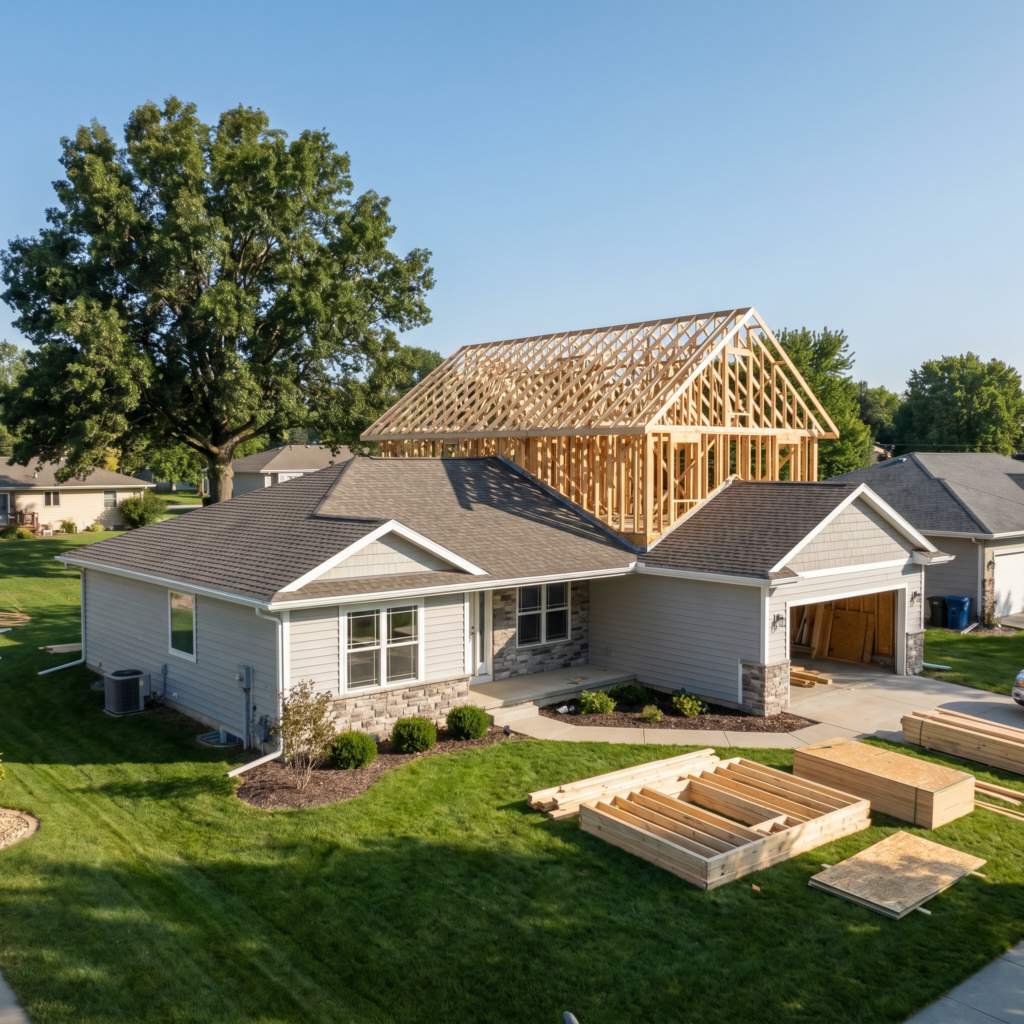
A second story addition is one of the largest construction decisions an Iowa family can make. The cost runs well into six figures for a full floor, the house is usually uninhabitable during construction, and the first question most homeowners ask (can my ranch even support a second story?) has a legal answer that only a licensed Iowa structural engineer can give on site. This guide walks through 2026 Des Moines metro cost ranges, the build-up-versus-build-out-versus-move financial comparison that matters in Iowa specifically, the foundation feasibility question, the Iowa permit reality, the live-through-construction logistics, and the decision framework for deciding whether the project actually makes sense for a specific home. Cost figures are 2026 Iowa planning estimates. Actual costs vary by home condition, foundation type, design complexity, and contractor.
TLDR: Second story additions in the Des Moines metro typically run $300 per square foot at Iowa rates, producing all-in planning ranges of $120,000 to $180,000 for a partial addition (400 to 600 square feet) and $240,000 to $300,000 or more for a full second floor (800 to 1,000 square feet). The decision is rarely just “how much does it cost.” It is “is this smarter than moving?” Combined seller and buyer transaction costs in Iowa, when agent commissions, closing costs on both sides, moving, and staging are added together, typically run $50,000 to $75,000 or more in pure friction on a median Des Moines metro home before any upgrade. The single most important step before any design work begins is a licensed Iowa structural engineer’s on-site foundation assessment. No remote guide, no blog post, and no general contractor alone can answer whether a specific home can carry a second story.
The rest of this guide covers the Iowa-specific numbers, the legal and structural prerequisites, and the decision framework in that order.
The Real Question Iowa Homeowners Are Asking
“Should I add a second story?” is almost never the actual question. The actual question is “should I add a second story, or build out, or finish the basement, or move?” Each of those four options has a very different cost, disruption profile, and resale outcome in Iowa. The median listing price in the Des Moines metro area, which includes West Des Moines, Ankeny, Waukee, and Johnston, runs around $335,000 in 2026 per FRED data for the Des Moines-West Des Moines metro; Des Moines city proper median sale prices run lower, so the broader metro figure applies primarily to suburb-based readers. Iowa housing inventory reached above 4,500 listings in late 2025, giving move-up buyers more choice than in recent years. That context matters because combined seller and buyer transaction costs in Iowa, including agent commissions (averaging 5.84 percent), seller closing costs (around 2.6 percent), buyer closing costs, moving, and staging, typically add up to $50,000 to $75,000 or more on a median metro home. Sellers alone typically pay around 8 to 9 percent of the sale price; the $50,000 to $75,000 total is the combined friction cost when both sides of a move are counted. Those numbers often rival the cost of a partial second story on the right house in the right neighborhood. If the family is staying for the school district, the commute, or the neighborhood, building up can make more financial sense than trading up. If the family needs a different location, a second story is the wrong answer regardless of what it costs.
Pro Tip 1: Before budgeting for a second story, find out whether the existing basement is already finished. An unfinished basement typically finishes for $30,000 to $75,000 per Busy Builders’ guide on finishing your basement, which is a fraction of a second story and often solves the same square-footage problem.
What a Second Story Addition Actually Costs in Iowa
Busy Builders starts Iowa home additions at $300 per square foot, verified across multiple location and service pages. That starting rate reflects structural framing, roofing, exterior finish, interior finish, and coordination with licensed electrical, mechanical, and plumbing trades. What it does not include is foundation reinforcement (when needed), major HVAC extension, staircase work, temporary housing, or the structural engineer’s assessment that must happen before any design work begins. The table below summarizes the full 2026 Iowa cost picture.
| Cost Item | 2026 Iowa Planning Range | Notes |
|---|---|---|
| Construction (framing, roofing, exterior, interior finish) | $300 or more per square foot | Busy Builders Iowa starting rate |
| Partial addition (400 to 600 square feet) | $120,000 to $180,000 or more | Master suite or small second floor |
| Full second floor (800 to 1,000 square feet) | $240,000 to $300,000 or more | Full floor addition |
| Structural engineer assessment | $500 to $2,000 | Required before design begins |
| Foundation reinforcement (if needed) | $5,000 to $30,000 or more | Depends on foundation condition |
| HVAC extension sized for new square footage | $3,000 to $12,000 or more | May require new zone or equipment |
| Staircase | $3,000 to $10,000 or more | Includes first-floor disruption |
| Roof removal and replacement | $8,000 to $20,000 | Required for full second floor |
| Temporary housing (4 to 8 months) | $6,000 to $32,000 | Des Moines metro rental market |
| Contingency | 10 to 20 percent of total | Older homes lean toward 20 percent |
Planning estimates. Actual costs vary by home condition, design, and contractor. See Busy Builders’ home addition services for a written scope tailored to a specific home.
Pro Tip 2: The structural engineer assessment is not optional, and it is not a line item to defer until later. It is the first check written on any second story project. Skipping it puts the entire budget at risk.
Pro Tip 3: Budget a 10 to 20 percent contingency on top of the quoted construction cost. Older homes lean toward 20 percent because hidden conditions (knob-and-tube wiring, obsolete plumbing, structural surprises) surface during construction.
Can Your Iowa Home Actually Support a Second Story?
This is the section where legal safety and customer protection matter most. Adding a second story typically doubles the home’s weight on the foundation, and most single-story Iowa ranch foundations were not designed to carry that load. Only a licensed Iowa structural engineer, on site, can determine whether a specific home can support a second story. No remote assessment, no online guide, no contractor conversation, and no inspection photo can answer that question. The engineer evaluates foundation depth (does it reach below Iowa’s 42-inch frost line), width, and reinforcement; first-floor wall capacity including headers, posts, and load-bearing wall sizing; soil conditions; existing cracks, settlement, or movement; and the capacity of the existing HVAC, electrical, and plumbing systems for extended service.
Foundation type is a useful planning signal, but it does not replace the engineer’s assessment. The table below summarizes typical Iowa foundation types and how they tend to perform as second-story candidates based on general structural patterns.
| Foundation Type | Iowa Prevalence | Typical Second-Story Feasibility | Typical Action Needed |
|---|---|---|---|
| Full poured concrete basement | Most common in Des Moines metro post-1970 | Best candidate | Structural engineer assessment still required |
| Concrete block basement | Common in pre-1970 Iowa homes | Possible, needs assessment | May need reinforcement |
| Crawl space | Uncommon in central Iowa metro | Possible but complex | Likely needs underpinning |
| Slab-on-grade | Some post-2000 suburban subdivisions | Most challenging | Often cost-prohibitive; engineer required |
General patterns only. Foundation type alone does not determine feasibility. Only a licensed Iowa structural engineer on-site assessment can confirm whether a specific home can carry a second-story load.
Pro Tip 4: Slab-on-grade ranches in post-2000 Des Moines metro subdivisions are the hardest second-story case. Foundation modifications are frequently cost-prohibitive, and the engineer may recommend building out instead. Do not commit to a second story on a slab without an engineer’s written assessment first.
Pro Tip 5: Pre-1980 Iowa ranches in inner-ring suburbs like Clive, Windsor Heights, and the Des Moines east side were typically designed for single-story load only. Structural reinforcement is more likely than not on these homes, which affects both budget and timeline.
Build Up versus Build Out versus Move: The Iowa Financial Comparison
For most Iowa homeowners, the question is not just “is a second story worth it” but “is a second story worth it compared to the alternatives.” The alternatives are main-floor addition, basement finish, or selling and moving up. Each has a different Iowa cost, disruption profile, and best-fit scenario.
| Option | Typical 2026 Iowa Cost | Disruption | Best Fit |
|---|---|---|---|
| Full second story addition | $240,000 to $300,000 or more all-in | High, typically must vacate | Small lot, can’t build out, love neighborhood |
| Partial second story addition | $120,000 to $180,000 or more | Moderate, may stay in home | Need 1 or 2 rooms, basement already finished |
| Main-floor addition (build out) | $120,000 to $180,000 or more | Low to moderate, can stay in home | Have lot space, want less disruption |
| Finishing existing basement | $30,000 to $75,000 | Low, can stay in home | Have unfinished basement, fastest cost-per-square-foot |
| Selling and moving up | $50,000 to $75,000 or more in transaction costs | High | Need different school district or location |
Planning estimates. Actual costs vary by home, lot, market conditions, and scope. Busy Builders has more context in its whole-house remodeling costs in Des Moines overview.
Pro Tip 6: Iowa transaction costs, counting both sides of a move, include agent commissions (averaging 5.84 percent), seller closing costs (around 2.6 percent), buyer closing costs (around $8,900 on a median home), moving, and staging. Combined, those typically run $50,000 to $75,000 or more before any price delta on the new house. That total friction cost is the right comparison point for the second story decision, not just the sticker price of a larger home.
Over-Improvement Risk in Iowa Neighborhoods
A second story that pushes the home’s market value above the neighborhood ceiling does not appraise at full cost. Iowa appraisers use comparable sales in the immediate area, and a $180,000 partial addition in a neighborhood with a $280,000 ceiling does not recover the investment on paper. This is a real risk in lower-median Iowa neighborhoods and a smaller risk in higher-median suburbs. General real estate guidance suggests additions typically return 60 to 80 percent of cost in appraised value, with actual results varying significantly by neighborhood and comparable sales. There is no 2025 Zonda Cost vs. Value Report line item specifically for a full second story addition; the closest comparable is the midrange primary suite addition, which runs around 30 percent ROI nationally. These figures are general rules of thumb, not guarantees for any specific home. This is not financial or investment advice. Consult a licensed Iowa appraiser and a qualified financial advisor for decisions specific to an individual situation.
Pro Tip 7: Before committing to the full project cost, ask a licensed Iowa appraiser to pull comparable sales in the immediate neighborhood and estimate the post-addition appraised value. The gap between project cost and appraised value is the over-improvement risk in dollar terms.
Iowa Permits and What to Expect
A second story addition requires a building permit in every Iowa jurisdiction. No exceptions. The permit application requires a site plan, engineer-stamped structural drawings, construction drawings, zoning approval confirming setback compliance, and separate permits for electrical, mechanical (HVAC), and plumbing work. Typical permit review runs 5 to 10 business days for a standard residential addition when plans are complete; complex projects or jurisdictions with backlogs take longer. See Busy Builders’ guide to Iowa building permits for the broader workflow. Iowa general contractors are registered, not licensed, through the Iowa DIAL contractor registration system. Electricians, plumbers, and HVAC technicians require separate Iowa state licenses that should also be verified on the installing trades.
Pro Tip 8: Proceeding without a permit on a second story addition creates liability during construction, risk of forced demolition by the local building department, and title issues at future sale when an inspection discovers unpermitted work. The cost of cutting the corner is always higher than the cost of pulling the permit.
The Live-Through-Construction Reality
Most guides skip this section, and it is the part homeowners most regret not knowing up front. A full second story addition requires removing the existing roof and exposing the first floor to weather during framing. Iowa families typically cannot live in the home during that phase, which means renting a nearby unit for the 4 to 8 month construction window. Iowa rental costs in the Des Moines metro typically run $1,500 to $4,000 per month for a family-sized unit, which adds $6,000 to $32,000 to the true cost of the project. Partial additions, dormers, and bonus rooms that do not require full roof removal may allow the family to stay in the home, though dust, noise, and utility interruptions are still disruptive. Full-roof-off construction is also weather-sensitive and is typically scheduled for spring through fall in Iowa to avoid winter exposure.
Pro Tip 9: Add 10 percent to the rental budget for overlap on both ends. Construction rarely finishes on the earliest possible date, and move-out typically starts a week before framing begins.
Is Your Home a Good Candidate? A Decision Framework
The table below summarizes the factors that typically push a second story addition into “good candidate” or “poor candidate” territory for an Iowa home.
| Factor | Good Candidate | Poor Candidate |
|---|---|---|
| Foundation | Full poured concrete basement | Slab-on-grade |
| Home age | Post-1980 | Pre-1960 without structural updates |
| Lot | Small, can’t build out | Large, build-out option available |
| Neighborhood value ceiling | High median, room to add value | Lower median, over-improvement risk |
| Time horizon | Staying 7 or more years | Selling within 3 years |
| Budget capacity | Equity or financing for $150,000 to $300,000 plus | Tight budget, basement not yet finished |
| Motivation | Love neighborhood or school district | Need to change location |
General guidelines only. Foundation capacity, permit feasibility, and appraisal outcomes all require site-specific professional assessment.
Pro Tip 10: The fastest way to find out whether a second story makes sense is to get three professional opinions in sequence: a licensed Iowa structural engineer, a registered Iowa contractor, and a licensed Iowa appraiser. The total cost is typically $1,500 to $4,000, and it prevents $150,000+ decisions based on incomplete information.
Illustrative Iowa Scenarios
Illustrative scenario based on 2026 Des Moines metro planning data, not a verified Busy Builders project: a Johnston homeowner on a small lot with an unfinished basement has a full poured concrete basement, wants two additional bedrooms and a second bathroom, and cannot build out due to HOA setback restrictions. A licensed Iowa structural engineer assesses the foundation and confirms it is a good candidate. The family proceeds with a partial second story addition of 500 square feet, including two bedrooms and a bathroom, for a planning range of $150,000 to $180,000 including structural engineering, HVAC extension, and staircase. The family rents a nearby unit for 5 months at approximately $10,000 total. The alternative was selling (around $55,000 in transaction costs) and buying a larger home in the same school district at a higher market price. The second story pencils out for this specific family and this specific house.
Illustrative scenario, not a verified Busy Builders project: a Norwalk homeowner on a larger lot has a slab-on-grade ranch built in 2005. The licensed Iowa structural engineer assesses the foundation for a second story and estimates that slab-on-grade reinforcement would add $40,000 to $60,000 or more before framing begins, bringing the total to over $280,000 for 800 square feet. The engineer recommends building out instead. A 400 square foot main-floor addition is designed for $120,000 to $140,000, requires no foundation modification, and allows the family to stay in the home through most of construction. For this house, build-out is the right answer. Busy Builders has more Iowa cost context in its Iowa construction costs guide.
Pro Tip 11: The same floor plan, same size, and same finish level can produce very different project costs on two different Iowa homes because the foundation and first-floor structure are different. The engineer’s assessment is the only way to know which home you actually have.
Key Takeaways
A second story addition in the 2026 Des Moines metro typically runs $120,000 to $180,000 or more for a partial addition and $240,000 to $300,000 or more for a full second floor at Busy Builders’ starting Iowa rate of $300 per square foot. The decision is rarely just “how much does it cost,” because Iowa transaction costs to sell and buy run $50,000 to $75,000 or more before any upgrade, which changes the “stay and build up” versus “sell and trade up” math significantly. The single most important step before any design or budget work is a licensed Iowa structural engineer’s on-site foundation assessment. Full poured concrete basements are typically the best second-story candidates; slab-on-grade ranches are the hardest case and often cost-prohibitive without major reinforcement. Over-improvement risk is real in lower-median Iowa neighborhoods where a $180,000 addition can push the home above comparable sales and fail to appraise at full cost. Permits are required in every Iowa jurisdiction, including separate permits for electrical, mechanical, and plumbing, and Iowa general contractors are registered through DIAL while electricians, plumbers, and HVAC technicians hold separate state licenses. The live-through-construction reality for a full second story is typically 4 to 8 months of temporary housing at $1,500 to $4,000 per month, which should be in the project budget from day one. Before committing to a second story, check whether the existing basement is finished, whether the lot has room to build out, and whether the neighborhood can support the added value. Busy Builders has completed 1,285+ Central Iowa projects since 2020, handles coordination across structural engineering, permits, design, and construction under one point of contact, and backs the work with a written warranty on workmanship; warranty details are provided in the contract.
Pro Tip 12: Save every engineer’s report, every permit document, and every contractor invoice. At resale time, buyers and appraisers both value documented structural work more than undocumented work, and the paper trail protects the homeowner against future liability questions.
Frequently Asked Questions
Q1: How much does a second story addition cost in Iowa in 2026?
Busy Builders starts Iowa home additions at $300 per square foot. A partial addition of 400 to 600 square feet typically runs $120,000 to $180,000 or more. A full second floor of 800 to 1,000 square feet typically runs $240,000 to $300,000 or more. Beyond the per-square-foot cost, budget for a licensed structural engineer assessment ($500 to $2,000), foundation reinforcement if needed ($5,000 to $30,000 or more), HVAC extension ($3,000 to $12,000 or more), staircase ($3,000 to $10,000), roof replacement ($8,000 to $20,000 for a full second floor), temporary housing for 4 to 8 months, and a 10 to 20 percent contingency. All figures are 2026 Iowa planning estimates; actual costs vary.
Q2: Is adding a second story cheaper than moving in Des Moines?
It depends on the specific situation. Combined seller and buyer transaction costs in Iowa (agent commissions averaging 5.84 percent, seller closing costs around 2.6 percent, buyer closing costs, moving, and staging) typically add up to $50,000 to $75,000 or more in friction on a median Des Moines metro home. Sellers alone typically pay around 8 to 9 percent of the sale price; the $50,000 to $75,000 total is the combined cost when both sides of a move are counted. A partial second story on the right house ($120,000 to $180,000 or more) in a neighborhood the family already loves can pencil out comparably to selling and buying a larger home at current prices. A full second story at $240,000 to $300,000 or more is a different calculation. Run both numbers for the specific situation with a registered Iowa contractor and a realtor before deciding.
Q3: Can any Iowa ranch home support a second story?
No. Only a licensed Iowa structural engineer, on site, can determine whether a specific home can support a second story. No remote assessment, online guide, or general contractor alone can make this determination. Most single-story Iowa ranch foundations were not designed to carry second-story load. Full poured concrete basements are typically the best candidates. Slab-on-grade ranches are often cost-prohibitive to reinforce. Pre-1960 homes without structural updates typically require significant reinforcement. The engineer’s assessment should always be the first step, before any design or budget work.
Q4: Do I need a permit to add a second story in Iowa?
Yes, always. Adding a second story is a major structural addition that requires a building permit in every Iowa jurisdiction, plus separate permits for electrical, mechanical (HVAC), and plumbing work. Iowa building officials require engineer-stamped structural drawings. Verify the general contractor is registered through Iowa DIAL before signing, and verify that the installing electrician, plumber, and HVAC technician hold separate Iowa state licenses. Proceeding without a permit creates liability during construction, risk of forced demolition, and title issues at future sale.
Q5: How long does a second story addition take in Iowa?
A full second story typically runs 4 to 8 months from permit approval to move-in, covering design finalization, permitting, structural work, framing, roofing, mechanical rough-ins, insulation, drywall, and finish work. A partial addition (bonus room, dormer, small second floor) typically runs 12 to 18 weeks. Iowa weather is a real scheduling factor because roof-off construction is typically scheduled spring through fall to avoid winter exposure. Timelines are typical averages, not guarantees.
Q6: Is a second story addition a good investment in Iowa?
The answer depends on three factors. First, the neighborhood value ceiling: a $180,000 addition in a neighborhood with a $280,000 ceiling may not appraise at full cost because Iowa appraisers use comparable sales. Second, the time horizon: homeowners staying 7 or more years recoup more than those selling in 2 or 3 years. Third, the motivation: families staying for the school district or neighborhood are buying non-financial value that is hard to quantify. There is no 2025 Zonda Cost vs. Value Report line item for a full second story addition. General real estate guidance suggests additions typically return 60 to 80 percent of cost in appraised value, with significant variation by neighborhood. This is not financial advice. Consult a licensed Iowa appraiser and a qualified financial advisor for decisions specific to an individual situation.
Ready to Figure Out If a Second Story Makes Sense for Your Home?
Busy Builders has completed home additions and major remodels for 1,285+ Central Iowa homeowners since 2020, across Des Moines, West Des Moines, Ankeny, Waukee, Johnston, Urbandale, and the surrounding metro. Call: 844-435-9800 to talk through your home, your lot, and your budget, or schedule a free consultation to get a written scope before committing to structural engineering or design work.
Legal Disclaimer
This article is for general educational purposes only and does not constitute engineering, architectural, legal, financial, investment, or construction advice. Cost figures are 2026 Iowa planning estimates; actual costs vary by home condition, foundation type, design complexity, material availability, and contractor. Only a licensed Iowa structural engineer, on site, can determine whether a specific home can support a second story; no remote assessment, online guide, or general contractor alone can make this determination. Foundation capacity, load paths, and reinforcement requirements depend on site-specific inspection by a professional engineer licensed in Iowa. ROI and appraised value figures are general rules of thumb and national estimates; actual results vary by neighborhood, market, design, and comparable sales, and results vary. This is not financial or investment advice. Consult a licensed Iowa appraiser and a qualified financial advisor for decisions specific to an individual situation. Permit requirements vary by jurisdiction and change over time; confirm current local requirements with the relevant building department before finalizing design or beginning construction. Iowa general contractors are registered, not licensed, through Iowa DIAL; electricians, plumbers, and HVAC technicians hold separate Iowa state licenses and should be verified independently before work begins. Iowa frost line is at least 42 inches and footing requirements vary by site and local code. Construction timelines described in this article are typical averages, not guarantees. Busy Builders provides a written warranty on workmanship; specific terms, exclusions, and coverage details are provided in the project contract.