Most deck-versus-patio articles read the same everywhere in the country. This one is different because Iowa is different. Central Iowa has more than 100 freeze-thaw cycles per year, expansive clay soil that swells and shifts with the seasons, and a 42-inch frost line that drives footing depth deeper than most of the country requires. Those three factors change how a deck or patio actually performs here, change how long each option lasts, and change which material holds up on Iowa clay five winters in. This guide covers the 2026 Des Moines metro cost ranges for both options, the Iowa permit rules most national sites get wrong, the freeze-thaw durability data Iowa homeowners actually need, and a decision framework for matching the right choice to the specific yard and budget. Cost figures are 2026 Des Moines metro planning estimates. Actual costs vary by design, site conditions, and contractor.
TLDR: A concrete patio is almost always the cheaper upfront choice for a flat Iowa yard, typically $9.60 to $25 per square foot installed. A deck costs more upfront ($20 to $65 per square foot depending on material) but handles sloped yards without grading and carries stronger documented resale ROI, with wood decks returning 94.9 percent and composite decks 88.5 percent per the 2025 Zonda Cost vs. Value Report national averages. In Iowa’s climate, composite decking outperforms pressure-treated wood for long-term durability, and concrete pavers typically outperform poured concrete because their joints allow for seasonal movement. Deck permits are usually required; patio permits usually are not. Confirm locally before digging.
The decision between a deck and a patio is not generic. It depends on the yard’s slope, the homeowner’s maintenance tolerance, the budget ceiling, and how long the family plans to stay in the home. The sections below walk through each factor in the order Iowa homeowners actually need to consider them.
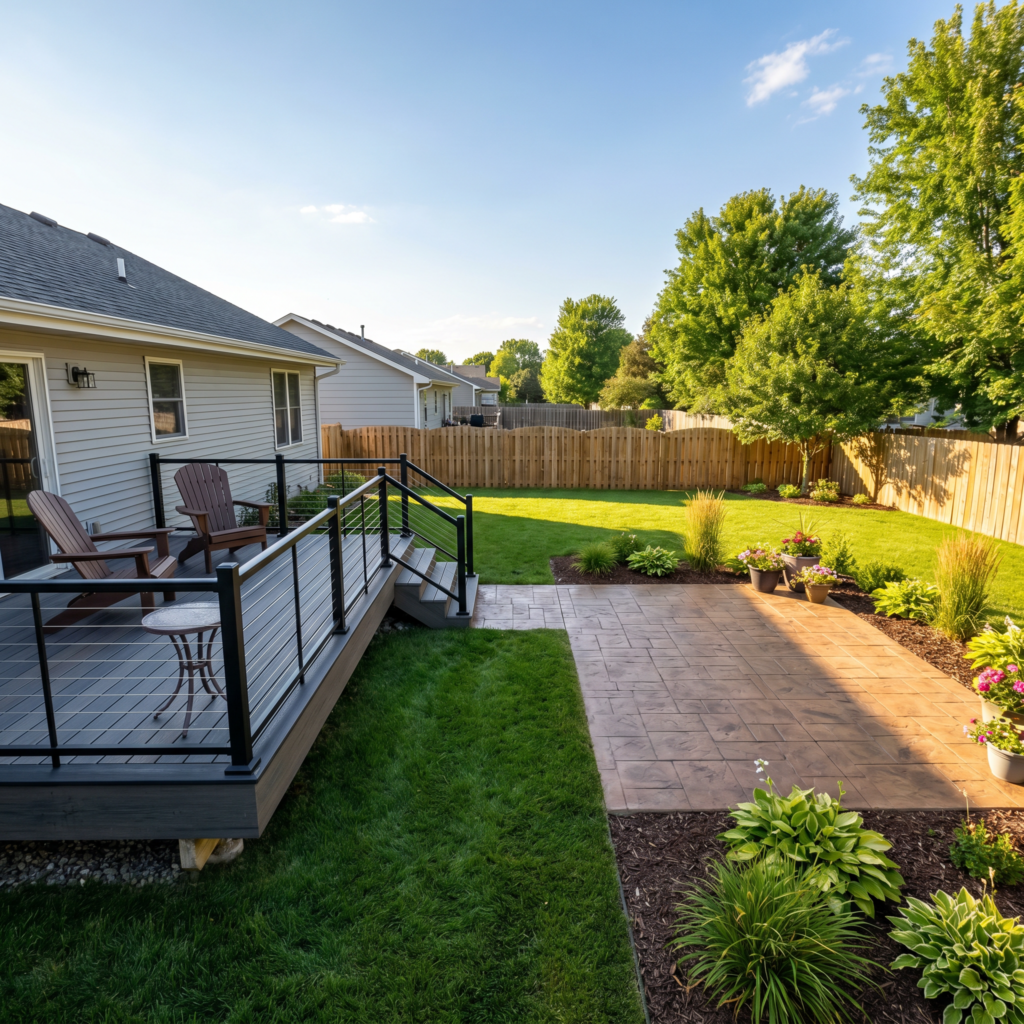
What a Deck and a Patio Actually Are
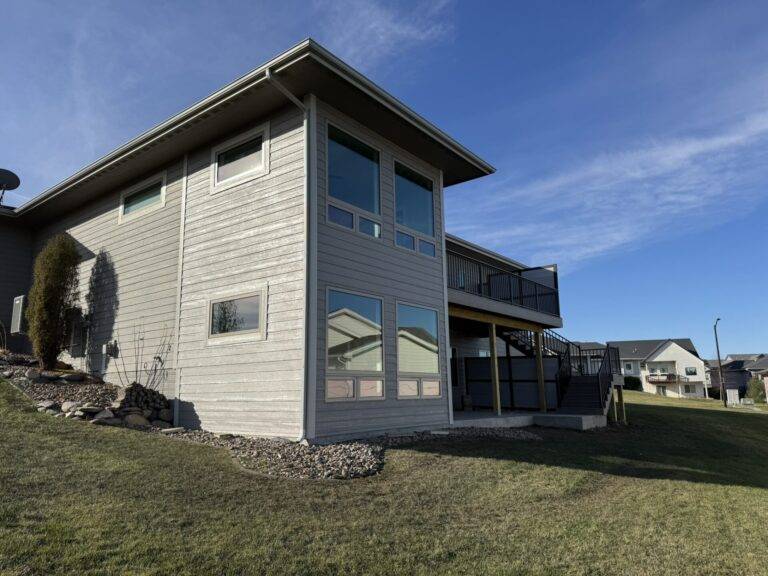
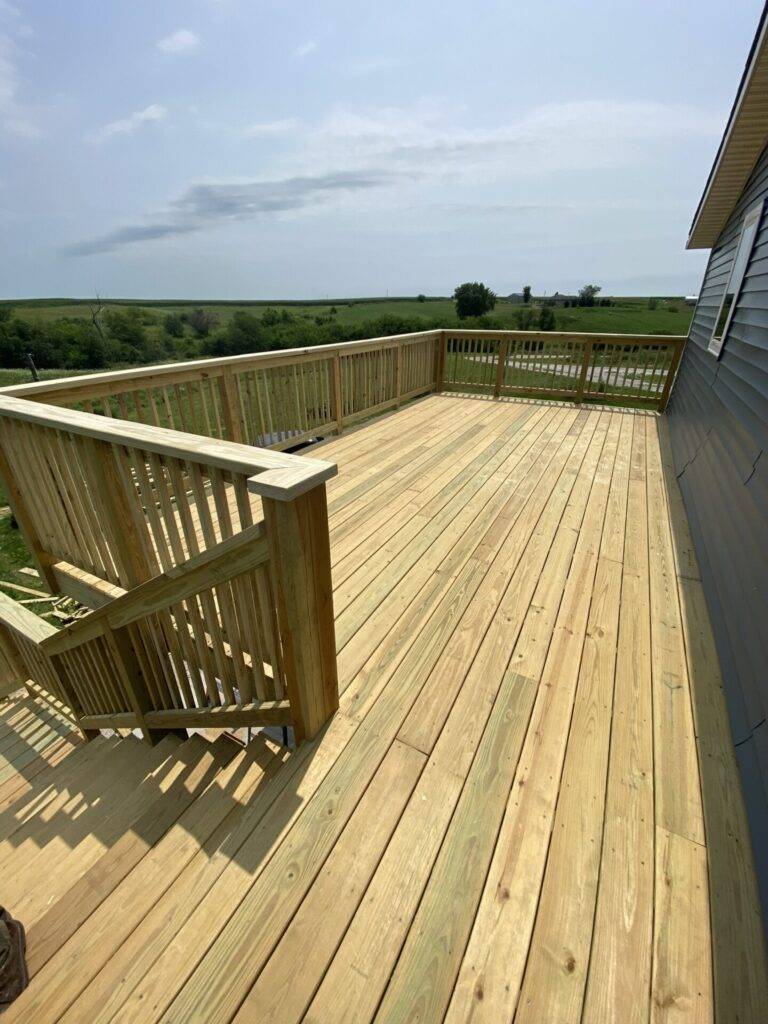
A deck is an elevated structure supported by posts set in concrete footings. The framing is wood or steel; the surface is pressure-treated wood or composite. A deck can be attached to the house or freestanding. Because it is a structure, a deck in Iowa typically requires a building permit, engineered footings reaching below the frost line, and structural fastener detailing at the house connection.
A patio is a ground-level surface made of poured concrete, stamped concrete, concrete pavers, or brick. There is no structural framing and no footings beyond a compacted gravel base. Because it sits on grade, a patio in most Iowa jurisdictions does not require a building permit, though setback rules, drainage rules, and HOA rules still apply.
That structural difference is the root of every cost, permit, durability, and maintenance difference that follows.
2026 Iowa Cost Comparison
Pressure-treated wood decks are the cheapest deck option in the Des Moines metro. Composite decking costs more upfront but reduces lifetime maintenance. Plain concrete patios are the cheapest outdoor surface of any kind. Stamped concrete and pavers close the gap between a patio and a deck on per-square-foot cost. The table below summarizes 2026 Des Moines metro planning ranges.
| Project | Size | Cost per Sq Ft | Typical Project Cost |
|---|---|---|---|
| Pressure-treated wood deck | 192 sq ft | $20 to $35 | $3,840 to $6,720 |
| Pressure-treated wood deck | 300 sq ft | $20 to $35 | $6,000 to $10,500 |
| Composite deck | 192 sq ft | $40 to $65 | $7,680 to $12,500 |
| Composite deck | 300 sq ft | $40 to $65 | $12,000 to $19,500 |
| Plain concrete patio | 200 sq ft | $9.60 to $19 | $1,920 to $3,800 |
| Stamped concrete patio | 300 sq ft | $12 to $25 | $3,600 to $7,500 |
| Paver patio | 300 sq ft | $15 to $25 | $4,500 to $7,500 |
Planning estimates. Actual costs vary by design complexity, site conditions, access, and contractor. Busy Builders has written more detail in its deck building costs in Des Moines guide for homeowners comparing specific projects.
Pro Tip 1: Square foot cost comparisons hide the total picture. A $3,800 plain concrete patio that cracks and heaves in year four costs more over ten years than a $7,500 paver patio that lasts 25 years with minor re-leveling.
Pro Tip 2: Composite decking costs roughly twice as much per square foot as pressure-treated wood, but it lasts 2 to 3 times longer and eliminates the annual stain-and-seal cycle. For long-term Iowa owners, the lifetime cost comparison often favors composite.
Iowa Permit Rules
The permit rules are where most national deck-versus-patio articles get Iowa wrong. Iowa jurisdictions consistently require a building permit for a deck when the deck is attached to the house, exceeds 200 square feet, or sits more than 30 inches above grade. Freestanding decks under 200 square feet and under 30 inches high are generally exempt from a building permit, though setback requirements still apply. This threshold is verified across Fort Madison, Pleasant Hill, Johnson County, Linn County, and other Iowa jurisdictions. Permitted decks in Iowa must be built with footings reaching at least 42 inches below grade to get below the frost line and prevent seasonal heave. Review timelines for a standard residential deck permit typically run 5 to 10 business days when plans are complete. See Busy Builders’ overview of Iowa building permits for the broader permit workflow.
Patios made of concrete, pavers, or brick typically do not require a building permit in Iowa jurisdictions, because the surface sits on grade and is not a structure. Drainage and setback rules still apply, and HOA rules may be stricter than local code. Confirm with the local building department and the HOA before starting any outdoor project.
Pro Tip 3: Iowa general contractors are registered, not licensed, through the Iowa DIAL contractor registration system. Verify registration on any builder before signing a contract for either a deck or a patio.
Pro Tip 4: Always check HOA rules before deciding between a deck and a patio. HOAs can restrict height, material, color, railing style, and placement beyond what city code allows.
Freeze-Thaw and Iowa Clay: What Fails and Why
Iowa’s climate is the hinge of this entire comparison. The Des Moines metro sees more than 100 freeze-thaw cycles per year, summers that hit 90°F in July, winters that drop to -5°F in January, and expansive clay soil that swells when wet and shrinks when dry. Those conditions produce predictable failure patterns in both decks and patios when the design is wrong for Iowa.
On the deck side, the Iowa-specific key is footing depth. Footings placed at the 42-inch frost depth stay stable through seasonal freeze cycles. Footings placed too shallow heave as frost penetrates below them, which lifts posts, loosens railings, and eventually pulls the ledger board away from the house. Pressure-treated wood decks last 10 to 15 years in Iowa with annual inspection and maintenance, including a yearly stain or seal, fastener corrosion checks, and ledger-attachment inspection. Composite decks typically last 25 to 50 years with minimal maintenance and are not affected by Iowa’s freeze-thaw or moisture cycles because the material does not rot, warp, or splinter.
On the patio side, poured concrete is the most vulnerable surface in Iowa. Water infiltrates through hairline cracks or joints, freezes in winter, expands, and opens the crack wider the following spring. Clay soil makes the problem worse because moisture retention in the soil produces seasonal expansion that heaves the slab. Stamped concrete is also vulnerable because it is a solid slab that cracks like plain concrete once moisture gets in. Concrete pavers perform better in Iowa than poured concrete because the joints between individual units absorb seasonal movement, and individual pavers that shift can be lifted and re-leveled without replacing the whole patio. Proper base preparation (compacted gravel, drainage planning, edge restraint) is the single most important factor in patio longevity on Iowa clay.
The table below summarizes typical freeze-thaw performance for each material option on Iowa clay. These are typical performance descriptions based on contractor field data and material documentation, not guarantees for any specific site.
| Material | Freeze-Thaw Risk | Clay Soil Risk | Repairability | Typical Iowa Verdict |
|---|---|---|---|---|
| Pressure-treated wood deck | Low with proper footings | Low with 42-inch footings | Moderate | Acceptable when footings are correct |
| Composite deck | Very low | Low with 42-inch footings | Good | Best deck option for Iowa longevity |
| Plain concrete patio | High (cracking) | High (heaving) | Poor (patch or replace) | Highest failure risk of the options |
| Stamped concrete patio | High (cracking) | High (heaving) | Poor | Requires sealing and strict drainage |
| Concrete pavers | Low to medium | Medium (re-level as needed) | Excellent (individual units) | Typically best patio option for Iowa |
Typical performance patterns. Actual performance depends on base preparation, drainage, installation quality, and ongoing maintenance.
Pro Tip 5: The biggest single predictor of whether an Iowa patio lasts is base preparation, not material choice. A paver patio on a poorly compacted base will fail. A plain concrete patio on a well-prepared base with good drainage can last decades.
Pro Tip 6: Iowa deck footings must reach at least 42 inches below grade. Some sites with unusual soil conditions require deeper footings. Only the local building department can confirm the exact depth required for a specific lot.
Maintenance: What Each Option Actually Costs to Own
Upfront cost is only half the financial picture. Annual maintenance, periodic sealing, and long-term repair costs determine the real cost of ownership over 10 or 20 years. The table below summarizes typical Iowa maintenance requirements by material.
| Material | Annual Maintenance | Seal or Stain Frequency | Typical Lifespan |
|---|---|---|---|
| Pressure-treated wood deck | High | Annual | 10 to 15 years |
| Composite deck | Low | None required | 25 to 50 years |
| Plain concrete patio | Medium | Every 2 to 3 years | 20 to 30 years |
| Stamped concrete patio | Medium | Every 2 to 3 years | 15 to 25 years |
| Concrete pavers | Low to medium | Optional | 25 to 50 years |
Typical lifespan ranges assume correct installation and consistent maintenance. Lifespan varies with site conditions, maintenance quality, and Iowa weather exposure.
Pro Tip 7: The annual stain-and-seal cycle on a pressure-treated wood deck costs roughly $150 to $400 per year in materials and labor for a typical 300-square-foot deck. Over 15 years, that maintenance cost alone approaches the upfront cost difference between wood and composite.
Pro Tip 8: Concrete patios need resealing every 2 to 3 years in Iowa. Skipping the reseal cycle is the single most common reason concrete patios crack earlier than they should. Budget for the seal cycle in the decision from the start.
Resale ROI
The 2025 Zonda Cost vs. Value Report provides the strongest available resale data for outdoor living projects, and the data skews toward decks. Wood deck additions return 94.9 percent of cost at resale (average national cost $18,263, average value added $17,323). Composite deck additions return 88.5 percent (average national cost $25,096, average value added $22,199). Both outdoor living projects rank in the top 10 nationally for ROI. No equivalent national benchmark exists for patio resale value, though a quality stamped concrete or paver patio typically adds more resale value than a plain concrete patio. These ROI figures are national averages from the 2025 Zonda Cost vs. Value Report. Actual results vary by market, design, home price band, and local buyer preferences. This is not financial advice. Busy Builders has written more detail on real Iowa costs and material tradeoffs for homeowners weighing resale decisions.
Pro Tip 9: If resale within 2 to 3 years is the goal, the documented ROI data favors a deck. If the family plans to stay 10 or more years, lifetime cost and personal enjoyment tend to matter more than the national ROI figures.
Which Is Right for Your Iowa Yard
The decision matrix below captures the most common Iowa homeowner situations and which option typically fits best. These are general guidelines, not universal answers; every yard has specific conditions that affect the choice.
| Situation | Typical Better Choice | Why |
|---|---|---|
| Sloped or uneven yard | Deck | Posts handle grade change; no major grading or fill |
| Flat yard, tight budget | Plain concrete or paver patio | Lower upfront cost per square foot |
| Low maintenance priority | Composite deck or paver patio | Least upkeep over 25-plus years |
| Selling within 2 to 3 years | Deck | Documented 88 to 95 percent ROI nationally |
| Staying 10-plus years | Composite deck or paver patio | Balance of upfront cost and longevity |
| Walkout home wanting indoor-outdoor flow | Deck | Matches interior floor level |
| HOA or tight setbacks | Check both against HOA and local code | Neither is automatically exempt |
Guidelines only. Site conditions, finish preferences, and family priorities shift the answer for individual homeowners.
Pro Tip 10: For a backyard that slopes more than 2 feet from the house to the yard, a patio typically requires $2,000 to $5,000 in grading and fill before any surface is poured. A deck on footings absorbs that grade change at no additional framing cost.
Pro Tip 11: Walkout and daylight basement homes almost always favor a deck. The deck sits at the main floor level and the patio sits at the basement walkout level, giving the family two outdoor living spaces at two different grades. This is a common Des Moines metro configuration.
Illustrative Iowa Scenarios
Illustrative scenario, not a verified Busy Builders project: an Ankeny homeowner has a sloped backyard that drops 3 feet from the house to the yard. A patio would require significant grading and fill, adding $2,000 to $5,000 to the project cost before any surface material is placed. A 300-square-foot composite deck on properly placed footings handles the grade change without cut-and-fill. Composite deck planning range: $12,000 to $19,500 installed. This is an illustrative scenario based on 2026 Des Moines metro planning data, not a verified project.
Illustrative scenario, not a verified Busy Builders project: a Waukee homeowner installs a 300-square-foot plain poured concrete patio on clay soil without proper drainage detailing. After three Iowa winters, freeze-thaw cycles and clay soil movement produce a half-inch offset crack along the control joint. Repair estimate: $800 to $2,500 for grinding, epoxy fill, and reseal. Proper base preparation and drainage from the start is the prevention, not the repair. This is an illustrative scenario based on typical Iowa failure patterns, not a verified project.
Frequently Asked Questions
Q1: Is a deck or a patio cheaper in Iowa?
A patio is almost always cheaper upfront per square foot in Iowa. Plain concrete runs $9.60 to $19 per square foot installed. Pavers run $15 to $25 per square foot. A pressure-treated wood deck runs $20 to $35 per square foot. A composite deck runs $40 to $65 per square foot. For the same 300 square feet, a plain concrete patio typically costs $1,920 to $3,800, while a composite deck typically costs $12,000 to $19,500. Lifetime cost tells a different story because decks, especially composite, tend to last longer with less periodic maintenance.
Q2: Do I need a permit for a deck in Iowa?
Usually yes. Iowa jurisdictions consistently require a building permit when a deck is attached to the house, exceeds 200 square feet, or sits more than 30 inches above grade. Permitted decks must have footings reaching at least 42 inches below grade. Freestanding decks under 200 square feet and under 30 inches high are generally exempt from a building permit, though setback rules still apply. Patios made of concrete, pavers, or brick typically do not require a building permit in Iowa. Confirm with the local building department and the HOA before starting any outdoor project.
Q3: Which lasts longer in Iowa weather, a deck or a patio?
Composite decks and paver patios typically outperform the other options in Iowa’s climate. Plain poured concrete and stamped concrete crack under Iowa’s freeze-thaw cycles and clay soil movement, usually within the first 10 to 15 years if base preparation is inadequate. Pressure-treated wood decks last 10 to 15 years with regular maintenance; composite lasts 25 to 50 years with minimal care. Paver patios typically outperform poured concrete because their joints absorb seasonal movement and individual pavers can be re-leveled without replacing the whole surface.
Q4: Which adds more resale value, a deck or a patio?
National data from the 2025 Zonda Cost vs. Value Report shows wood deck additions returning 94.9 percent and composite deck additions returning 88.5 percent, both top 10 nationally for resale ROI. No equivalent national benchmark exists for patios, though a quality stamped concrete or paver patio adds more value than plain concrete. ROI figures are national averages. Actual results vary by market, design, home price band, and buyer preferences. This is not financial advice.
Q5: How deep do deck footings need to be in Iowa?
Deck footings in Iowa must extend at least 42 inches below grade to get below the frost line and prevent seasonal heave. This minimum is verified across multiple Iowa jurisdictions including Fort Madison, Nevada, Johnson County, and Linn County. Some sites with unusual soil or drainage conditions require deeper footings. Confirm the exact requirement with the local building department before excavation begins.
Key Takeaways
The deck-versus-patio decision in Iowa comes down to four factors working together: yard slope, upfront budget, maintenance tolerance, and time horizon for resale. A patio is typically cheaper upfront and works well on a flat yard with good drainage, especially when paver construction is chosen over poured concrete to handle Iowa’s freeze-thaw and clay soil movement. A deck costs more upfront but handles sloped yards without grading, carries stronger documented resale ROI at national averages of 88 to 95 percent, and in composite form delivers 25 to 50 year service life with minimal maintenance. Iowa’s 42-inch frost line makes deck footings more expensive than in most of the country but protects against seasonal heave when done correctly. Deck permits are usually required; patio permits usually are not. HOA rules may apply to both and can be stricter than city code. For most Iowa yards, the right answer is the option that matches the specific combination of slope, budget, and maintenance tolerance, not a universal “deck beats patio” or “patio beats deck” answer. Busy Builders is a registered Iowa contractor through DIAL, has completed 1,285+ Central Iowa projects since 2020, and handles both deck building and patio work under one point of contact, backed by a written warranty on workmanship. Warranty details are provided in the contract.
Pro Tip 12: Get at least two written quotes before committing to either option. The quote should specify footing depth for decks, base preparation details for patios, material brand and grade, warranty terms, and whether the contractor pulls the permit or the homeowner does.
Ready to Plan Your Deck or Patio?
Busy Builders has built decks and patios for 1,285+ Central Iowa homeowners since 2020, across Des Moines, West Des Moines, Ankeny, Waukee, Urbandale, and the surrounding metro. Call: 844-435-9800 to talk through your yard and your budget, or schedule a free consultation to get a written scope tailored to your site before committing.
Legal Disclaimer
This article is for general educational purposes only and does not constitute engineering, legal, financial, or construction advice. Cost figures are 2026 Des Moines metro planning estimates; actual costs vary by design, site conditions, access, material availability, and contractor. Permit thresholds, setback requirements, and footing depth rules vary by jurisdiction and change over time; confirm current local requirements with the relevant building department before finalizing design or beginning construction. HOA rules may be stricter than local code and should be verified before planning any outdoor project. ROI figures are national averages from the 2025 Zonda Cost vs. Value Report; actual results vary by market, design, home price band, and local buyer preferences, and results vary. This is not financial advice. Durability and lifespan ranges are typical performance patterns based on contractor field data and material documentation, not guarantees for any specific site; installation quality, base preparation, drainage, and ongoing maintenance all affect real-world performance. Foundation and footing requirements for decks vary by site and local code; consult the local building department and a registered Iowa contractor for site-specific guidance. Busy Builders provides a written warranty on workmanship; specific terms, exclusions, and coverage details are provided in the project contract.
Related service: our deck building service.