Online basement bar and entertainment room prices range from $1,000 to over $125,000, which is useless for homeowners planning a real Central Iowa project. This guide breaks down 2026 Des Moines metro cost ranges for dry bars, wet bars, home theaters, and combined entertainment suites, along with the Iowa code rules and hidden costs that shape every bid.
TLDR: Central Iowa planning ranges run roughly $2,000 to $10,000 for a dry bar, $8,000 to $25,000 for a wet bar, $15,000 to $45,000 for a mid-range home theater, and $35,000 to $75,000 for a combined entertainment suite. Plumbing distance from the main stack, soundproofing level, and the four-permit stack in Des Moines drive most of the price gap.
The Sink Decides Everything
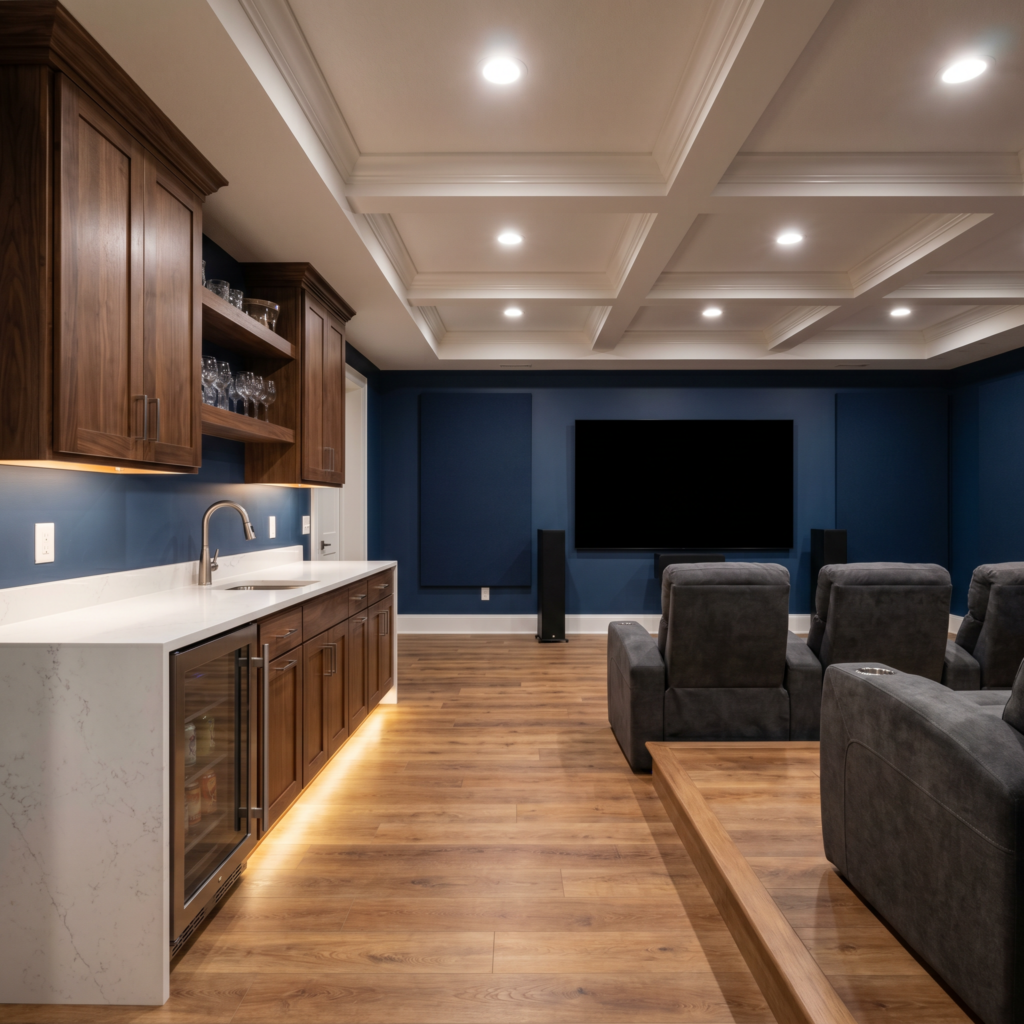
A dry bar is cabinets, a countertop, a beverage fridge, and an outlet. A wet bar adds a sink, which brings supply lines, a drain, a properly vented trap, and sometimes a slab cut to reach the main plumbing stack. That single feature commonly doubles or triples the cost. Add a home theater on top, and soundproofing, dedicated circuits, AV hardware, and HVAC rebalancing all enter the bid.
Pro Tip 1: Locate the bar within 15 feet of the main plumbing stack. Stack distance is the single biggest cost lever on any wet bar build.
Dry Bar vs. Wet Bar vs. Home Theater
Four common scopes compared. Figures are 2026 Des Moines metro planning estimates, not quotes.
| Feature | Dry Bar | Wet Bar | Home Theater | Bar + Theater Suite |
|---|---|---|---|---|
| Typical 2026 Iowa cost | $2,000 to $10,000 | $8,000 to $25,000 | $15,000 to $45,000 | $35,000 to $75,000 |
| Plumbing required | No | Yes | No | Yes |
| Electrical scope | 1 to 2 circuits | 2 to 3 circuits | 3 to 5 dedicated | 5+ dedicated |
| Permit types | Building, electrical | Add plumbing | Sometimes add mechanical | All four trades |
| Typical size | 8 to 12 linear ft | 8 to 14 linear ft | 200 to 400 sq ft | 400 to 600 sq ft |
| Build time | 1 to 2 weeks | 3 to 6 weeks | 4 to 8 weeks | 8 to 14 weeks |
The dry-to-wet jump is driven by plumbing. The wet-to-theater jump is driven by hardware and soundproofing. The suite jump is driven by permit count and HVAC.
Pro Tip 2: Choose a dry bar if guests tend to refill drinks upstairs. The sink drives most of the wet bar premium, and many homeowners underuse it once the novelty fades.
2026 Central Iowa Cost Tiers
Each scope sorted into Budget, Mid-Range, and Premium tiers. Budget uses prefab or semi-custom components; Premium uses full custom cabinetry, high-end AV, and professional soundproofing.
| Scope | Budget Tier | Mid-Range Tier | Premium Tier |
|---|---|---|---|
| Dry Bar (8 ft) | $2,000 to $4,000 | $5,000 to $9,000 | $10,000 to $15,000 |
| Wet Bar (8 ft) | $8,000 to $13,500 | $15,000 to $22,000 | $22,000 to $30,000+ |
| Home Theater (250 sq ft) | $10,000 to $15,000 | $20,000 to $35,000 | $45,000 to $75,000 |
| Combined Suite (500 sq ft) | $25,000 to $40,000 | $45,000 to $65,000 | $75,000 to $125,000 |
These tiers assume the basement shell is already finished. An unfinished basement adds $60,000 to $110,000 for framing, electrical, HVAC, insulation, and drywall before any bar or theater work begins.
Pro Tip 3: Iowa’s minimum habitable ceiling height is 7 feet, with beams and ducts allowed to drop to 6 feet 8 inches. Measure the clear height before signing any bid.
Pro Tip 4: Budget 20 to 30 percent of a home theater build for soundproofing. Skipping it turns a $30,000 theater into a room no one uses while the kids sleep upstairs.
Line-Item Cost Breakdown
Component-level ranges below help sanity-check a bid.
| Line Item | 2026 Planning Range |
|---|---|
| Cabinets | $150 to $500 per linear foot |
| Countertops | $50 to $150 per sq ft |
| Sink installed (with supply and drain) | $380 to $1,400 |
| Plumbing rough-in per fixture | $450 to $1,800 |
| 4K projector or 85-inch OLED TV | $2,000 to $10,000 |
| AV receiver and 7.1 speakers | $1,300 to $7,500 |
| Soundproofing | $2 to $15 per sq ft |
Totals vary based on how labor and material lines combine on a specific bid.
Pro Tip 5: Des Moines typically requires four separate permits for a full bar plus theater scope: building, electrical, plumbing, and mechanical. Budget all four upfront.
Hidden Costs Iowa Homeowners Miss
The plumbing distance penalty is the most common surprise. A wet bar 12 feet from the main stack might add $1,500 to $2,500 in plumbing; the same bar 60 feet away can add $4,000 to $6,000 plus $2,000 to $5,000 in slab cutting.
HVAC rebalancing is the second. Bodies and electronics pack heat that an existing furnace was not sized for, and a dedicated ductless mini-split commonly adds about $4,000.
Radon re-testing is the third. Sealing the basement envelope changes radon patterns. Iowa is entirely EPA Radon Zone 1, and as many as 5 in 7 Iowa homes test above the EPA action level per the Iowa Radon Survey.
Pro Tip 6: Iowa’s plumbing code is the 2024 Uniform Plumbing Code, state-adopted March 26, 2025. Most Iowa jurisdictions follow the state adoption, but confirm with the local building department before final design. Wet bars need a properly vented trap with correct slope.
Pro Tip 7: A dedicated ductless mini-split for a home theater typically adds $4,000 but prevents overloading the existing furnace.
Pro Tip 8: Re-test radon after sealing the basement envelope. Kits run about $15 at hardware stores, or free through some Iowa county health departments.
Iowa Code and Permits
Habitable ceilings run 7 feet minimum, with beams and ducts dropping to 6 feet 8 inches in localized spots. Iowa jurisdictions enforce a mix of the 2021 and 2024 International Residential Code editions depending on city, plus the 2023 National Electrical Code and the 2024 Uniform Plumbing Code statewide. Always confirm the adopted edition with the local building department before design.
Permit fees vary by city and project size. Typical Des Moines metro ranges:
| Permit Type | Typical Des Moines Metro Fee Range |
|---|---|
| Building | $200 to $1,000 |
| Electrical | $50 to $300 |
| Plumbing | $100 to $500 |
| Mechanical / HVAC | $100 to $800 |
| Egress window add-on | $75 to $250 |
Permit fees alone often total $450 to $2,600 for a full bar plus theater scope. The City of Des Moines Permit and Development Center handles intake for Des Moines proper; surrounding cities run their own offices.
Pro Tip 9: If the entertainment room doubles as a guest bedroom, plan a compliant egress window from day one. Iowa requires 5.7 square feet of net clear opening, and retrofitting later adds $3,000 to $6,000.
Illustrative Central Iowa Projects
Illustrative scenario: A West Des Moines homeowner adds a 10-foot custom wet bar in an already-finished basement located 12 feet from the main stack, with semi-custom cabinets, quartz countertop, undermount sink, beverage fridge, and kegerator rough-in. Planning range: $18,000 to $24,000.
Illustrative scenario: An Urbandale homeowner converts a 500 sq ft unfinished basement corner into a combined bar and media room with framing, electrical, HVAC extension, wet bar near the existing stack, 85-inch TV wall, and basic acoustic treatment. Planning range: $55,000 to $72,000.
Pro Tip 10: Use an 85-inch TV instead of a projector for rooms under 250 square feet. Lower upfront cost, better daytime viewing, and no bulb replacement every three to five years.
Working With a Registered Iowa Contractor
Iowa registers general contractors rather than licensing them. Verify Iowa DIAL’s contractor registration before signing, confirm the permit will be pulled in the contractor’s name, and insist on a written scope that specifies plumbing run distance, soundproofing STC level, and HVAC method. Out-of-state contractors carry a $25,000 surety bond requirement.
Pro Tip 11: Verify DIAL registration before signing. It is required for any general contractor earning $2,000 or more annually. Electricians, plumbers, and HVAC technicians hold separate state licenses.
Pro Tip 12: Itemize every bid by cabinetry, countertops, plumbing rough-in with run distance, electrical wiring, soundproofing STC level, HVAC method, and permit fees. Lump-sum bids hide the trade-offs that cause regret.
Frequently Asked Questions
Q1: Do I need a permit for a basement bar in Iowa?
Yes for anything beyond cosmetic work. Dry bars often trigger building and electrical permits; wet bars add a plumbing permit; any HVAC change adds a mechanical permit. Des Moines requires separate permits by trade.
Q2: How much does a wet bar add vs. a dry bar?
A wet bar typically adds $5,000 to $15,000 over a comparable dry bar, driven by plumbing rough-in, slab cutting if needed, and fixture costs. The delta grows with distance from the main plumbing stack.
Q3: What is the minimum ceiling height for a basement entertainment room in Iowa?
Seven feet minimum for habitable space. Beams, girders, and ductwork can project down to 6 feet 8 inches in localized spots. Bathrooms and laundry rooms only need 6 feet 8 inches throughout.
Q4: How much should I budget for soundproofing a basement home theater?
Plan 20 to 30 percent of the total theater cost. Basic STC 45 to 50 treatment runs $3 to $5 per square foot, STC 55 to 60 runs $8 to $12, and professional STC 65+ runs $20 to $30. Most Iowa homeowners land at STC 50 to 55 to reduce bass transfer to upstairs bedrooms.
Q5: Does a basement bar or home theater add resale value in the Des Moines metro?
Some. Basement finishing generally recovers around 70 percent of cost nationally, but bar and theater features lean more on buyer appeal and days-on-market than dollar-for-dollar return. Over-customizing for one hobby can hurt resale. Results vary, and this is not financial advice.
Q6: Can I combine a bar and home theater in the same room to save money?
Yes, and most Iowa homeowners do. A combined 500 sq ft suite runs $35,000 to $75,000 mid-range. Savings come from sharing framing, HVAC, lighting, and permits. The trade-off is bar noise during movie nights.
Key Takeaways
The sink drives the biggest single cost jump on any basement bar. Dry bars run $2,000 to $10,000 and wet bars run $8,000 to $25,000; stack distance decides where in that range a project lands. A mid-range home theater runs $15,000 to $45,000, with soundproofing consuming 20 to 30 percent. A combined suite runs $35,000 to $75,000 inside a finished basement. Iowa code requires 7-foot minimum habitable ceilings and a compliant egress window if the room doubles as a sleeping area. Des Moines requires four separate permits for a full scope. Always verify DIAL registration rather than licensing.
Plan a Real Central Iowa Estimate
Every basement is different. Stack distance, ceiling clearance, soundproofing goals, and HVAC load all affect the final bid more than any national average can predict. Busy Builders has served 1,285+ Central Iowa homeowners since 2020 with transparent, itemized pricing on basement projects. Schedule a free consultation.
Call: 844-435-9800
Website: busybuildersiowa.com
Busy Builders serves Des Moines, West Des Moines, Ankeny, Urbandale, Clive, Johnston, Waukee, Ames, Indianola, and communities across ten Central Iowa counties.
Legal Disclaimer
Cost figures in this post are 2026 Des Moines metro planning estimates; actual costs vary by site, scope, and finish level. Code references reflect Iowa-adopted editions as of April 2026 and should be confirmed with the local building department before relying on any specification. ROI and resale figures are national averages; results vary, and this is not financial advice. Permit fees vary by city and project scope. Soundproofing STC ratings reduce sound transmission but do not block it entirely. Busy Builders provides a written warranty on workmanship, with details provided in the contract. Illustrative scenarios are examples for planning purposes and are not verified Busy Builders projects.
Busy Builders | Full-Service Construction and Remodeling | Serving Central Iowa Since 2020