Sunroom, three-season room, four-season room, patio enclosure. Iowa contractors use these terms for very different projects, and choosing the wrong one costs Central Iowa homeowners thousands in unused space or forced upgrades. This guide breaks down the structural, code, cost, and resale differences so the right choice fits the budget and the winter tolerance.
TLDR: A sunroom or three-season room is a light-framed enclosure that works roughly April through October in Iowa. A four-season room is a conditioned home addition that works year-round, counts as living area on appraisal, and typically recovers more resale value. The biggest cost trap is building three-season now and trying to upgrade later.
Sunroom vs. Four-Season Room at a Glance
The clearest separator is code compliance. If walls, floor, ceiling, and foundation all meet Iowa’s adopted residential code, the result is a four-season room. If any element cuts corners on insulation or footing depth, the result is a sunroom or three-season room. A three-season room without home heating becomes unusable for roughly four months each year in Central Iowa. A four-season room keeps working through blizzards and July humidity.
Pro Tip 1: If year-round use might matter within five years, build four-season now. A later conversion typically costs 70 to 90 percent of a new four-season build.
What Is a Sunroom or Three-Season Room?
A sunroom is a light-framed enclosure built on an existing deck, patio, or slab. Frames are aluminum or light wood, windows are single-pane or thin double-pane, and there is no tie-in to the home’s heating and cooling system. A Central Iowa sunroom works roughly April through mid-October and becomes unusable from late November through February without portable heat.
Pro Tip 2: If the sunroom will sit over an existing deck, plan for it to stay three-season. Upgrading later requires tearing out the deck and pouring a frost-depth footing.
What Is a Four-Season Room?
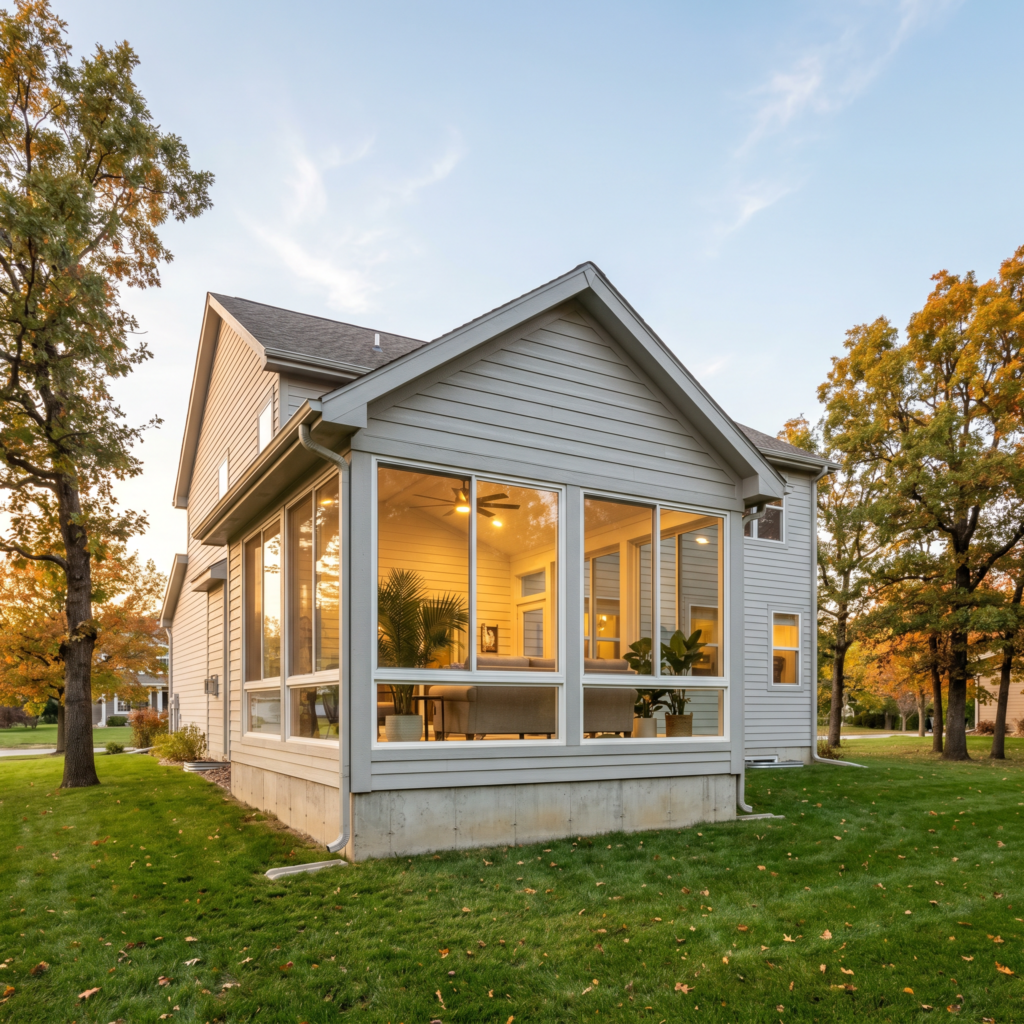
A four-season room is a full home addition that happens to have a lot of glass. Walls, floor, and ceiling meet Iowa’s adopted Residential Code insulation values. The foundation reaches below the frost line. Windows are double or triple-pane low-E, often argon-filled. Heating comes from extended ductwork or a dedicated mini-split. A four-season room is functionally indistinguishable from any other finished room, which means it counts as Gross Living Area on appraisal.
Pro Tip 3: For any year-round conditioned room in Iowa, include radon-resistant construction. All 99 Iowa counties sit in EPA Radon Zone 1, and as many as 5 in 7 Iowa homes test above the EPA action level (Iowa Radon Survey).
Side-by-Side Comparison
The table below covers the structural differences that matter for Iowa homeowners.
| Feature | Sunroom / 3-Season | Four-Season Room |
|---|---|---|
| Framing | Aluminum or light wood | Conventional 2×4 or 2×6 wood |
| Insulation | Minimal or none | Full code-compliant envelope |
| Windows | Single or thin double-pane | Double or triple-pane low-E |
| Foundation | Existing deck or slab | Frost-depth footing, at least 42 inches |
| HVAC | None or portable heat | Extended ductwork or mini-split |
| Typical use months in Iowa | April to October | Year-round |
| Counts as Gross Living Area | No | Yes |
| Typical build time | 2 to 4 weeks | 6 to 12 weeks |
Every structural element changes between the two options, which is why prices diverge sharply.
Real Iowa Costs in 2026
The numbers below use 2026 Des Moines metro data as planning estimates, not quotes. Actual costs vary by site conditions, finish level, and roof tie-in complexity.
| Tier | 3-Season (per sq ft) | 4-Season (per sq ft) | 14×16 3-Season Total | 14×16 4-Season Total |
|---|---|---|---|---|
| Budget / Prefab | $50 to $70 | $80 to $110 | $11,200 to $15,700 | $17,900 to $24,600 |
| Mid-Range (stick-built) | $70 to $90 | $110 to $150 | $15,700 to $20,200 | $24,600 to $33,600 |
| Premium (matched to home) | $90 to $150 | $200 to $300 | $20,200 to $33,600 | $44,800 to $67,200 |
These ranges help with planning, but every bid should itemize foundation, HVAC, and windows separately.
Pro Tip 4: Ask every bidder to itemize foundation depth, HVAC method, and window specifications on separate lines. Lump-sum bids often hide thin foundations or single-pane glass on rooms sold as four-season.
Illustrative scenario: An Ankeny family builds a 14×16 three-season aluminum sunroom over an existing composite deck with single-pane sliders and no heating tie-in. Planning range: $18,000 to $22,000.
Illustrative scenario: An Urbandale family builds a 14×16 four-season stick-built addition on a new frost footing at least 42 inches deep, with matched gable roof, low-E double-pane casements, and ducted HVAC. Planning range: $55,000 to $70,000.
Permits, Code, and Inspections in Iowa
Every room addition in Iowa requires a permit, and HVAC or electrical work typically requires separate sub-permits. Iowa jurisdictions enforce a mix of the 2021 and 2024 International Residential Code editions depending on the city, along with the 2023 National Electrical Code adopted statewide. Separate mechanical and plumbing codes also apply. Always confirm the adopted edition with the local building department before design. The table below summarizes code requirements that typically apply to either room type.
| Requirement | Sunroom / 3-Season | Four-Season Room |
|---|---|---|
| Building permit | Yes | Yes |
| Frost-depth footing (42 inches minimum) | Sometimes | Yes, always |
| Full insulation envelope | No | Yes |
| HVAC permit | No | Yes, if ducted |
| Electrical permit | Often yes | Yes |
| Egress window (if sleeping use) | Not applicable | Yes, required |
| Radon-resistant construction | Rare | Recommended |
Permit fees typically run a few hundred dollars in Des Moines metro cities. The City of Ames sunroom permit application specifies the 42-inch minimum footing depth.
Pro Tip 5: Iowa registers general contractors rather than licensing them, which means a homeowner verifies Iowa DIAL’s contractor registration before signing instead of checking a state license. Registration with DIAL is required for anyone earning $2,000 or more annually from construction. Electricians, plumbers, and HVAC technicians hold separate state licenses.
Pro Tip 6: A dedicated ductless mini-split often beats extending existing ductwork. Sizing is simpler, installation is faster, and it avoids overloading a furnace originally sized for the existing home.
Property Taxes, Appraisal, and Insurance
Any permitted addition triggers reassessment in Iowa. A four-season room adds more because it increases Gross Living Area. A three-season room typically does not count as Gross Living Area but still raises improvement value. Iowa’s property tax cycle has a built-in lag: improvements are assessed as of January 1, and the first tax bill arrives roughly 18 months later. The Iowa Department of Revenue property tax overview details the cycle.
Pro Tip 7: Call the homeowner’s insurance agent before framing starts. New square footage typically needs an endorsement for full coverage.
ROI and Resale Value
National averages put four-season room recovery around 50 to 70 percent of project cost and three-season recovery around 45 to 55 percent. Results vary. These figures are national, not Iowa-specific, and none of this constitutes financial advice. In the Des Moines metro, a well-matched four-season addition competes with a finished basement as the top “usable square footage” upgrade.
| Metric | 3-Season Room | 4-Season Room |
|---|---|---|
| Planning cost range (14×16) | $15,000 to $34,000 | $24,000 to $67,000 |
| Typical ROI range (national) | 45 to 55 percent | 50 to 70 percent |
| Counts as Gross Living Area | No | Yes |
| Property tax impact | Raises improvement value | Raises assessed value and GLA |
| Insurance impact | Needs endorsement | Needs endorsement |
These are planning estimates; actual returns vary with market conditions and finish level.
Pro Tip 8: Four-season rooms with hard roof tie-ins and matching siding appraise higher than aluminum cap-on-deck sunrooms. Matching the exterior is the biggest lever for appraisal value.
How to Decide: A Central Iowa Checklist
Four-season wins if year-round comfort matters. An existing deck pushes the project toward three-season, because retrofitting a frost footing under a deck is rarely cost-effective. Appraisal credit requires four-season, since only conditioned space counts as Gross Living Area. Budget under $25,000 realistically points to three-season. Homeowners staying ten or more years usually come out ahead with four-season.
Pro Tip 9: Radon testing costs about $15 for a short-term kit at hardware stores, or free and low-cost through some Iowa county health departments, and a test before and after any conditioned addition is worth running. All 99 Iowa counties are designated as entirely EPA Radon Zone 1.
Pro Tip 10: Low-E argon-filled glass pays back quickly in Iowa winters. Skip single-pane entirely, even on three-season builds.
Working With a Registered Iowa Contractor
Beyond the DIAL check, confirm the permit will be pulled in the contractor’s name, insist on a written frost-depth foundation specification, and get the HVAC tie-in method in writing before signing. Out-of-state contractors working in Iowa also carry a $25,000 surety bond requirement.
Pro Tip 11: Ask for site-specific radon guidance before signing. Basement and slab conditions vary, and the builder should know what the site requires.
Pro Tip 12: Get every bid in writing with itemized line items for foundation depth, HVAC method, window U-value, and roof tie-in detail. Verbal agreements on these four items are where most Iowa sunroom projects go sideways.
Frequently Asked Questions
Q1: Can a three-season room be converted into a four-season room later?
Sometimes, but the math rarely works. A real conversion usually means tearing out to the subfloor, adding frost-depth footings, upgrading insulation and windows, and running HVAC. That typically costs 70 to 90 percent of a new four-season build.
Q2: Does a sunroom add to Iowa property taxes?
Yes. Any permitted addition triggers reassessment. A four-season room adds more because it increases Gross Living Area. A three-season room adds less but still raises the improvement value. The first tax bill typically arrives about 18 months after the January 1 assessment.
Q3: What is the minimum foundation depth for a year-round addition in Iowa?
At least 42 inches below grade for most Central Iowa jurisdictions, with some areas requiring deeper. The City of Ames permit application specifies 42 inches as the minimum, and no legitimate four-season addition should be built on shallower footings.
Q4: Does Iowa require a registered contractor for a sunroom?
Iowa registers general contractors rather than licensing them. Registration through DIAL is required for any contractor earning $2,000 or more annually. Electricians, plumbers, and HVAC technicians hold separate state licenses for their scopes.
Q5: Which adds more resale value, a four-season room or a finished basement?
Finished basements typically recover around 70 percent of cost nationally. Four-season rooms typically recover 50 to 70 percent. Basements often win on dollar-for-dollar ROI; four-season rooms often win on buyer appeal and days-on-market in Des Moines metro listings.
Q6: Can a four-season room be used as a bedroom?
Yes, if it meets Iowa-adopted code for sleeping rooms. That includes an egress window with the required net clear opening, a smoke detector, and a permanent heat source. Plan for egress from day one, since retrofitting later is significantly more expensive.
Key Takeaways
A four-season room is a full home addition; a sunroom is a lighter enclosure. That difference drives cost, tax impact, and appraisal treatment. For 2026 Central Iowa planning, three-season rooms run roughly $50 to $90 per square foot and four-season rooms run $110 to $300. Year-round additions need footings at least 42 inches deep. Four-season rooms count as Gross Living Area; three-season rooms do not. Both trigger reassessment. Building three-season now and upgrading later usually costs 70 to 90 percent of new four-season construction, so decide up front. For Iowa general contractors, verify DIAL registration rather than licensing.
Get a Real Iowa Estimate
Every home is different. Slope, soil, existing decks, and roof lines affect sunroom and four-season room costs more than any national average can predict. Busy Builders has served 1,285+ Central Iowa homeowners since 2020 with transparent, itemized pricing on additions.
Call: 844-435-9800
Website: busybuildersiowa.com
Busy Builders serves Des Moines, West Des Moines, Ankeny, Urbandale, Clive, Johnston, Waukee, Ames, Indianola, and communities across ten Central Iowa counties.
Legal Disclaimer
Cost figures in this post are planning estimates based on 2026 Des Moines metro market data; actual costs vary by site, scope, and material selection. Code references reflect Iowa-adopted editions as of April 2026 and should be confirmed with the local building department before relying on any specification. ROI and resale figures are national averages; results vary, and this is not financial advice. Property tax and appraisal impacts vary by county assessor. Busy Builders provides a written warranty on workmanship, with details provided in the contract. Illustrative scenarios are examples for planning purposes and are not verified Busy Builders projects.
Busy Builders | Full-Service Construction and Remodeling | Serving Central Iowa Since 2020