Picking basement insulation in Iowa is not really a fiberglass-versus-spray-foam debate. It is a moisture physics problem, and the Iowa climate makes the answer clearer than homeowners expect. This guide covers why fiberglass fails against concrete basement walls, what closed-cell spray foam does differently, Iowa’s R-value code requirements, 2026 cost ranges, and the radon connection most homeowners miss.
TLDR: Closed-cell spray foam is the right primary insulation for Iowa basement walls because it serves as insulation, air barrier, and vapor barrier in one application. Fiberglass against concrete traps moisture and promotes mold growth. Iowa code requires R-15 continuous or R-19 cavity on basement walls statewide. Spray foam typically costs $1,500 to $5,600 installed and pays back in three to five years.
The Short Answer for Iowa Basements
In Iowa’s climate, closed-cell spray foam on the concrete wall face, plus fiberglass in interior stud cavities, is the assembly that satisfies code, manages moisture, and prevents mold. The key is sequence: spray foam first, directly against concrete, creates the thermal and vapor boundary. Fiberglass goes only inside stud bays above that boundary. Physics, not preference, drives the decision.
Pro Tip 1: In an Iowa basement, closed-cell spray foam goes on the concrete. Fiberglass goes only in interior stud cavities above that thermal and vapor boundary.
Why Fiberglass Fails Against Concrete in Iowa
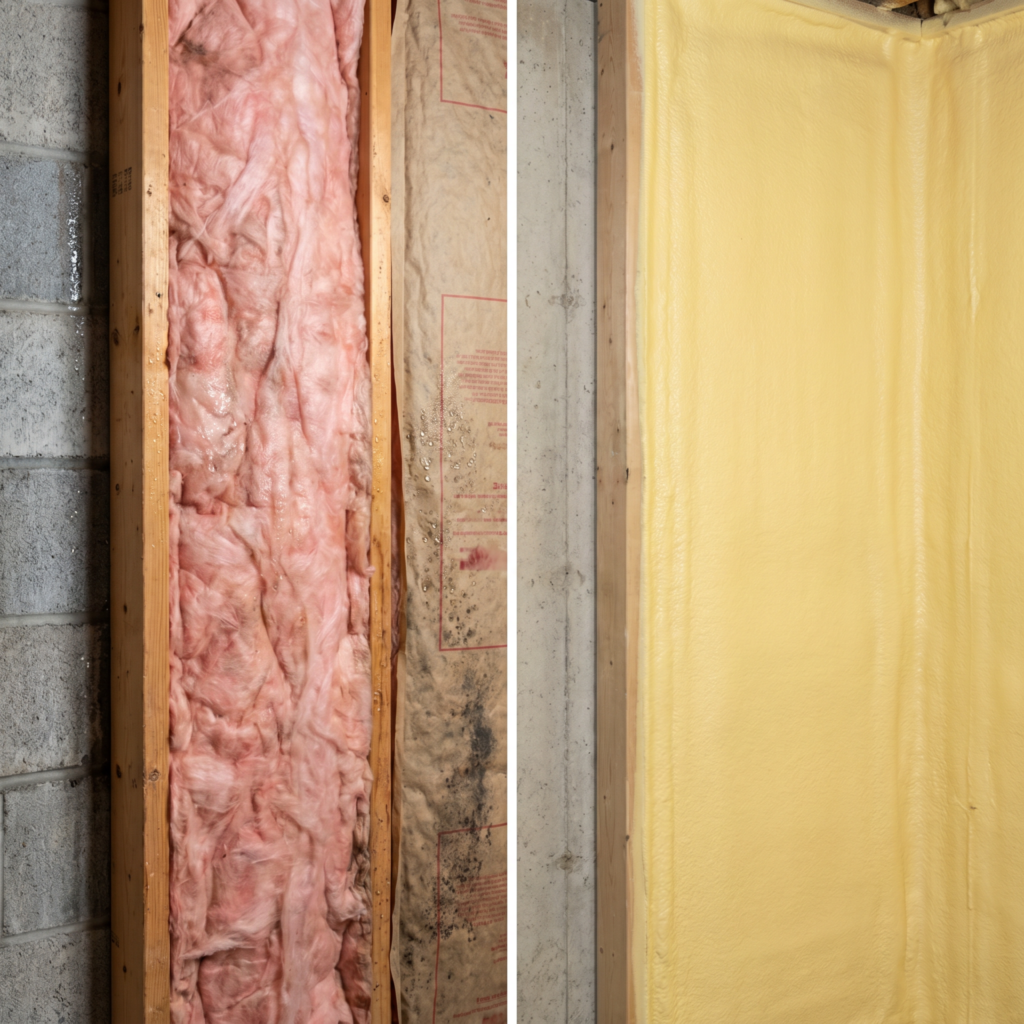
Iowa basement walls hold at roughly 50 degrees year-round on the exterior face because the soil surrounding the foundation stays at that temperature regardless of the weather upstairs. Warm interior air at 68 to 70 degrees hits that cold surface, and moisture condenses on the concrete. Fiberglass batts against the wall become saturated with condensate, lose most of their R-value, and develop mold on their paper facings and resin binders. Over time, fiberglass also sags on vertical surfaces, opening thermal gaps.
Pro Tip 2: Never install fiberglass batts directly against concrete foundation walls in Iowa. Condensation saturates the batt, turning it into a mold habitat.
Pro Tip 3: Fiberglass paper and resin facings are organic. A wet batt grows mold even though the glass fibers do not.
What Closed-Cell Spray Foam Does Differently
Closed-cell spray foam bonds directly to concrete and fills every crack and penetration during application. It delivers R-5.6 to R-8.0 per inch, so two inches on the wall face reaches R-11 to R-16 in one step. Most closed-cell spray foam products at two inches achieve vapor permeance of 1 perm or less, meeting Class II vapor retarder requirements, but the specific permeance depends on the product; verify the data sheet with the installer. At that rating, a separate poly vapor barrier is not needed. Open-cell spray foam is a different product, useful for attics and interior partitions, but not appropriate as the primary insulation on a basement wall. The table below summarizes why.
| Feature | Open-Cell | Closed-Cell |
|---|---|---|
| R-value per inch | R-3.5 to R-3.7 | R-5.6 to R-8.0 |
| Vapor permeance | Vapor-open | ~1 perm or below at 2″ (verify product) |
| Air barrier | Yes | Yes |
| Moisture resistance | Poor | Excellent |
| Best for basement walls | No | Yes |
| Installed cost per board foot | $0.60 to $1.30 | $1.30 to $2.90 |
Pro Tip 4: Two inches of closed-cell spray foam on concrete delivers R-12 to R-14 and meets vapor-retarder requirements in a single step.
Pro Tip 5: Do not use open-cell spray foam on basement walls. It is vapor-open, creating a condensation risk below grade.
Iowa Code Minimum R-Values
Iowa is primarily IECC Climate Zone 5A, with only the northernmost counties bordering Minnesota in Zone 6A. Both zones require the same minimum: R-15 continuous or R-19 cavity on basement walls. The Iowa Insulation Institute energy code summary confirms this for both zones. Iowa’s R101.2 amendment excludes residential remodels from mandatory IECC compliance, but most Iowa building departments still require a minimum level of insulation for permit-required basement finishes. Verify with the local authority before finalizing the scope.
| Material | R per Inch | 2 Inches | 3.5 Inches |
|---|---|---|---|
| Fiberglass batt | R-3.2 to R-3.8 | R-6 to R-8 | R-11 to R-13 |
| Open-cell spray foam | R-3.5 to R-3.7 | R-7 to R-8 | R-12 to R-13 |
| Closed-cell spray foam | R-5.6 to R-8.0 | R-11 to R-16 | R-20 to R-28 |
Two inches of closed-cell spray foam alone approaches Iowa’s R-15 continuous requirement. A hybrid assembly comfortably exceeds it.
Pro Tip 6: Iowa requires R-15 continuous or R-19 cavity on basement walls in both Climate Zone 5A (most of the state) and Climate Zone 6A (northernmost counties).
Pro Tip 7: Iowa’s R101.2 amendment exempts remodels from mandatory IECC compliance, but local departments usually still require a minimum level of insulation for permitted finishes.
2026 Cost Comparison for an Iowa Basement
The planning ranges below apply to a typical 1,000 to 1,200-square-foot basement wall area in the Des Moines metro. Figures are planning estimates, not quotes.
| Factor | Fiberglass Batt | Open-Cell Spray Foam | Closed-Cell Spray Foam |
|---|---|---|---|
| Installed cost (typical basement walls) | $500 to $2,500 | $1,000 to $3,000 | $1,500 to $5,600 |
| Minimum job charge | None | $1,500 to $2,000 | $1,500 to $2,000 |
| Typical Iowa energy savings | Minimal on basement walls | 20 to 30 percent | 30 to 50 percent |
| Payback period | Not applicable | 5 to 10 years | 3 to 5 years |
| Expected lifespan | 15 to 30 years | 20+ years | 50+ years |
Fiberglass looks cheaper up front, but the real comparison is between spray foam and fiberglass, plus the eventual mold remediation bill. Remediation in the Des Moines metro typically costs $3,000 to $15,000, often more than the spray foam premium.
Pro Tip 8: A failed fiberglass basement insulation in Iowa typically costs $3,000 to $15,000 in mold remediation. The closed-cell premium is usually less than the cost of a single remediation bill.
The Radon Connection
Closed-cell spray foam seals cracks, floor-to-wall joints, and pipe penetrations in the foundation wall, reducing radon entry pathways and improving the effectiveness of a sub-slab depressurization system. Spray foam does not eliminate radon and is not a substitute for active mitigation. All 99 Iowa counties fall within EPA Radon Zone 1, and the Iowa HHS radon resources page reports that as many as 5 in 7 Iowa homes test above the EPA action level. Test before the project and test after. For the broader picture on radon and moisture in Iowa basements, the signs go beyond radon alone.
Pro Tip 9: Spray foam reduces radon entry pathways; it does not eliminate radon. Always test before and after any basement insulation project.
Where Each Material Fits: The Hybrid Assembly
The practical answer for most Iowa basements is a hybrid. Two inches of closed-cell spray foam on the concrete establishes the thermal and vapor boundary. A 2×4 stud wall framed one inch off the spray foam surface carries interior finishes. R-11 or R-13 fiberglass batts fill the stud cavities for additional R-value. The total assembly reaches R-23 to R-27, comfortably exceeding Iowa’s R-15 continuous minimum.
| Location | Fiberglass | Closed-Cell Spray Foam |
|---|---|---|
| Foundation walls (below grade) | Not recommended | Best choice |
| Rim joists | Acceptable with careful air sealing | Preferred |
| Interior framed stud bays | Acceptable above the thermal boundary | Optional add-on |
| Interior partition walls | Yes | Not needed |
| Under slab (new construction) | No | Rigid board or spray foam |
Iowa registers general contractors through Iowa DIAL’s contractor registration rather than licensing them. Verify registration before signing, and ensure the scope specifies foam type, applied thickness in inches, and resulting R-value in writing. Spray foam is also temperature-sensitive; most closed-cell products require ambient and substrate temperatures above 40 degrees, so that October-through-March projects may need temporary heating.
Pro Tip 10: The typical Iowa assembly is two inches of closed-cell spray foam on concrete plus a 2×4 stud wall with R-11 or R-13 fiberglass in the cavity, total R-23 to R-27.
Pro Tip 11: Spray foam requires certified installers and professional equipment. DIY kits work for rim joist patches, not for a full basement.
Pro Tip 12: Get foam type, applied thickness in inches, and resulting R-value in writing before signing. A bid that says only “spray foam” leaves too much room for short application.
Illustrative Central Iowa Projects
Illustrative scenario: An Ankeny homeowner finishes a 1,000 sq ft unfinished basement. Two inches of closed-cell spray foam on all concrete foundation walls provides R-12 to R-14 with a vapor barrier; a 2×4 interior wall with R-11 fiberglass in the cavities brings the total assembly to R-23 to R-25; closed-cell also goes on all rim joists, insulation planning range: $3,500 to $6,500.
Illustrative scenario: A Johnston homeowner re-insulates an existing basement where unfaced fiberglass was installed directly against the foundation. Demo exposes mold on the paper facing, so a qualified mold remediation professional assesses the scope before removal. Old insulation is removed, concrete cleaned and dried, and two inches of closed-cell spray foam applied, planning range for removal and spray: $4,000 to $7,500, depending on the remediation scope.
Frequently Asked Questions
Q1: Can I use fiberglass insulation in my Iowa basement?
Yes, but only in specific locations: interior stud bays above a properly established thermal boundary at the concrete face, and interior partition walls. Fiberglass should never be installed directly against concrete basement walls in Iowa, where condensation can saturate the batt and cause mold.
Q2: What R-value does an Iowa basement wall need?
Iowa’s adopted energy code requires R-15 continuous or R-19 cavity on basement walls. Iowa is primarily IECC Climate Zone 5A, with the northernmost counties in Zone 6A, and both zones carry the same basement wall minimum. Iowa’s R101.2 amendment excludes residential remodels from mandatory compliance, but local building departments commonly still require minimum insulation on permitted basement finishes.
Q3: How much does spray foam insulation cost for an Iowa basement?
Professional closed-cell spray foam for typical 1,000 to 1,200 sq ft basement walls runs $1,500 to $5,600 installed, with a contractor minimum job charge of $1,500 to $2,000. Iowa homeowners typically recover the premium over fiberglass through energy savings in three to five years.
Q4: Does spray foam help with radon in Iowa?
Closed-cell spray foam seals cracks, floor-wall joints, and pipe penetrations that are common radon entry points, and it improves sub-slab depressurization performance. It does not eliminate radon and is not a substitute for active mitigation. Always test before and after any basement project.
Q5: What is the difference between open-cell and closed-cell spray foam for a basement?
Closed-cell is the correct choice for basement walls: R-5.6 to R-8.0 per inch, vapor-impermeable, and blocks moisture from the concrete. Open-cell (R-3.5 to R-3.7 per inch, vapor-open) allows moisture to pass through, creating a condensation risk below grade. Open-cell works in attics and interior walls.
Q6: Can I install spray foam insulation myself in an Iowa basement?
DIY spray foam kits work for small patches and rim joists. Still, basement-scale projects require professional equipment, correctly mixed two-component material, and certified applicators for even coverage and correct thickness. An uneven or thin application creates cold spots and code compliance issues.
Key Takeaways
Closed-cell spray foam is the correct primary insulation for Iowa basement walls because it serves as insulation, air barrier, and vapor barrier in one step. Fiberglass should never touch concrete in an Iowa basement; the cold surface creates condensation that can saturate the batts and promote mold growth. Iowa requires R-15 continuous insulation or R-19 cavity insulation statewide, and the R101.2 amendment exempts remodels from mandatory compliance, though local departments usually still require minimum insulation. Closed-cell spray foam runs $1,500 to $5,600 installed with a three- to five-year payback. Spray foam reduces radon entry pathways but does not eliminate radon; test before and after. The standard Iowa assembly is closed-cell on concrete, with fiberglass in the stud cavities, achieving R-23 to R-27.
Plan a Real Central Iowa Estimate
Every Iowa basement is different. Wall height, existing moisture conditions, and local permit requirements all shape the final scope. Busy Builders has served 1,285+ Central Iowa homeowners since 202,0, offering transparent, itemized pricing for basement insulation and finishing. Schedule a free consultation.
Call: 844-435-9800
Website: busybuildersiowa.com
Busy Builders serves Des Moines, West Des Moines, Ankeny, Urbandale, Clive, Johnston, Waukee, Ames, Indianola, and communities across ten Central Iowa counties.
Legal Disclaimer
Cost figures in this post are 2026 Des Moines metro planning estimates; actual costs vary by project size, existing conditions, and contractor. R-value code references reflect Iowa-adopted editions as of April 2026 and should be confirmed with the local building department. The Iowa energy code R101.2 amendment excludes residential remodels from mandatory IECC compliance; confirm what the local permit authority requires before finalizing design. Spray foam reduces radon entry pathways but does not eliminate radon; all 99 Iowa counties are EPA Radon Zone 1. Test for radon before and after any basement project, regardless of insulation type. Spray foam is not a substitute for active radon mitigation. If mold is found during demolition or insulation removal, consult a qualified mold remediation professional; this post does not substitute for professional mold assessment. Busy Builders provides a written warranty on artistry, with details provided in the contract. Illustrative scenarios are examples for planning purposes and are not verified Busy Builders projects.
Busy Builders | Full-Service Construction and Remodeling | Serving Central Iowa Since 2020