
Home Building
Central Iowa
Building a custom home is the biggest construction decision you’ll make, and who you hire to build it determines whether the process is honest and predictable or full of surprises you didn’t budget for.
Busy Builders has been building homes across Central Iowa since 2020, and every project starts with a clear plan, a fixed written estimate, and a registered general contractor who stays on site from permit to final walkthrough.
- General Contractor
Full-Service Home Building
About Us
Since 2020, Busy Builders has completed over 1,000 construction and remodeling projects across Central Iowa.
We build custom homes, spec homes, tiny homes, and multi-family residential projects for homeowners and investors who want a straight answer on cost, a realistic timeline, and a contractor who shows up.
Every home we build is designed for Iowa’s climate, built to Iowa code, and backed by the same integrity we bring to every other project we take on.
Our Mission
Honest pricing, a clear written plan, and no surprise charges on every home building project in Central Iowa.
We tell you what the project actually costs before a permit is filed, and we do not pad the estimate with contingencies we pocket if the build goes smoothly.
Our Vision
We want to be the registered general contractor that homeowners in Des Moines, West Des Moines, Ankeny, Waukee, Johnston, and Grimes call first when it’s time to build and recommend to every neighbor who asks.
- Explore Our Services
Home Building Projects We Specialize In
Build on Your Lot
You own the land. We handle site work, utilities, and the build.
Spec Homes
Proven plans and finish packages. Faster start, fewer decisions.
Multi-Family Construction
Duplexes and small multi-family. Zoning and density checked first.
Custom Home Building
Your plan, your lot, your finishes. From about $150 per square foot.
Tiny Homes
Small permanent dwellings. Zoning checked before design work starts.
- Home Building Step By Step
How Do We Build Your Home?
SITE ASSESSMENT & DESIGN
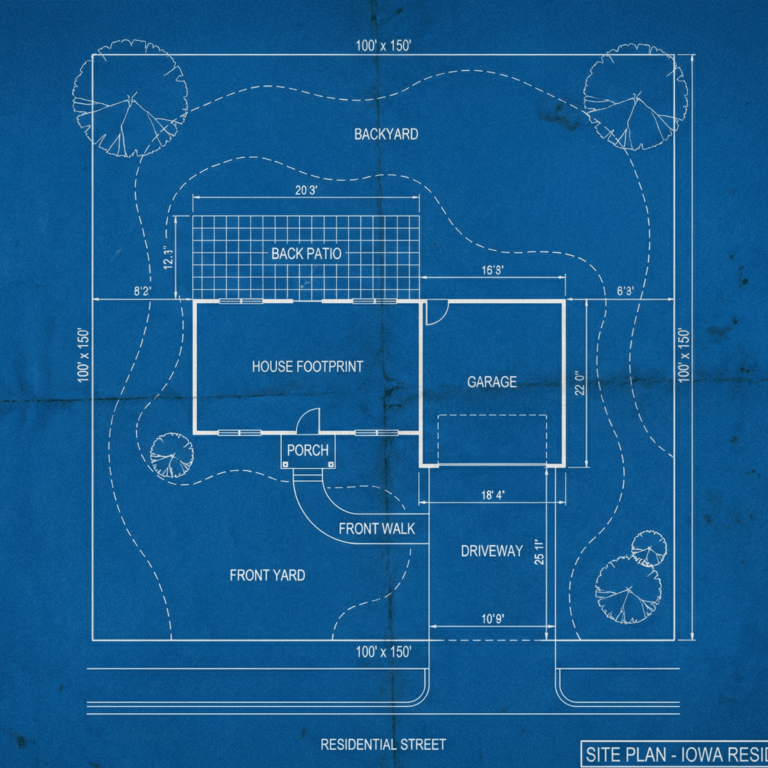
Every home build starts with the land. Before any design work begins, we assess the lot for grade changes, drainage patterns, soil conditions, utility access, setback requirements, and orientation for solar exposure and prevailing Iowa winds.
Iowa clay soil is one of the most important variables in a Central Iowa home build because it expands when wet and contracts when dry, which directly affects foundation design and excavation approach.
We discuss floor plan options, home style, and budget at this stage, so the homeowner has a complete picture before a permit application is submitted.
See our guide on what new home construction in Central Iowa’s soil conditions actually requires before choosing a lot.
- Full lot assessment covering grade, drainage, soil, utility access, and setbacks
- Floor plan and home style options presented with Iowa climate performance context
- Written scope of work, design, and budget confirmed before any permits are filed
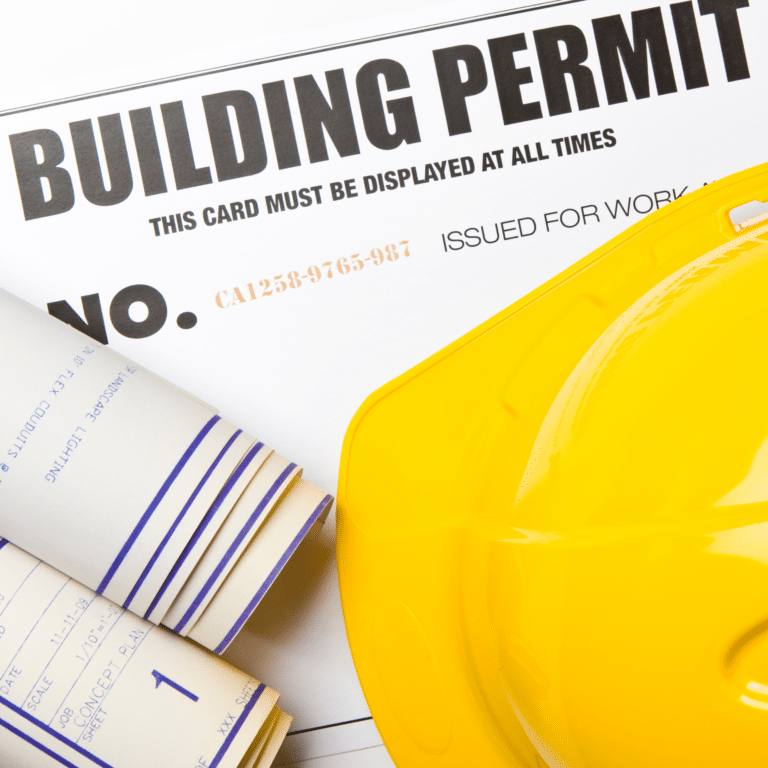
New home construction requires a building permit in every Iowa jurisdiction, and most cities in the Des Moines metro require structural drawings, energy compliance documentation, and site plans to be submitted with the application.
Iowa Building Code is administered through DIAL, the Department of Inspections, Appeals, and Licensing, under Iowa Administrative Code agency 481. Iowa adopted the 2024 IRC effective September 10, 2025, and every home we build meets the current code.
We file all required permits, submit all drawings, coordinate third-party engineering where required, and schedule every inspection as part of the project scope.
Read our full guide on navigating home building permits in Iowa before your project starts.
- Full permit application, structural drawings, and energy compliance documentation submitted
- Iowa Administrative Code agency 481 and 2024 IRC compliance on every project
- All inspections scheduled and coordinated, homeowner doesn't manage a thing
PERMITS & APPROVALS
SITE PREP & EXCAVATION
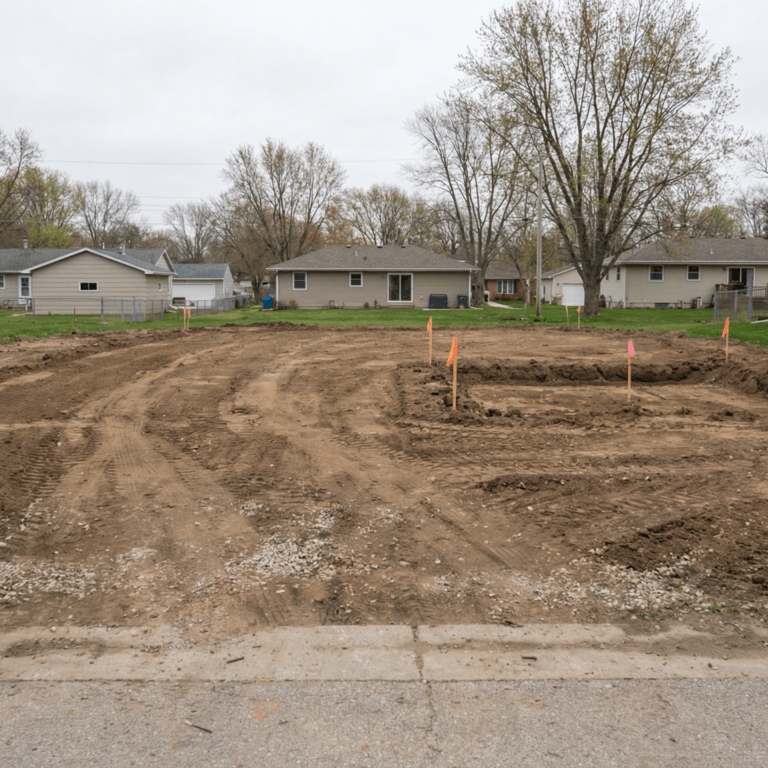
Site prep covers clearing, grading, and excavating the lot to the design elevation before foundation work begins.
Iowa clay soil requires careful attention to how the site is graded so water drains away from the foundation after the home is built.
We call 811 before any excavation begins to locate underground utilities, which is required by Iowa law.
Topsoil is stripped and stockpiled for finish grading at the end of the project.
The excavation depth for a full basement in Central Iowa goes well below the 42 inch frost line, and we size the excavation to give crews adequate room to work the foundation walls and waterproofing correctly.
- Site clearing, grading, and excavation to design elevation before foundation work
- Iowa clay soil drainage planning to protect the foundation after the home is occupied
- 811 utility locate completed before any excavation begins, per Iowa law
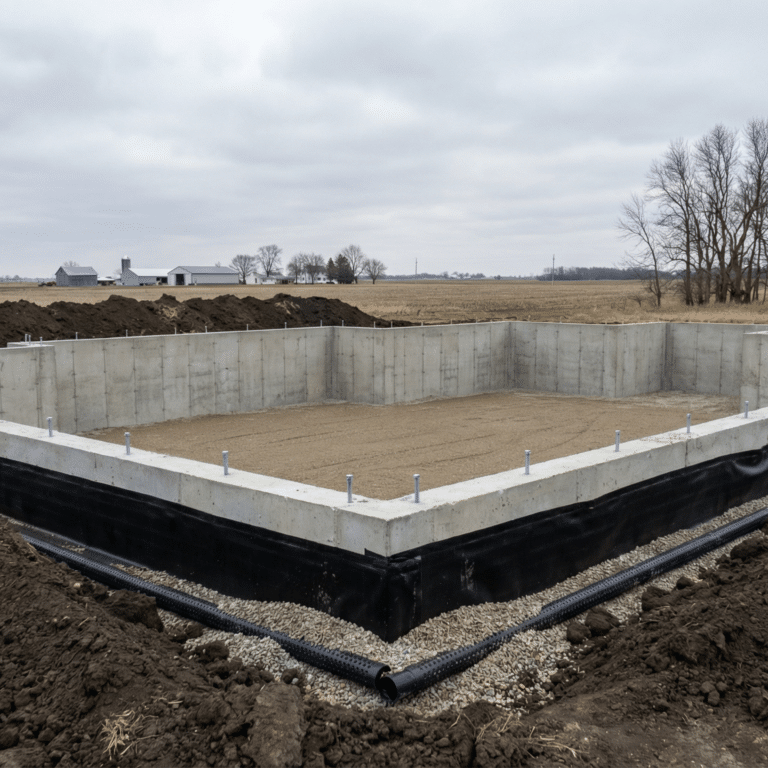
The foundation carries every load in the home and determines whether the structure stays level and dry for the next 50 years.
Iowa’s 42 inch frost line is non-negotiable on every project we build. Footings are set below that depth on every pour. Iowa clay soil adds lateral pressure to foundation walls that sandy or loam soils do not, and we account for that pressure in wall thickness and reinforcement design.
Waterproofing and drainage tile are installed on the exterior of the foundation before backfill goes in.
A poured concrete wall with exterior waterproofing membrane and perimeter drain tile is the standard approach for Central Iowa residential construction.
- Footings poured below Iowa's 42 inch frost line on every project
- Foundation wall design accounting for Iowa clay soil lateral pressure
- Exterior waterproofing membrane and perimeter drain tile installed before backfill
Setting The FOUNDATION
House FRAMING
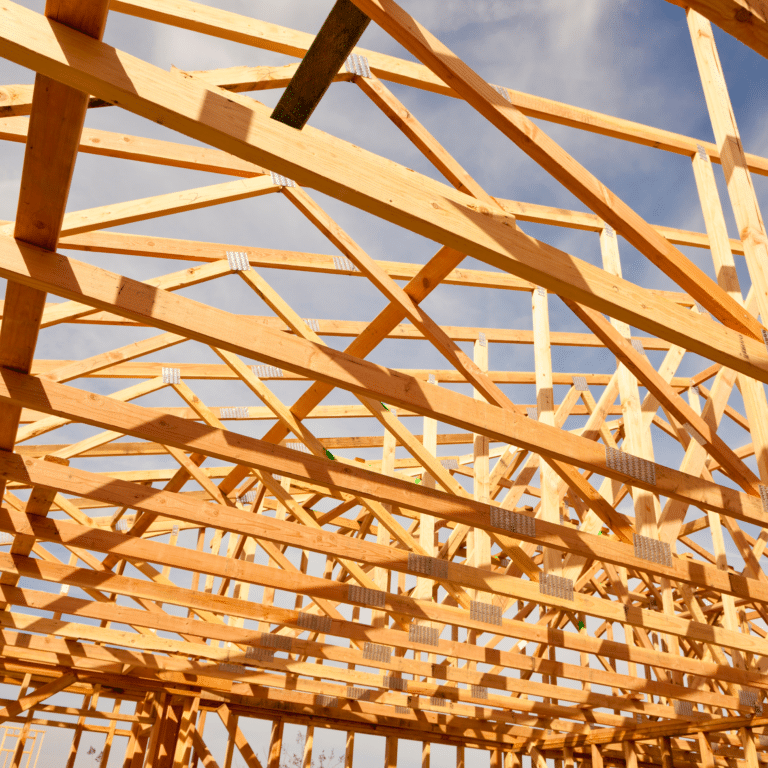
Framing is where the floor plan becomes a physical structure.
We frame floor systems, exterior walls, interior partition walls, and roof systems using lumber sized and spaced per the Iowa building code and the structural drawings submitted with the permit.
Load-bearing wall and beam locations are built exactly to the structural plan.
Iowa’s wind loads, snow loads, and temperature extremes are factored into every roof and wall assembly we design.
Pressure-treated lumber is used wherever wood contacts concrete per Iowa and IRC code.
Once framing is complete, the structure is inspected before any mechanical work begins.
Read our guide on how long it takes to build a custom home to understand where framing fits in the full build timeline.
- Floor, wall, and roof framing built to structural drawings and Iowa building code
- Load-bearing walls and beams placed exactly to structural plan, inspected before mechanical
- Pressure-treated lumber at all concrete contact points per Iowa and IRC code
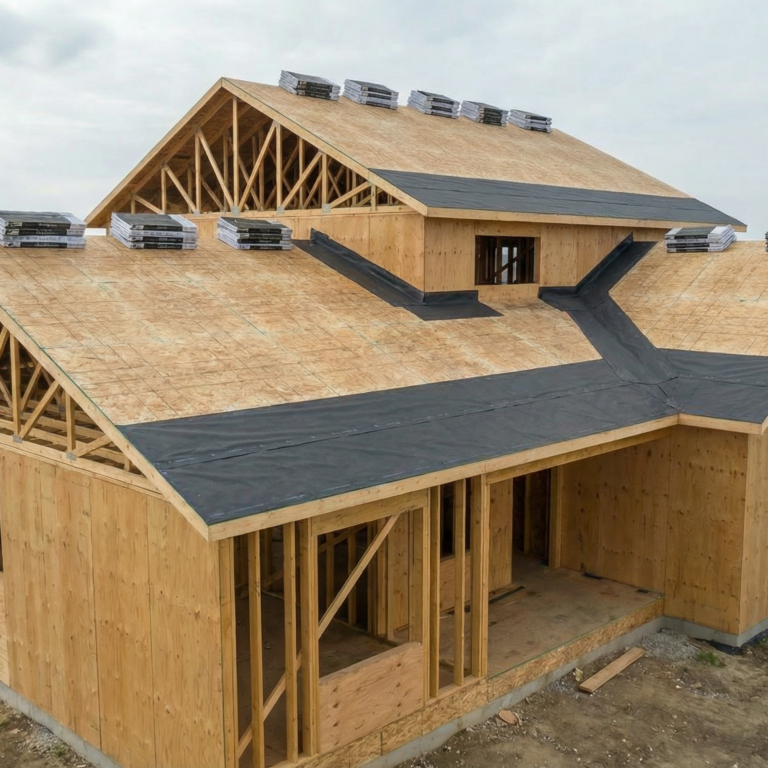
Roofing and exterior sheathing close the structure in so mechanical work can begin inside regardless of Iowa weather.
Roof sheathing, underlayment, and shingles are installed with proper flashing at all valleys, penetrations, and wall-to-roof transitions.
Exterior wall sheathing and housewrap create a continuous air and moisture barrier from the foundation to the roofline.
Window and door rough openings are flashed before units are set. Iowa’s freeze-thaw cycles and high wind events make proper flashing and air sealing at every transition point critical for long-term performance.
Getting the exterior envelope right at this stage protects every mechanical system and interior finish that follows.
- Roofing with full flashing at all valleys, penetrations, and wall-to-roof transitions
- Continuous housewrap air and moisture barrier from foundation to roofline
- Window and door rough openings flashed before units are set
ROOFING & EXTERIOR ENVELOPE
WINDOWS & EXTERIOR DOORS
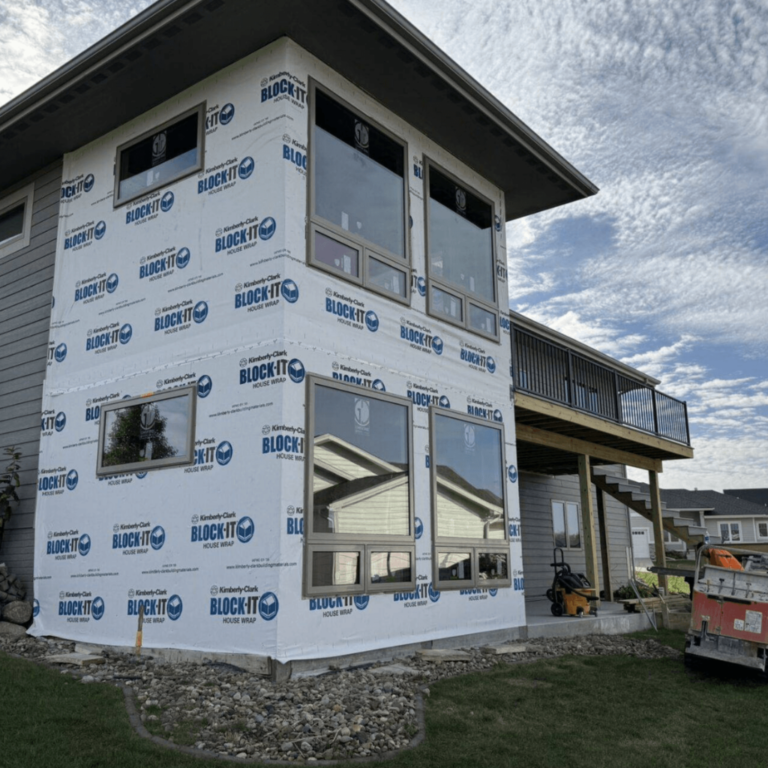
Windows and exterior doors are set once the rough openings are confirmed and flashed.
Window performance specs for Iowa homes need to account for temperatures ranging from below 0°F to above 90°F, and low-E glass with proper frame thermal breaks is the standard for energy code compliance across the Des Moines metro.
All units are tested for operation, seal, and weathertightness before the interior work begins.
Egress windows are installed in all below-grade bedrooms per Iowa building code.
Exterior door hardware, thresholds, and weatherstripping are set to minimize air infiltration before insulation is installed.
Read our guide on energy-efficient construction options for Iowa homes to understand how window selection affects long-term energy costs.
- Low-E glass windows and insulated exterior doors meeting Iowa energy code requirements
- All units tested for operation, seal, and weathertightness before interior work begins
- Egress windows installed in all below-grade bedrooms per Iowa building code
Mechanical rough-in is the most complex coordination step in a new home build.
Plumbing drain lines, supply lines, and vent stacks are roughed in before concrete floors are poured, where applicable, and above-floor supply and drain runs happen once framing is complete.
Iowa NEC 2023 with state amendments under Iowa Administrative Code 481-404 governs all electrical work.
HVAC duct layouts are designed around the floor plan to deliver proper airflow to every room.
All rough-in work is done by licensed electricians and licensed plumbers, pulled with individual permits, and inspected before any drywall closes the walls.
This is the step where decisions made during the design phase either make the mechanical systems easy to run or expensive to work around.
- Plumbing, electrical, and HVAC rough-in coordinated across all trades before drywall
- Iowa NEC 2023 electrical compliance under Iowa Administrative Code 481-404
- Licensed electricians and plumbers on all mechanical work, permitted and inspected
MECHANICAL ROUGH-IN: PLUMBING, ELECTRICAL & HVAC
INSULATION Installation
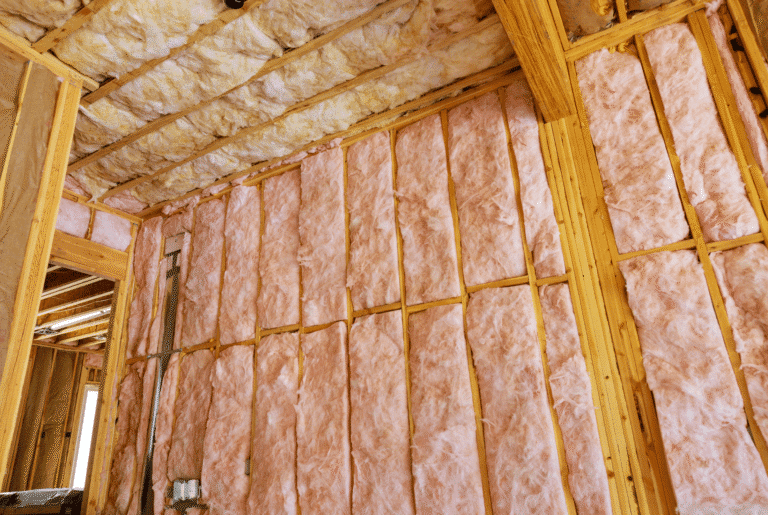
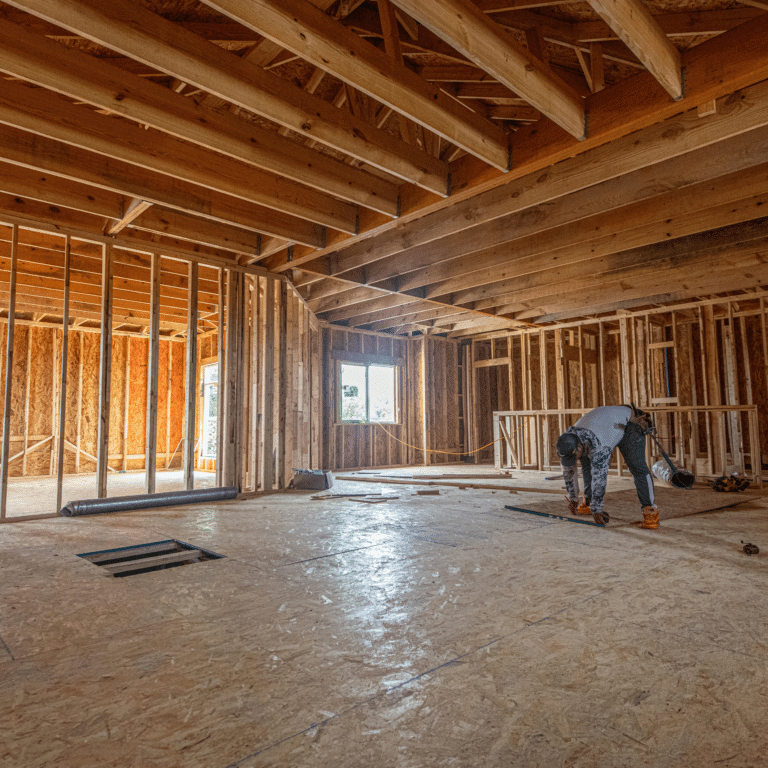
Insulation in a Central Iowa home has to perform across a temperature range that pushes from below 0°F in January to above 90°F in July.
Wall cavities, attic floors or cathedral ceiling assemblies, rim joists, and below-grade walls all require different insulation strategies to meet Iowa’s energy code and deliver real-world comfort.
Spray foam is used at rim joists and all penetrations where air sealing is the priority.
Blown-in or batt insulation fills wall and ceiling cavities to the R-value required by the current Iowa code.
Radon-resistant construction details are incorporated at the foundation level during this phase on all Central Iowa builds because as many as 5 in 7 Iowa homes test above the EPA action level of 4 pCi/L.
See the EPA’s radon guidance for more detail on why this matters in Iowa.
- Spray foam air sealing at rim joists and all penetrations before cavity insulation
- Wall and attic insulation meeting Iowa energy code R-value requirements
- Radon-resistant construction details incorporated at foundation level on every Central Iowa build
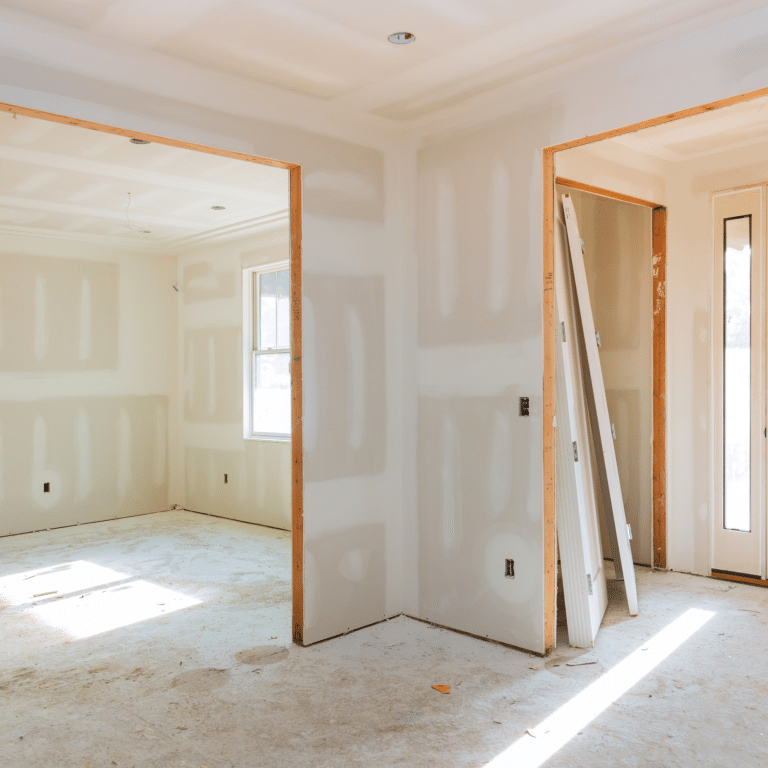
Drywall goes up once all mechanical inspections are passed and insulation is complete and inspected.
We hang, tape, mud, and sand every surface to a Level 4 or Level 5 smooth finish ready for paint.
Moisture-resistant drywall is used in all bathrooms and wet areas.
Interior doors, door casings, window trim, baseboard, and stair components are installed after drywall is complete.
Paint is applied after trim so every edge is cut in clean against a finished surface.
Cabinet installation in kitchens and bathrooms happens at this stage, coordinated with countertop fabrication lead times so the project doesn’t stall waiting on materials.
Explore our kitchen remodeling and bathroom remodeling service pages to understand finish-level options for those spaces.
- Level 4 or Level 5 drywall finish on all walls and ceilings, ready for paint
- Interior doors, trim, baseboard, and stair components installed after drywall is complete
- Cabinet installation coordinated with countertop fabrication to keep the schedule moving
DRYWALL & INTERIOR FINISHES
FLOORING, FIXTURES & EXTERIOR FINISH
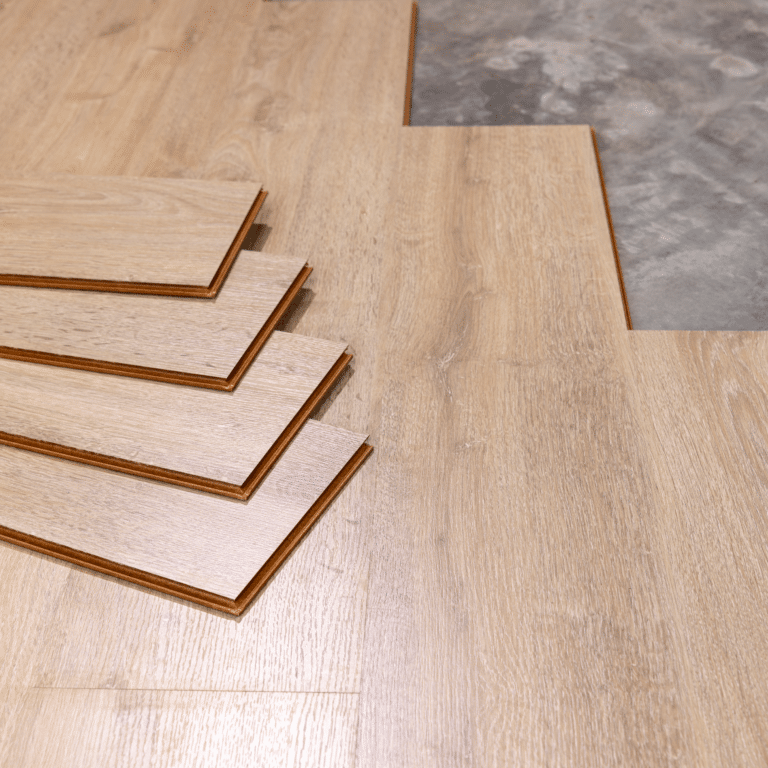
Flooring goes in after paint is complete, so finished surfaces aren’t damaged by other trades.
Hardwood, luxury vinyl plank, tile, and carpet are all available, depending on the room and the homeowner’s preferences.
Plumbing fixtures, light fixtures, outlets, switches, and hardware are installed and connected during this step.
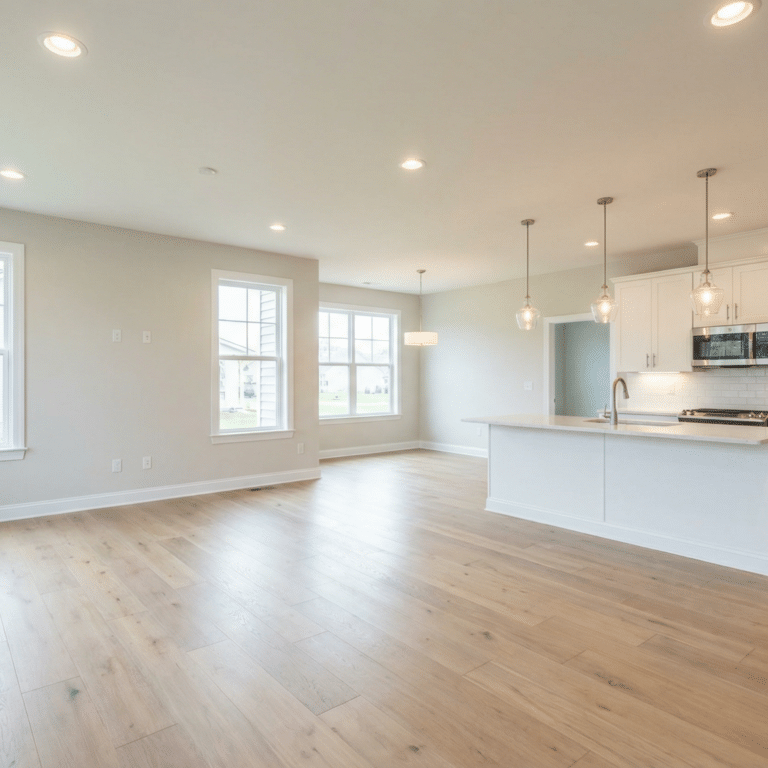
Exterior finish work, including siding, soffit, fascia, gutters, and concrete flatwork for driveways and sidewalks, is completed at this stage as well.
Final grading and topsoil restoration bring the lot back to its finished grade so drainage flows correctly away from the foundation.
Landscaping, if included in the scope, is completed last so it isn’t damaged by equipment traffic during the build.
- Flooring installation after paint is complete to protect finished surfaces
- Plumbing fixtures, light fixtures, hardware, and electrical devices installed and connected
- Exterior siding, gutters, concrete flatwork, and final grading completed before walkthrough
The final walkthrough is where we go through every room together before calling the project complete.
We test every plumbing fixture, electrical outlet, light switch, HVAC register, appliance, and GFCI circuit before the walkthrough begins.
Every surface, connection, hardware piece, and finish detail is reviewed side by side with the homeowner.
If anything doesn’t meet the standard we set at the start of the project, we fix it before handoff.
The crew removes all tools, materials, debris, and protective coverings so the home is clean and ready to occupy from day one.
We hand over all permit documentation, inspection records, and warranty information at project close.
Those records matter at resale, with your insurance carrier, and with your mortgage lender.
- Full room-by-room inspection of every surface, connection, fixture, and finish detail with the homeowner
- Function test on all plumbing, electrical, HVAC, and GFCI circuits before handoff
- Complete clean up and delivery of all permit documentation, inspection records, and warranties at project close
FINAL WALKTHROUGH & CLEAN UP
- Achievement
Trusted Home Building Contractors in Central Iowa
Since 2020, 1,285+ Central Iowa homeowners have trusted us to build and remodel their dreams, and it shows. We are a registered and insured Iowa contractor; Iowa Contractor Registration #C140184.









- Frequently Asked Questions
FAQs About Home Building
Central Iowa
How much does it cost to build a home in Central Iowa?
New home construction in Central Iowa starts at approximately $150 per square foot for a standard build, with total project costs driven by square footage, finish level, lot conditions, and feature complexity.
A straightforward 2,000 square foot home with standard finishes typically runs $300,000 to $400,000, including site work, foundation, and all mechanical systems.
A higher-end custom home with premium finishes, a finished basement, and custom features can run $500,000 or more, depending on scope.
Online calculators typically miss site prep costs, permit fees, deep footing requirements for Iowa’s frost line, and utility connection costs.
Busy Builders provides a detailed written estimate before any permit is filed.
See our complete Iowa home building costs guide for a full breakdown.
How long does it take to build a custom home in Central Iowa?
Most custom home builds in Central Iowa run 8 to 14 months from permit approval to final walkthrough depending on size, complexity, finish level, and site conditions.
Permit processing time in your specific city is the most variable factor at the start. Framing typically takes 4 to 8 weeks depending on home size. Mechanical rough-in, insulation, and drywall together run another 6 to 10 weeks.
Interior finishes and exterior work run 8 to 12 weeks at the end. We build a realistic schedule into the written estimate before the project starts so you know what to expect at every phase.
See our detailed breakdown of how long it takes to build a custom home.
Do I need a permit to build a home in Iowa?
Yes, without exception.
New home construction requires a building permit in every Iowa jurisdiction, and most cities in the Des Moines metro require structural drawings, energy compliance documentation, and site plans to be submitted with the permit application.
Iowa Building Code is administered through DIAL under Iowa Administrative Code agency 481. Iowa adopted the 2024 IRC effective September 10, 2025, and all new construction must meet current code.
Busy Builders handles all permit filing, drawing submissions, and inspection scheduling as part of every project scope.
Review our full guide on navigating home building permits in Iowa for city-specific details.
We are a registered and insured Iowa contractor; Iowa Contractor Registration #C140184.
Should I build a ranch or a two-story home in Iowa?
Both are common in Central Iowa and both have trade-offs that depend on lot size, budget, and how the household plans to use the space.
A ranch home puts all living space on one level, which makes it more accessible and often easier to heat and cool efficiently in Iowa’s climate.
A two-story home delivers more square footage on a smaller footprint, which matters on tighter lots in established Des Moines metro neighborhoods.
Two-story builds also typically cost less per square foot than ranch homes of the same size because the roof and foundation costs are shared across more square footage.
See our detailed comparison of ranch vs. two-story custom homes in Iowa before making the decision.
Can I build a custom home for under $500,000 in Central Iowa?
Yes, and most standard custom home builds in Central Iowa land well under that number with thoughtful planning.
A well-designed 2,000 to 2,500 square foot custom home with quality standard finishes can be built in the $350,000 to $475,000 range, depending on lot costs, site conditions, and finish selections.
The decisions that push projects over budget are typically finish upgrades, lot-specific site costs, and scope changes made after the permit is filed.
We help homeowners understand exactly where the money goes before the project starts.
See our full breakdown of whether you can build a custom home under $500,000 in today’s Central Iowa market.
What is the difference between a custom build and a spec home?
A custom home is designed from scratch around the homeowner’s specific needs, built on a lot the homeowner selects, and involves the homeowner in every major decision throughout the process.
A spec home is designed and built by Busy Builders on a lot we select, finished to a set specification, and available for purchase upon completion.
Spec homes move faster because design decisions are already made, and they are a good fit for buyers who want a new construction home without the 10 to 14 month timeline of a full custom build.
Both are built to the same Iowa code standard and the same quality level. If you are weighing both options, see our guide to home additions vs. new builds for additional context on how each path fits different household situations.
- Newest Blogs
Home Building Blogs for Central Iowa
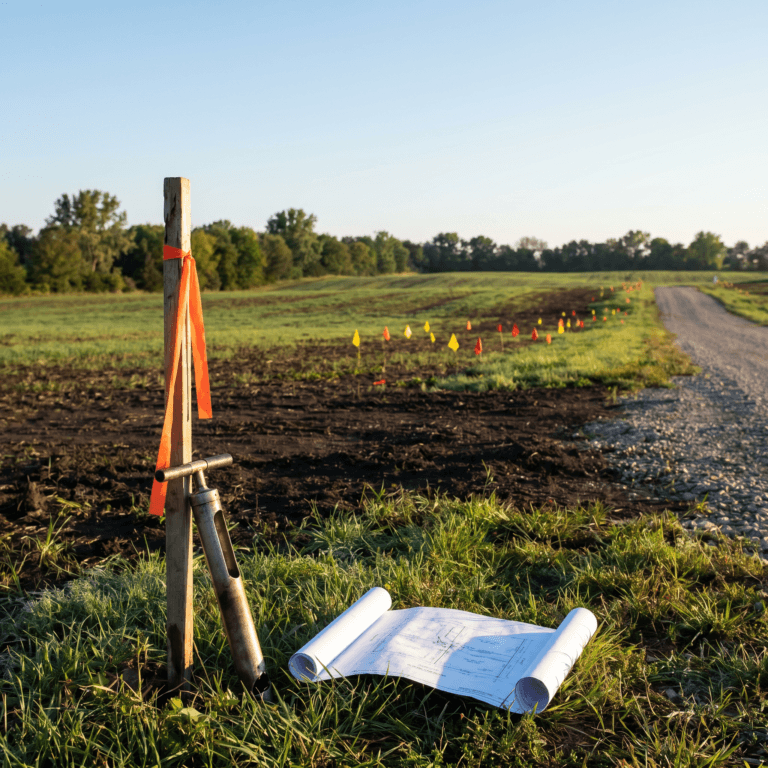
Building on Your Own Land in Iowa: What to Know Before You Start
Read MoreOwning a piece of land and picturing your custom home on it is one of the most exciting places to start a build. It also comes with a set of questions an in-development lot never raises: soil, utilities, access, and zoning. This guide walks through what to evaluate before you…Owning a piece of land and picturing your custom home on it is one of the most exciting places to start a build. It also comes with a set of questions an in-development lot never raises: soil, utilities, access, and zoning. This guide walks through what to evaluate before you break ground, what site work […]Owning a piece of land and picturing your custom home on it is one of the most exciting places to start a build. It also comes with a set of…
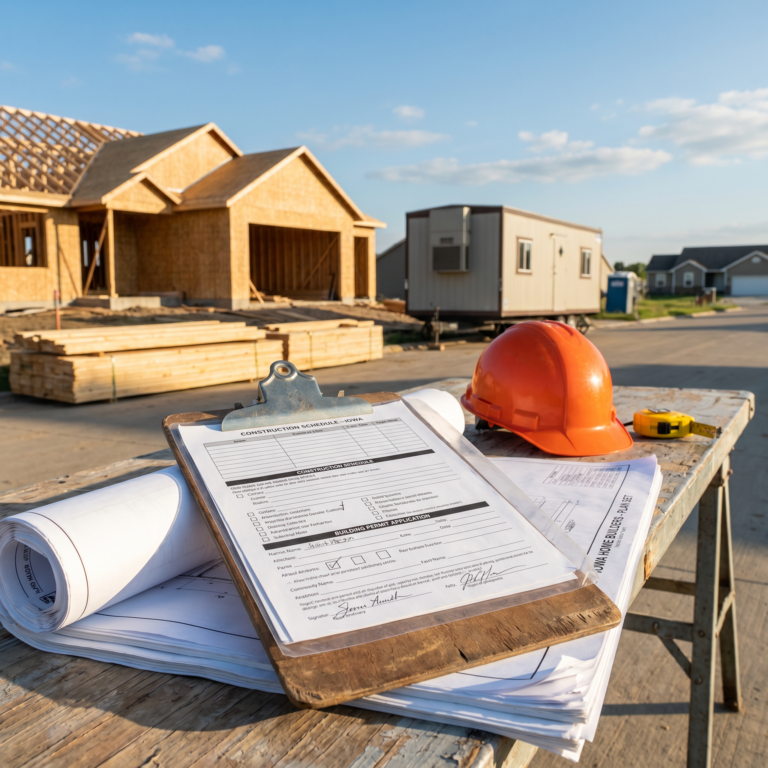
What Does a General Contractor Do in Iowa? A Homeowner’s Complete Guide
Read MoreHiring a general contractor is the single biggest decision in most home projects, yet many homeowners are not sure what a GC actually does or what Iowa requires of one. This guide explains exactly what a general contractor manages, what “registered with DIAL” means in Iowa, what you are paying…Hiring a general contractor is the single biggest decision in most home projects, yet many homeowners are not sure what a GC actually does or what Iowa requires of one. This guide explains exactly what a general contractor manages, what “registered with DIAL” means in Iowa, what you are paying for, and how to vet […]Hiring a general contractor is the single biggest decision in most home projects, yet many homeowners are not sure what a GC actually does or what Iowa requires of one.…
What Does a General Contractor Do in Iowa?
Read MoreA general contractor turns a project you can describe into a building you can live in. In Iowa, the role carries legal duties, registration requirements, and coordination work most homeowners never see. This guide explains what a GC actually does, what Iowa law requires, and how to tell a professional…A general contractor turns a project you can describe into a building you can live in. In Iowa, the role carries legal duties, registration requirements, and coordination work most homeowners never see. This guide explains what a GC actually does, what Iowa law requires, and how to tell a professional from a guy with a […]A general contractor turns a project you can describe into a building you can live in. In Iowa, the role carries legal duties, registration requirements, and coordination work most homeowners…