Owning a piece of land and picturing your custom home on it is one of the most exciting places to start a build. It also comes with a set of questions an in-development lot never raises: soil, utilities, access, and zoning. This guide walks through what to evaluate before you break ground, what site work actually costs in Iowa, and how the process differs from building in a subdivision.
TLDR: Building a custom home on land you already own in Iowa is possible, but it comes with site assessment requirements, utility connection costs, and zoning hurdles that in-development lots do not have. Most Iowa custom builders, including Busy Builders, work on customer-owned land. The keys are a thorough site evaluation, a realistic budget for utilities and site work, and a registered contractor who knows Iowa soil and code. Here is what to evaluate before you start.
You have the land. Maybe it has been in the family, maybe you bought acreage for the view, maybe you found a quiet lot on the edge of town. Now you want to put a home on it, and you assume the build is the whole cost.
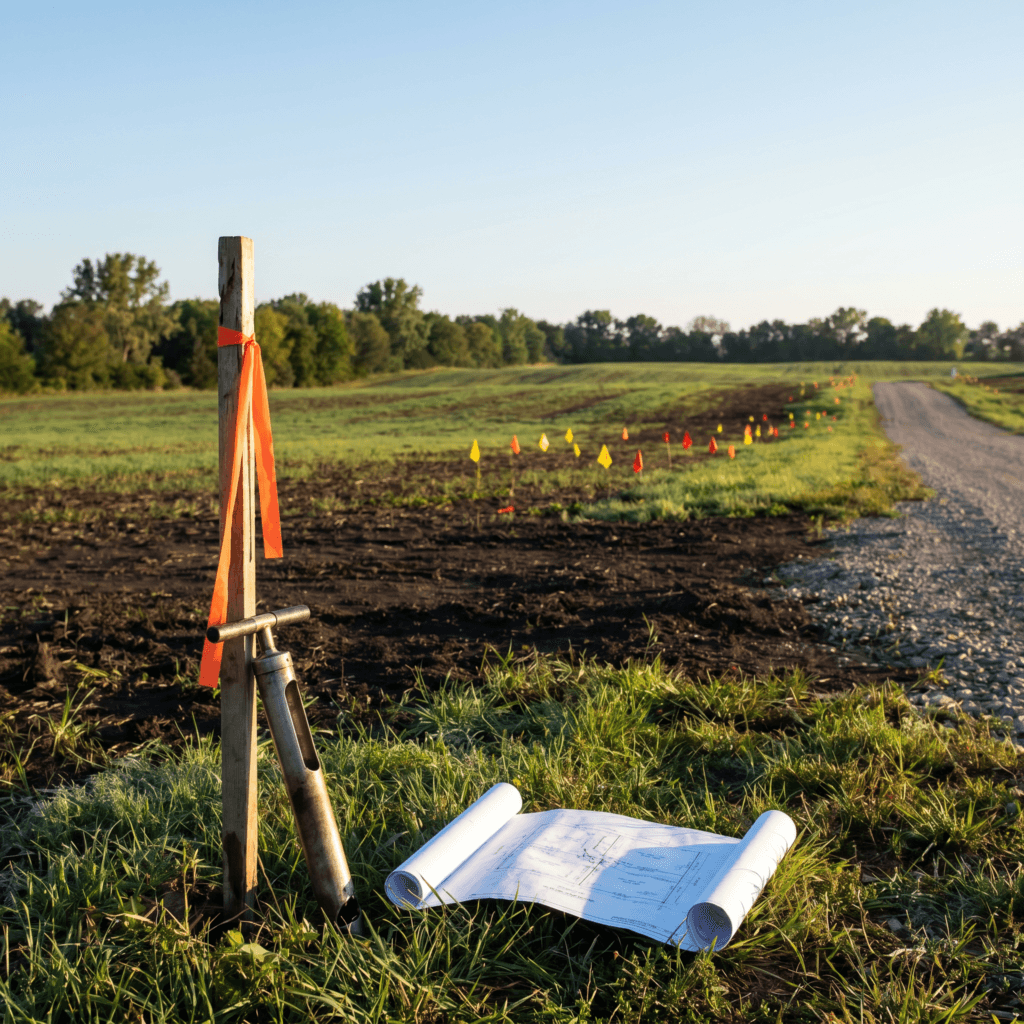
It is not. A raw or rural lot needs work before a foundation can go in: a soil report, possibly a perc test for septic, a survey, utility connections, and an access road. Those costs are real, they vary widely by site, and most builder base quotes do not include them. The good news is they are knowable once a builder walks your land.
Below, we cover what a builder needs to know before quoting, how Iowa zoning and setbacks work for rural and suburban lots, what utilities cost, the permit process for a build on your lot, the soil and foundation realities in Iowa, and how financing works. By the end, you will know how to evaluate your land before you commit.
What Iowa Builders Need to Know About Your Land Before Quoting
A builder cannot give you an accurate price for a home on raw land without understanding the site. The land itself drives a large part of the cost.
Before quoting, a builder wants to know several things: a soil report to confirm what the ground can support, a perc test if the site needs a septic system, a survey to set the boundaries and the build envelope, the flood-zone status, what utilities are available (water, sewer, electric, and gas), and the condition of the access road. Each of these affects the design, the foundation, and the budget.
This is why a site visit matters so much. Two lots that look similar can carry very different costs once you account for soil, slope, and utility distance. A builder who quotes a custom home on your land without seeing it is guessing. Our look at the foundation and soil reality most builders will not explain covers why the ground matters more than homeowners expect.
Pro Tip 1: Get a soil report and a survey before you ask for a firm build quote. They are the two documents that turn a rough estimate into a real number, and a builder cannot design the foundation without them.
Pro Tip 2: Walk your land with the builder, not just the drawings. Slope, drainage, and access show up on a site visit in ways a plat map does not, and they all affect cost.
Iowa Zoning and Setback Requirements for Rural and Suburban Lots
Where your land sits determines who governs it and what you can build. Zoning is one of the first things to confirm.
On urban and suburban lots, your city’s zoning department sets the rules, including setbacks, which are the minimum distances a building must sit from the property lines. Typical residential setbacks run around 25 feet in front, 5 to 10 feet on the sides, and 20 feet in the rear, though they vary by city and zone. Confirm your lot’s specific setbacks before you design.
Rural land works differently. For unincorporated areas in its region, the Region XII Council of Governments provides planning and zoning services for several west-central Iowa counties, and other rural counties have their own zoning authorities. Agricultural zoning can also restrict what you build and where. The rule is the same everywhere: confirm zoning and setbacks with the governing authority before you finalize a plan.
The table below shows how the two settings compare.
Table 1: Zoning and setbacks, suburban vs. rural Iowa lots
| Factor | Suburban or city lot | Rural or unincorporated lot |
|---|---|---|
| Zoning authority | City zoning department | County or regional authority |
| Typical setbacks | About 25 ft front, 5 to 10 ft side, 20 ft rear | Varies; often larger |
| Agricultural restrictions | Rare | Possible |
| Where to confirm | City hall | County or regional zoning office |
The takeaway: confirm who governs your land and what the setbacks are before you design, because they shape where the home can sit. A registered contractor can help you read the requirements for your specific lot.
Pro Tip 3: Confirm your setbacks in writing before the architect finalizes the plan. A design that violates a setback has to be reworked, which costs time and money you can avoid with one phone call early.
Utility Connections: What They Cost in Iowa
Utilities are the cost most homeowners underestimate on a build-on-your-lot project. A city lot with services at the curb is a different world from a rural parcel.
On a city or in-development lot, you pay connection fees to tie into municipal water and sewer. On a rural lot, you may need your own well and septic system instead, which are significant costs. In Iowa, a well often runs in the range of $6,000 to $15,000, and a septic system commonly runs $8,000 to $20,000 or more, depending on the site and system type. Extending electric service to a remote lot adds cost too. These are planning estimates, and actual costs vary by site and current pricing. National new residential construction data from the U.S. Census Bureau shows how site and structure costs have trended upward.
The key point: these utility costs are usually not included in a builder’s base quote for the home itself. They are site costs you budget separately.
The table below shows typical ranges.
Table 2: Utility connection cost ranges in Iowa (planning estimates)
| Utility | City or in-development lot | Rural lot |
|---|---|---|
| Water | Municipal connection fee | Private well, about $6,000 to $15,000 |
| Sewer | Municipal connection fee | Septic system, about $8,000 to $20,000+ |
| Electric | Usually at the lot | Service extension, varies by distance |
| Gas | Connection if available | May not be available |
The takeaway: budget utilities as a separate line from the home itself, and expect a rural lot to cost more to service than a city lot. Our guide to what it costs to build a custom home puts these in the bigger picture.
Pro Tip 4: Get well and septic quotes early on a rural lot. They are among the largest site costs, and confirming them up front keeps your total budget honest before you commit to a build.
Pro Tip 5: Ask your builder explicitly what their base quote includes and excludes for site work. Utilities, the access road, and site prep are often separate, and assuming they are included is a common budgeting mistake.
Permit Process for Build-on-Your-Lot in Iowa
The permit process for a home on your land follows the same general path as an in-development build, just coordinated a little differently. Your builder pulls the permit using your lot’s address.
Your registered contractor prepares the drawings, submits the permit application to the governing authority, and schedules inspections as the build progresses. On a rural or raw lot, the authority may require the soil report before issuing the permit, since the foundation design depends on it. Iowa adopted the 2024 International Residential Code, effective September 10, 2025, under Iowa Administrative Code 481-301.8, which sets the standards your build must meet.
The main difference from a subdivision build is the front-end work. A lot in a development usually has soil data, utilities, and zoning already handled, while your land may need all three confirmed first. Our guide to navigating home building permits in Iowa walks through the steps.
Pro Tip 6: Ask whether your jurisdiction requires the soil report before permit issuance. On many rural lots it does, and knowing that early prevents a permit delay at the worst possible moment.
Iowa Soil and Foundation Considerations
Iowa’s ground shapes your foundation, and on raw land that matters more than ever. The soil and the frost line are the two big factors.
Much of Iowa has clay soil, which can require an engineered foundation in many areas to handle how the soil shifts with moisture. Your soil report tells the builder and the structural professional what design the site needs. On top of that, foundations must reach below the frost line, the depth the ground must go so the foundation does not move when it freezes, which in Iowa is at least 42 inches. That requirement, detailed in the IRC foundation chapter, means deeper footings and more cost than shallow-frost states.
Radon belongs in the foundation conversation too. All 99 Iowa counties sit in EPA Radon Zone 1, the highest category, and the Iowa Radon Survey found that as many as 5 in 7 Iowa homes test above the EPA action level. A new build is the cheapest time to design in a radon-resistant system, so include it in the foundation plan. Building to a strong energy standard from the start, using the Department of Energy’s weatherization guidance, lowers the operating costs you carry once you move in.
The table below summarizes the site assessment items and their typical costs.
Table 3: Site assessment checklist and typical costs (planning estimates)
| Item | Why it matters | Typical cost |
|---|---|---|
| Soil report | Determines foundation design | Moderate |
| Perc test | Required if septic is needed | Moderate |
| Survey | Sets boundaries and build envelope | Moderate |
| Engineered foundation | Common on Iowa clay soil | Adds to foundation cost |
| Radon rough-in | Iowa is Zone 1 | Low when built in |
The takeaway: Iowa soil and frost depth often mean a deeper, engineered foundation, so plan for it rather than treating it as a surprise. A registered contractor reads your soil report and designs to it.
Pro Tip 7: Build a radon-resistant system into the foundation design from day one. All of Iowa is Zone 1, and roughing it in during construction costs far less than retrofitting a system after you move in.
Pro Tip 8: Do not skip the soil report to save money on a rural lot. Building a foundation that does not match the soil is the kind of mistake that gets expensive years later, when it is hardest to fix.
Financing a Build-on-Your-Lot in Iowa
Financing a home on land you own works a little in your favor. Lenders treat that land as part of the equation.
Build-on-your-lot projects qualify for construction loans, the staged financing used for new builds. Most Iowa lenders treat land you already own as equity toward your down payment, which can reduce the cash you need at closing. As with any construction loan, lenders require a registered contractor and a detailed cost-to-complete, and this is not lending advice, so talk to your lender about your specifics. If budget is tight, our look at whether you can build a custom home under $500k shows how site costs fit a smaller build. The federal Consumer Financial Protection Bureau publishes plain-language guidance on home financing worth reading before you apply. Our overview of financing a custom home build in Iowa covers the financing path, and our guide to how long it takes to build a custom home helps you plan the interest-only window.
The table below compares building on your own land with buying in a development.
Table 4: Build-on-your-lot vs. in-development build
| Factor | Your own land | In-development lot |
|---|---|---|
| Site assessment | You arrange soil, survey, perc | Often already done |
| Utilities | May need well, septic, extensions | Usually at the lot |
| Zoning | Confirm with governing authority | Set by the development |
| Land as loan equity | Owned land counts toward down payment | Land bought into the loan |
| Front-end work | More | Less |
The takeaway: building on your own land gives you control and counts your land as equity, but it puts the site work on you, so budget and plan for it. Our look at the custom home building process in Iowa shows how it comes together.
These illustrative scenarios show how site costs vary across the metro. They are examples, not specific Busy Builders projects, and your costs will vary.
Illustrative scenario, rural Story County lot: A family builds on acreage that needs a well, a septic system, and an electric service extension. Site work alone, before the home build begins, runs about $35,000 because of the well, septic, and access work the raw lot requires.
Illustrative scenario, suburban Norwalk lot: A homeowner builds on a Norwalk lot with city water and sewer at the street. Utility connections run about $12,000, far less than a rural parcel, because the services are already close.
Illustrative scenario, in-fill lot in Grimes: A couple builds on an in-fill lot in Grimes with utilities and a graded site ready to go. Site work is minimal, around $5,000, because most of the front-end work was already handled.
Pro Tip 9: Ask your lender how they treat your owned land as equity before you apply. It can meaningfully reduce your cash to close, and knowing the number early shapes your whole budget.
Pro Tip 10: Budget the site work as its own number, separate from the home. The gap between a $5,000 in-fill lot and a $35,000 rural lot is the difference that surprises homeowners who only budgeted for the house.
Putting It Together
Building on your own land rewards planning. The homeowners who are happiest did the site homework before they fell in love with a floor plan.
Start with the land: soil, survey, utilities, zoning, and access. Get those answers, budget the site work separately, and choose a registered contractor who knows Iowa soil and code. Then design the home to the lot you actually have, not the lot you wish you had.
Pro Tip 11: Sequence your spending: confirm the land and site costs first, then finalize the home design and budget. Designing the home before you know the site costs is how projects blow past budget.
Pro Tip 12: Choose a builder experienced with build-on-your-lot projects specifically, not just subdivision homes. The site work, soil, and permit coordination are different, and experience with raw land shows in the quote and the schedule. Our home building service page explains how we approach custom builds across Central Iowa.
Frequently Asked Questions
Q: Can I build a custom home on land I already own in Iowa? Yes. Most Iowa custom builders, including Busy Builders, work on customer-owned land. The difference from a subdivision build is the front-end work: you arrange the soil report, survey, and utility connections, and you confirm zoning with the governing authority. Once those are handled, the build follows the normal process. Start with a site visit so the builder can give you an accurate quote for your specific lot.
Q: What does site prep cost for a build-on-your-lot project in Iowa? It varies widely by site. An in-fill lot with utilities ready can need as little as a few thousand dollars in site work, while a rural lot that needs a well, septic system, and electric extension can run $35,000 or more before the home build begins. A well alone often runs $6,000 to $15,000 and a septic system $8,000 to $20,000 or more. These are planning estimates, so get site-specific quotes early.
Q: Do I need a soil test before building in Iowa? In most cases, yes, and it is one of the smartest first steps. A soil report tells your builder and the structural professional what foundation the site needs, which matters because much of Iowa has clay soil that can require an engineered foundation. Many jurisdictions also require the soil report before issuing a permit on a raw lot. Get it early, because the foundation design and the budget both depend on it.
Q: How does rural Iowa zoning affect where I can build? Rural and unincorporated land is governed by county or regional zoning authorities rather than a city, and agricultural zoning can restrict what you build and where. Setbacks are often larger than in town. The Region XII Council of Governments provides planning services for several west-central Iowa counties, and other counties have their own offices. Confirm your lot’s zoning and setbacks with the governing authority before you design, so the plan fits the rules.
Q: Can I use my land as a down payment for a construction loan in Iowa? Often, yes. Most Iowa lenders treat land you already own as equity toward your down payment, which can reduce the cash you bring to closing. You will still need a registered contractor, approved plans, and a detailed cost-to-complete for the loan. How much your land counts depends on its value and the lender. This is not lending advice, so talk to your lender about how they treat your specific parcel.
Key Takeaways
The land drives the cost and the plan
- A builder needs soil, survey, utilities, and zoning before quoting.
- A site visit turns a rough estimate into a real number.
- Two similar-looking lots can carry very different costs.
Utilities and site work are separate from the home
- A rural lot may need a well ($6,000 to $15,000) and septic ($8,000 to $20,000+).
- A city lot pays municipal connection fees instead.
- Base quotes usually exclude site work; budget it separately.
Iowa soil and code shape the foundation
- Clay soil often requires an engineered foundation.
- Frost-depth footings of at least 42 inches add cost.
- All 99 counties are Radon Zone 1; build in a radon system.
Zoning depends on where the land sits
- Cities set suburban setbacks; counties or regional authorities govern rural land.
- Agricultural zoning can restrict rural builds.
- Confirm setbacks before you design.
Financing can count your land
- Build-on-your-lot projects qualify for construction loans.
- Lenders often treat owned land as down-payment equity.
- A registered contractor is required by most Iowa lenders.
Ready to Build on Your Land?
You now know what to evaluate before building on your own land in Iowa: the soil, the utilities, the zoning, and the site costs that a subdivision lot hides. The next step is a builder who will walk your land and give you an honest, site-specific plan.
Busy Builders has completed 1,285+ projects across Central Iowa since 2020. We work on customer-owned land, and we bring transparency, local soil and code knowledge, and straight answers to every project. Here is what working with us looks like:
- Free consultation and a site visit to evaluate your land
- Clear, itemized estimates that separate site work from the home
- A registered Iowa contractor handling permits and inspections
- Coordination with licensed subcontractors for electrical, plumbing, and heating work
- Written warranty on workmanship (details provided in your contract)
Ready to move forward? Contact us today.
Call: 844-435-9800
Website: https://busybuildersiowa.com/
We serve West Des Moines and communities across Central Iowa.
Disclaimer: This article is for general information and is not project-specific advice. Cost figures are planning estimates that vary by scope, materials, site conditions, and current pricing. Permit and zoning requirements vary by city, county, and jurisdiction; verify current requirements with the governing authority before starting any project. Construction lending terms vary by lender and this is not lending advice; consult your lender. Radon levels vary by home; the Iowa Radon Survey reports that as many as 5 in 7 Iowa homes test above the EPA action level, and testing is recommended. No specific outcomes are guaranteed. Consult a registered contractor, and the appropriate licensed subcontractors for electrical, plumbing, and heating work, for guidance specific to your project.
Busy Builders | Full-Service Construction and Remodeling | Serving Central Iowa Since 2020