A wet bar turns a basement into a real gathering space, but the sink that makes it “wet” is also what makes it cost two to three times more than a dry bar. The price hinges on one question most homeowners never think to ask: does the concrete floor have to be cut to reach the drain? This guide is the plumbing-focused companion to our broader basement bar guide, and it digs into what a wet bar actually costs in Iowa, why the slab-cut decision drives the budget, and the permit and licensed-plumber requirements that come with running water downstairs.
TLDR: A wet bar in an Iowa basement typically costs $8,000 to $25,000, versus $2,000 to $10,000 for a comparable dry bar. The single biggest cost driver is whether the drain requires cutting the concrete floor, which can add $2,000 to $6,000. A wet bar needs a plumbing permit and a licensed Iowa plumber. Here is what each part costs.
You want a bar in the basement, and you want a real sink in it, not just a mini-fridge and a counter. That sink is the difference between a dry bar and a wet bar, and it is also where most of the cost lives.
The reason is plumbing. A sink needs a supply line, a drain, and a properly vented trap, and in a basement the drain often sits below the level of the existing pipes. Reaching it can mean cutting through the concrete floor to tie into the main line, and that one decision can swing the budget by thousands.
This post focuses on the wet bar specifically. For the full picture of dry bars, home theaters, and combined entertainment suites, see our basement bar and entertainment room guide. Below, we cover what makes a bar “wet,” the slab-cut decision that drives the cost, a line-item breakdown, the permit and licensed-plumber requirements, and the radon factor that comes with sealing up a basement.
What Makes a Bar “Wet” and Why It Costs More
The line between a dry bar and a wet bar is a single feature, and it changes everything about the budget. That feature is running water.
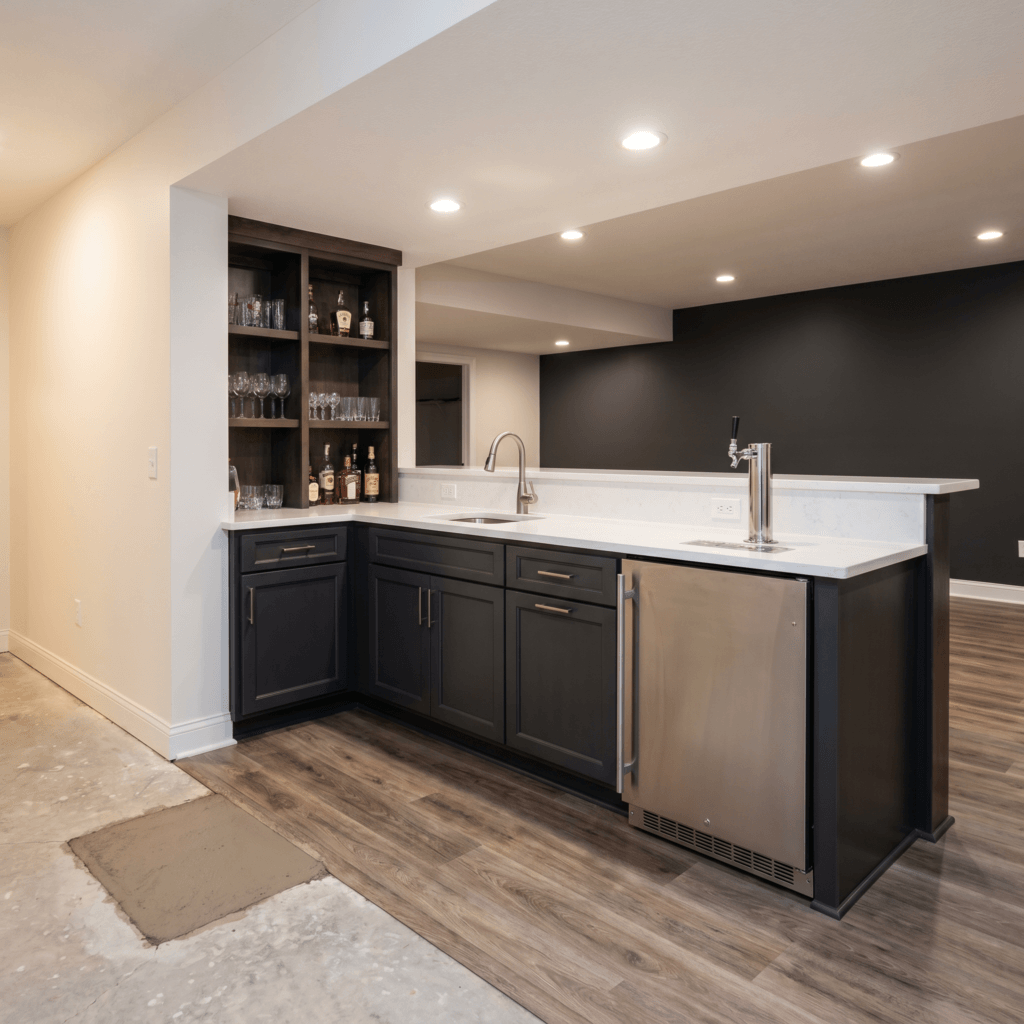
A dry bar is cabinets, a countertop, a beverage fridge, and an outlet, with no plumbing. A wet bar adds a sink, which brings a supply line for water, a drain to carry it away, and a vented trap to do it safely. That plumbing is why a wet bar commonly costs two to three times what a comparable dry bar does. These are planning estimates, and actual costs vary by layout, distance to plumbing, and current pricing.
The table below compares the two.
Table 1: Dry bar vs. wet bar in an Iowa basement (planning estimates)
| Feature | Dry bar | Wet bar |
|---|---|---|
| Typical cost | $2,000 to $10,000 | $8,000 to $25,000 |
| Plumbing | None | Supply, drain, vented trap |
| Permit | Building, electrical | Add a plumbing permit |
| Who does the plumbing | Not applicable | Licensed Iowa plumber |
| Build time | 1 to 2 weeks | 3 to 6 weeks |
The takeaway: the sink is the entire reason a wet bar costs more, so decide early whether you will use one enough to justify it. Our look at the best basement layouts for Iowa homes can help you place the bar where plumbing is easiest, and our comparison of a basement gym, family room, or guest suite shows how a bar fits alongside other uses.
The Slab-Cut Question: The Biggest Cost Driver
Here is the question that decides where in the range your wet bar lands. It is about the drain, and it is about concrete.
A basement floor is a poured slab, and the drain pipes often run below it. If your bar’s drain has to tie into a line beneath the slab, the crew has to cut and remove concrete, run the new drain, and patch the floor, which commonly adds $2,000 to $6,000. If there is an accessible drain nearby, or the layout allows an above-slab solution, you avoid that cost. Distance matters too: a bar near the main stack needs shorter runs than one across the basement.
The table below shows how the plumbing scenario drives cost.
Table 2: Wet bar plumbing cost impact (planning estimates)
| Scenario | Relative cost | Why |
|---|---|---|
| Near an accessible drain, above slab | Lowest | Short runs, no concrete work |
| Far from the stack, above slab | Moderate | Longer supply and drain runs |
| Drain requires cutting the slab | Highest | Concrete cut and patch adds $2,000 to $6,000 |
The takeaway: ask where the nearest drain is and whether the slab must be cut before you set a budget, because that one answer can move the price by thousands. A registered contractor and a licensed plumber assess this together after a walkthrough.
Wet Bar Cost Breakdown by Element
A wet bar budget is the sum of its parts, and seeing them itemized helps you sanity-check any bid. The plumbing is one line among several.
A typical wet bar includes the plumbing rough-in, the sink and faucet, cabinetry, a countertop, and an undercounter fridge or kegerator. The plumbing rough-in for a fixture commonly runs $450 to $1,800, the sink installed with supply and drain $380 to $1,400, cabinetry $150 to $500 per linear foot, and the countertop $50 to $150 per square foot. These are planning estimates, and actual costs vary.
The table below itemizes the common elements.
Table 3: Wet bar cost breakdown by element (2026 planning estimates)
| Element | Typical range |
|---|---|
| Plumbing rough-in per fixture | $450 to $1,800 |
| Sink installed (supply and drain) | $380 to $1,400 |
| Cabinetry | $150 to $500 per linear foot |
| Countertop | $50 to $150 per square foot |
| Undercounter fridge or kegerator | $500 to $2,500 |
The takeaway: the plumbing and cabinetry are the two largest line items, so that is where to focus when comparing quotes. Our cost breakdown for finishing a basement and our guide to basement finishing costs in Des Moines put a wet bar in the context of a full basement project, and our basement finishing service page explains how we scope the work.
Permits and the Licensed Plumber Requirement
A wet bar is not a no-permit project, and the plumbing has to be done by the right person. Iowa is specific about both.
A wet bar requires a plumbing permit and a building permit, and in some cities an electrical permit for a dedicated circuit. Importantly, the plumbing work must be performed by a licensed Iowa plumber. Iowa registers general contractors with the Department of Inspections, Appeals, and Licensing rather than licensing them, but plumbers are licensed separately by the state, and your registered contractor coordinates that licensed trade work. Many Central Iowa communities use a third-party inspection provider, Veenstra & Kimm, now part of Kleinfelder, which handles inspections for dozens of area cities.
The table below shows the permit picture.
Table 4: Permit requirements for an Iowa basement wet bar
| Feature | Permit required |
|---|---|
| Dry bar (no plumbing) | Building, electrical; often none if basement is finished |
| Wet bar (sink and plumbing) | Building plus plumbing permit |
| Dedicated bar circuit | Sometimes an electrical permit |
| Adjacent bar bathroom | Separate plumbing permit |
The takeaway: a wet bar always needs a plumbing permit and a licensed plumber, so budget for both and let your registered contractor pull the permits. Iowa adopted the 2024 International Residential Code under Iowa Administrative Code 481-301.8, and you can confirm a contractor is registered with Iowa DIAL and verify that registration before hiring. National construction cost data from the U.S. Census Bureau shows how much plumbing and finishes drive a project budget.
The Radon Factor When You Finish a Basement Bar
One Iowa reality belongs in any basement project that seals up space. Radon does not announce itself, and finishing a basement can change how it behaves.
All of Iowa sits in EPA Radon Zone 1, the highest category, and the Iowa Radon Survey found that as many as 5 in 7 Iowa homes test above the EPA action level. Finishing a basement and adding a wet bar seals the area, which can change radon patterns, so test before you finish. If the home does not already have radon mitigation, adding a system commonly costs $800 to $2,500. And if your bar room will double as a sleeping area, it needs an egress window with a minimum 5.7 square foot net clear opening under the IRC requirements, as our guide to egress windows, codes, and costs explains.
These illustrative scenarios show how wet bar budgets play out across the metro. They are examples, not specific Busy Builders projects, and your costs will vary.
Illustrative scenario, budget wet bar in Altoona: A homeowner in Altoona adds an 8 foot wet bar in an already-finished basement, near an accessible drain so no slab cutting is needed. With semi-custom cabinets, a sink, and a beverage fridge, the project comes in around $12,000.
Illustrative scenario, mid-range wet bar in Ankeny: A family in Ankeny adds a 10 foot wet bar about 20 feet from the main stack, with a quartz countertop, an undermount sink, and a kegerator rough-in. The longer plumbing runs bring the project to about $20,000.
Illustrative scenario, premium wet bar with a bar bathroom in Johnston: A homeowner in Johnston builds a premium wet bar where the drain requires cutting the slab, plus a small adjacent half bath. The slab work, premium finishes, and second set of fixtures push the project to about $38,000.
Frequently Asked Questions
Q: How much does a wet bar cost in an Iowa basement? A wet bar typically costs $8,000 to $25,000, compared with $2,000 to $10,000 for a comparable dry bar. The biggest variable is the plumbing: a bar near an accessible drain costs far less than one that requires cutting the concrete floor, which can add $2,000 to $6,000. Cabinetry, the sink, and finishes make up the rest. These are planning estimates, so get an itemized quote after a walkthrough of your basement.
Q: Do I need a permit for a wet bar in Iowa? Yes. A wet bar requires both a plumbing permit and a building permit, and sometimes an electrical permit for a dedicated circuit. The plumbing must be performed by a licensed Iowa plumber, since plumbers are licensed separately from registered general contractors. Your registered contractor pulls the permits and coordinates the licensed trades and inspections. Confirm the specific requirements with your city before work begins.
Q: What is the difference between a wet bar and a dry bar? A dry bar has cabinets, a countertop, a beverage fridge, and an outlet, with no plumbing. A wet bar adds a sink, which requires a water supply line, a drain, and a vented trap. That plumbing is why a wet bar costs two to three times more than a comparable dry bar and why it needs a plumbing permit and a licensed plumber. If you will not use a sink often, a dry bar saves a substantial amount.
Q: Does my basement floor have to be cut to add a wet bar? Sometimes, and it is the biggest cost factor. If the bar’s drain has to tie into a line below the floor, the crew must cut and remove concrete, run the drain, and patch the floor, commonly adding $2,000 to $6,000. If there is an accessible drain nearby or the layout allows an above-slab solution, you avoid that cost. A licensed plumber can tell you which applies after assessing your basement.
Q: Does a wet bar require a licensed plumber in Iowa? Yes. While Iowa registers general contractors with DIAL rather than licensing them, the plumbing trade is licensed separately by the state, so a wet bar’s plumbing must be installed by a licensed Iowa plumber. Your registered general contractor coordinates that licensed plumber along with the permits and inspections. This protects you and ensures the supply, drain, and vented trap meet code.
Key Takeaways
The sink is the cost
- A wet bar runs $8,000 to $25,000 versus $2,000 to $10,000 for a dry bar.
- The supply line, drain, and vented trap drive the difference.
- Decide early whether you will use a sink enough to justify it.
The slab-cut question drives the budget
- A drain below the slab means cutting concrete, adding $2,000 to $6,000.
- A bar near an accessible drain avoids that cost.
- Distance from the main stack lengthens the plumbing runs.
Permits and a licensed plumber are required
- A wet bar needs a plumbing permit and a building permit.
- The plumbing must be done by a licensed Iowa plumber.
- Your registered contractor pulls the permits and coordinates the trades.
Mind radon and egress when you finish
- All of Iowa is Radon Zone 1; test before finishing, mitigate for $800 to $2,500 if needed.
- A bar room that doubles as a bedroom needs a 5.7 square foot egress window.
- Sealing a basement can change radon patterns.
Ready to Plan Your Basement Wet Bar?
You now know what a wet bar costs in an Iowa basement, why the slab-cut question drives the budget, and the permit and licensed-plumber requirements that come with it. The next step is a contractor who will walk your basement, locate the plumbing, and give you an honest, itemized quote.
Busy Builders has completed 1,285+ projects across Central Iowa since 2020. We bring transparency, local code knowledge, and straight answers to every project. Here is what working with us looks like:
- Free consultation and a walkthrough to locate your basement plumbing
- Clear, itemized estimates that separate plumbing, cabinetry, and finishes
- A registered Iowa contractor coordinating licensed plumbers and electricians
- Permits pulled and inspections scheduled for you
- Written warranty on workmanship (details provided in your contract)
Ready to move forward? Contact us today.
Call: 844-435-9800
Website: https://busybuildersiowa.com/
We serve West Des Moines and communities across Central Iowa.
Disclaimer: This article is for general information and is not project-specific advice. Cost figures are planning estimates that vary by scope, materials, plumbing location, and current pricing. Permit requirements vary by city and jurisdiction; verify current requirements with your local building authority before starting any project. Plumbing work must be performed by a licensed plumber. Radon levels vary by home; all of Iowa is in EPA Radon Zone 1, and the Iowa Radon Survey reports that as many as 5 in 7 Iowa homes test above the EPA action level, so testing is recommended before finishing a basement. ROI and resale figures are illustrative and not financial advice. No specific outcomes are guaranteed. Consult a registered contractor, and the appropriate licensed subcontractors for plumbing, electrical, and heating work, for guidance specific to your project.
Busy Builders | Full-Service Construction and Remodeling | Serving Central Iowa Since 2020