Adding a porch or sunroom is one of the most popular ways Central Iowa homeowners get more out of their space. The trouble is that “screened porch,” “3-season room,” and “4-season room” get used to mean almost the same thing, and the differences hit your budget, your permit, and your appraisal in real ways. This guide breaks down what each one is, what it costs around the Des Moines metro, and which type earns its keep in our climate.
TLDR: A screened porch in Central Iowa runs about $8,000 to $22,000, a 3-season room about $18,000 to $40,000, and a 4-season room starts near $35,000. Only the 4-season room is built as a full home addition and counts toward your finished square footage. The right choice comes down to how many months you will actually use the space and what you want it to add at resale.
You have been picturing morning coffee out back, screened off from the mosquitoes, or a bright room you can sit in during a January snow. Then the quotes arrive and the numbers are all over the place. One builder says $14,000, another says $48,000, and both call it a “sunroom.”
That gap is not random. It comes from three different ways to build the same footprint: an open-air room with screens, a glass-enclosed room with no heat, or a true insulated addition you can use every day. Below, we walk through each one the way an Iowa builder does, with honest cost ranges, the permit each triggers, how many months you can really use it here, and what it does for resale.
What Iowa Builders Mean by Each Term
Marketing words blur these three together. Construction does not. The difference is in the framing, the glass, and whether the space is heated and cooled.
A screened porch is an open structure with screen mesh in place of walls. It sits on standard porch framing, has a roof, and has no insulation. You feel the outside temperature, just without the bugs.
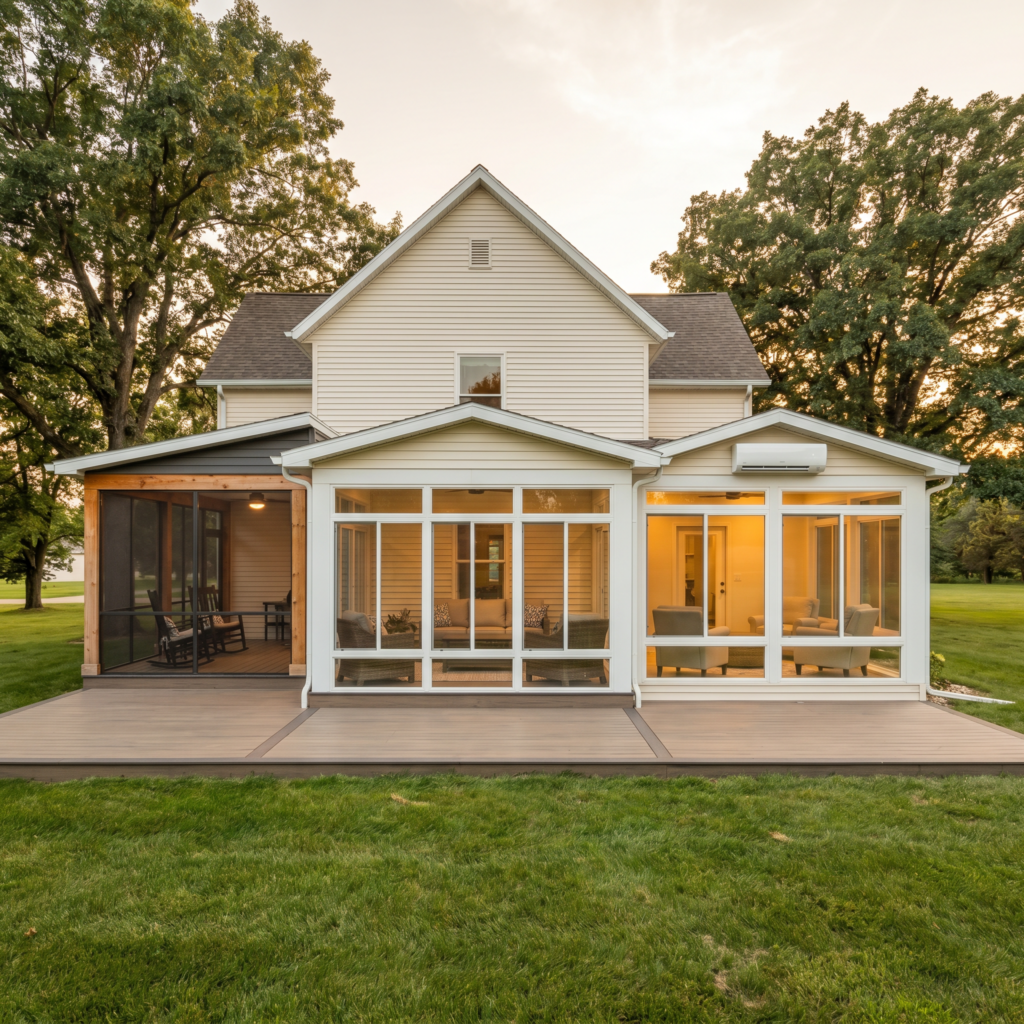
A 3-season room is enclosed with glass or window panels instead of screens. It is not insulated to a living-space standard and has no permanent heat or air conditioning. It is comfortable in spring, summer, and fall, which is where the name comes from.
A 4-season room is built like the rest of your house: insulated walls, a proper foundation, insulated glass, and a permanent way to heat and cool it. Because it meets living-space standards, it qualifies as a permanent home addition. If you want a room you use in February, this is the only one of the three that delivers it.
Here is the part that trips people up. Many Iowa contractors call all three a “sunroom.” So when you compare quotes, do not compare the word. Compare the build: screened or glassed, insulated or not, permanent heating and cooling or not.
Pro Tip 1: At the top of each quote, write the builder’s answer to three questions: screened or glass, insulated yes or no, permanent heat and cooling yes or no. Two quotes that look far apart are often just two different products.
Costs in Central Iowa for Each Type (2026)
Cost climbs with every layer you add: screens, then glass, then insulation and a heat source. Each step also changes the foundation you need. These are planning estimates, and actual costs vary by scope, materials, site conditions, and current pricing.
Iowa’s frost line drives a real piece of the bill. Footings here must reach below the frost line, which is the depth the foundation must go so it does not shift when the ground freezes. In Iowa that depth is at least 42 inches. Reaching it costs more than the shallow footings used in southern states, and it matters most on the heavier 4-season build.
The table below shows typical ranges by type and finish level for a Des Moines metro project.
Table 1: Cost by porch type and finish level (Central Iowa, planning estimates)
| Type | Budget | Mid-range | Premium |
|---|---|---|---|
| Screened porch | $8,000 to $12,000 | $12,000 to $17,000 | $17,000 to $22,000 |
| 3-season room | $18,000 to $25,000 | $25,000 to $33,000 | $33,000 to $40,000 |
| 4-season room | $35,000 to $45,000 | $45,000 to $60,000 | $60,000 and up |
Use these as a starting point, not a quote. The same footprint can land anywhere in a range depending on roof style, glass quality, and whether you build on an existing deck or pour a new foundation.
Labor, materials, permit fees, and the foundation make up most of the bill. On a screened porch, framing and screen are the big line items. On a 4-season room, the foundation, insulation, insulated glass, and the heat source carry the cost. The electrical work and any heating equipment on a 4-season room are handled by licensed subcontractors, not the general crew.
Pro Tip 2: If your budget is tight, ask whether your existing deck can carry a screened porch. Building on a sound, code-compliant deck can save you a new foundation. A 4-season room almost always needs its own frost-depth footings.
Pro Tip 3: Get three written quotes, and make sure each lists the foundation type. A slab-versus-frost-depth-footings difference can swing a 4-season project by thousands of dollars, and it is the line homeowners most often miss.
Permit Requirements in Iowa
Permits are where the three types split hard. The more the structure behaves like living space, the more the building authority wants to see.
A screened porch is the lightest case. Because it is open and unconditioned, many Central Iowa cities treat it as a minor structure, though attached porches still commonly need a permit. A 3-season room raises the bar because it encloses the space. A 4-season room is reviewed as a full home addition, with structural drawings, energy compliance, and inspections at each phase.
Iowa adopted the 2024 International Residential Code, effective September 10, 2025, under Iowa Administrative Code 481-301.8. That code, plus your city’s own rules, sets what each project must meet. Foundation depth follows the frost-depth requirements in the IRC foundation chapter.
Whoever builds it should be a registered contractor. Iowa does not “license” general contractors; it requires them to be registered with Iowa DIAL. Many Central Iowa cities also use a third-party inspection provider such as Veenstra & Kimm, now part of Kleinfelder, so your contractor coordinates those visits as the work progresses.
Table 2: Permit triggers by porch type in Central Iowa
| Factor | Screened porch | 3-season room | 4-season room |
|---|---|---|---|
| Typical permit | Often a minor structure permit | Building permit | Full addition permit |
| Structural drawings | Sometimes | Usually | Yes |
| Energy compliance review | No | Limited | Yes |
| Counts as living space | No | No | Yes |
The takeaway: the cheaper the structure, the lighter the paperwork. Never assume, though. Rules differ between cities, so confirm with your local building authority before you start.
Pro Tip 4: A registered contractor pulls the permit, schedules inspections, and handles the certificate of occupancy on a 4-season addition. If a quote leaves the permit “to the homeowner,” ask why.
Pro Tip 5: Permit fees and timelines differ across the metro. Ankeny, Waukee, and Johnston each run their own review. Build the approval window into your schedule so a delay does not push your start date.
Which Type Actually Gets Used in Iowa’s Climate
This is the question that should drive your decision, and it is the one most homeowners skip. A beautiful room you use two months a year is an expensive habit.
Iowa weather is the test. We see roughly 40 to 50 thunderstorm days a year and winters that drop below zero. A screened porch is wonderful from late spring through early fall, then sits empty once the cold sets in. A 3-season room stretches the window a little, but realistically it gives you about five to six usable months.
A 4-season room is the only one you can sit in during a Des Moines January. To make it work, you extend your home’s heating and cooling into the space or install a ductless mini-split. Insulated walls and insulated glass keep that comfortable, and the Department of Energy’s weatherization guidance explains why sealing and insulation matter most in a cold climate. That equipment adds cost up front and a little to your monthly bill, but it is what turns a fair-weather room into everyday square footage.
Table 3: Realistic usable months in Iowa’s climate
| Type | Usable window | Heating and cooling | Winter use |
|---|---|---|---|
| Screened porch | About 5 months | None | No |
| 3-season room | About 5 to 6 months | None permanent | Rarely |
| 4-season room | 12 months | Extended HVAC or mini-split | Yes |
The lesson is simple: match the build to the months you will use it. Paying for a 3-season room and expecting winter use leads to disappointment, while a screened porch can be the smartest buy if summer evenings are your real goal.
Pro Tip 6: Think in months of use, not square feet. A $14,000 screened porch you enjoy five months a year can beat a $50,000 room you only heat on holidays.
Pro Tip 7: If you want year-round use, price the ductless mini-split as part of the project from day one. Adding heating and cooling after the room is framed almost always costs more.
ROI and Resale Value
Not every porch type shows up on an appraisal the same way, and that surprises sellers.
A permitted 4-season room is built to living-space standards, so it can add to your finished square footage when an appraiser measures the house. A screened porch and an unconditioned 3-season room generally do not count as finished living area, even though buyers still value the lifestyle they add.
That does not make a screened porch a bad investment. It makes it a different one. You buy it for enjoyment and curb appeal, not for added square footage on paper. A 4-season room is the one that does double duty. Across the Midwest, added-living-space projects tend to return a healthy share of their cost at resale, though returns vary by market and project quality and these figures are not financial advice. National data from the U.S. Census Bureau shows steady demand for added living space.
Table 4: Resale and appraisal impact by type
| Type | Counts toward finished square footage | Main resale value | Best reason to build |
|---|---|---|---|
| Screened porch | No | Curb appeal, lifestyle | Summer enjoyment |
| 3-season room | No | Flexible bonus space | Spring-to-fall living |
| 4-season room | Yes (when permitted) | Added square footage, year-round use | Long-term value |
Bottom line: if resale square footage matters to you, the 4-season room is the only one of the three that delivers it on the appraisal.
Pro Tip 8: Keep your permit and final-inspection paperwork in a folder you can hand a buyer. A 4-season room only helps your appraisal if it was permitted and inspected.
3 Project Examples
These illustrative scenarios show how the three types play out across the metro. They are examples, not specific Busy Builders projects, and your costs will vary.
Illustrative scenario (budget screened porch): A homeowner in Urbandale adds a 200 square foot screened porch built on a sound existing deck. With cedar posts, a gable roof, and fiberglass screen, the project lands near $12,000 over about three weeks. They use it May through September.
Illustrative scenario (mid-range 3-season room): A family in Waukee builds a 250 square foot 3-season room with vinyl glass panels and a finished ceiling. The project runs about $28,000 over roughly five weeks. They enjoy it early spring through late fall, then close it up for winter.
Illustrative scenario (premium 4-season room): A homeowner in Johnston adds a 300 square foot 4-season room with insulated walls, insulated glass, frost-depth footings, and a ductless mini-split. The project comes in around $52,000 over about ten weeks. Because it was permitted and inspected, the finished square footage shows up at appraisal.
Pro Tip 9: Notice the 4-season example costs more than the screened and 3-season examples combined. That is normal. The jump pays for a foundation, insulation, glass, and heating and cooling.
Pro Tip 10: Match your screen or glass choice to your priorities. Fiberglass screen is budget-friendly and easy to replace, while higher grades resist sagging and pets. The right pick depends on your yard and budget, not the most expensive option on the shelf.
What to Ask Your Iowa Contractor
The right questions up front prevent expensive surprises later. Bring this list to your first meeting.
Ask which of the three you are buying (screened, 3-season, or 4-season) and confirm it in writing. Ask what permit the project triggers and who pulls it. Ask how deep the footings go, since Iowa requires at least 42 inches. Ask whether the room will count toward your finished square footage at appraisal. Ask whether they are a registered Iowa contractor and request their DIAL registration number. Ask how heating and cooling will be handled if you want year-round use.
If your project encloses a slab or low foundation, add one more topic: radon. All 99 Iowa counties sit in EPA Radon Zone 1, and the Iowa Radon Survey found that as many as 5 in 7 Iowa homes test above the EPA action level. Sealing a new room against the ground is a good time to confirm your home’s radon plan.
Pro Tip 11: Ask to see photos of two or three similar porches the contractor built in the last year. A screened porch and a 4-season room are very different builds, so you want someone who has done your type recently.
Pro Tip 12: Before you sign, confirm the quote separates the foundation, the enclosure, and any heating and cooling as line items. An itemized quote lets you compare bids fairly and shows exactly where your money goes. For more on how an enclosed room compares to a true addition, our guide on adding a 4-season porch in Des Moines walks through the build, and our home additions service page covers larger projects across the metro.
Frequently Asked Questions
Q: Do I need a permit for a screened porch in Iowa? Often yes, though it depends on your city and whether the porch attaches to the house. Many Central Iowa cities treat a screened porch as a minor structure, while others require a standard building permit. Because an attached porch ties into your home’s structure, most jurisdictions want it reviewed. Confirm current requirements with your local building authority, and let a registered contractor pull the permit for you.
Q: What does a 4-season room cost in Des Moines? A 4-season room around the Des Moines metro typically starts near $35,000 and runs to $60,000 or more, depending on size, glass quality, and how heating and cooling is handled. The foundation and insulation drive much of the cost. These are planning estimates, so get three written quotes for your specific home.
Q: Can I convert a screened porch to a 3-season room later? Sometimes, but it is rarely as cheap as it sounds. A screened porch was not built with the structure and framing a glass enclosure may need, so a conversion can mean reworking parts you already paid for. If you think you will want glass within a few years, it is usually smarter to build the 3-season room from the start. Ask your contractor to price both paths.
Q: What’s the difference between a sunroom and a 4-season room? “Sunroom” is a marketing word that Iowa builders use for screened porches, 3-season rooms, and 4-season rooms alike. A 4-season room is a specific build: insulated walls, insulated glass, a code-compliant foundation, and permanent heating and cooling, so you can use it all year. The only way to know what a “sunroom” quote means is to confirm those details. Our guide on sunrooms versus four-season rooms in Iowa explains the distinction.
Q: How long does porch construction take in Iowa? A screened porch often takes about two to three weeks, a 3-season room about four to five weeks, and a 4-season room roughly eight to ten weeks. Weather, permit timing, and material lead times all affect the schedule. A 4-season room takes longest because it includes a foundation, inspections, and heating and cooling work. Build a little flexibility into your timeline.
Key Takeaways
The three types are different builds, not different names
- Screened porch: open, screened, unconditioned, lowest cost.
- 3-season room: enclosed with glass, no permanent heat or air.
- 4-season room: insulated, heated and cooled, built as a full addition.
Cost rises with each layer
- Screened porch: about $8,000 to $22,000.
- 3-season room: about $18,000 to $40,000.
- 4-season room: starts near $35,000.
- Iowa’s frost line (at least 42 inches) raises foundation cost, most on 4-season builds.
Permits scale with the build
- Screened porches often need only a minor structure permit.
- 3-season and 4-season rooms trigger building or full addition permits.
- Confirm rules with your city; they vary across the metro.
Use and value should drive the choice
- Screened porch and 3-season room: about 5 to 6 months of use.
- 4-season room: year-round use and the only type that adds finished square footage at appraisal.
Hire a registered contractor
- Iowa requires DIAL registration, not licensing, for general contractors.
- Ask for the registration number and itemized line items.
Ready to Plan Your Porch or Sunroom?
You now know the real differences among a screened porch, a 3-season room, and a 4-season room, and how each affects your budget, your permit, and your home’s value. The next step is a conversation with a builder who knows Central Iowa homes and can give you an honest estimate.
Busy Builders has completed 1,285+ projects across Central Iowa since 2020. We bring transparency, local code knowledge, and straight answers to every project. Here is what working with us looks like:
- Free consultation to talk through your goals and budget
- Clear, itemized estimates with no surprises
- A registered Iowa contractor handling permits and inspections
- Coordination with licensed subcontractors for electrical and heating work
- Written warranty on workmanship (details provided in your contract)
Ready to move forward? Contact us today.
Call: 844-435-9800
Website: https://busybuildersiowa.com/
We serve West Des Moines and communities across Central Iowa. To see how a porch fits a larger plan, read our overview of 3-season and 4-season porches, our guide to home addition permits in Iowa, and our West Des Moines home additions page.
Disclaimer: This article is for general information and is not project-specific advice. Cost figures are planning estimates that vary by scope, materials, site conditions, and current pricing. Permit requirements vary by city and jurisdiction; verify current requirements with your local building authority before starting any project. ROI and resale figures are illustrative and not financial advice; actual returns vary by market and project quality. Radon levels vary by home; the Iowa Radon Survey reports that as many as 5 in 7 Iowa homes test above the EPA action level, and testing before and after any enclosed or below-grade work is recommended. No specific outcomes are guaranteed. Consult a registered contractor, and the appropriate licensed subcontractors for electrical and heating work, for guidance specific to your project.
Busy Builders | Full-Service Construction and Remodeling | Serving Central Iowa Since 2020