Iowa has the highest radon levels in the country and clay soils that make basements wet. These two problems share a basement, enter through the same paths, and often make each other worse. This guide explains how they connect, what they cost to fix, and the right order to address them.
TLDR: Iowa is the worst state in the nation for radon, with as many as 5 in 7 Iowa homes above the EPA action level and indoor levels averaging more than six times the U.S. average. Iowa’s clay soils also drive chronic basement moisture problems. Both enter through the same foundation cracks. Sealing a basement for moisture can concentrate radon if you haven’t addressed it first. The right sequence is to test for radon (under $20), fix moisture sources, then finish.
Most Iowa homeowners treat radon and basement moisture as occasional, unrelated problems. The reality is that both are active in nearly every Central Iowa home, both enter through the same physical paths, and homeowners who fix one without considering the other often make the situation worse. This guide walks through why Iowa is uniquely affected by both, how they interact, what real solutions cost, and the order to tackle them so you don’t spend thousands fixing the same problem twice.
Iowa’s Radon Problem Is Not Like Other States
To understand why radon deserves serious attention here, it helps to know how Iowa compares to the rest of the country. Iowa is not in the top five for radon risk. It is not simply “high risk.” Iowa is the worst state in the country, with the highest percentage of homes above the EPA action level of any state in the nation.
Every Iowa county is designated EPA Zone 1, the agency’s highest risk category, which means at least half of homes in the county are expected to test above 4 pCi/L. According to the Iowa Department of Health and Human Services, as many as 5 in 7 Iowa homes exceed that action level. The average Iowa indoor radon level is 8.5 pCi/L, compared to a U.S. average of 1.3 pCi/L. That is more than six times the national average, and more than twice the level at which the EPA recommends mitigation.
The health stakes are real. Radon is the second leading cause of lung cancer in the United States and the number one cause among people who have never smoked. The Iowa Cancer Consortium estimates that roughly 400 Iowans die each year from radon-induced lung cancer, which is comparable to the annual death toll from traffic crashes in the state. Because radon is invisible, odorless, and tasteless, the only way to know your home’s level is to test for it. Levels also vary significantly from house to house, even on the same street, so a neighbor’s test result tells you nothing about your own home.
Radon concentrates in basements because that is where it enters. The gas rises naturally from soil and rock under the foundation and accumulates in the lowest enclosed level of the house. This matters enormously when you start thinking about how moisture problems and finishing decisions affect the same space.
Iowa’s Moisture Problem Is Built Into the Ground
Iowa basements are wet for geological reasons, not because homeowners failed to maintain their properties. Understanding the cause helps explain why some fixes work and others don’t.
The starting point is soil. Iowa’s clay-heavy soils absorb water and hold it against foundation walls, creating what’s called hydrostatic pressure. That pressure pushes moisture through any available opening, no matter how small. Clay also expands when wet and contracts when dry, which means the soil around your foundation is in constant motion through wet and dry cycles. Over years, that movement stresses concrete walls and creates fine cracks that eventually become moisture pathways.
The seasonal pattern compounds the problem. Spring snowmelt combined with spring rains saturates the soil and temporarily raises the water table. Iowa’s freeze-thaw cycles, working down to the 42-inch frost line, move soil and create new cracks every year. By the time you’ve owned an Iowa home for a decade, the foundation has been through forty or fifty significant moisture and temperature cycles.
The most common entry points are predictable. Water finds its way in through foundation wall cracks, the cold joint where the floor meets the wall, window wells with inadequate drainage, floor drains, and pipe penetrations. None of these are unusual or signs of poor construction. They are the natural weak points in any concrete foundation system.
Surface water management plays a bigger role than most homeowners realize. A 2,000 square foot roof sheds approximately 1,250 gallons of water in a single one-inch rainstorm. If your downspouts don’t direct that water at least 6 to 8 feet away from the foundation, it goes straight into the soil around your basement. Grading is the other half of the equation. The ground should slope away from the house at roughly six inches over ten feet. Even a few inches sloping the wrong way creates chronic moisture intrusion that no amount of interior sealing can fully solve.
One final point that confuses homeowners: water doesn’t only come from your yard. It travels horizontally through clay from neighboring properties, from street runoff, and from underground sources. The cause of your wet basement may not be anything happening on your own lot.
Table 1: Common Iowa Basement Moisture Sources
| Source | How It Enters | First Fix to Try |
|---|---|---|
| Gutters/downspouts | Overflow or short discharge | Extend downspouts 6-8 ft from foundation |
| Poor grading | Soil slopes toward house | Regrade to slope away 6 in. over 10 ft |
| Foundation wall cracks | Hydrostatic pressure | Professional evaluation; epoxy injection |
| Cold joint (wall-floor seam) | Weak point in poured concrete | Interior drainage system |
| Window wells | Pooling at windows | Add cover; improve drainage at base |
| High water table | Groundwater rises through floor | Sump pump with battery backup |
| Interior sources | Dryers, showers, poor ventilation | Venting, dehumidification |
How Radon and Moisture Interact
This is the connection most home-improvement content misses, and it is the single most important idea in this guide.
Radon and moisture enter your basement through the same physical paths. Foundation cracks, cold joints, pipe penetrations, window wells, and sump pump pits all serve as entry points for both. When you seal a crack to keep water out, you’re often also reducing radon entry. When you ignore one, you’ve likely failed to fully address the other.
The interaction gets more complicated when homeowners take action to control moisture. Sealing a basement, adding vapor barriers, or completing a full finish reduces the natural air exchange between the basement and the outside world. That is good for moisture control and energy efficiency, but it has a serious consequence: if radon is present, sealing concentrates it. The same basement that measured a moderate radon level when it was an open, drafty space can measure a much higher level after finishing because the radon has nowhere to go.
This creates a real paradox. A finished basement where your family spends evenings watching movies, sleeping in guest rooms, or working from home is the highest-exposure environment in the entire house if radon has not been addressed. Iowa’s wet basements push homeowners toward sealing and finishing, which is precisely the moment when undetected radon becomes a daily health concern instead of an occasional one. The same logic applies to general energy-efficient home upgrades that tighten the building envelope. Tighter homes are more efficient, but tighter homes also concentrate any radon that enters.
Sump pump pits deserve special attention here because they create a direct, open pathway from the soil under your foundation into the air your family breathes. An uncovered sump pit is one of the most common ways radon enters a finished basement. Covering and sealing the pit is a small, low-cost step that pays off in both moisture and radon management.
The practical conclusion is straightforward: test for radon before you finish or seal your basement. Discovering a radon problem after the drywall is up and the flooring is down is far more expensive than catching it during planning.
Testing: What You Need to Know
Two kinds of testing matter for an Iowa homeowner, and they work very differently.
Radon testing is the simpler of the two. Do-it-yourself test kits are widely available at hardware stores for under $20, and many Iowa county health departments offer them at low or no cost. The kit consists of a small collector that absorbs radon over a period of days. You place it in your basement (or the lowest livable area of the home), about three feet off the ground, away from drafts, exterior walls, and high-humidity sources. After the test period, you mail it to a lab and receive results within a couple of weeks.
Short-term tests run 2 to 7 days and give you a snapshot. Long-term tests run 90 days or more and provide a more accurate year-round average, because radon levels fluctuate with seasons, weather, and ventilation patterns. Professional testing runs $100 to $250 for short-term work. The CDC recommends professional testing for real estate transactions, where the test results carry legal and financial weight. A DIY kit is not appropriate as the sole basis for a home sale.
The EPA action level is 4 pCi/L. At or above that number, mitigation is recommended. Between 2 and 4 pCi/L, the agency suggests considering action, because there is no known safe level of radon exposure. If a short-term test comes back above the action level, the standard practice is to confirm with a second test before paying for mitigation. After installing a mitigation system, retest within 30 days to verify it’s working. After any major renovation, retest. As a general rule, retest every two years even if your levels were previously fine. The Iowa Radon Hotline at 1-800-383-5992 provides free guidance and referrals to certified professionals.
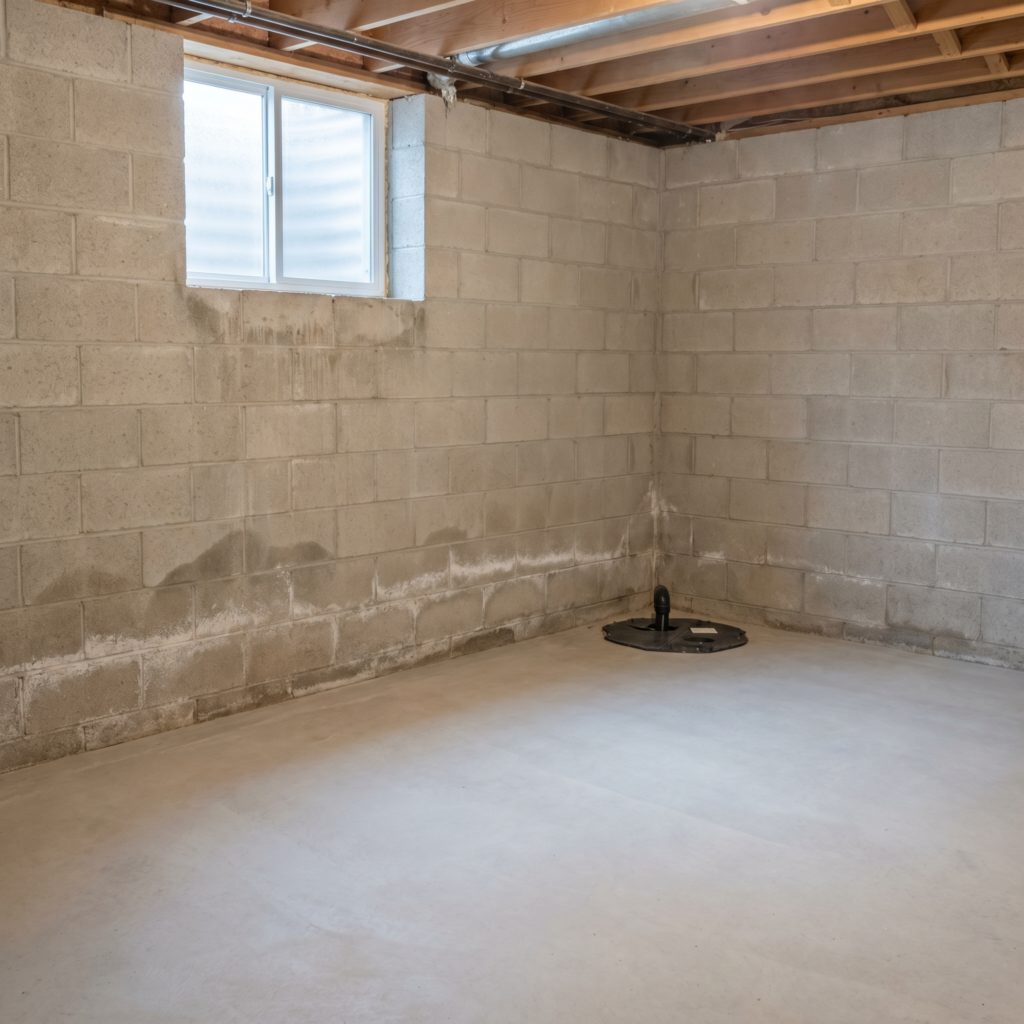
Moisture assessment requires a different approach. Rather than waiting for a test result, you look for warning signs. Water stains on walls or floor, white chalky mineral deposits called efflorescence, persistent musty smells, condensation on walls during summer humidity, rust on metal items stored in the basement, and visible mold or mildew all indicate moisture activity. Pay attention to whether problems appear after rain (suggesting surface water intrusion) or year-round (suggesting a high water table or constant seepage).
If you see bowing walls or major cracking, stop and get a professional structural evaluation. That is beyond a waterproofing issue and beyond the scope of what a do-it-yourself approach can address.
One important note on mold: the Iowa Department of Health and Human Services does not recommend routine mold testing. The reasoning is practical. Mold test results are difficult to interpret because there are no regulatory comparison standards, and the answer is the same regardless of what species or count appears in a report: fix the moisture source. If you see or smell mold, you address the water problem rather than paying for a mold test. Hard surfaces with surface mold can typically be cleaned with detergent and water. Porous materials like drywall and carpet usually need to be replaced.
Table 2: Iowa Radon Testing Quick Reference
| Test Type | Duration | Best For | Cost (DIY) | Cost (Professional) |
|---|---|---|---|---|
| Short-term | 2-7 days | Initial screening, real estate | Under $20 | $100-$250 |
| Long-term | 90+ days | Year-round average, most accurate | Under $30 | $200+ |
| Post-mitigation | 30 days after install | Verify system works | Under $20 | $100-$200 |
For real estate transactions, the EPA recommends a certified professional. Iowa Radon Hotline: 1-800-383-5992.
Solutions and What They Cost
Once you’ve identified the problems, the next step is understanding what real solutions cost. Both radon and moisture work span a wide cost range depending on severity, foundation type, and the scope of the underlying issue.
For radon, the standard solution is called sub-slab depressurization. A contractor installs a vent pipe that runs from below the slab up through the home and out through the roof, with an inline fan that pulls radon-laden air from under the foundation and exhausts it outside before it can enter the living space. This approach works in virtually all homes. Retrofit installation in Iowa typically costs between $800 and $2,500, with most homes falling in the middle of that range. Complex foundations, crawl spaces, or homes with multiple foundation types can push the cost higher.
During new construction, the same effect is achieved much more cheaply with a passive system. A passive system consists of the same vent pipe as the active system but without the fan, designed so that warm air rising through the pipe creates enough natural draft to pull radon from under the foundation. The installed cost during new construction is roughly $400 to $500. If post-construction testing reveals the natural draft isn’t sufficient, a fan can be added later for a few hundred dollars more. The cost difference between installing a passive system during construction and retrofitting an active system afterward is one of the strongest financial arguments for addressing radon during new builds.
This is why Iowa House File 2297 matters. The bill, which would require passive radon mitigation systems in all new single-family and two-family Iowa homes, passed the Iowa House 87 to 4 and passed the Senate unanimously. As of mid-May 2026, the bill is awaiting the governor’s signature, with an expected effective date of July 1, 2026 if signed. Verify current status before finalizing any new construction project, but the direction of Iowa law is clear: passive radon systems are becoming the standard, not the exception.
Moisture solutions follow a different logic. Because the underlying cause varies dramatically from home to home, the right fix can range from a few hundred dollars to tens of thousands. The sound approach is to start with the cheapest, least invasive solutions and escalate only if those don’t solve the problem.
The first level is exterior surface water management. Cleaning gutters, extending downspouts, and regrading soil to slope away from the foundation typically runs $500 to $2,000 and often solves moisture problems entirely when the cause is surface water rather than groundwater. Many homeowners spend thousands on interior systems when an $800 grading and gutter fix would have solved the problem.
If surface water management doesn’t resolve the issue, individual foundation wall cracks can be sealed with epoxy or polyurethane injection for $400 to $800 per crack. This works for minor, non-structural cracks. Any crack large enough to suggest movement requires a professional structural evaluation first.
When water continues to enter despite the basics being addressed, the next level is interior waterproofing. This involves installing a drainage channel along the inside perimeter of the basement floor, connecting it to a sump pit, and installing a sump pump to remove water. The cost typically runs $3,000 to $8,000. Interior systems don’t keep water out of the home, but they manage it before it spreads, which is the practical Iowa solution for most ongoing intrusion.
Vapor barriers, which run $1,500 to $3,000 installed, address moisture vapor rather than liquid water. They have a role in finishing projects but won’t solve an active water intrusion problem on their own.
The most expensive option is exterior waterproofing, which requires excavating around the foundation, applying a waterproof membrane to the exterior wall, and installing drain tile to carry water away. Costs run $20,000 to $80,000 depending on home size and access. This is comprehensive and effective, but for most Iowa homes, it’s a last resort reserved for severe, ongoing intrusion that interior systems cannot manage.
Sump pumps deserve their own discussion because they are central to most Iowa basement moisture systems. The typical lifespan is 7 to 10 years. Replacement costs $800 to $1,600 all-in. A battery backup system, which keeps the pump running during power outages, costs $200 to $500 and is not optional in Iowa, where the storms most likely to flood your basement are also the storms most likely to knock out your power.
Table 3: Radon and Moisture Solutions, Cost Overview
| Problem | Solution | Cost Range | Notes |
|---|---|---|---|
| Elevated radon, existing home | Sub-slab depressurization | $800-$2,500 | Standard fix, effective in nearly all homes |
| Radon, new construction | Passive system | $400-$500 | Far cheaper than retrofit |
| Surface water | Gutter/downspout + regrading | $500-$2,000 | Try first |
| Minor wall cracks | Epoxy/polyurethane injection | $400-$800/crack | Professional evaluation first |
| Ongoing water intrusion | Interior drainage + sump pump | $3,000-$8,000 | Practical Iowa solution |
| Severe water table | Exterior excavation + membrane | $20,000-$80,000 | Last resort |
| Sump pump replacement | Submersible pump, labor | $800-$1,600 | Replace at 7-10 years |
| Sump pump backup | Battery system | $200-$500 | Critical for Iowa storms |
Cost estimates for Central Iowa. Get three written quotes for your specific home.
The Right Order of Operations
The most expensive mistake in Iowa basement work is doing things in the wrong order. The right sequence is straightforward, and following it can save thousands of dollars in rework.
Start with radon testing. A DIY kit under $20 and a couple of weeks for results gives you a baseline before you make any other decisions. If the level is above 4 pCi/L, you’ll need to plan for mitigation. If it’s below, you have one less variable to worry about.
Next, address moisture sources, starting with the cheapest fixes. Check your gutters and downspouts, look at the grading around your home, and resolve obvious surface water issues before considering any interior work. If you see water stains, efflorescence, or smell anything musty, document those signs and consider getting a professional moisture evaluation before framing any walls.
Verify your sump pump situation. If your home doesn’t have one and you’re in Central Iowa, it almost certainly needs one. If your existing pump is more than seven years old, plan to replace it before any finishing work begins, because tearing into finished space to swap a failed pump is far more expensive than replacing one preemptively.
Mitigate radon if your initial tests showed levels above the action level. Sub-slab depressurization is straightforward when the basement is open and accessible. It becomes much more disruptive when walls and flooring are already in place.
Address any remaining moisture intrusion. If surface water fixes solved the problem, you may not need this step. If water continues to enter, an interior drainage system installed before finishing is dramatically simpler than retrofitting one through finished walls.
Only after all of that is the basement ready to finish. Before any finishing decisions, fixing these basement problems before you finish is worth reading as a complete checklist.
What happens when homeowners reverse this order? The costs compound quickly. Tearing out walls to add a radon mitigation pipe, pulling up flooring to install perimeter drainage, or replacing a failed sump pump through finished framing all add labor that wouldn’t have been necessary if the work had been done in sequence. The price difference between doing it right and doing it twice is typically several thousand dollars and weeks of project delay.
If your basement is already finished and you’ve never tested for radon, the right move is to test now. If you’ve never had moisture professionally evaluated and you see warning signs, get an evaluation. It’s not too late to address either problem, but it is more expensive than catching it before the finish work was done.
Table 4: Action Priority Checklist
| Step | Action | Cost | Timing |
|---|---|---|---|
| 1 | Test radon level | Under $20 DIY; $100-$250 pro | Now, every 2 years |
| 2 | Check gutters, downspouts, grading | $500-$2,000 to fix | Before basement work |
| 3 | Assess foundation walls for cracks/stains | Free visual; pro eval if bowing | Before basement work |
| 4 | Verify or install sump pump | $800-$3,000 | Before finishing |
| 5 | Mitigate radon if above 4 pCi/L | $800-$2,500 | Before finishing |
| 6 | Address moisture intrusion | $500-$8,000+ | Before finishing |
| 7 | Finish basement | $25,000-$90,000 | After steps 1-6 |
Illustrative Scenarios
Illustrative scenario: An Ankeny homeowner buys a 1985 ranch and decides to finish the basement as a family room. They skip testing and start framing. A year later at resale, the buyer’s inspector finds radon at 12 pCi/L. Mitigation now requires cutting through finished flooring and walls to add a sub-slab pipe. The mitigation work runs about $3,200, with another $1,800 in patching and refinishing the damaged areas. The total comes to roughly $5,000, plus a delayed closing while the work is completed. A $15 DIY kit before framing would have caught the problem. Mitigation before finish work would have run $1,200 to $1,800 with no patching required.
Illustrative scenario: A Johnston homeowner notices their sump pump runs frequently and the basement smells faintly musty after spring snowmelt. A contractor identifies two issues: the soil grades toward the house in one section of the yard, and a downspout is partially blocked and discharging only a few feet from the foundation. Regrading the problem area and extending the downspouts costs about $800. The smell clears within a week. The homeowner avoided a $4,500 interior drainage system because the actual cause was surface water management, not a high water table.
Frequently Asked Questions
Q: Does every Iowa home have a radon problem?
A: Not every home is above the action level, but Iowa’s statistics are serious. As many as 5 in 7 Iowa homes exceed 4 pCi/L, the highest percentage in the nation. The only way to know your home’s level is to test. Neighboring homes can have very different readings, so a neighbor’s test doesn’t predict yours. Assume your home may be elevated until you have your own data.
Q: How do I test my home for radon in Iowa?
A: Buy a DIY kit at any hardware store for under $20, or check with your county health department for low-cost options. Place the kit in your basement following the instructions and mail it to a lab when the test period ends. For real estate transactions, the EPA recommends a certified professional rather than a DIY kit. The Iowa Radon Hotline at 1-800-383-5992 provides free guidance.
Q: What does a radon mitigation system cost in Iowa?
A: Retrofitting an existing home with sub-slab depressurization typically runs $800 to $2,500 in Iowa, depending on foundation type and home complexity. During new construction, a passive system costs $400 to $500. If a passive system is installed and post-construction testing shows elevated levels, a fan can be added for a few hundred dollars more.
Q: What are the signs of a moisture problem in my Iowa basement?
A: Watch for water stains on walls or floor, white chalky deposits called efflorescence, persistent musty smells, visible mold or mildew, summer condensation on walls, rust on metal items stored in the basement, and standing water after rainstorms. Bowing or major cracking walls indicate something beyond a waterproofing problem and require a professional structural evaluation.
Q: Should I test for mold in my Iowa basement?
A: Iowa HHS does not recommend routine mold testing. Test results are hard to interpret, there are no regulatory comparison standards, and the answer is the same regardless of what the report says: fix the moisture source. If you see or smell mold, address the water problem. Hard surfaces can usually be cleaned with detergent and water. Porous materials like drywall and carpet typically need to be replaced.
Q: Do I need to address radon and moisture before finishing my Iowa basement?
A: Yes, and this is the most important point in this entire guide. Test for radon first. Assess and fix moisture before framing a single wall. Finishing over undetected radon or moisture leads to far more expensive repairs later, often $5,000 or more above what the same work would have cost in the proper sequence.
Key Takeaways
Iowa’s reality. Iowa is the worst state in the country for radon, with as many as 5 in 7 Iowa homes above the EPA action level and indoor levels more than six times the U.S. average. Clay soils combined with freeze-thaw cycles drive chronic basement moisture. Both problems enter through the same cracks.
Testing. A DIY radon kit costs under $20 and is the right starting point for any homeowner. Professional testing runs $100 to $250 and is required for real estate transactions. Iowa HHS does not recommend routine mold testing; fix the moisture source instead. Retest radon every two years and after any major renovation.
Solutions. Radon mitigation retrofit runs $800 to $2,500. A passive system during new construction runs $400 to $500. Surface water fixes start at $500. Interior waterproofing runs $3,000 to $8,000. Iowa House File 2297, which would require passive radon systems in all new single-family and two-family homes, is awaiting the governor’s signature with an expected effective date of July 1, 2026.
Order of operations. Test radon first. Fix moisture before framing. Mitigate radon if needed. Finish last. Doing this work in the wrong order is the single most expensive mistake in Iowa basement projects.
Ready to Address Your Iowa Basement?
You now have the full picture. The cheapest, most effective path through a basement project is the right sequence: test, fix moisture, mitigate radon, then finish. Skipping a step costs more than completing it.
Busy Builders has completed 1,285+ projects across Central Iowa since 2020. We address radon and moisture as the mandatory first step before any Iowa basement finishing project. Our consultations begin with a free in-home assessment, followed by moisture diagnosis before any finishing scope is discussed. When testing indicates radon mitigation is needed, we help you understand the next step and can refer you to certified Iowa radon professionals. All work is done by registered Iowa contractors, with permit and inspection management when required, and backed by a written warranty on workmanship (details provided in your contract). Every estimate is itemized with no upsell pressure.
We serve Des Moines, West Des Moines, Ankeny, Waukee, Urbandale, Johnston, Grimes, Ames, Altoona, Newton, and communities across Central Iowa.
Call: 844-435-9800
Website: https://busybuildersiowa.com/
All cost estimates in this guide are for planning purposes only. Actual costs vary by home size, foundation type, severity, and market conditions. Radon health information is sourced from the U.S. Environmental Protection Agency, the Iowa Department of Health and Human Services, the CDC, and the American Lung Association. This article does not constitute medical advice; consult a physician for personal health concerns or call the Iowa Radon Hotline at 1-800-383-5992. House File 2297 has passed both chambers of the Iowa Legislature and awaits the governor’s signature as of mid-May 2026, with an expected effective date of July 1, 2026 if signed; verify current status before finalizing any new construction. Recommendations to fix moisture sources rather than test for mold reflect current Iowa HHS guidance. Always obtain a professional structural evaluation for bowing walls or major cracks. Always obtain three written quotes for waterproofing or mitigation work. Busy Builders is a registered Iowa contractor with the Iowa Department of Inspections, Appeals, and Licensing.
Busy Builders | Full-Service Construction and Remodeling | Serving Central Iowa Since 2020