Finishing a basement changes how air moves through your whole house. Iowa basements deal with radon, humidity, and tight winter construction that traps stale air below grade. This guide covers the ventilation systems that work in Central Iowa, what the 2024 IRC requires, realistic costs, and the mistakes that cause musty rooms.
TLDR: Finished basements in Iowa need planned ventilation, not leftover airflow. The Iowa Radon Survey shows as many as 5 in 7 Iowa homes test above the EPA action level, so test before you finish. Extend supply and return ducts, add code-required bath exhaust, and consider an HRV or ERV for balanced fresh air. Budget about $500 to $6,500 depending on the system.
Why Your Finished Basement Needs a Ventilation Plan
You finish a basement to add living space. Then winter seals the house up, and the new family room smells musty by February. Basements collect moisture, radon, and stale air. Drywall hides the problem. A ventilation plan moves air on purpose.
The good news: ventilation is one of the cheaper parts of basement finishing, and it protects everything else you spend.
Pro Tip 1: Test your air before design starts. A $15 radon kit and a $10 humidity gauge beat any sales pitch.
What Iowa Code Requires in a Basement Ventilation Plan
Iowa adopted the 2024 IRC effective September 10, 2025 under Iowa Administrative Code 481-301.8. These are the rules that shape a basement layout.
| Space | Requirement | What It Means for You |
|---|---|---|
| Habitable rooms | 7 ft minimum ceiling | Verify height before framing soffits |
| Basement bathroom | Exhaust fan vented outside | Never vent into joists or attic |
| Basement bedroom | Egress window (R319) | 5.7 sq ft net clear opening |
| Mechanical room | Combustion air supply | Louvered door or ducted air |
| Whole basement | Conditioned air | Supply and return, not supply only |
Every row gets checked at inspection, so design for it up front. Egress windows are emergency exit windows for sleeping rooms.
Pro Tip 2: Vent bath fans outside through the rim joist or wall. Dumping moist air into the joists feeds mold.
Ventilation System Options Compared
You have four practical paths. The right one depends on budget, radon numbers, and how tight your house is.
| System | Installed Cost | Best For | Limitation |
|---|---|---|---|
| Exhaust fans only | $350 to $900 | Baths, small budgets | Can pull in radon |
| HVAC extension | $1,000 to $3,500 | Most finished basements | Adds no fresh air |
| ERV | $2,500 to $6,500 | Tight homes, humidity balance | Higher upfront cost |
| HRV | $2,500 to $6,000 | Cold-climate fresh air | Less humidity transfer |
The takeaway: ducts handle temperature; only an HRV or ERV brings balanced fresh air. Planning estimates, actual costs vary.
Pro Tip 3: Exhaust-only setups depressurize the basement and can pull soil gas inside. Skip them if your radon test is borderline.
Pro Tip 4: In Climate Zone 5A, an HRV usually wins for winter fresh air. If summer humidity is your bigger fight, price the ERV.
Moisture Control Comes Before Airflow
Ventilation cannot outrun a wet foundation. Iowa’s freeze-thaw cycles push moisture through basement walls, and finished walls trap it. Match each source below to its fix.
| Moisture Source | Warning Sign | Fix Before Finishing |
|---|---|---|
| Exterior grading | Water at walls after rain | Regrade, extend downspouts |
| Wall seepage | White residue, damp patches | Seal, drainage, sump repair |
| Interior humidity | Sweating pipes, 60%+ RH | Dehumidifier, insulate lines |
Fix the water first, then ventilate. Insulate walls to R-15 continuous or R-19 cavity so warm air stops condensing on cold concrete. New finishes also release VOCs at first, as the EPA’s indoor air quality guidance explains.
Pro Tip 5: Set a drain-connected dehumidifier to 50% relative humidity so it runs all year without bucket duty.
Pro Tip 6: Photograph wall conditions before insulation goes in. Documentation protects you at resale.
Radon: The Iowa Step You Cannot Skip
The Iowa Radon Survey found as many as 5 in 7 Iowa homes above the EPA action level. All 99 counties sit in EPA Radon Zone 1. Test before finishing. Mitigation runs about $800 to $2,500 and installs cleanly before drywall. Retest after, because new walls change airflow.
Pro Tip 7: Rough in a mitigation pipe during finishing even if your test read low. The $150 rough-in beats a $1,500 retrofit.
Pro Tip 8: Never terminate a radon vent near a window or door.
What Ventilation Work Costs in Central Iowa
Ventilation rarely drives the budget; skipping it drives repair budgets.
| Line Item | Typical Range | Notes |
|---|---|---|
| Bath exhaust, ducted outside | $350 to $900 | Code requirement |
| Supply and return extensions | $1,000 to $3,500 | Licensed HVAC subcontractor |
| Dehumidifier with drain | $250 to $1,500 | Portable to ducted |
| Radon mitigation | $800 to $2,500 | Test first |
Most projects land between $1,500 and $5,000 total. These are planning estimates, actual costs vary.
Pro Tip 9: Bundle ventilation into the finishing project so the HVAC crew mobilizes once.
Illustrative Scenarios from Central Iowa
Illustrative scenario: An Ankeny family finished an 850 square foot rec room and office. Duct extensions plus an HRV added about $4,200 to the eight-week finish. See basement finishing in Ankeny for local specifics.
Illustrative scenario: A Nevada homeowner tested at 6.2 pCi/L. Mitigation ran $1,400, the retest read 0.9, and the 700 square foot family room finished in ten weeks.
Illustrative scenario: A Winterset couple fought summer mustiness in an older finished basement. A ducted dehumidifier plus new supply and return runs cost about $3,800 over two weeks.
Pro Tip 10: Retest radon every two years and after any major remodel.
Planning Ventilation During a Larger Remodel
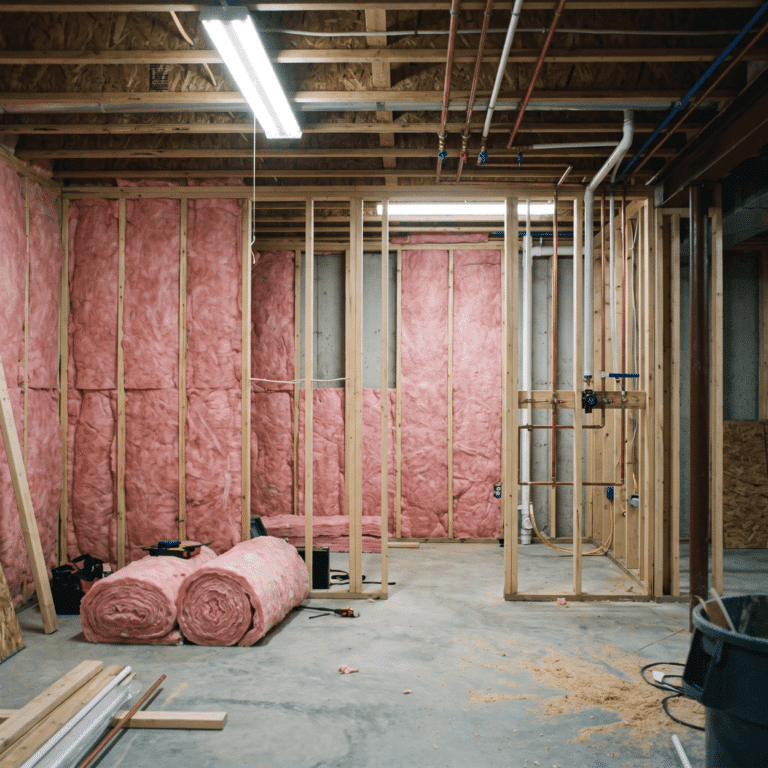
If your project moves walls or adds a bathroom, fold ventilation into the full basement remodeling scope. Ducts route cleaner before framing, and one permit covers the work. Electrical, plumbing, and HVAC run through licensed subcontractors, coordinated by your registered contractor.
Pro Tip 11: Schedule the HVAC rough-in inspection before insulation covers anything.
Pro Tip 12: Put ventilation in your contract scope by name. “HVAC as needed” is how rooms end up with one sad supply vent.
FAQs
Does a finished basement in Iowa need fresh air ventilation? Code requires conditioned air and bath exhaust. Tight Iowa homes usually benefit from an HRV or ERV on top. Start with a radon and humidity test to size the need.
Can I just use the existing furnace ducts? Sometimes, but supply-only setups leave rooms stuffy. Have a licensed HVAC subcontractor confirm capacity and return paths before framing.
How much does ventilation add to a finishing budget? Most projects spend $1,500 to $5,000, plus $800 to $2,500 if mitigation is needed. These are planning estimates, actual costs vary. Ask for ventilation as its own bid line item.
When should I test for radon? Before design, and again about a month after finishing. Most Iowa homes test high, so assume you need it. Winter readings are most accurate.
Will good ventilation help my home’s value? It protects it. Appraisers credit below-grade space at roughly 60 to 75% of above-grade value, and musty air drags that down. Not financial advice, actual returns vary.
Key Takeaways
Test first
- Radon and humidity numbers set the design.
Meet the code
- 7 foot ceilings, ducted bath exhaust, egress for bedrooms, combustion air for appliances.
Balance the air
- Supply plus return at minimum; HRV or ERV for real fresh air in tight homes.
Moisture before airflow
- Fix grading and seepage before drywall, then insulate to R-15 continuous.
Budget honestly
- $1,500 to $5,000 covers most projects.
Ready to Finish Your Basement the Right Way?
Busy Builders has completed 1,285+ projects across Central Iowa since 2020. Get a free consultation with a scope that names your ventilation plan line by line.
Call: 844-435-9800 Website: https://busybuildersiowa.com/ Written warranty on workmanship (details provided in your contract).
Disclaimer: This article is for general information, not project-specific advice. Cost figures are planning estimates that vary by scope, materials, site conditions, and current pricing. Permit requirements vary by city; verify current requirements with your local building authority before starting. Radon levels vary by home; test before and after finishing. Radon statistics come from the Iowa Radon Survey. Below-grade moisture outcomes depend on site conditions, and no guarantee against water intrusion is made. Gas appliance work must be performed by licensed professionals, and trade work runs through licensed subcontractors. No specific outcomes are guaranteed. Consult a registered contractor for guidance specific to your project.
Busy Builders | Full-Service Construction and Remodeling | Serving Central Iowa Since 2020