Remote and hybrid work didn’t go away after the pandemic, and homeowners across Central Iowa are looking at their unfinished basements as the answer to a dedicated workspace problem. The math is compelling: a finished basement office costs a fraction of what a home addition would, the space already exists, and a quiet basement room is often more productive than a kitchen-table setup. The question most homeowners actually ask isn’t whether to do it. It’s whether it will feel like an office or feel like a basement. This guide answers that question directly, with the Iowa-specific considerations (radon above all) that turn a good basement office project into a great one or a bad one.
TLDR: A dedicated basement home office in the Des Moines metro typically costs $8,000 to $18,000 for a mid-range room or $32,000 to $55,000 if the office is part of a larger basement finish. The work involves framing, electrical, lighting, soundproofing, and connectivity. The single most important Iowa-specific step is testing for radon before you finish, because Iowa has the highest radon levels in the country and a basement office means 40-plus hours per week of exposure. Permits are required: a city building permit and a separate electrical permit through iowaelectrical.gov. Done well, a basement office returns roughly 71% of project cost at resale per NAR data, and pays back daily in the form of quiet, dedicated workspace that doesn’t cost monthly coworking fees.
Most online advice on basement offices treats them like any other room finish. That advice misses what’s actually different about working in a basement: the lighting problem (no windows by default), the connectivity problem (concrete walls and WiFi don’t mix well), the comfort problem (basements run cool and humid in Iowa), and most importantly the radon exposure problem (8 hours a day for years is a meaningfully different exposure profile than occasional basement use). This guide treats a basement home office as the distinct project it is, which is what your office actually deserves before you commit a contractor to it.
Why Basement Home Offices Are Booming in Central Iowa
The shift to remote and hybrid work created a new market for dedicated home workspace that didn’t exist at scale before 2020. National surveys consistently show that homeowners with dedicated office space report higher productivity, better work-life separation, and (when it’s time to sell) faster home sales at closer-to-asking prices. The kitchen table doesn’t cut it for a job you do every weekday.
The basement is the most cost-efficient way to add that dedicated workspace, especially in Central Iowa where most homes have full or partial basements that are sitting underutilized. The cost math is straightforward: basement finishing in Des Moines runs roughly $30 to $70 per square foot for mid-range work, depending on scope. A home addition runs $250 to $500 per square foot or more, with a longer timeline, more permits, and far more disruption to your daily life. For dedicated workspace, the basement wins on every metric except natural light, and we’ll talk about how to solve the natural light problem below.
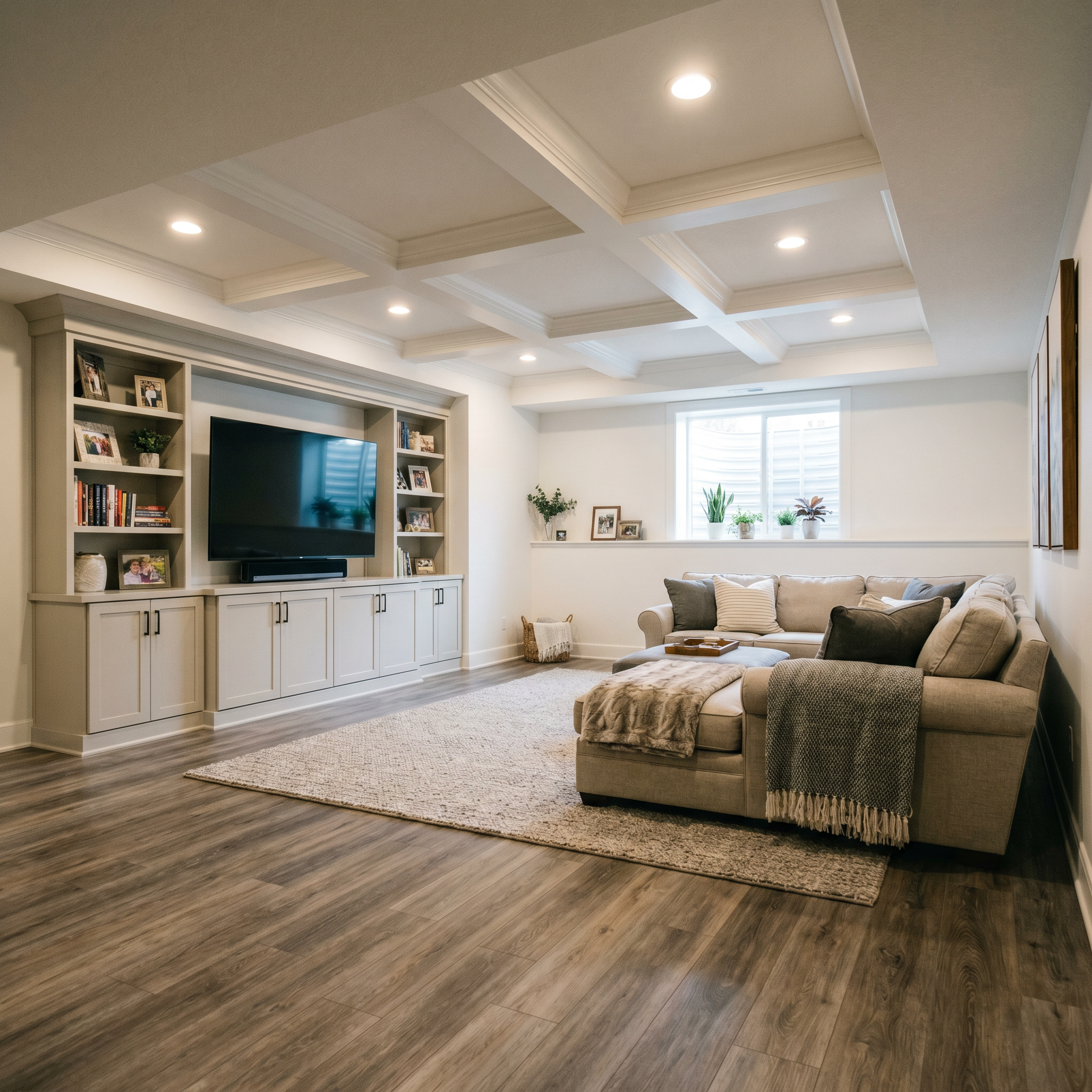
There are two distinct paths to a basement office. The first is a dedicated office-only room, framed and finished as a standalone space within an otherwise unfinished basement. This is the lower-cost path and works well for homeowners who want to solve the workspace problem first and worry about the rest of the basement later. The second is an office room as part of a larger basement finish, where you turn the whole basement into living space (family room, half bath, office, maybe a guest area) in a single project. This costs more up front but produces a more cohesive result and avoids the disruption of finishing the basement in two separate phases. For more on the trade-off between basement finishing and other space-creation approaches, see our basement finishing vs. home addition comparison.
The Iowa-Specific Issues You Must Handle First
Before you spend any money on framing, drywall, or finishes, three Iowa realities need attention. Skipping any of them is the difference between a basement office you’ll use happily for ten years and one you’ll regret almost immediately.
Radon: Test Before You Finish
Iowa has the worst radon levels in the country. Iowa HHS data shows roughly 70% of Iowa homes exceed the EPA action level of 4 picocuries per liter (pCi/L). Iowa’s average indoor radon level is 8.5 pCi/L, more than six times the U.S. average of 1.3 pCi/L. Approximately 400 Iowans die each year from radon-induced lung cancer, which is the second-leading cause of lung cancer overall and the leading cause among non-smokers.
For occasional basement use, the calculus is different than for a basement home office. If you’re spending three or four hours a week downstairs doing laundry or playing pool with friends, that’s one exposure profile. If you’re spending 40-plus hours a week working in a basement office, that’s 2,000 work hours per year in a below-grade space where radon naturally accumulates from the soil beneath the slab. The exposure adds up, and Iowa’s elevated baseline means many basement offices that “feel fine” are actually delivering meaningful radon exposure to the worker spending all day there.
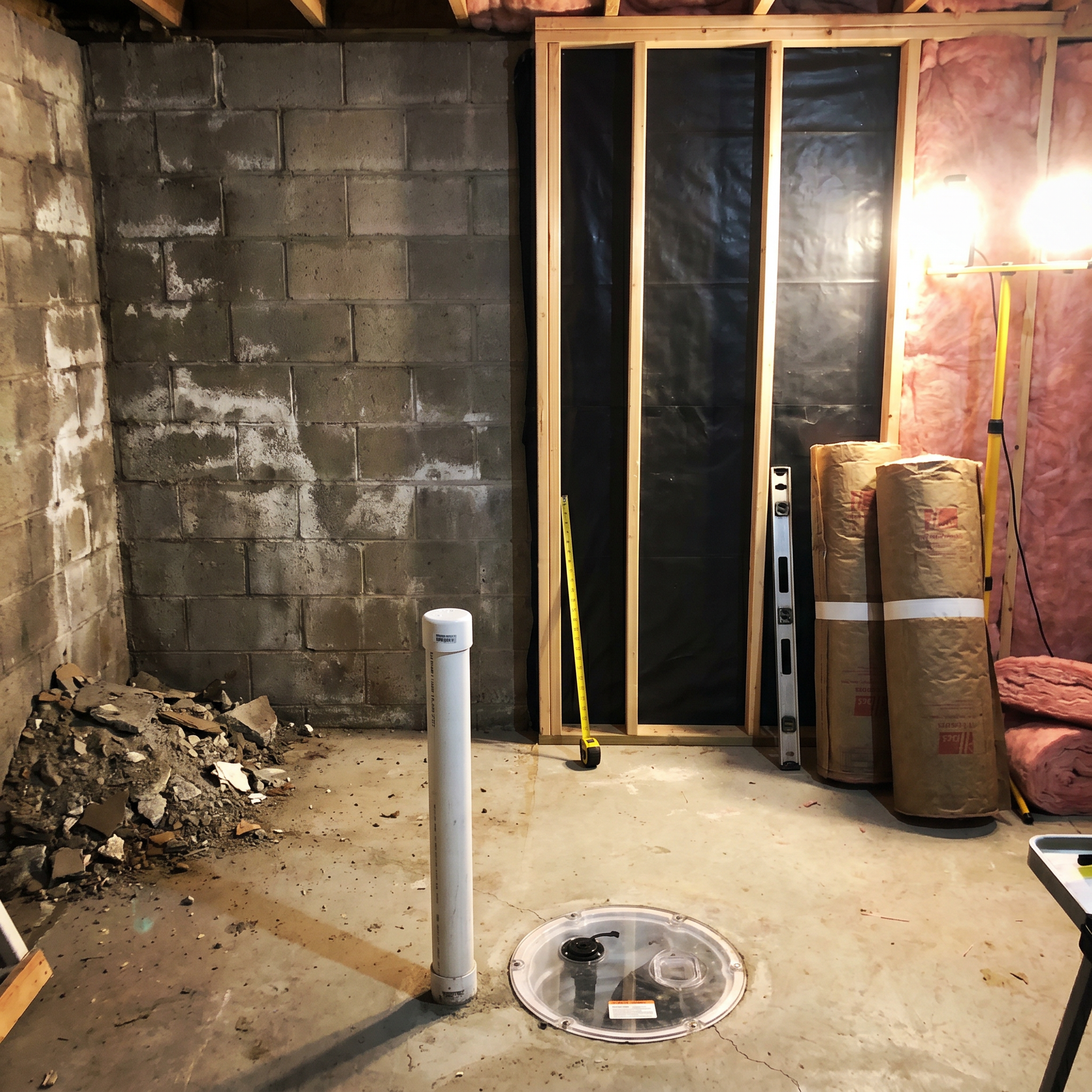
The protocol is straightforward and not expensive. Test before you finish. A short-term radon test kit costs $15 to $30 from a hardware store, local library, or the American Lung Association. Iowa’s Radon Hotline at 1-800-383-5992 will direct you to local resources and certified testing services. If your test results come back below 4 pCi/L, you can move forward with finishing without mitigation. If results come back at or above 4 pCi/L, mitigation should happen before finishing, because retrofitting a mitigation system after walls and ceiling are closed is more complex and more expensive than installing it into an unfinished space.
Mitigation retrofit costs $800 to $2,500 in most Central Iowa homes, depending on the foundation type and how the system needs to be routed. The most common approach is sub-slab depressurization, which uses a fan to pull soil gases out from under the foundation and vent them above the roofline before they can enter the home. Once installed and active, retest every two years to confirm the system is still working as intended.
The Iowa HHS radon resources page is the authoritative state source for testing and mitigation information.
Moisture: Fix It Before You Cover It
Iowa’s clay soils expand and contract with moisture cycles, putting ongoing pressure on basement walls and slabs. Combined with Iowa’s frequent freeze-thaw cycles, which are among the most active in the country, this creates conditions where moisture infiltration is common and ongoing. A wet basement destroys office equipment, ruins finished walls and flooring, encourages mold, and turns a productive workspace into a health hazard. Fix moisture before you finish, not after.
Walk your unfinished basement before any planning conversation with a contractor and look for these warning signs: water stains on walls or floor (especially near the corners where walls meet the slab), white powdery efflorescence on concrete (mineral deposits left behind when water evaporates through the surface), a musty odor (a reliable indicator that moisture is present even when you can’t see it), visible cracks with seepage, or an active sump pump that runs regularly. Any of these means moisture remediation needs to happen first.
Moisture remediation in a Central Iowa basement typically costs $3,000 to $15,000 depending on the source and severity. Common interventions include exterior grading improvements (pulling soil away from the foundation), gutter and downspout extensions, interior drainage and sump pump installation, foundation crack repair, and waterproofing membranes. Each of these is a project in its own right, and a basement office built over an unaddressed moisture problem will fail within a few years regardless of finish quality.
Ceiling Height: Measure Before You Plan
Iowa building code, following the International Residential Code (IRC) section R305.1, requires a minimum 7-foot ceiling height for habitable below-grade space. This is the ceiling height required for the finished space itself, not the existing unfinished ceiling height of your basement.
The distinction matters because most basements have ductwork, beams, plumbing runs, and other mechanical elements that reduce ceiling height in specific locations. IRC R305.1.1 allows beams, girders, and other obstructions to drop to 6 feet 4 inches in limited spans, but this is a mechanical clearance exception, not the room standard. Your finished office room ceiling needs to be 7 feet across most of the space.
Measure before you plan, particularly if your home was built before 1990, when older construction sometimes used lower basement ceilings than modern code requires. If your unfinished basement ceiling is 7 feet or borderline, you have options: use recessed lighting rather than pendant fixtures (no drop), place soffits strategically around mechanical elements, and embrace an open-ceiling industrial look in mechanical zones to maintain headroom where you need it. What you cannot do is finish below the 7-foot minimum and expect to pass inspection or pass a future home sale.
What a Basement Home Office Costs in Des Moines
The cost of a basement home office depends primarily on scope: whether you’re building an office-only room within an otherwise unfinished basement, or building the office as part of a larger basement finish. Both paths are legitimate. The right one depends on your budget, timeline, and whether you have other uses for the rest of the basement.
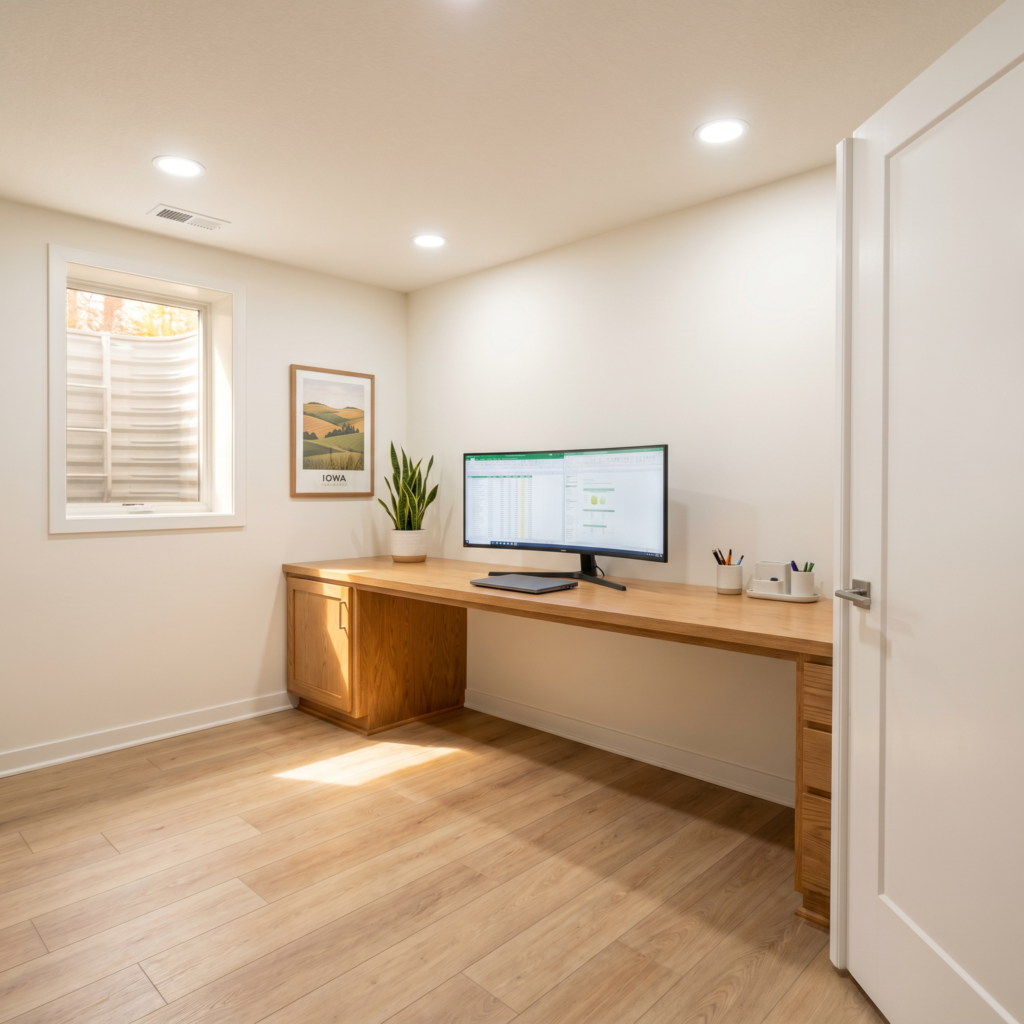
A dedicated office-only room in the range of 150 to 250 square feet, finished to a mid-range standard, typically costs $8,000 to $18,000 in Des Moines and the surrounding metro. This includes framing, drywall, luxury vinyl plank flooring, two to three dedicated electrical circuits, recessed LED lighting, one solid-core door, paint, and basic soundproofing in the walls. It does not include radon mitigation, moisture remediation, or ceiling modifications, which are additional if your basement requires them.
If you’re finishing the whole basement and including an office room as part of the larger project, expect $32,000 to $55,000 for a mid-range finish of roughly 800 to 1,000 square feet, including the office room, a half bathroom, and a family room area. High-end basement finishes with multiple dedicated zones and full bath run $55,000 to $70,000-plus depending on finish level and scope.
Several cost drivers are specific to office use rather than general basement living space. Dedicated electrical circuits matter more for an office than for a family room. The National Electrical Code requires a 20-amp circuit for office outlets and a separate circuit for lighting; many builders also add a dedicated circuit for office equipment to prevent nuisance breaker trips when you start the printer and the space heater on the same line. Budget $600 to $1,500 for proper dedicated office circuits.
Hardwired ethernet wiring (typically CAT6 cable) is the connectivity decision that homeowners regret most often when they skip it. WiFi signals are unreliable in below-grade concrete spaces, particularly for video calls and large file uploads. A single CAT6 run from your router or networking closet to the office costs $150 to $400 if done during construction, and three to five times more after walls are closed and you have to fish cable through finished space. Do this during the build.
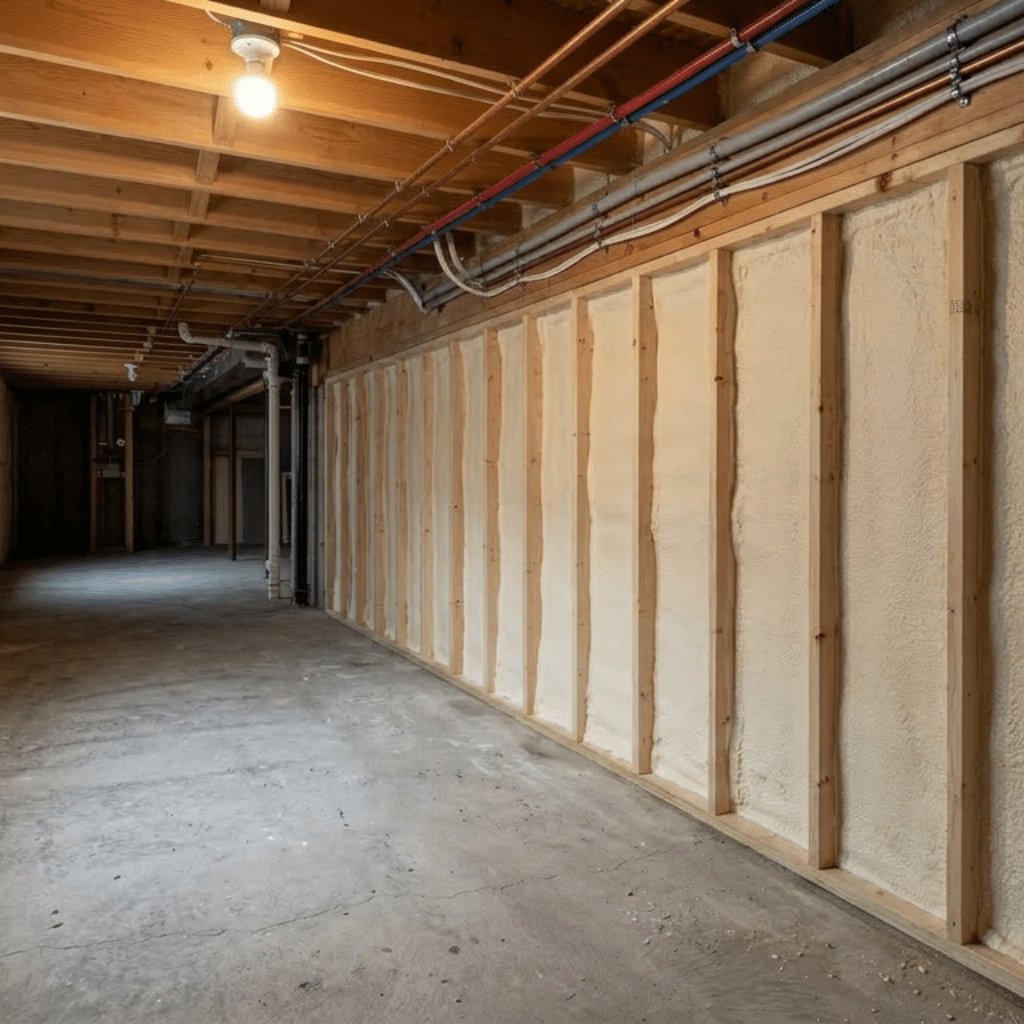
Soundproofing is the second biggest comfort decision after lighting. Basic mineral wool insulation in wall cavities costs $1 to $3 per square foot of wall area and meaningfully reduces sound transmission from adjacent rooms and from the floor above. More aggressive soundproofing (resilient channels, double drywall layers, sound-rated doors) costs more but matters significantly for video call audio quality. Most builders default to hollow-core interior doors, which transmit sound badly; a solid-core door with proper weatherstripping is one of the highest-impact soundproofing upgrades for the money.
Lighting at office quality (rather than basement-utility quality) typically costs $1,200 to $3,000 for a properly designed layered system. We’ll cover the lighting decisions in detail in the next section.
An egress window is not required by code for a home office (egress requirements under IRC R310 apply only to sleeping rooms), but adding one runs $2,500 to $5,000 and meaningfully improves both natural light and future flexibility if the room ever needs to function as a bedroom.
Table 1: Basement Home Office Budget Tiers (Des Moines Metro 2026)
| Scope | Budget | What You Get |
|---|---|---|
| Office room only (150 sq ft, basic) | $6,000-$9,000 | Framing, drywall, basic lighting, standard circuits, LVP, paint |
| Office room (200 sq ft, mid-range) | $10,000-$18,000 | Above plus soundproofing, layered lighting, dedicated circuits, CAT6 ethernet, quality finishes |
| Office in full basement finish (800 sq ft, mid-range) | $32,000-$50,000 | Full basement with office, bathroom, family room |
| Office in high-end full basement (1,000 sq ft) | $55,000-$70,000+ | Custom finishes, multiple zones, full bath |
Estimates for planning purposes only. Radon mitigation, moisture remediation, and ceiling modifications are additional if needed. Always obtain three written quotes for your specific project.
Making It Feel Like an Office, Not a Basement
The single biggest concern homeowners express about basement offices is whether the space will feel oppressive after weeks and months of full-time work. The honest answer is that a basement office built without attention to lighting, climate, and acoustics will feel like a basement no matter how nice the finishes are. A basement office built with deliberate attention to these factors can feel as good as any above-grade room. The difference is in the design choices, not the construction quality.
Lighting Is the Biggest Lever
Below-grade spaces have limited natural light by default, and that’s the primary thing that makes them feel different from above-grade rooms. The fix is a combination of borrowed natural light and high-quality artificial light at the right color temperature.
For natural light, an egress window with an enlarged window well is the single best intervention. Even though egress isn’t code-required for an office, the natural light benefit is real, and the future flexibility (the room can function as a bedroom if your life changes) is worth the $2,500 to $5,000 investment for many homeowners. Window well reflector liners (white or polished metal panels that line the inside of the well) bounce more daylight into the room. Tiered window well designs with planted greenery instead of bare gravel feel less like a hole in the ground and more like a small courtyard.
For artificial light, the most important choice is color temperature. Standard household bulbs run 2700K to 3000K (warm white), which is appropriate for relaxing in a living room but feels gloomy and dim for all-day work. Office-quality lighting runs 5000K to 6500K (“daylight” or “cool white”), which matches the color temperature of actual outdoor daylight and keeps you alert and focused. LED recessed lights at 5000K, layered with task lighting at your desk and accent lighting elsewhere, produce a workspace that doesn’t feel like a basement even at noon in December.
A few specific lighting principles that matter for basement offices. First, layered lighting (overhead general lighting plus task lighting plus accent lighting) avoids the single-overhead-fixture cave effect that makes basement rooms feel oppressive. Second, light-colored flooring (LVP in light wood tones rather than dark) and light neutral wall colors reflect ambient light and open up the space visually. Third, dimmers on the overhead lights let you adjust the room from bright-and-alert during work hours to softer in the evenings if the room doubles for any other use.
Soundproofing Matters More Than You Think
Sound from the floor above (footsteps, kids, dishwasher, TV) is the number one productivity complaint from people with basement offices. HVAC noise is the second. Sound from outside the office room within the basement (family room TV, washing machine on the other side of the wall) is the third.
The most cost-effective intervention is filling wall cavities with rockwool or mineral wool insulation during construction. This costs $1 to $3 per square foot of wall area in materials and provides substantial sound attenuation across the speech frequencies that matter for video calls. For walls separating the office from the family room or laundry, this should be standard.
For sound from the floor above (impact sound from footsteps), wall cavity insulation alone doesn’t help much because the sound transmits through the structure rather than through the air. Resilient channels installed between the ceiling joists and the drywall, combined with an extra layer of drywall, meaningfully reduce impact sound transmission. This is a more involved upgrade that costs more but matters significantly if you have kids or anyone else who walks heavily upstairs during your work hours.
A solid-core office door with proper weatherstripping around the frame is the highest-return soundproofing upgrade for the dollar. Hollow-core doors (the builder default) transmit sound poorly; a solid-core door costs $150 to $300 more and changes the audio quality of every video call you take.
HVAC and Climate Control
Iowa basements typically run 5 to 10 degrees cooler than the main floor in winter and noticeably more humid in summer. Both conditions affect comfort and productivity during all-day work.
Two options exist for office-quality climate control. The first is extending your existing forced-air ductwork into the basement with dedicated supply and return registers in the office room. This works well when the existing HVAC system has capacity and the ductwork can be reasonably routed. The downside is that you’re controlled by the main thermostat, which means the office temperature follows whatever the rest of the house is doing.
The second is installing a ductless mini-split system dedicated to the basement office (or the basement zone). Mini-splits cost more up front ($2,500 to $5,000 installed for a single-zone system) but give you independent temperature control over the office, which means you can keep the office at 70 degrees while the rest of the house is at 65, without conditioning the whole basement.
Dehumidification is not optional in any Iowa basement finish. Whole-house dehumidifiers integrated into the HVAC system or standalone basement dehumidifiers handle this. Without active dehumidification, summer humidity in a finished basement office runs uncomfortable and can contribute to mold growth.
Connectivity
Hardwired CAT6 ethernet from your router or networking equipment to the office is the connectivity decision that matters most. Below-grade concrete is hostile to WiFi signals, particularly the higher-frequency bands (5 GHz and 6 GHz) that deliver the best video call performance. A hardwired ethernet drop bypasses the WiFi reliability problem entirely.
Run the cable during construction, before walls are closed up. A single CAT6 run from the router location to the office costs $150 to $400 during construction. The same run after walls are closed requires fishing cable through finished space and costs three to five times more. Many basement offices also benefit from a small networking closet or shelf where the router can be relocated closer to the workspace; this is much cheaper to plan during construction than retrofit.
Table 2: Iowa-Specific Considerations Before You Finish
| Item | What to Check | Why It Matters | Typical Cost If Needed |
|---|---|---|---|
| Radon test | Test before any finishing work | Iowa avg 8.5 pCi/L; 40-hr work week = meaningful exposure | Test $15-$30; mitigation $800-$2,500 |
| Moisture inspection | Water stains, efflorescence, musty smell, active sump | Wet finish destroys office equipment and finishes | Remediation $3,000-$15,000 |
| Ceiling height | Measure clear height, note beams and ducts | IRC R305.1 requires 7-ft minimum | Modification varies |
| Electrical panel capacity | Available slots, panel age | New circuits need panel headroom | Subpanel install $1,500-$3,500 if needed |
| Internet plan | CAT6 path from router to office | WiFi unreliable in concrete; video call quality | $150-$400 during build |
| HVAC extension | Existing duct reach or mini-split | Basements run 5-10°F cool, humid in summer | Duct extension $800-$2,000; mini-split $2,500-$5,000 |
| Permit requirements | City building permit + state electrical permit | Both required for typical office build | Permit fees $200-$800 combined; varies by city and project valuation |
Permits and Code Requirements in Des Moines
Permitting trips up a lot of homeowners and even some contractors. Get this right.
A building permit is required for any basement finish involving framing, drywall, electrical work, or HVAC modifications. In Des Moines, building permits are filed through the city’s self-service permit portal. In West Des Moines, permits go through the city’s online permit portal at wdm.iowa.gov. Ankeny, Waukee, Urbandale, Johnston, Grimes, and Altoona each have their own permit offices with city-specific submission requirements.
The detail that contractors and homeowners most commonly miss is that electrical permits in Iowa are filed separately through iowaelectrical.gov, not through the city building permit portal. Iowa Electrical is the state’s electrical permit and inspection system, and any electrical work in a basement office (new circuits, panel modifications, wiring runs) requires an electrical permit filed there, separate from the city building permit. Most basement office projects require both permits.
Iowa updated to the 2023 National Electrical Code (NEC) effective July 1, 2025. All new electrical work permitted after that date must comply with 2023 NEC standards, which include updates around GFCI and AFCI protection, working space requirements, and several other technical provisions. A licensed Iowa electrician will know these changes; a homeowner doing their own electrical work likely won’t.
Iowa requires a licensed electrician for panel work and any new circuit wiring in a finished basement. Iowa registers general contractors (such as Busy Builders) with the Iowa Department of Inspections, Appeals, and Licensing, and separately licenses the specialized trades that do the trade-specific work. The general contractor coordinates the project and manages the permits; the licensed electrician does the electrical work and pulls the electrical permit; both are necessary for a code-compliant basement office build.
For the ceiling height requirement (7-foot minimum under IRC R305.1) and the egress provision (not required for offices under IRC R310 since offices are not sleeping rooms), the same code applies across Central Iowa cities. Verify your contractor’s state registration at Iowa DIAL before signing any contract, and confirm that any electrical sub on the project holds a current Iowa electrical license filed through iowaelectrical.gov.
ROI and Resale Value of a Basement Home Office
The financial case for a basement home office has two components: resale recovery when you eventually sell, and daily ROI in the form of productive workspace you’re using now rather than paying for elsewhere.
For resale, the National Association of Realtors’ 2025 Remodeling Impact Report shows basement conversion to living area returns an average of 71% of project cost at resale nationally. This is one of the higher-return categories in the report, well above many kitchen and bathroom remodels at the upscale tier. Note that this is the national average rather than an Iowa-specific guarantee, and actual resale recovery varies by market conditions, project quality, and buyer demand at the time of sale.
One important appraisal detail: basement square footage is valued separately from above-grade gross living area (GLA) per Fannie Mae guidelines, typically at 60 to 75% of the above-grade rate. This is why claims like “finishing your basement adds X% to your home value” should be read skeptically. The added value depends on the quality of the finish, the local market, and how the appraiser categorizes the space. A well-finished basement office in a competitive market like West Des Moines or Ankeny commands a meaningful premium; the same finish in a rural market may not.
The daily ROI is often the more compelling case. A coworking space membership in the Des Moines metro typically runs $200 to $400 per month for a dedicated desk arrangement, or $2,400 to $4,800 per year. A home addition with dedicated office space costs $250 to $500 per square foot ($25,000 to $50,000 for a small office addition) and takes 6 to 12 months from design through completion. A basement office finish at $8,000 to $18,000 for a dedicated room pays back the coworking-space alternative in two to four years and avoids the addition’s longer disruption and higher cost entirely.
The buyer demand piece matters too. Homes with dedicated office space have sold faster and at closer-to-asking prices since 2020, and that pattern shows no sign of reversing as hybrid work becomes a permanent fixture of how American workers operate. A basement office is an asset both for your current use and for your home’s appeal to the next buyer.
Illustrative Scenarios
Illustrative scenario: An Ankeny remote software developer with an unfinished basement decides to finish a 200 square foot dedicated office room. Pre-finish radon test comes back at 3.2 pCi/L, below the EPA action level, so no mitigation is needed. The project includes framing, drywall, mineral wool insulation in walls for soundproofing, two dedicated 20-amp circuits and one for lighting, a CAT6 ethernet run from the upstairs router, layered LED recessed lighting at 5000K daylight color temperature, luxury vinyl plank flooring, paint, and a solid-core door with weatherstripping. Total cost lands at $13,500 including permits. Timeline runs four weeks from permit approval to completion. The developer’s video call audio quality is now better than it was in the spare bedroom upstairs.
Illustrative scenario: A Johnston couple with a 2005 home and a partially unfinished 900 square foot basement decides to convert the whole space rather than just adding an office room. One partner needs a dedicated office for full-time remote work; the family also wants a family room and half bath. Pre-finish radon test comes back at 6.8 pCi/L, above the action level, so they install a sub-slab depressurization mitigation system for $1,400 before any finish work begins. Post-mitigation retest returns 1.1 pCi/L. The full basement finish at mid-range runs $47,000 including the office room, family room, half bath, and all electrical and lighting work. Two separate permits are pulled: a city building permit through the Johnston permit office, and a state electrical permit through iowaelectrical.gov. Project timeline is 10 weeks from permit approval to substantial completion.
Frequently Asked Questions
Q: Do I need a permit for a basement home office in Des Moines?
A: Yes. A building permit is required for framing, drywall, and HVAC work, filed through the city’s permit office. A separate electrical permit is required through iowaelectrical.gov for any new circuits or wiring. Both permits are required for a typical basement office build, and both have to be in place before work begins. Your registered general contractor manages this process; verify the contractor at Iowa DIAL before signing.
Q: Is it safe to work in a basement in Iowa with radon levels what they are?
A: Test first, don’t guess. Iowa has the highest radon levels in the country, with roughly 70% of homes exceeding the EPA action level of 4 pCi/L and an average indoor concentration of 8.5 pCi/L. If your test shows levels at or above 4 pCi/L, install a mitigation system before you spend 40 hours per week in the basement. Testing costs $15 to $30; mitigation costs $800 to $2,500 retrofit. The Iowa Radon Hotline at 1-800-383-5992 will direct you to local resources. Retest every two years after mitigation to confirm the system is working.
Q: Do I need an egress window for a home office?
A: No. Iowa code follows IRC R310, which requires egress windows in sleeping rooms (bedrooms) but not in home offices, family rooms, or other non-sleeping spaces. However, an egress window significantly improves natural light in a basement office and gives the room flexibility if you ever want to convert it to a bedroom in the future. Many homeowners add one for those reasons even though code doesn’t require it. Budget $2,500 to $5,000 for an egress window installation in an existing foundation wall.
Q: How do I get reliable internet in a basement home office?
A: Run hardwired CAT6 ethernet from your router or networking equipment to the office during construction. WiFi signals are often unreliable in below-grade concrete spaces, especially for video calls where consistent low-latency throughput matters. A single CAT6 run costs $150 to $400 during construction and three to five times more after walls are closed because the cable has to be fished through finished space. Plan this during the build, not after.
Q: What does a basement home office do to my home’s resale value?
A: The NAR 2025 Remodeling Impact Report shows basement conversion to living area returns an average of 71% of project cost at resale nationally. Dedicated office space has been one of the most in-demand buyer features since 2020 and remains so in 2026. Note that basement square footage is appraised separately from above-grade gross living area per Fannie Mae guidelines, typically at 60 to 75% of the above-grade rate, which is why claims about specific percentage increases to home value should be read with caution. Actual resale impact varies by market, project quality, and buyer demand at the time of sale.
Key Takeaways
To pull the threads together, here’s what to walk away with.
A basement home office is the most cost-efficient way to add dedicated workspace in a Central Iowa home. Mid-range office rooms typically cost $8,000 to $18,000 standalone, or $32,000 to $55,000 as part of a larger basement finish. A home addition for the same dedicated workspace would cost three to five times more.
Test for radon before you finish. Iowa’s 8.5 pCi/L average indoor level changes the math when you’re planning 2,000 work hours per year in a basement. Testing costs $15 to $30; mitigation costs $800 to $2,500 retrofit and is meaningfully cheaper if installed before finish work begins.
Address moisture before you cover anything. Iowa’s clay soils and freeze-thaw cycles mean basement moisture issues, if present, will only get worse after finishing. Walk the unfinished space for water stains, efflorescence, musty odors, and cracks with seepage before signing any contract.
Pull both permits. A city building permit covers framing, drywall, and HVAC. A separate state electrical permit through iowaelectrical.gov covers all new wiring and circuits. Iowa updated to 2023 NEC effective July 1, 2025, so any electrical work permitted after that date must comply with current standards.
Design for the use, not just the space. Layered LED lighting at 5000K daylight color temperature, hardwired CAT6 ethernet, soundproofed walls and a solid-core door, and dedicated climate control are what turn a finished basement into an actual office. Skip any one of these and the space will feel like a basement no matter how nice the finishes are.
Ready to Plan a Basement Home Office?
You now have the framework for what a basement home office project actually involves in Central Iowa. The next step is a conversation with a builder who handles all of the moving parts: the radon and moisture pre-work, the structural finishing, the dedicated electrical and connectivity wiring, and both permits.
Busy Builders has completed 1,285+ projects across Central Iowa since 2020. Our basement finishing process begins with a free project consultation that includes a walk-through of your unfinished space, a discussion of any radon or moisture issues that need to be addressed first, and an itemized estimate that distinguishes pre-work from the finish itself. We coordinate with licensed Iowa electricians (separate from our general contractor registration) for all electrical work, manage both the city building permit and the state electrical permit through iowaelectrical.gov, and back all workmanship with a written warranty (details provided in your contract). For a broader look at basement finishing costs across the metro, see our basement finishing costs Des Moines 2026 guide, or learn about our full basement remodeling services on our basement remodeling page.
We serve Des Moines, Ankeny, West Des Moines, Waukee, Johnston, Grimes, Urbandale, Altoona, Norwalk, and communities across Central Iowa.
Call: 844-435-9800
Website: https://busybuildersiowa.com/
All cost estimates, ranges, and resale recovery figures in this guide are for planning purposes only. Actual project costs vary by basement condition, scope, materials, finish selections, and current market pricing. Radon testing recommendations reflect EPA and Iowa HHS guidance; a blog cannot diagnose or remediate radon in any specific home and is not a substitute for actual testing by a certified Iowa professional. Resale value impact figures cited from the National Association of Realtors 2025 Remodeling Impact Report reflect national averages rather than Iowa-specific guarantees, and actual resale impact varies by market conditions, project quality, and buyer demand. Iowa-specific cost factors (radon, moisture, ceiling height, electrical code updates) vary by home and should be evaluated on a project-by-project basis by a registered Iowa contractor. Always obtain three written quotes for your specific project. Verify any Iowa builder’s registration at the Iowa Department of Inspections, Appeals, and Licensing before signing a contract. Iowa electrical permits must be filed through iowaelectrical.gov. Busy Builders is a registered Iowa contractor with the Iowa Department of Inspections, Appeals, and Licensing.
Busy Builders | Full-Service Construction and Remodeling | Serving Central Iowa Since 2020
Related service: our basement finishing service.