If you’ve already read our main financing guide for Iowa custom home builds, you have a solid foundation in how construction loans work, what they cost in 2026, and what lenders require. This companion piece picks up where that guide leaves off, focusing on the four government-backed programs that most Iowa builder blogs leave out entirely: Iowa Finance Authority (IFA) FirstHome and Homes for Iowans, VA one-time close construction loans for veterans, FHA one-time close construction loans, and USDA Rural Development financing. These programs change the math substantially for first-time buyers, veterans, and rural Iowa homeowners, and many people who would qualify never apply because they assume they won’t.
TLDR: Iowa Finance Authority offers below-market permanent mortgage rates (6.000% for FirstHome as of May 12, 2026, versus 6.625% conventional) plus $2,500 down payment grants and up to 5% in second-loan assistance. VA one-time close construction loans require $0 down for eligible veterans, have no loan limit, and charge no payments during the construction phase. FHA one-time close construction loans accept 3.5% down with a 620 credit minimum. USDA Rural Development financing works for Iowa communities under roughly 35,000 in population, not for urban Des Moines or Ankeny. Together these programs serve thousands of Iowa homebuyers who don’t realize they qualify.
A note on the rates in this guide: This blog cites specific program rates that were live as of May 12, 2026. Rates change frequently, sometimes weekly. We update this guide regularly, but always verify current numbers at the official sources linked throughout (welcomehomeia.com for IFA, va.gov for VA, rd.usda.gov for USDA) before making any financing decisions.
Before we dig in, a few important framing points. First, this blog informs but does not advise. Mortgage decisions are personal financial decisions that depend on your credit, income, debt, and goals, and they should be made with a qualified Iowa mortgage lender, not from a contractor blog. Second, rates and eligibility limits change. The IFA rate quoted above was live as of May 12, 2026, at 2:26 PM Central time. By the time you read this, it may have shifted. Always verify current rates at the official source before planning around a specific number. Third, Busy Builders is a registered Iowa contractor, not a lender, mortgage broker, or financial advisor. We coordinate with whichever lender you choose; we don’t determine your eligibility for any of the programs discussed here.
With all that said, the programs below have helped thousands of Iowans build homes they otherwise couldn’t have built. They’re worth understanding before you settle on conventional financing by default.
Quick Refresher on Construction Loans
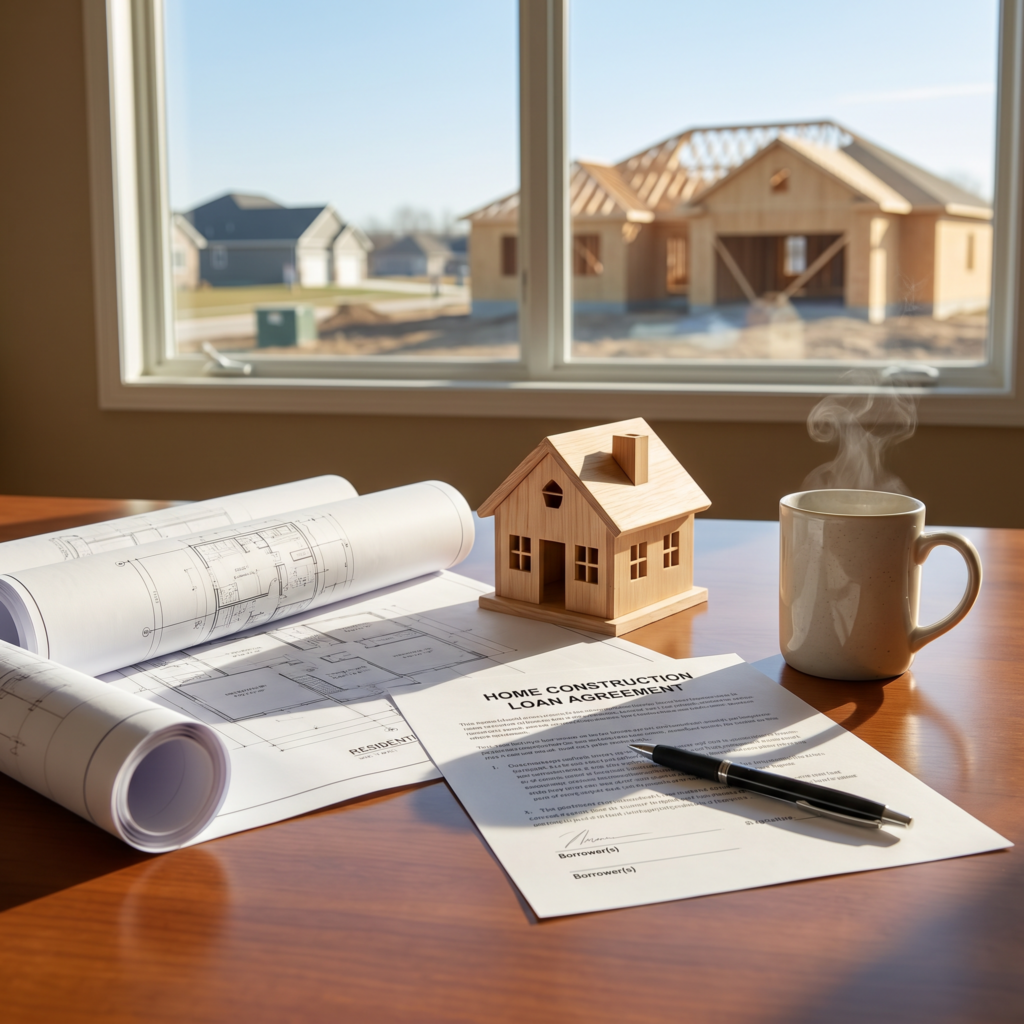
If you haven’t read the main financing guide yet, here’s the briefest possible orientation so this companion piece stands on its own. A construction loan is different from a mortgage. A mortgage funds the purchase of a home that already exists. A construction loan funds the building of a home that doesn’t yet exist, releasing money in phases (called “draws”) as the builder completes verified milestones like foundation, framing, mechanical rough-in, drywall, and final finishes.
During construction, you pay interest only, and you pay it only on the money that has actually been drawn rather than on the full loan amount. Once construction is complete and the home receives its certificate of occupancy, the construction loan either converts automatically to a permanent 30-year mortgage (called a “construction-to-permanent” loan with one closing) or pays off with a separate permanent mortgage (called a “standalone construction loan” with two closings). Construction loan rates in Iowa typically run 1 to 2 percentage points above conventional 30-year mortgage rates, which reflects the higher risk the lender takes on a home that doesn’t yet exist.
The total financing cost during an 8 to 12 month Iowa build runs $15,000 to $35,000 in interest and fees for a typical $400,000 to $500,000 construction loan. Down payments range from 10 to 25% with 15 to 20% being the most common. Approval timelines run 4 to 6 weeks, which is why most lenders recommend starting the financing conversation 5 to 6 months before groundbreaking.
The programs below either lower one of those costs, lower the down payment, or both. That’s the whole reason they matter.
Iowa Finance Authority: FirstHome and Homes for Iowans
The Iowa Finance Authority is the state agency that helps Iowans access affordable mortgage financing. IFA itself is not a lender. Instead, it works with participating lenders (banks, credit unions, mortgage companies) across the state to offer below-market interest rates and down payment assistance to qualifying buyers. The two main programs are FirstHome (for first-time homebuyers and certain other categories) and Homes for Iowans (for buyers who don’t meet the first-time buyer definition but still fall within IFA’s income and price limits).
As of May 12, 2026, the IFA FirstHome rate is 6.000%, and the Homes for Iowans rate is 6.500%. For comparison, conventional 30-year mortgage rates in Iowa are running approximately 6.625% APR on the same day. The IFA rate advantage isn’t enormous in any single month, but over the life of a 30-year mortgage, a half-percent reduction translates to tens of thousands of dollars in interest saved. On a $400,000 loan, the difference between 6.000% and 6.625% over 30 years is roughly $55,000 in interest, which is real money for any household.
In addition to the lower rate, IFA FirstHome includes meaningful down payment assistance. The standard package is a $2,500 outright grant that you don’t repay, plus an optional second loan of up to 5% of the home price. The second loan carries no monthly payments and is only repaid when you sell the home, refinance, or pay off the first mortgage. For many first-time buyers, this combination effectively means walking into a custom home build with several thousand dollars less out-of-pocket than they would need for conventional financing.
To qualify for IFA FirstHome, you must meet several criteria. The “first-time buyer” definition is more generous than it sounds: it includes anyone who has not owned a principal residence in the past three years, plus certain other categories like buyers purchasing in federally designated targeted areas. Your household income must fall under IFA’s limits, which run up to $139,580 for most Iowa counties (with some higher-cost counties allowing up to $173,460). The home you’re financing must fall under IFA’s purchase price limit, which is $544,000 for FirstHome and $665,000 for Homes for Iowans. Your credit score must be at least 640, which is a more accessible threshold than the 680 to 720 most conventional lenders prefer for their best rates.
One important nuance for custom builds: IFA programs apply to the permanent mortgage, not the construction loan itself. In a typical IFA-financed custom build, you take a separate construction loan during the build phase, and then refinance into an IFA permanent mortgage once construction is complete and the home receives its certificate of occupancy. Some IFA-participating lenders structure this as a single closing with conversion, while others structure it as two closings. The mechanics vary by lender, and this is exactly the kind of detail where working with an IFA-experienced lender from the start matters far more than working with a national online lender who has never done it.
For active veterans and military families, IFA also offers a Military Homeownership Grant of $5,000, which stacks with the standard $2,500 FirstHome down payment grant and the optional second loan. A veteran qualifying for both grants walks into financing with $7,500 of non-repayable assistance before any other program benefits come into play.
For current rates and full eligibility details, visit the Iowa Finance Authority’s official rate page at welcomehomeia.com. Rates update regularly. The 6.000% FirstHome rate cited above was live as of May 12, 2026, and may have changed by the time you read this.
VA One-Time Close Construction Loans for Veterans
The VA loan program is arguably the single most underutilized home financing benefit available to Iowans. Veterans Affairs administers a loan guarantee program that allows eligible veterans, active-duty service members, certain reservists, and surviving spouses to buy or build a home with $0 down, no private mortgage insurance, and competitive interest rates. As of May 12, 2026, VA 30-year mortgage rates in Iowa are running approximately 5.875% APR, a full three-quarters of a percentage point below conventional rates.
For custom home builds specifically, the VA offers a “one-time close” construction loan that combines the construction phase and the permanent mortgage into a single closing. This is a significant advantage over conventional construction-to-permanent loans because it eliminates the risk that you’ll fail to re-qualify between the construction phase and the permanent mortgage (a risk that becomes real if you lose your job, take on new debt, or experience an interest rate spike during construction). It also eliminates the second set of closing costs that come with a two-close standalone structure.
The structural advantages get even better. VA one-time close construction loans require no payments during the construction phase. The interest that accrues during the 8 to 12 months of building gets rolled into the permanent mortgage rather than billed monthly. This is a meaningful cash flow advantage compared to conventional construction loans, where you’re typically paying $1,500 to $3,000 per month in interest-only payments while construction is in progress. For a veteran who is already paying rent or a current mortgage while their new home is being built, removing the monthly construction-phase interest payment makes the math considerably more livable.
The VA eliminated all loan limits in 2020 for veterans with full entitlement. This means a fully entitled veteran can build a custom home of essentially any size without bumping into a VA-imposed cap. (Lenders may have their own internal limits for risk management reasons, but those are lender-specific rather than program-imposed.) The minimum credit score is 620 per most lenders’ overlays, though some VA-approved lenders accept lower scores. The debt-to-income ratio cap is generally 41%, though VA’s residual income calculation can allow higher DTI in some circumstances.
The catch with VA construction loans is finding a lender. Many lenders advertise VA loans for existing home purchases but don’t offer VA construction loans, because the construction-phase administration is more complex and the lender market for these is smaller. If you’re a veteran considering a custom build, your search for a lender should specifically ask “Do you offer VA one-time close construction loans?” rather than just “Do you do VA loans?” The answer to the first question narrows the lender pool meaningfully, but the lenders who do offer them have done many of them and know the process inside out.
For current VA loan eligibility, benefits, and the full set of rules, visit VA’s official home loans page at va.gov. Eligibility for the VA loan benefit is determined by VA itself based on service history; Busy Builders cannot determine VA eligibility for any specific veteran.
FHA One-Time Close Construction Loans
The Federal Housing Administration insures mortgages issued by approved lenders, which lets those lenders offer more accessible terms than they could on uninsured loans. Most people associate FHA with the 3.5% down payment for first-time buyers, but FHA also offers a one-time close construction loan product that brings the same accessibility advantages to custom home builds.
As of May 12, 2026, FHA 30-year mortgage rates in Iowa are running approximately 5.875% APR, similar to VA rates and notably below conventional rates. The 3.5% minimum down payment is meaningfully lower than the 10 to 25% required for conventional construction loans, which makes FHA the most accessible path to a custom home for buyers who lack a large down payment but have steady income and reasonable credit.
The credit score minimum is 620 for most FHA-approved lenders, though some accept 580 or lower with a 10% down payment. The 2026 FHA loan limit floor for single-family homes is $541,287, which means FHA one-time close financing works for most custom builds in Central Iowa where the all-in cost (land plus construction plus soft costs) lands at or below that figure. For higher-priced builds, FHA isn’t a fit.
The structural advantages of an FHA one-time close mirror the VA version: a single closing, no re-qualification after construction, and rates that are typically below conventional. You do, however, pay mortgage insurance premiums on FHA loans, which include both an upfront premium (1.75% of the loan amount, typically rolled into the loan) and an annual premium (0.55% to 1.05% of the loan balance per year, divided into monthly payments). Mortgage insurance is not free money. It’s a cost that runs alongside your principal and interest, and it remains for the life of the loan in most cases (unlike conventional PMI, which drops off automatically at 78% loan-to-value). When evaluating whether FHA is right for your situation, run the math on the total monthly payment including MIP rather than just the rate.
FHA one-time close construction loans are most often the right answer for buyers who genuinely don’t have 10 to 25% to put down on a conventional construction loan but who can comfortably afford the monthly payments on the permanent mortgage. The trade-off is the ongoing MIP cost in exchange for accessible entry. For first-time buyers who would also qualify for IFA FirstHome, the IFA program (with its $2,500 grant and 5% second loan) often produces a better overall result, but the comparison is worth running with a knowledgeable lender rather than assuming.
USDA Rural Development for Rural Iowa
The USDA Rural Development program provides single-family home loans (called Section 502 loans) for qualifying buyers in rural and small-town areas. For Iowans building custom homes outside urban Des Moines, Ankeny, West Des Moines, and Cedar Rapids, USDA financing is often the best option available, offering $0 down financing with below-market rates and accessible credit requirements.
The geographic eligibility test is the first hurdle. USDA defines “rural” as communities with populations generally under 35,000, though the actual eligibility boundary lines are drawn at the address level rather than the city level. Some addresses inside small towns are eligible while others a mile away are not, depending on where USDA’s eligibility maps draw the line. Communities like Newton, Solon, Tiffin, and similar small Iowa towns are clearly within USDA territory. Communities like Grimes and other Des Moines suburbs are borderline, with some addresses eligible and others not. Communities like Ankeny and West Des Moines are generally not eligible. The only way to know for certain is to check your specific address against the USDA eligibility map at the official site.
The income eligibility test is the second hurdle. USDA loans are limited to households whose income falls within program limits, which run approximately $112,450 for 1 to 4 person households in most Iowa counties and approximately $129,950 in the Des Moines metro counties. These limits are revised periodically and vary by household size and county, so the right approach is to verify your specific situation at the source rather than relying on a generalized number.
If you qualify on both geography and income, the program advantages are substantial. USDA Section 502 Guaranteed loans require $0 down for eligible buyers, with interest rates typically running just slightly above conventional and well below FHA. There is no monthly mortgage insurance premium in the FHA sense, though USDA does charge a guarantee fee (currently 1% of the loan amount upfront, financed into the loan, plus a 0.35% annual fee). Credit score requirements are typically 640 for the streamlined automated underwriting process, though manual underwriting can sometimes approve lower scores.
For custom home builds specifically, USDA construction-to-permanent financing exists but is less commonly offered than VA or FHA construction loans. The lender pool is smaller, and the administrative complexity is greater. If you’re considering USDA financing for a custom build in rural Iowa, contact the Iowa USDA Rural Development office directly at 210 Walnut Street, Des Moines, (515) 284-4663, for current participating lender information. The official Iowa office’s web presence is at USDA Rural Development Iowa.
A practical note for rural Iowa builders: USDA eligibility boundaries can change over time as USDA reviews population data. Always verify your specific address at USDA’s official eligibility site before planning around USDA financing, and recheck shortly before closing if your build timeline runs longer than a year. Busy Builders cannot guarantee USDA eligibility for any specific lot or any specific household income situation.
Table 1: Iowa Financing Options Side by Side (Rates as of May 12, 2026)
| Program | Min. Down | Rate Range | Credit Min. | Best For | Key Limitation |
|---|---|---|---|---|---|
| Conventional C-to-P | 10-25% | 6.625% APR | 620-720+ | Standard custom builds | Higher down payment required |
| IFA FirstHome | Varies (with DPA) | 6.000% | 640 | First-time buyers under income limit | Purchase price cap $544K |
| IFA Homes for Iowans | Varies (with DPA) | 6.500% | 640 | Non-first-time within IFA limits | Purchase price cap $665K |
| VA One-Time Close | $0 | 5.875% APR | 620 | Eligible veterans | Must find VA construction-loan lender |
| FHA One-Time Close | 3.5% | 5.875% APR | 620 (580 with 10% down) | Low-down-payment buyers | MIP for life of loan; $541,287 limit |
| USDA Rural | $0 | Below conventional | 640 (streamlined) | Rural Iowa under income limit | Geographic and income restrictions |
Rates are illustrative and were live as of May 12, 2026. Actual rates depend on creditworthiness, lender, market conditions, and program-specific terms. Verify current rates with a qualified Iowa mortgage lender. IFA rates at welcomehomeia.com; VA rates at va.gov; USDA rates at rd.usda.gov.
What Each Program Requires Before You Apply
The pre-application work is similar across all five programs but varies in specific document requirements and timing. Here’s what you’ll need ready for any of them.
Credit history at the required score level is the gating item. Pulling your credit reports from all three bureaus and reviewing them for errors should happen 6 to 12 months before you apply, not in the week before. Errors on credit reports are common and take 30 to 60 days to dispute and correct. If your credit score is borderline for the program you want, the same 6 to 12 month window is when you can take corrective action: paying down revolving balances below 30% of available credit, paying off any small collection accounts, and avoiding any new credit applications.
Income documentation includes two years of W-2 tax returns for traditional employees and two years of profit-and-loss statements plus tax returns for self-employed buyers. The two-year minimum is standard across IFA, VA, FHA, USDA, and conventional construction lenders. If you’ve changed jobs recently or had any gaps in income, plan to explain these in writing during underwriting.
Debt-to-income ratio matters. Conventional construction lenders generally cap DTI at 43%. IFA programs can go to 50% with an “approve/eligible” automated underwriting decision. VA caps DTI at 41% by default but allows higher with strong residual income calculations. FHA caps DTI at 43 to 50% depending on compensating factors. USDA caps total DTI at 41%. The practical implication is that paying down debt 6 to 9 months before applying often makes the difference between qualifying for a program and being declined.
Down payment funds need to be “seasoned,” meaning they’ve been in your accounts for at least 60 days before application. Recent large deposits trigger sourcing requirements, which means you have to document where the money came from. Gift funds from family are allowed under most programs but require gift letters and donor documentation.
Builder requirements are where Busy Builders becomes relevant to your financing process. Lenders verify builder track record, registration status, and the specific contract you’re signing. An established Iowa-registered contractor with a verifiable history (such as Busy Builders, with 1,285+ completed projects since 2020) is materially easier to finance than a first-time builder or an out-of-state builder. Lenders also require detailed plans and specifications (appraiser-ready, not sketches), a signed builder contract with full cost breakdown, a construction draw schedule, and an as-completed appraisal. The as-completed appraisal is the appraisal that determines the finished home’s value rather than the lot’s pre-construction value, and it protects the lender by ensuring the completed home will be worth the loan amount.
For a complete picture of what your build will cost (which feeds directly into your loan request size), see our custom home cost Iowa 2026 guide. For timeline planning, see our how long to build a custom home in Iowa guide. Both of these tie directly to the documentation packages your lender will require.
The Six-Month Financing Timeline
The timeline below applies regardless of which program you choose, though VA, FHA, and USDA may add 2 to 4 weeks of additional underwriting time compared to conventional construction loans.
Six months before groundbreaking, shop 3 to 5 lenders. Compare total cost, not just headline rate. A 7.0% loan with 3% origination fees often costs more over the life of the loan than a 7.25% loan with 1% origination fees, depending on how long you hold the mortgage. Your shopping should include at least one IFA-participating lender if you might qualify, at least one VA construction lender if you’re a veteran, and at least one local Iowa community bank in addition to the national mortgage shops. The variation in available terms and fees across this group is often larger than buyers expect.
Five months before groundbreaking, submit your full application to your chosen lender. Provide all documentation in one package rather than dribbling it in over weeks. The faster you complete underwriting’s document requests, the faster the process moves.
Four months out, the appraisal is ordered and underwriting begins. The appraiser values the as-completed home based on the plans and specifications, the builder contract, and comparable homes in your market. This is also when title work, survey, and other third-party reports come in.
Three months out, you should have final approval with all conditions met. If approval is being delayed past this point, push the lender to identify exactly what’s holding it up. Common late-stage holds include outstanding documentation, appraisal disputes, or builder verification issues. These are solvable problems but only if you know they exist.
Two months out, rate lock typically happens. Construction loan rate locks generally run 60 to 90 days, with some lenders offering extended locks at higher cost. If your timeline could slip past your lock expiration, ask about extension options before you lock.
One month out, do a final document review and prep for closing. Schedule the closing date, confirm the wire instructions for closing funds, and double-check that your builder’s lien waiver and certificate of insurance are in the lender’s hands.
Groundbreaking week, you close. Construction loan funds become available for the first draw, typically the foundation draw, once the builder has completed the corresponding work and a draw inspection confirms it. From there, the construction phase plays out draw by draw through 8 to 12 months until certificate of occupancy.
Illustrative Scenarios
Illustrative scenario: An Ankeny young family with a 735 credit score and 20% down builds a $400,000 home using a conventional construction-to-permanent loan. Their construction loan rate is 7.0% (1.4 percentage points above the 6.625% conventional 30-year rate, which reflects the construction risk premium). Monthly interest-only payments during the 10-month build run approximately $1,900 on average as draws progress. Total interest during construction comes to approximately $14,000. Closing costs run $7,500. Total financing cost during the build is approximately $18,200. At construction completion, the loan converts automatically to a 30-year fixed mortgage at the locked permanent rate, and the family begins regular principal and interest payments. They do not qualify for IFA because they have owned a home within the past three years.
Illustrative scenario: A Grimes veteran with a 670 credit score and full VA entitlement builds a $425,000 home using a VA one-time close construction loan. Down payment is $0. The rate is 5.875% (the same rate that applies to the permanent mortgage after construction completes). Monthly payments during the 10-month construction phase are $0; the accruing interest is rolled into the permanent loan balance. The veteran also stacks the IFA Military Homeownership Grant of $5,000, which reduces the financed amount. Total financing cost during the build is meaningfully lower than the conventional comparison, both because the rate is lower and because the construction-phase monthly payments are zero. A single closing handles both construction and permanent phases.
Illustrative scenario: A first-time buyer couple in West Des Moines with a 660 credit score and household income of $115,000 builds a $500,000 home using IFA FirstHome for the permanent mortgage. The $500,000 home is within IFA’s $544,000 FirstHome purchase price limit. The IFA permanent mortgage rate is 6.000% (compared to 6.625% conventional). The couple receives the $2,500 IFA FirstHome down payment grant outright (no repayment required) and takes the optional 5% second loan ($25,000) to reduce their cash-out-of-pocket at closing. The construction loan during the build is conventional, then refinances into the IFA permanent mortgage at construction completion. Over the 30-year life of the IFA mortgage versus a conventional comparison, the rate savings alone exceed $40,000 in interest costs.
Frequently Asked Questions
Q: How is a construction loan different from a mortgage?
A construction loan funds the building of a home that doesn’t yet exist, releasing money in draws as work is completed and verified by the lender. A mortgage funds the purchase of a home that already exists. During construction, you pay interest only on the money that has actually been drawn rather than on the full loan amount. Once construction is complete, the construction loan either converts automatically to a 30-year permanent mortgage (construction-to-permanent) or is paid off by a separate permanent mortgage (standalone construction loan with two closings).
Q: What credit score do I need for a construction loan in Iowa?
The minimum credit score varies by program. IFA programs and FHA accept 640. VA accepts 620 with most lenders. Conventional construction loans typically require 680, with the best rates available at 720 and above. USDA requires 640 for streamlined automated underwriting, though manual underwriting can sometimes approve lower scores. If your credit score is borderline for the program you want, work on corrective action 6 to 12 months before applying rather than the week before.
Q: Can I use my current home’s equity for a down payment?
Yes. A home equity line of credit (HELOC) or a cash-out refinance on your current home is one of the most common down payment sources for Iowa custom builds. HELOC rates often run lower than construction loan rates, which can produce a small interest cost advantage during the build. The trade-off is that you’re encumbering your current home with additional debt until the new home is complete and you can sell the existing one. Run the timing carefully with your lender.
Q: Can veterans really build a custom home with $0 down in Iowa?
Yes. The VA one-time close construction loan requires $0 down for eligible veterans with full entitlement, has no VA-imposed loan limit, and requires no payments during the construction phase. The catch is that not all lenders offer VA construction loans, because the administrative complexity is greater than for VA purchase loans on existing homes. Your search for a lender should specifically ask whether they offer VA one-time close construction loans, not just whether they offer VA loans generally.
Q: Does IFA financing work for custom homes?
Yes, with a structural caveat. IFA programs (FirstHome and Homes for Iowans) provide below-market permanent mortgage rates and down payment assistance, but they apply to the permanent mortgage after construction is complete rather than to the construction loan itself. In a typical IFA-financed custom build, you take a separate construction loan during the build phase and then refinance into an IFA permanent mortgage at construction completion. Work with a lender experienced in IFA construction loan structuring to make this transition smooth. The FirstHome rate as of May 12, 2026, was 6.000%; rates change frequently, so check welcomehomeia.com for current numbers.
Q: What if construction costs go over budget?
Build a 10 to 15% contingency into your construction loan request from the start, which translates to $45,000 to $67,500 on a $450,000 build. If overruns exceed contingency, your options are limited: covering the gap with personal funds, requesting a loan modification (which requires lender approval and may take 30 to 60 days), or reducing scope to bring the project back within budget. Lenders control draws, so they won’t release funds for work not yet completed. The best protection against this scenario is a detailed, honest cost breakdown at contract signing and a builder with a track record of accurate estimates.
Key Takeaways
To pull the threads together, here’s what to walk away with.
Conventional construction-to-permanent loans are the default path, with rates running 1 to 2 percentage points above the conventional 30-year mortgage rate and down payments of 10 to 25%. They work well for buyers with strong credit and meaningful cash reserves, but they’re not the only path and often not the cheapest one.
IFA FirstHome and Homes for Iowans offer below-market permanent mortgage rates plus $2,500 down payment grants and optional 5% second loans for qualifying first-time and lower-income Iowa buyers. The May 12, 2026 FirstHome rate of 6.000% versus 6.625% conventional saves tens of thousands of dollars over a 30-year mortgage.
VA one-time close construction loans are the strongest financing path for eligible veterans. $0 down, no construction-phase payments, no VA-imposed loan limits, and rates below conventional. The catch is finding a lender who offers VA construction loans specifically; the lender pool is smaller than for VA purchase loans on existing homes.
FHA one-time close construction loans offer 3.5% down payment with a 620 credit minimum, making them the most accessible option for buyers with limited cash reserves but stable income. The trade-off is ongoing mortgage insurance premiums for the life of the loan.
USDA Rural Development financing works for Iowa communities outside the urban Des Moines and Ankeny corridor, offering $0 down with below-market rates for qualifying rural buyers. Verify your specific address eligibility at the USDA site before planning around USDA financing.
Start the financing conversation 5 to 6 months before groundbreaking. Shop 3 to 5 lenders. Compare total cost rather than just headline rate. And work with a lender experienced in your specific program; the structural details that distinguish a smooth close from a frustrating one usually come down to the lender’s familiarity with the chosen program.
Ready to Start the Financing Conversation?
You now have a working knowledge of the four government-backed programs that most Iowa builder blogs leave out. The next step is a lender conversation that’s specific to your situation: your credit, your income, your geography, your veteran status if applicable, and your build budget. Busy Builders does not provide mortgage advice (we’re not a lender), but we work with all of the major lender categories above, and we’re happy to share our experience working alongside different lender categories.
Busy Builders has completed 1,285+ projects across Central Iowa since 2020. Our custom home process begins with a free project consultation that includes a budget conversation, a realistic timeline discussion, and (if helpful) referrals to lenders we’ve worked with successfully. We provide the detailed plans, specifications, and cost breakdowns that lenders require, manage permits and inspections, and coordinate with the licensed trade contractors (electricians, plumbers, HVAC technicians) your project needs. All work is performed by registered Iowa contractors with the Iowa Department of Inspections, Appeals, and Licensing, and backed by a written warranty on workmanship (details provided in your contract). You can verify any Iowa contractor’s registration at DIAL before signing a contract.
We serve Des Moines, Ankeny, Waukee, Grimes, Altoona, Urbandale, Johnston, West Des Moines, Ames, and rural Iowa communities across our service area.
Call: 844-435-9800
Website: https://busybuildersiowa.com/
This guide is informational and is not financial, mortgage, tax, or legal advice. Mortgage decisions should be made with a qualified Iowa mortgage lender who can evaluate your specific situation. Interest rates and program terms are subject to change without notice. The IFA, VA, FHA, and USDA rates cited in this guide were live as of May 12, 2026, and are illustrative rather than guaranteed. Actual rates depend on creditworthiness, lender, market conditions, and program-specific terms. IFA program eligibility, income limits, and purchase price caps are subject to change; verify current terms at welcomehomeia.com. VA loan eligibility is determined by the Department of Veterans Affairs; verify your eligibility at va.gov. USDA eligibility depends on geographic and income criteria that vary by address and household; verify your specific address at rd.usda.gov before planning around USDA financing. Busy Builders is a registered Iowa contractor with the Iowa Department of Inspections, Appeals, and Licensing, not a lender, mortgage broker, or financial advisor. Construction loan rates, terms, and approval timelines vary by lender; always shop multiple lenders and compare total cost rather than headline rate. Cost figures and timeline estimates in this guide reflect industry ranges and may not match your specific project. Always obtain three written quotes for your construction project. Verify any Iowa contractor’s registration at the Iowa Department of Inspections, Appeals, and Licensing before signing a contract.
Busy Builders | Full-Service Construction and Remodeling | Serving Central Iowa Since 2020
Related service: our home building service.