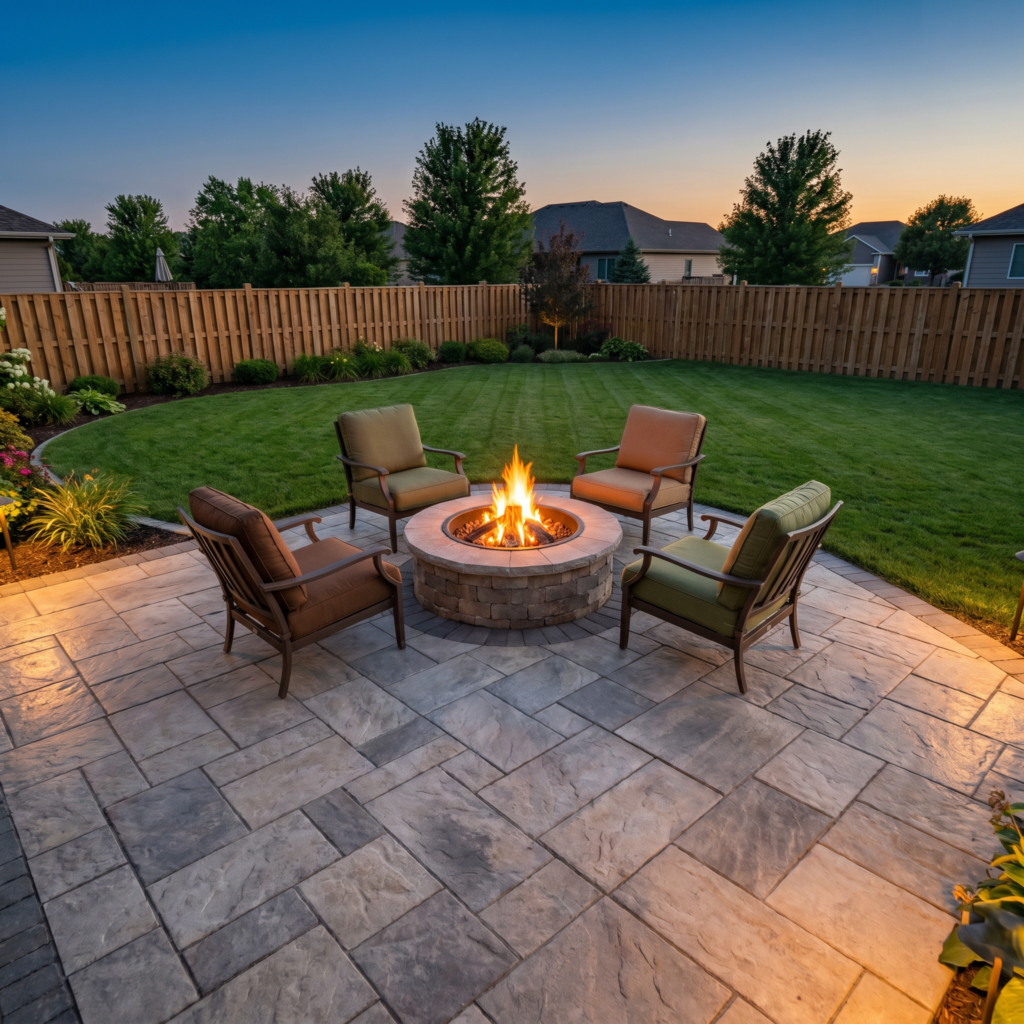
You want a patio with a fire pit, and you want to avoid surprises at permit time, during build time, or after a neighbor’s complaint. This guide covers Iowa costs, fire pit types, the city ordinances that actually matter (including West Des Moines’s rule most homeowners don’t know), gas permit requirements, and design choices for Iowa’s freeze-thaw climate.
TLDR: A patio + built-in wood-burning fire pit combo in Iowa typically runs $2,200 to $6,800. A standalone custom fire pit runs $325 to $2,000. Gas fire pits range from $3,500 to $8,000 all-in, including the gas line. Ground-level patios usually require no permit; gas lines always do; wood-burning fire pits are subject to city ordinances that vary across Central Iowa. West Des Moines bans smoke-producing fire pits entirely.
Iowa’s 5-month outdoor season makes a fire pit patio a high-impact addition. The catch: Central Iowa fire pit rules are not uniform. Choosing the right fire pit type is mostly a regulatory question.
What Does a Patio + Fire Pit Combo Cost in Iowa?
Costs depend on patio size, fire pit type, materials, and whether you are adding a gas line. The table below shows typical Iowa-adjusted ranges (Iowa runs roughly 14 percent below the national average on construction costs).
| Scenario | Typical Cost Range | Notes |
|---|---|---|
| Patio + basic wood-burning fire pit | $2,200 to $6,800 | Stone or paver patio + simple built-in pit |
| Custom built-in fire pit alone (9 to 16 sq ft) | $325 to $2,000 | Pit structure only, not patio or gas |
| Gas fire pit all-in (propane, with gas line) | $3,500 to $8,000 | Includes licensed plumber, permit, line, unit |
| Full paver patio + fire pit + seating wall | $8,000 to $21,000 | Larger scope, varies by material and size |
| Portable propane fire pit (unit only) | $75 to $500 | Plus $300 to $950 installed if hard-piped |
These are planning estimates. Final cost depends on site conditions, materials, and contractor.
Site prep (excavating clay, building a proper gravel base) adds $500 to $1,500. Most online estimates leave this out.
Pro Tip 1: Get three written estimates with line-item breakdowns that show the patio base, surface, fire pit structure, gas line (if any), and labor separately.
Pro Tip 2: Run a gas conduit during patio construction, even if you start with a wood-burning pit. Adding $150 in conduit now can save $800 to $1,500 in disruption costs if you later convert to gas (illustrative estimate; get a written quote for your project).
Types of Fire Pits: Which Is Right for Your Iowa Patio?
Four main options work for Iowa patios. Each has a different cost, regulatory complexity, and use case.
| Type | Cost Range | Iowa Permit? | OK in West Des Moines? | Best For |
|---|---|---|---|---|
| Wood-burning built-in | $325 to $2,000 | Usually no (pit itself) | No (smoke-producing) | Traditional ambiance, lowest cost |
| Natural gas (hard-piped) | $3,500 to $8,000 | Yes (gas permit) | Yes | Convenience, no smoke, restrictive cities |
| Propane (hard-piped) | $3,500 to $7,000 | Yes (gas permit) | Yes | Flexibility without natural gas service |
| Propane (portable) | $75 to $500 | No | Yes (no smoke) | Flexibility, lowest gas cost |
| In-ground | $1,000 to $3,000 | Usually no | No (smoke-producing) | Lower visual profile |
Your city ordinance mostly drives the right choice. For cities that allow wood fires under IFC rules (Ames, Ankeny, Johnston, Grimes, Urbandale, Norwalk), a wood-burning built-in is the most cost-effective option. For West Des Moines or any city with smoke restrictions, gas is the only legal path.
Pro Tip 3: Iowa’s clay soil means in-ground fire pits can collect water after rain and snowmelt. Always include a gravel drainage layer at the bottom.
Pro Tip 4: Pavers around the fire pit beat a continuous concrete slab in terms of heat tolerance. Pavers flex with thermal expansion; concrete cracks.
For a deeper comparison of patio surface materials, see our patio cost and material guide.
Iowa Fire Pit Laws: What Your City Actually Allows
Most national blogs skip this. Iowa’s recreational fire rules are layered: the state has one rule, your city likely overrides it, and a fire marshal burn ban can override both.
| City or Area | Wood-Burning Fire Pit Allowed? | Key Rule or Setback |
|---|---|---|
| Most Central Iowa cities (Ames, Ankeny, Johnston, Grimes, Urbandale, Norwalk) | Yes, with IFC compliance | 10 to 15 ft from any combustible structure |
| Des Moines (Polk County) | No (wood-burning fire pit not permitted for recreational use) | Cooking grills/devices OK; gas fire pit OK |
| West Des Moines | No (smoke-producing pits banned) | Only no-smoke gas fire pits permitted |
| Waukee | Restricted | 25 ft from structures; permit required if over 36 in diameter or 2 ft tall |
| Bondurant | Confirm with the city before lighting anything | 15 ft setback from any structure, including decks and porches |
| Ames | Yes | 15 ft setback from any structure including decks and porches |
| Marshalltown | Yes (contained) | 15 ft for contained pits; 25 ft for ground-level open fires |
Rules can change and vary by jurisdiction. Always confirm with your local fire department before installing.
Iowa DNR statewide rule: Recreational fires for cooking, heating, and recreation are exempt from Iowa’s open burning rules. However, local city ordinances override the state exemption, and the State Fire Marshal can issue burn bans during dry conditions.
West Des Moines callout: As of publication, West Des Moines’ adopted fire code prohibits smoke-producing fire pits and portable outdoor fireplaces within the city limits. Only no-smoke fire pits are permitted; bonfires require a Fire Prevention Bureau permit. Confirm current rules with the West Des Moines Fire Prevention Bureau before purchasing or installing a fire pit. For WDM residents, a gas fire pit is the legal path forward.
Des Moines / Polk County: Open burning, including recreational wood fires, is prohibited under Iowa Administrative Rule 567-23.2(455B) and Polk County Air and Waste rules. The Iowa DNR specifically notes that Polk and Linn counties require burning permits, confirming that Des Moines-area homeowners face stricter rules than the statewide recreational fire exemption suggests. Cooking grills and outdoor cooking devices fueled by approved fuels are exempt. Still, a traditional wood-burning fire pit for ambiance is not permitted for residential use without a variance from Polk County Air Pollution Control (typically reserved for civic organizations). For Des Moines homeowners, a gas fire pit is the practical legal path forward. Confirm current rules with the Des Moines Fire Department or Polk County Air Pollution Control before purchasing any fire-burning device.
Waukee: Open burning is generally prohibited except as specifically permitted. Portable outdoor fireplaces and BBQ grills using untreated wood are permitted for entertainment, cooking, or warmth. Built-in fire pits that are not portable outdoor fireplaces must be at least 25 feet from any structure or combustible material. Any fire larger than 36 inches in diameter or 2 feet tall requires a permit. No burning when the wind exceeds 15 mph, and all fires must be constantly attended.
Bondurant: Open burning is not permitted within the city limits of Bondurant without a permit. Confirm with the city before lighting any fire pit, including portable units.
General IFC rules (drawn from the City of Ames recreational fire code as a representative example) apply to most Iowa cities: contained pit (not open ground), 3 ft or less diameter, 2 ft or less height, constant adult attendance, 10 to 15 ft setback, no burning in high winds, extinguishment on hand, dry wood only, and no flammable liquids to start.
Pro Tip 5: Check your HOA covenants even when the city allows fire pits. HOAs can restrict fire pits entirely or limit the types of fuel allowed.
Pro Tip 6: Call your local fire department before buying a fire pit. A 5-minute phone call prevents a $5,000 mistake.
Pro Tip 7: Iowa burn bans are issued by local fire departments and emergency managers, often coordinated through the Iowa State Fire Marshal Division. During dry conditions, your city may prohibit all outdoor fires. Check the Iowa State Fire Marshal’s website before lighting any fire pit.
Fire safety note: Fire pits create a real fire risk. Follow all local rules, keep extinguishment materials on hand, and never leave a fire unattended.
Gas Fire Pit Permits and Gas Line Rules in Iowa
The patio usually needs no permit. The gas line always does.
| Requirement | Iowa Rule |
|---|---|
| Gas line extension for outdoor fire pit | Permit required; licensed Iowa plumber must perform work |
| Underground gas line burial depth | Minimum 12 inches; some jurisdictions require 18+ |
| Pipe material | Polyethylene (PE) per ASTM D2513 for underground runs |
| Shutoff valve location | Within 6 ft of the fire pit appliance |
| Pressure test | Required before any piping is concealed |
| Enclosure venting (gas pit housings) | Two opposing vents, 36+ sq in total |
| Electrical (if electronic ignition) | Separate electrical permit may apply |
Gas permit fees in Iowa typically range from $50 to $400, with a roughly 1-week review window. Gas piping work follows NFPA 54 (National Fuel Gas Code) for design and sizing, and outdoor gas fire pit appliances should carry ANSI Z21.97 / CSA 2.41 certification. Look for the mark on the unit.
Iowa requires gas line work to be performed by a licensed plumber or mechanical contractor through the Iowa Plumbing and Mechanical Systems Board (DIAL). Note the distinction: general contractors are registered through DIAL; plumbers and mechanical contractors are licensed through a separate state board.
Pro Tip 8: Verify your plumber holds a current Iowa license through DIAL before any gas line work begins.
Pro Tip 9: Pull the permit even for a small outdoor gas line addition. Unpermitted gas work is a major red flag in a home sale.
For full inspection sequencing, see our Iowa deck and porch permit guide.
Design Guide: Building a Fire Pit Patio That Works in Iowa
A fire pit patio that survives Iowa freeze-thaw and meets code is mostly about base prep, material choice, and placement.
Surface material. Pavers handle heat expansion better than a continuous concrete slab. If a paver cracks, replacement runs around $300; the same crack on a concrete slab is a $1,500 to $2,000 repair.
Placement. Minimum 10 ft from any combustible structure under most Iowa codes, with some cities requiring 15 to 25 ft. That includes decks, porches, fences, overhangs, wood furniture, and mulch. Keep the 3 ft surround noncombustible: brick, pavers, sand, or crushed stone. No grass, mulch, or wood decking immediately adjacent.
Size. Standard residential fire pits are 36 to 48 inches in diameter. The 36-inch size is most common and stays within the IFC 3-ft maximum for contained recreational fires.
Seating. Plan 5-6 ft from the fire pit center to the seating edges.
Drainage. Iowa clay soil and freeze-thaw cycles require a 6+ inch compacted gravel base under the entire patio. In-ground fire pits also need a Pitravel layer at the bottom of the pit.
Pro Tip 10: For gas pits, you can place the fire pit closer to dining or seating areas than a wood pit since there’s no spark drift.
Pro Tip 11: Iowa’s freeze-thaw can shift fire pit platforms and crack rigid gas connections. Use a stable footing and flexible gas connectors at the appliance.
ROI: Does a Patio + Fire Pit Add Value in Iowa?
Industry data suggests permanent fire pits deliver 50 to 70 percent ROI at resale. A well-designed patio, combined with outdoor living features, can achieve 80 percent or higher in competitive markets. Returns vary by market, design quality, home value, and buyer demand.
The lifestyle value matters specifically in Iowa. Buyers in competitive Central Iowa suburbs (Waukee, Ankeny, Johnston, Urbandale, Norwalk) increasingly expect quality outdoor space. A gas fire pit in West Des Moines comes with a unique premium: it’s the only legal fire feature option, making a properly installed one a real differentiator.
Avoid over-investing. An elaborate $15,000 fire feature on a $250,000 home will not return proportional value. Scale to your home value and market.
Pro Tip 12: Have a local real estate agent walk your block before committing to a high-end fire pit. ROI varies dramatically by neighborhood.
For a broader context on outdoor design, see our guide to outdoor living integration in Iowa homes.
Frequently Asked Questions
Q: How much does a patio with a fire pit cost in Iowa?
A basic patio + built-in wood fire pit combo runs $2,200 to $6,800. A gas fire pit all-in (with line) runs $3,500 to $8,000. A full paver patio with a fire pit and seating wall runs $8,000 to $21,000. Iowa runs roughly 14 percent below the national average; add $500 to $1,500 for site prep.
Q: Do I need a permit for an outdoor fire pit in Iowa?
The patio: usually not at ground level. The wood-burning fire pit structure: usually no. The gas line to a fire pit: yes, always. Confirm with your city before starting. West Des Moines has unique restrictions that you must verify with its Fire Prevention Bureau.
Q: Are fire pits legal in Des Moines and West Des Moines?
West Des Moines restricts smoke-producing fire pits; only no-smoke gas options are permitted. Des Moines follows Polk County air rules; cooking fires with grates are generally allowed, but purely recreational wood fires are restricted. Always confirm current rules with your local fire department.
Q: How far does a fire pit need to be from my house in Iowa?
Most Iowa cities require a 10- to 15-ft setback from any combustible structure, including decks, porches, fences, and overhangs. Some cities (Marshalltown) require 25 ft for ground-level open fires. Confirm with your local fire department.
Q: Can I put a fire pit on a concrete patio in Iowa?
Yes, with precautions. Never place a portable fire pit directly on concrete without a heat-insulating buffer of sand, gravel, or pavers. Direct heat causes concrete to crack and spall over time. Pavers around the fire pit are the better long-term choice in Iowa.
Q: What is the best fuel type for an Iowa fire pit?
It depends on your city. Natural gas or propane is the safest regulatory choice in restrictive cities like West Des Moines, and it has no smoke. Wood is the traditional choice, but it faces the most complexity under local ordinances. Portable propane gives you flexibility without a permit for the unit itself.
Key Takeaways
Cost in Iowa
- Patio + wood fire pit combo: $2,200 to $6,800
- Gas fire pit all-in: $3,500 to $8,000
- Full paver patio + fire pit + seating wall: $8,000 to $21,000
- Site prep adds $500 to $1,500
Iowa Fire Rules
- West Des Moines bans smoke-producing fire pits
- Des Moines restricts pure recreational wood fires (cooking with grates OK)
- Most other Central Iowa cities follow IFC: 10 to 15 ft setback, dry wood, constant attention
- Iowa DNR exempts recreational fires statewide, but city rules override
Permits
- Patio (ground-level): usually no permit
- Wood fire pit structure: usually no permit
- Gas line: always required; licensed plumber must perform work
- Plumbers are licensed (not registered) through Iowa DIAL
Design
- Pavers beat concrete adjacent to fire pits
- 10 to 25 ft setback minimum from combustibles
- 36-inch diameter is the most common, code-compliant size
- Run a gas conduit during patio construction, even if the pit starts a wood-burning pit
Ready to Build Your Patio + Fire Pit?
You know the costs, the city ordinances, the gas permit rules, and the design tradeoffs. The next step is talking with a contractor who knows local fire codes, works with licensed Iowa plumbers, and plans gas conduit during patio construction.
Busy Builders has served 1,285+ Central Iowa homeowners since 2020. We are DIAL-registered, we coordinate with licensed Iowa plumbers for any gas line work, and we provide written line-item estimates with no surprises.
Call: 844-435-9800 Website: https://busybuildersiowa.com/
We serve Des Moines, West Des Moines, Ankeny, Waukee, Johnston, Grimes, Urbandale, Norwalk, and all of Central Iowa. Schedule your free consultation today.
Important note: Cost ranges and ROI figures are planning estimates based on industry data adjusted for Iowa’s regional construction costs. Actual costs and resale value vary by site conditions, materials, contractor, market, and buyer demand. This article is not financial advice. Fire pit ordinances and burn ban status vary by Iowa city and change over time; always confirm current rules with your local fire department before installing or using a fire pit. Property tax implications vary by county in Iowa; consult your local assessor. HOA covenants may restrict fire pits regardless of city rules. Fire pits pose a real fire risk; follow all local rules, maintain extinguishing materials, and never leave a fire unattended.
Busy Builders | Full-Service Construction and Remodeling | Serving Central Iowa Since 2020
Related service: our deck building service.