Building a deck in Iowa takes more than good lumber and a solid plan. Before you dig the first post hole, you need to know which permits apply, what inspectors will check, and what structural standards your deck must meet. This guide breaks down Iowa’s deck code requirements for 2026, including how permit rules vary by city, what the inspection process looks like, and what happens if you skip the permit altogether. Always confirm requirements with your local building department before starting, since enforcement varies across Iowa.
TLDR: Most Iowa decks require a permit if they attach to your home, stand 30 or more inches above grade, or cover more than 200 square feet as a freestanding structure. Footings must go at least 42 inches deep to clear Iowa’s frost line in central and northern Iowa. Permit fees range from $75 flat to valuation-based scales depending on your city. Read on for the full breakdown by permit threshold, inspection phase, and structural standard.
You’ve got the design sketched out. You know where it goes and what size you want. But before you pour a single footing, there’s a critical question to answer: does your project require a permit, and what does your city actually require?
Iowa doesn’t have a single statewide answer. Des Moines, Grimes, and Ankeny each have separate fee schedules, submission portals, and permit thresholds. Scott County requires permits for every deck, no exceptions. Getting this right before construction costs far less than dealing with fines, stop-work orders, or complications when you try to sell.
This guide covers what Central Iowa homeowners need to know about deck permits, inspections, and structural requirements in 2026.
Do You Need a Permit to Build a Deck in Iowa?
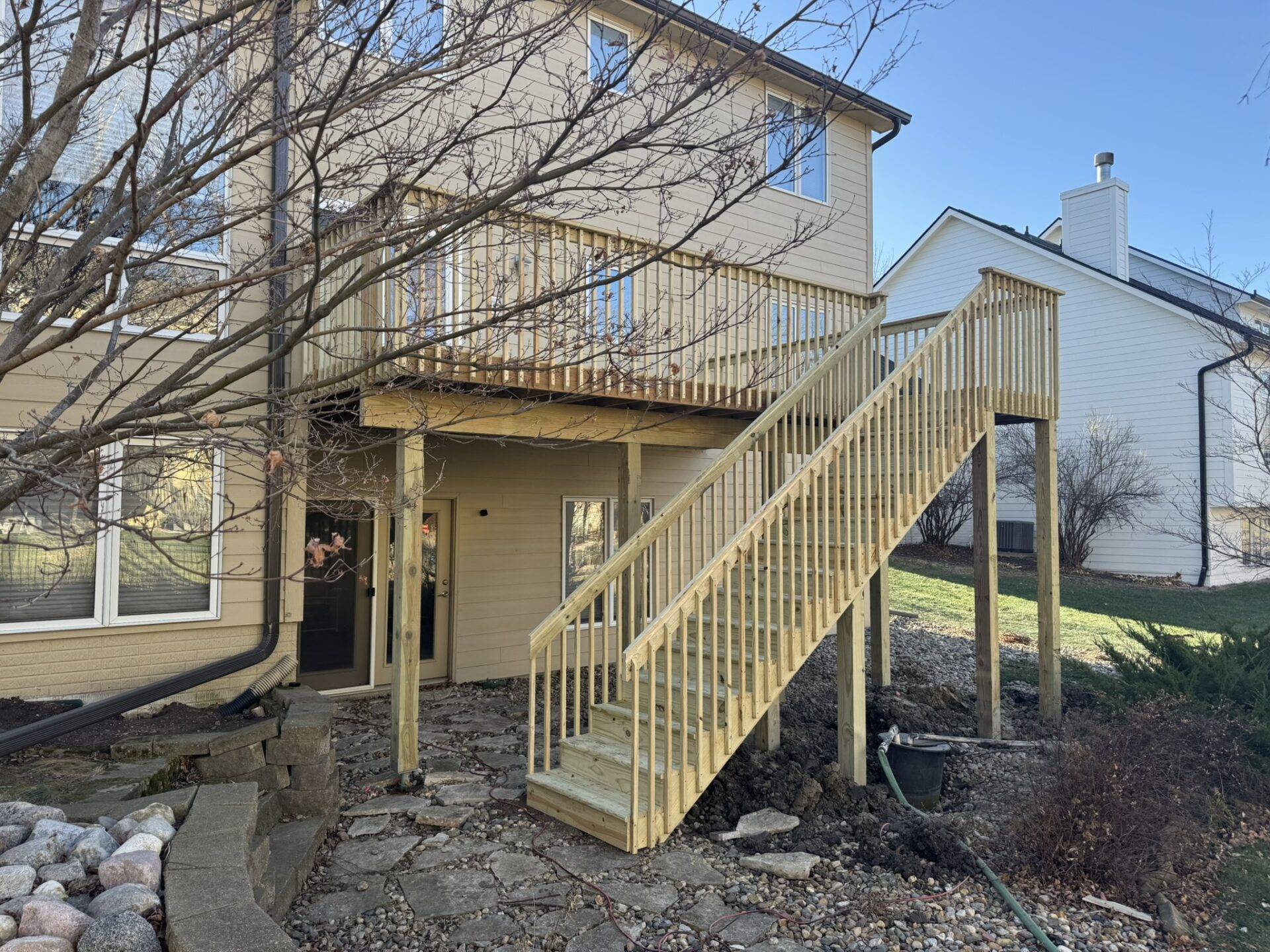
In most Iowa cities, a permit is required if your deck attaches to your home, regardless of size. A permit is also required if the deck rises more than 30 inches above grade or covers more than 200 square feet as a freestanding structure. Any deck with a permanent roof or cover requires a permit regardless of height.
A freestanding deck may be exempt in some cities, but only if it meets all four conditions at the same time: under 200 square feet, no more than 30 inches above grade at any point, not a required exit from the home, and no roof or cover. Miss one condition and the exemption disappears.
Pro tip 1: “Exempt from a permit” does not mean “exempt from code.” Setback rules, structural standards, and material requirements apply to every deck. If an exempt deck causes injury, liability still falls on the homeowner.
The table below covers the most common Iowa permit scenarios. Confirm your city’s specific threshold before starting.
| Situation | Permit Required? |
|---|---|
| Deck attached to home, any size | Yes, in all Iowa jurisdictions |
| Deck 30 or more inches above grade | Yes, in most Iowa cities |
| Freestanding deck over 200 sq ft | Yes, in most jurisdictions |
| Deck with roof, trellis, or cover | Yes, regardless of height |
| Deck serving as required exit door | Yes |
| Small freestanding deck under 30″, under 200 sq ft | Maybe not, confirm locally |
| Adding stairs to existing deck | Often yes, confirm locally |
| Replacing surface boards only | Usually no, confirm locally |
How to Get a Deck Permit in Iowa
Permit applications go to your city or county building department, not the state. Most larger Iowa cities offer online submission. Des Moines uses the CSS portal. West Des Moines uses the City Access Portal. Smaller communities may require paper applications.
You’ll typically need a completed application, a site plan showing the deck location relative to property lines, and construction drawings with post locations, joist spans, beam sizes, and footing depths. Review takes about 5 to 10 business days after a complete submission.
Fee structures vary by city. Grimes charges a flat $75 deck permit fee. Ankeny calculates fees at $12 per square foot of deck valuation. Most Des Moines area permits run $75 to $300 depending on city and deck size. Review a city-by-city overview of Iowa permit requirements for a current breakdown before budgeting.
Pro tip 2: Start the permit process before ordering materials. A 5 to 10 business day review window can delay construction if you wait until lumber arrives.
Iowa requires contractors working on residential projects to be registered with DIAL, the Department of Inspections, Appeals, and Licensing. Under Iowa Code §91C.1, homeowners performing work on their own property are exempt from contractor registration requirements, but the permit still applies. If a contractor asks you to pull the permit yourself, that is a red flag about their DIAL registration status. Electricians, plumbers, and HVAC technicians require separate state licenses regardless of who manages the general permit.
Iowa Deck Inspections: What Gets Checked and When
Iowa deck inspections happen in phases. Missing a phase, such as pouring concrete before footing approval or laying decking before framing is inspected, creates real problems. Call your building department at least 24 hours before each phase.
| Inspection Phase | When to Call | What Inspector Checks |
|---|---|---|
| Footing / Post Hole | After holes dug, before concrete | Depth (42″+ minimum in most areas), diameter, location |
| Framing Rough-In | After framing, before decking | Posts, beams, ledger, joists, hardware |
| Final | All work complete | Decking, stairs, guardrails, handrails |
| Electrical / Plumbing | Per trade permit schedule | Outlets, lighting, any mechanical work |
Pro tip 3: Call 811 before any digging. Iowa law requires you to locate underground utilities before excavation. It’s free and takes about three business days to complete.
Iowa Deck Structural Requirements
Iowa’s climate puts specific demands on deck construction. The state averages 45 to 84 freeze-thaw cycles per year. Clay-heavy soils expand when wet and contract when dry, adding lateral stress to posts and footings year-round.
Footings
Iowa’s frost line requires footings to be at least 42 inches deep in central and northern Iowa, including the Des Moines metro. Footings above this depth will heave during freeze-thaw cycles and destabilize the entire deck. Southern Iowa cities may allow shallower footings, so always confirm the required depth with your local building department before excavating. Minimum footing diameter is typically 12 inches for residential decks without a roof. Never set wood posts directly in concrete. Use post bases with hardware rated for the load to prevent moisture damage.
Ledger Board
The ledger board connects your deck to the home’s band joist. Faulty ledger attachment is one of the leading causes of deck collapse nationally. Iowa requirements call for 1/2-inch lag screws or carriage bolts with washers, never nails alone, spaced every 16 inches. Siding must be removed behind the ledger, and proper flashing must be installed above it to direct water away from the home. All fasteners used with pressure-treated ACQ lumber must be hot-dip galvanized or stainless steel. Standard hardware corrodes on contact with modern preservatives.
Guardrails and Stairs
The table below summarizes the key guardrail and stair requirements Iowa inspectors check. Iowa has adopted the 2024 IRC as the statewide baseline, though individual cities may still enforce their own adopted editions with local amendments. Confirm which applies in your jurisdiction before finalizing structural plans.
| Requirement | Standard |
|---|---|
| Guardrail required when | Deck is 30″ or more above grade |
| Guardrail minimum height | 36″ from deck surface |
| Baluster spacing | No more than 4″ apart |
| Minimum stair width | 36 inches |
| Maximum riser height | 7-3/4 inches |
| Minimum tread depth | 10 inches |
| Handrail required when | 4 or more risers; some Iowa cities require at 3, confirm locally |
| Handrail height | 34″ to 38″ above nose of tread |
All exposed structural lumber must be pressure-treated or a naturally decay-resistant species. Use ground-contact rated lumber (UC4A) for posts and joists near soil. It carries about 2.5 times more preservative than above-ground lumber and handles Iowa’s soil conditions better over time.
What Happens If You Build Without a Permit?
Skipping a permit creates problems that grow over time. The most immediate consequence is a fine, often double the original permit fee. Cities can also issue stop-work orders mid-construction. In serious cases, local authorities require demolition of the unpermitted structure.
The longer-term consequences hit harder. Buyers’ lenders and inspectors will identify unpermitted decks when you sell. Lenders can require you to bring the structure into compliance or remove it before closing. Some homeowner’s insurance policies limit or deny coverage if an unpermitted deck causes damage or injury.
| Scenario | With Permit | Without Permit |
|---|---|---|
| Construction fines | None | Often double the permit fee |
| Work order | Not applicable | Stop-work or cease and desist possible |
| Home sale | No issue | May delay or kill sale |
| Insurance claim | Covered | Possible coverage denial |
| Retroactive permit | Not applicable | More expensive; city can demand tear-down |
Iowa-Specific Factors That Affect Your Build
Iowa’s clay-heavy soils affect more than just footing depth. Soil bearing capacity varies across the state, so larger footings may be needed in softer or highly expansive soil. Ask your building department about local requirements before finalizing your structural plan.
Some smaller Iowa communities use third-party inspection services rather than a city building department. Veenstra & Kimm, now part of Kleinfelder, handles permit reviews for a number of Iowa cities and follows the same process as a city inspector. If you’re building outside a major metro area, ask your county whether a third-party inspector handles your review.
For budgeting your full project, our guide to deck construction costs in Des Moines and our breakdown of the best deck materials for Iowa weather give you a solid starting point.
Frequently Asked Questions
Q: Do I need a permit to build a deck in Iowa?
In most cases, yes. Decks attached to your home require a permit in all Iowa jurisdictions. Decks over 30 inches above grade or over 200 square feet as freestanding structures require a permit in most cities. Scott County requires permits for all decks with no exceptions. Confirm your city’s specific threshold before starting construction.
Q: How deep do deck footings need to be in Iowa?
In central and northern Iowa, including the Des Moines metro, footings must go at least 42 inches deep. Footings above this depth will heave during winter freeze-thaw cycles and compromise the entire structure. Southern Iowa cities may allow shallower footings. Always confirm the required depth with your local building department before you excavate.
Q: What inspections are required for an Iowa deck?
Most jurisdictions require three phases: a footing inspection before concrete is poured, a framing inspection before decking goes down, and a final inspection when all work is complete. Separate permits and inspections apply to any electrical or plumbing work. Call at least 24 hours ahead for each phase and have your approved plans on-site.
Q: What happens if I build a deck without a permit?
Fines are the most immediate consequence, often double the original permit fee. Cities can issue stop-work orders or require demolition. When you sell, unpermitted decks create complications with buyers’ lenders and inspectors. Insurance coverage may also be affected. Getting the permit upfront costs far less than dealing with the retroactive process.
Q: Can a homeowner pull their own deck permit in Iowa?
In most Iowa cities, yes. Iowa Code §91C.1 exempts homeowners doing work on their own primary residence from contractor registration requirements. The permit requirement still applies regardless. If a contractor asks you to pull the permit yourself, that is a red flag about their DIAL registration status.
Key Takeaways
Permit requirements. Most Iowa decks require a permit if attached to the home, over 30 inches above grade, or over 200 square feet as a freestanding structure. All four exemption criteria must be met together to skip a permit. Exempt decks still must meet code.
How to get the permit. Apply at your city or county building department. Plan for 5 to 10 business days for review. Fees range from $75 flat to valuation-based scales. Start before ordering materials.
Inspections. Three phases apply: footing before concrete, framing before decking, and final after all work is complete. Call 24 hours ahead. Call 811 before any digging.
Structural standards. Footings go at least 42 inches deep in central and northern Iowa; confirm locally for southern Iowa. Ledger boards need lag screws or carriage bolts with flashing. Guardrails are required at 30 inches and above. Use ACQ-rated hardware throughout.
Skipping the permit. Fines, stop-work orders, home sale complications, and insurance issues are real consequences. Cities can require demolition. The retroactive permit process costs more and gives cities grounds to demand tear-down.
Ready to Build? Work with a Team That Knows Iowa Codes
You now have a clear picture of what Iowa’s permit process, inspection sequence, and structural standards actually require. The next step is making sure your project starts correctly from day one.
Busy Builders has helped more than 1,285+ Central Iowa homeowners with construction and remodeling projects since 2020. Our registered contractors know the permit processes in Des Moines, Ankeny, Waukee, and surrounding communities. We handle the application process, coordinate inspections, and make sure the structural work meets code before the inspector ever shows up.
Here’s what you get when you work with us:
Free consultation to walk through your deck plans and budget. Permit application support and local code guidance. Experienced crews familiar with Central Iowa building departments. Transparent timelines and honest cost estimates. Workmanship warranty on every project.
Contact us today to get started.
Call: 844-435-9800 Website: busybuildersiowa.com
Learn more about our deck building services and schedule your free consultation.
Busy Builders | Full-Service Construction and Remodeling | Serving Central Iowa Since 2020