Iowa homeowners want exactly what everyone else wants, a home that feels connected to the outdoors, where the line between inside and outside gets blurry on a warm evening. The challenge is that Iowa’s climate doesn’t cooperate the way Southern California’s does. This guide explains what indoor-outdoor living actually looks like in Central Iowa, which structures deliver it, and what each one costs, so you can make a decision that works year-round, not just in the photos.
TLDR: Iowa gives you about five months of comfortable open-air living before mosquitoes, fall pests, and winter shut everything down. The right outdoor structure extends that season significantly, or eliminates the limit with a four-season room. Match the structure to your goals and budget, not to what looks good in a magazine set in Florida.
You’ve probably seen the Instagram version of indoor-outdoor living: folding glass walls that open to a lush patio, ceiling fans spinning in the breeze, the whole back of the house disappearing into the landscape. Designers call this biophilic design, connecting people to nature through architecture. It’s a real trend, with over 310,000 Instagram posts tagged in 2025, and 39% of homeowners completing an outdoor living project in the past year.
Here’s the Iowa version of that conversation: June, July, and August are peak mosquito season in Central Iowa, with mosquitoes active as early as May and as late as October. Winter temperatures can reach -20°F. The frost line in the Des Moines area is 42 inches deep, which affects every permanent structure you build. Without some form of enclosure, comfortable outdoor living in Central Iowa runs roughly five months. The structure you choose determines whether that number stays at five or grows to twelve.
Why Iowa Makes Indoor-Outdoor Living a Design Challenge
Iowa’s Climate Zone 5A puts the full range of weather pressure on any outdoor structure. Summers hit 95°F with high humidity. Winters drop hard and stay cold. Spring and fall bring freeze-thaw cycles that shift the ground and stress shallow foundations. Iowa’s 42-inch frost line requirement means any permanent outdoor structure needs deep footings, and anything built shallower will move with the ground over time.
Mosquito season adds another constraint. Standing water from Iowa’s spring rains and summer storms fuels mosquito populations throughout Central Iowa. Fall pest migration, wasps, boxelder bugs, creates a second nuisance window in September and October near outdoor structures.
The honest framing: an open deck is Iowa’s most popular outdoor addition, and it’s also the one that gets abandoned most often in July. The homeowners who use their outdoor space consistently across the seasons are the ones who have built a structure around it. The question is which structure fits your goals.
The Iowa Outdoor Living Spectrum: Five Options Compared
The table below compares the main options on the metrics that matter for Iowa: usable season, cost range, and typical ROI. ROI figures reflect what projects typically see in similar markets, actual returns vary by property, condition, and buyer. Always consult a real estate professional for guidance specific to your home and neighborhood.
| Structure | Usable Season in Iowa | Approx. Cost Range | Notes |
|---|---|---|---|
| Open Deck | May through September | $15 to $75/sqft installed | Entry point; weather-dependent |
| Covered Deck | May through October | $10,000 to $25,000 mid-range | Rain and sun protection |
| Pergola | May through October | $2,100 to $8,500 Des Moines | Minimal rain coverage; ambiance |
| Screened Porch | May through October | $10,000 to $35,000 new construction | Bug-free; no heat or cooling |
| Four-Season Room | Year-round | $45,000 to $95,000+ | Full insulation, HVAC, year-round use |
Costs vary by project scope, site conditions, and labor rates. Always get multiple written quotes.
Open and Covered Decks: The Starting Point
An open deck is where most Iowa homeowners begin thinking about outdoor living, and for good reason. It’s the lowest-cost entry point and works well for spring evenings and fall weekends when the weather cooperates. The problem shows up in July, when mosquitoes make an uncovered, unscreened deck genuinely uncomfortable during peak evening hours.
A covered deck solves the sun and rain problems without addressing insects. It extends your usable season into October by blocking Iowa’s afternoon thunderstorms and UV exposure, and it creates a passive cooling buffer between the sun and your glass doors in summer. It won’t keep out mosquitoes, but it does make the space far more comfortable on hot, overcast days that make open decks miserable. Mid-range covered deck builds in the Waukee and Des Moines area run $10,000 to $25,000; premium builds with complex rooflines or high-end materials can reach $30,000 to $70,000.
Choosing the right material matters for any Iowa deck because freeze-thaw cycles are hard on wood. See our guide to choosing the right decking material for a full breakdown of which materials hold up in Central Iowa winters.
Screened Porches: Iowa’s Bug-Free Answer
If mosquitoes are what’s keeping your family off the deck in July, a screened porch is the most targeted solution available. Screens block insects while keeping the air moving and the outdoor feeling intact. You don’t get heat or air conditioning, a screened porch has screens only, no glass windows, so it’s not usable in January. But it extends your comfortable outdoor season from five months to roughly six, and it’s the structure families with kids most often say they wish they’d built sooner.
New screened porch construction in Des Moines runs $10,000 to $35,000 for a typical build. Screening an existing deck or porch costs $2,000 to $5,800 for the screen installation alone, depending on size and frame condition. A small 12 x 12 screened porch can run as little as $1,500 if the framing already exists.
Screened porches require permits in most Iowa cities before any structural work begins. Always confirm requirements with your local building department before starting.
Three-Season vs. Four-Season: The Year-Round Question
This is where “blurring the line” between inside and outside becomes a real decision with real stakes. A three-season room uses windows but lacks insulation and HVAC, it’s usable roughly April through October in Iowa, and genuinely uncomfortable the other five to six months. In Iowa’s Climate Zone 5A, a three-season room is an unheated glass box in winter. Don’t build one expecting year-round use. If your goal is year-round indoor-outdoor living in Iowa, a three-season room is the wrong product. Budget for a four-season room, or plan to close the space off entirely for five months every winter.
A four-season room is a different product entirely. It’s a full home addition: a foundation that extends below Iowa’s 42-inch frost line, structural framing, insulated high-performance windows with a U-factor of 0.30 or lower, and integrated HVAC. In Iowa’s temperature range of -20°F to 95°F, that thermal performance specification isn’t a luxury, it’s what separates a room you’ll use in February from one you’ll close off until April. Before committing to a four-season room, have a licensed HVAC contractor assess whether your existing system has capacity for the added square footage. Your options include extending existing ductwork, adding a ductless mini-split heat pump, or installing electric baseboard heat, and that decision affects both the project budget and your monthly energy costs.
A four-season room also adds livable square footage that counts in your home’s appraisal, something a deck or screened porch doesn’t do. Buildings in the Des Moines area start at about $300 per square foot. See the full cost and planning breakdown in our guide to adding a four-season porch in Des Moines.
| Porch Size | Approx. Dimensions | Typical Cost Range (Des Moines 2026) |
|---|---|---|
| Small | 10 by 12 feet (120 sq ft) | $36,000 to $45,000 |
| Mid-sized | 12 by 16 feet (200 sq ft) | $55,000 to $70,000 |
| Large | 14 by 20 feet (280 sq ft) | $75,000 to $95,000 |
Costs reflect Central Iowa labor and material rates. Always get multiple written quotes. Permits for a four-season room in the Des Moines area typically run $500 to $1,500.
The Door Connection: How You Get From Inside to Outside
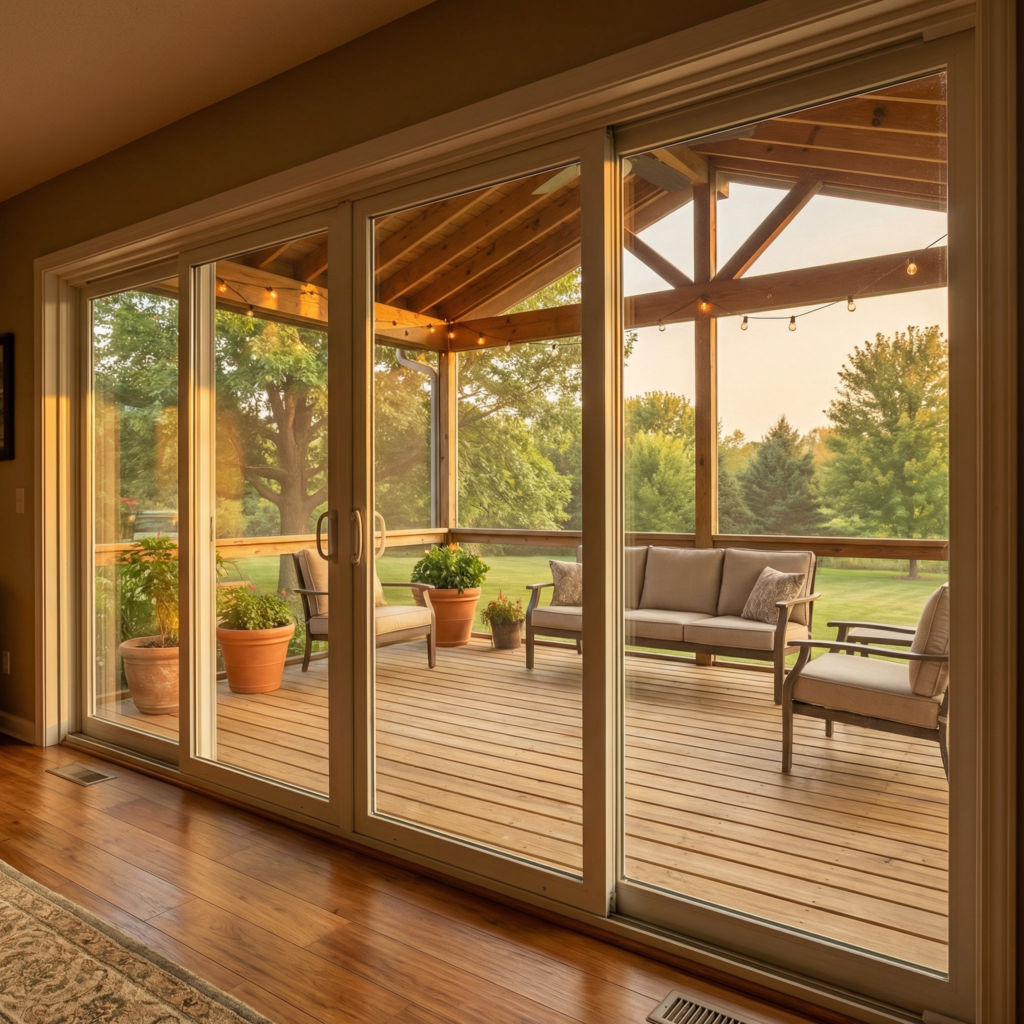
The door connecting your interior to the outdoor structure determines how much the indoor-outdoor experience actually works day-to-day. Two options dominate modern projects: sliding patio doors and bifold/folding doors.
Sliding patio doors are the practical choice for Iowa. They open about 50% of the opening width, have fewer moving parts, require less maintenance, and deliver better thermal performance, a U-factor of 0.28 to 0.35 compared to 0.35 to 0.45 for bifold systems. The installed cost for a 12- to 16-foot opening ranges from $3,000 to $15,000. For everyday use in a cold climate, sliding doors deliver a better long-term comfort and energy profile.
Bifold and folding door systems open to 90% of the wall width, creating the dramatic “disappearing wall” effect you see in high-end design. They cost more, $10,000 to $35,000 installed, and have higher maintenance requirements. The thermal penalty versus sliders is modest but real in Iowa winters. They’re the right choice when entertaining is the primary use case and you want the full wall-opening effect on occasion, not daily.
| Door Type | Opening Width | Installed Cost | U-Factor | Best Iowa Use |
|---|---|---|---|---|
| Sliding Patio Door | About 50% | $3,000 to $15,000 | 0.28 to 0.35 | Everyday use, energy efficiency |
| Bifold/Folding Door | Up to 90% | $10,000 to $35,000 | 0.35 to 0.45 | Entertaining, full opening effect |
| French Door | Up to 100% | $1,500 to $5,000 | Varies | Classic style, smaller openings |
Outdoor Kitchens, Pergolas, and Patios
A patio surface anchors any outdoor living area, and in Iowa, the choice of material matters. Concrete patios in Des Moines run $9.60 to $19.00 per square foot installed, but Iowa’s freeze-thaw cycles can crack a concrete slab over time. Paver patios handle those cycles better because individual pavers flex with the ground, and damaged pavers can be replaced without tearing up the whole surface.
Outdoor kitchens cost a national average of about $16,400, with most projects ranging from $6,300 to $27,000. The cost ranges in this section reflect market averages for Central Iowa, not BusyBuilders’ quotes. For outdoor features outside the scope of a larger remodel, contact us to discuss coordination options. In Iowa, plan for covered and weather-sealed installations, summer humidity and winter cold are hard on equipment left fully exposed. Pergolas anchor outdoor spaces with shade and structure; Des Moines pergola costs run $2,100 to $8,500 for most builds. A permit is required for pergola structures over 120 square feet in the Des Moines area.
For patios, pergolas, and outdoor kitchens that aren’t part of a larger deck or addition project, Busy Builders can coordinate with specialty contractors for those scopes.
What Iowa Homeowners Get Wrong
These are the patterns that turn an outdoor living investment into a source of frustration, choosing an open deck only to be surprised when mosquitoes make it unusable in July and August. Building a three-season room and expecting it to work through Iowa winters, it won’t. Skipping HVAC capacity planning for a four-season room and discovering mid-project that the existing furnace can’t handle the added square footage. Underestimating Iowa’s 42-inch frost line, which adds foundation cost compared to warmer climates. Starting outdoor structural work without permits can lead to stop-work orders, fines, and complications at resale. Not checking HOA rules before designing, materials, colors, and styles may be restricted in your subdivision. And skipping the Iowa One Call 811 utility locate before any footing work begins, which is required by Iowa law, is not optional.
All of these are avoidable with a clear plan and the right contractor guiding the process. For anything involving permits, inspections, or Iowa building code requirements, we handle that coordination for our customers on every project.
FAQs
Q: How do I extend my outdoor living season in Iowa?
Screening blocks mosquitoes and makes the space usable from May through October. A covered structure adds protection from rain and sun without enclosing the space. Only a four-season room with full HVAC delivers genuine year-round use in Iowa’s Climate Zone 5A. The right choice depends on how many months of use you want and your budget.
Q: What’s the difference between a three-season room and a four-season room in Iowa?
A three-season room has windows but no insulation or HVAC, it’s usable roughly April through October and becomes an unusable cold space during Iowa winters. A four-season room has full insulation, high-performance windows with a U-factor of 0.30 or lower, a foundation below the 42-inch frost line, and integrated HVAC. That’s the only structure that works year-round in Central Iowa’s temperature range of -20°F to 95°F. Three-season and four-season rooms are meaningfully different products, don’t let cost alone drive the decision.
Q: Is a four-season room worth the cost in Iowa?
For homeowners who want usable living space year-round, it typically is. A four-season room adds square footage that counts in your home’s appraisal, unlike a deck or screened porch, which don’t contribute to gross living area. In the Des Moines market, year-round living space generally appeals to buyers. Projects in the area typically start at $300 per square foot and can yield meaningful value, but returns vary by property, condition, and market. Consult a real estate professional for guidance specific to your home.
Q: What kind of door works best for connecting indoor and outdoor spaces in Iowa?
Sliding patio doors are the better everyday choice for Iowa’s cold climate. They deliver better thermal performance, a U-factor of 0.28 to 0.35, lower maintenance, and cost less than bifold systems ($3,000 to $15,000 installed versus $10,000 to $35,000). Bifold and folding doors create a dramatic full-wall opening effect that’s ideal for entertaining spaces, but they come with a real thermal penalty in Iowa winters. For a space you’ll use daily in all seasons, sliding doors perform better over time.
Q: Do I need a permit for a screened porch or four-season room in Iowa?
Yes to both. Structural outdoor additions require permits in most Iowa cities. A screened porch requires a permit before any structural work begins. Four-season room permits in the Des Moines area typically run $500 to $1,500. Pergola structures over 120 square feet also require permits in the Des Moines area. Always confirm with your local building department before starting, requirements vary by city and project type.
Key Takeaways
Iowa gives you five months without help. Open decks and uncovered outdoor spaces are comfortable from May through September. After that, mosquitoes and the weather close them down. Structure is what extends the season.
Match the structure to the season you want. Screened porch for bug-free outdoor living through October. Covered deck for rain and sun protection. Four-season room for year-round use. Three-season rooms do not work through Iowa winters.
Foundation depth is non-negotiable. Iowa’s 42-inch frost line means every permanent outdoor structure needs deep footings. Anything shallower moves with the ground.
HVAC planning matters for four-season rooms. Have a licensed mechanical contractor assess whether your existing system can handle the added square footage before you finalize the project scope.
Permits protect you. All permanent outdoor structures require permits in most Iowa cities. Call 811 before any footing work begins, it’s the law in Iowa.
Ready to Extend Your Iowa Outdoor Season?
Busy Builders has completed 1,285+ projects across Central Iowa since 2020, including decks, covered decks, screened porches, and home additions, including four-season rooms. We handle permits, coordinate inspection scheduling, and manage HVAC contractor coordination for every project, you don’t have to piece it together yourself.
Call us at 844-435-9800 or visit busybuildersiowa.com to schedule your free consultation. We serve Des Moines, West Des Moines, Ankeny, Urbandale, Johnston, Waukee, Grimes, Clive, Bondurant, and communities throughout Central Iowa.
Busy Builders | Full-Service Construction and Remodeling | Serving Central Iowa Since 2020
Related service: professional deck construction.
Disclaimer: This article is for general information and is not project-specific advice. Cost figures are planning estimates that vary by scope, materials, site conditions, and current pricing. Permit requirements vary by city and jurisdiction; verify current requirements with your local building authority before starting any project. No specific outcomes are guaranteed. Consult a registered contractor for guidance specific to your project. ROI and resale figures are illustrative and not financial advice; actual returns vary by market and project quality. Structural changes require evaluation by a qualified professional; do not rely on general guidance for load-bearing decisions. Below-grade moisture outcomes depend on site conditions; there is no guarantee against water intrusion.