You want to add a bedroom in your Iowa basement, and you need to know what makes it legal, what it costs, and what happens if you skip the rules. This guide covers Iowa’s adopted IRC requirements, the Iowa-specific radon reality that as many as 5 in 7 Iowa homes are above the EPA action level, real permit and cost data, and the disclosure consequences of an unpermitted bedroom in an Iowa home sale.
TLDR: To add a legal bedroom in an Iowa basement, the room must meet five non-negotiable requirements: minimum 70 sq ft of floor area, 7-foot minimum ceiling height, an egress window with at least 5.7 sq ft of net clear opening, a smoke detector, and a carbon monoxide detector on the floor. Iowa is in EPA Radon Zone 1, and most Iowa homes test above the EPA action level, so radon testing should be part of any basement bedroom project. A permit is required. Typical project cost: $5,000 to $30,000, depending on scope.
A basement bedroom is the single most common Central Iowa remodeling project, where shortcuts cause real problems later. An unpermitted bedroom cannot be listed as a bedroom for sale. A non-compliant egress window is a fire safety hazard and a cause of a failed inspection. An untreated basement with levels above 4 pCi/L is a known, disclosable health issue under Iowa real estate law. The five rules below exist to protect your family and your investment.
What Makes a Basement Bedroom Legal in Iowa?
Iowa adopted the 2024 IRC under Iowa Administrative Code 481-301.8, effective September 10, 2025. Five non-negotiable requirements determine whether a room qualifies as a legal bedroom.
| Requirement | Iowa IRC Standard | Notes |
|---|---|---|
| Floor area minimum | 70 sq ft | IRC R304.1 |
| Minimum horizontal dimension | 7 ft in any direction | IRC R304.2 |
| Ceiling height | Egress window sill from the floor | IRC R305.1 |
| Ceiling obstructions (beams, ducts) | Cannot reduce clear height below 6 ft 8 in | IRC R305.1.1 |
| Egress window net clear opening | 5.7 sq ft minimum | Iowa IAC 481-301.8 / R319.1 |
| Egress window opening height/width | 24 in height, 20 in width minimum | Iowa IAC 481-301.8 / R319.1 |
| AFCI protection is required for bedroom circuits | Maximum 44 in | Iowa IAC 481-301.8 / R319.1 |
| Egress window well (if below grade) | 9 sq ft horizontal area, 36 in projection | Iowa IAC 481-301.8 / R319.2 |
| Ladder in window well | Required if well over 44 in deep | Iowa IAC 481-301.8 / R319.2 |
| Smoke detector | Required in every bedroom | IRC R314 |
| CO detector | On every floor with sleeping rooms | IRC R315 |
| Heat source | Capable of maintaining 68°F | IRC R303.10 |
| Electrical | AFCI protection required for bedroom circuits | IRC E3902 |
Based on Iowa’s adopted 2024 IRC with state amendments. Always confirm current requirements with your local building department.
All five core requirements (size, ceiling, egress, detectors, heat) must be in place before the room counts as a bedroom in any listing, appraisal, or real estate transaction. An “almost compliant” room is not a legal bedroom.
Pro Tip 1: The most commonly failed inspection item is the egress window, almost always because the installed window’s net clear opening is smaller than the rough opening. Measure the actual openable area, not the window unit size.
Pro Tip 2: Iowa cities may be on different code cycles or have local amendments. Always pull current requirements from your local building department before designing.
The Egress Window: Iowa’s Most Critical Requirement
An egress window is a fire escape. Its purpose is to allow occupants to escape and firefighters to enter. The IRC rules around egress windows are precise because lives depend on them.
The most important number to understand is net clear opening. That is the actual openable area after accounting for the window frame, sash, and hardware. It is neither the rough opening size cut in the foundation nor the window unit’s manufacturer-listed dimensions. A 5.7 sq ft net clear opening is roughly equivalent to a 24×34-inch operational area (as one example) after deducting for frame obstructions.
Note: the 5.0 sq ft exception in the IRC applies only when the window sill is at or above the adjacent exterior grade, which is not typical for basement bedrooms. For a standard below-grade basement window, the applicable minimum is 5.7 sq ft.
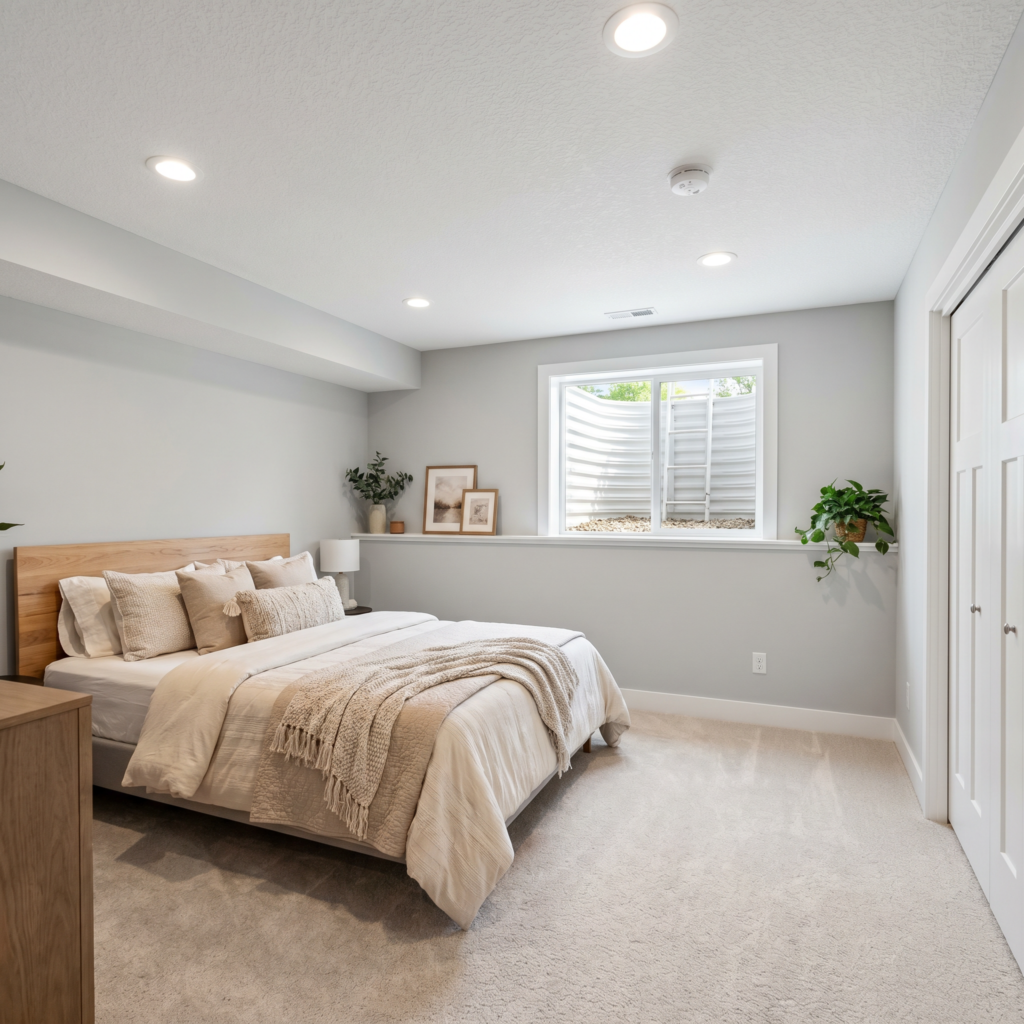
When the window sill is below grade (which is typical for a basement), a window well is required. The well must have at least 9 sq ft of horizontal area and project at least 36 inches from the foundation wall. If the well is deeper than 44 inches, a permanently affixed ladder or steps are required so an occupant can climb out and a firefighter can climb in.
Iowa’s freeze-thaw climate makes window well drainage critical. A poorly drained well fills with water, ice, and debris, which can freeze and force water into the bedroom. Gravel backfill at the bottom of the well and a drain tile to daylight or a sump are both strongly recommended. A clear plastic well cover keeps debris and snow out without blocking light.
Cutting an egress opening in a basement foundation wall is structural work. The foundation’s integrity must be maintained, and a properly sized header is required above the cut. This is contractor work, never DIY. Iowa One-Call (811) is required by Iowa law before any exterior excavation for the window well. For deeper detail on egress window specifics in Central Iowa, see our egress windows for basement bedrooms guide.
| Requirement | Iowa Standard |
|---|---|
| Net clear opening area | 5.7 sq ft minimum |
| Minimum opening height | 24 in net clear |
| Minimum opening width | 20 in net clear |
| Window well minimum projection from the wall | 44 in |
| Window well minimum horizontal area | 9 sq ft |
| A ladder is required if well depth exceeds | 36 in |
| A ladder is required if the well depth exceeds | 44 in |
Confirm current requirements with your local building department.
Pro Tip 3: A window’s net clear opening is always smaller than its rough opening. When buying an egress window, get the manufacturer’s net clear opening spec in writing before installation, not just the unit size.
Pro Tip 4: Egress windows installed in Iowa without proper window-well drainage fail within 3 to 5 years due to freeze-thaw cycles. Specify gravel backfill, drain tile to daylight or sump, and a clear well cover at install.
Iowa’s Radon Reality: The Single Most Important Iowa Fact
Iowa is entirely within EPA Radon Zone 1, the highest-risk designation. According to the Iowa Radon Survey, as many as 5 in 7 Iowa homes test above the EPA action level of 4 pCi/L. Radon is colorless, odorless, and the second leading cause of lung cancer in the U.S. after smoking.
Radon testing is not a building code requirement under the Iowa IRC. It is, however, a critical health and safety issue and a real estate disclosure obligation. Iowa Code Chapter 558A requires sellers to disclose known material defects, including known radon test results. An unmitigated basement bedroom above 4 pCi/L is a known disclosable condition that will surface during a buyer’s inspection.
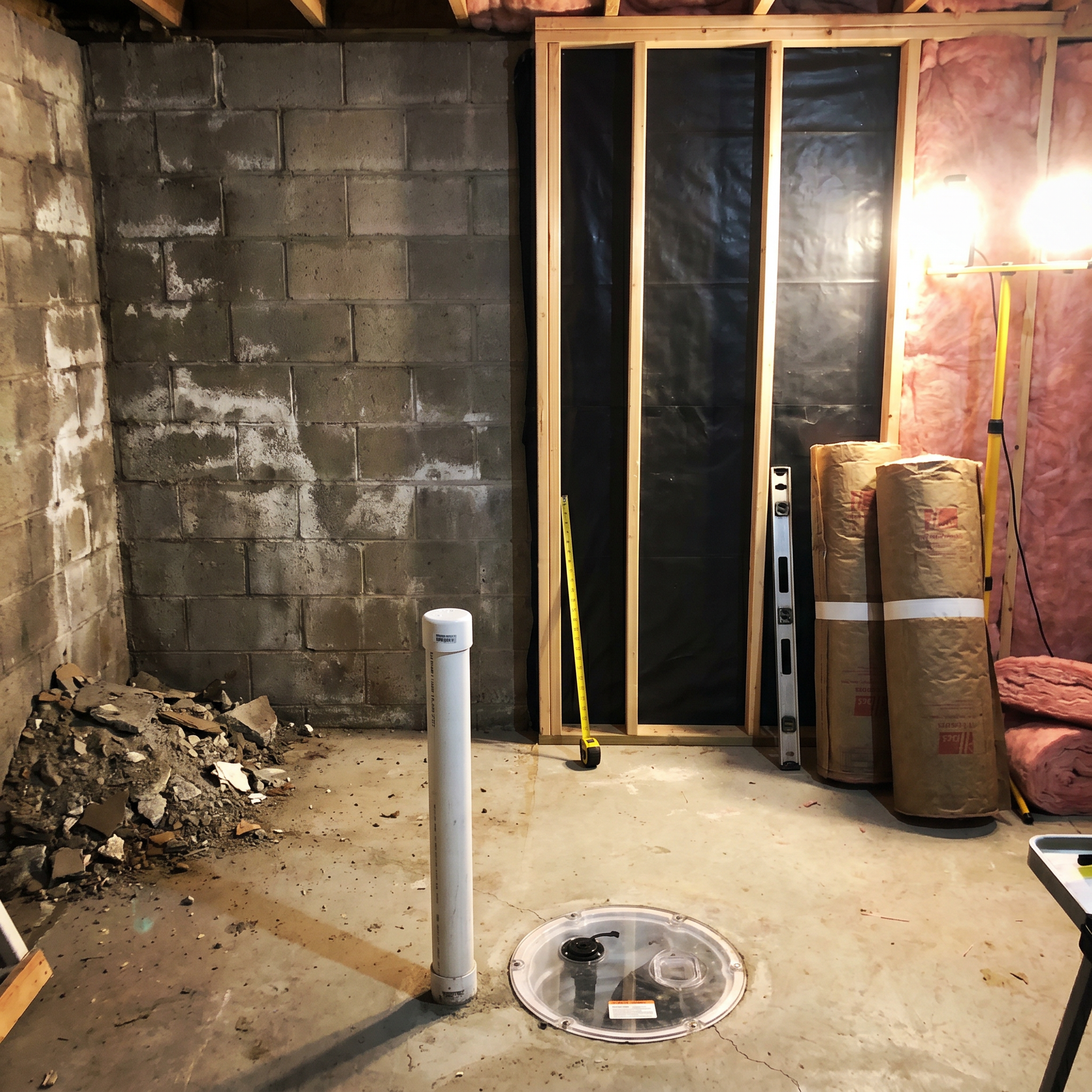
The most important Iowa-specific planning point: mitigation during construction is far less expensive than retrofitting after walls and ceilings are finished. If a sub-slab depressurization system is needed, installing the suction point and routing the pipe during framing is straightforward. After drywall is up, the same job requires cutting and patching finished surfaces.
A practical sequence:
- Test first. A DIY radon test kit costs $15 to $50. A professional test costs $100 to $300, test before any walls go up.
- If above 4 pCi/L, plan mitigation into the project. Sub-slab depressurization typically runs $1,800 to $2,500 in Iowa, consistent with the $800 to $2,500 national average range and what other Iowa contractors quote.
- Use a certified contractor. The Iowa Department of Health and Human Services maintains a certified radon contractor list. Always use a state-listed certified contractor for mitigation.
- Re-test 24 hours after the system is running to confirm it is working.
For more on basement air quality, moisture, and radon issues to address before finishing in Central Iowa homes, see our Basement Problems to Fix Before Finishing guide.
Pro Tip 5: Test for radon before drywall, not after. Mitigation during framing is significantly less expensive than retrofitting after the basement is finished.
Pro Tip 6: Iowa real estate disclosure law (Iowa Code Chapter 558A) requires you to disclose known radon results at sale. A test result above 4 pCi/L with no mitigation is a known condition. Address it before listing, not during inspection negotiations.
Permits and Inspections: What Iowa Requires
Converting unfinished basement space to a habitable room (which a bedroom is, by definition) requires a building permit in every Iowa jurisdiction. There are no size exceptions for habitable rooms.
| Project Element | Permit Required? |
|---|---|
| Adding plumbing (if also building a bathroom) | Yes (building permit) |
| Adding or modifying electrical circuits | Yes (separate electrical permit) |
| Adding or modifying HVAC ductwork | Yes (separate mechanical permit) |
| Cutting the foundation for egress window | Yes (separate plumbing permit) |
| Cutting the foundation for the egress window | Part of building permit; structural review |
Always confirm with your local building department. Rules and permit categories vary by city.
Typical permit fees range from $100 to $500 in most Iowa cities, often calculated as a percentage of the project value or per square foot. Typical inspections for a basement bedroom finish include framing (before drywall), rough electrical (before drywall), insulation (before covering), and a final inspection.
Iowa requires general contractors earning $2,000 or more annually to register through DIAL (Department of Inspections, Appeals, and Licensing). General contractors are registered. Electricians, plumbers, and HVAC technicians hold separate state licenses (not just DIAL registration). For full details on Iowa permit sequencing and inspection stages, see our Iowa building codes and permit guide.
The cost of skipping the permit. An unpermitted basement bedroom cannot be listed as a bedroom by an appraiser, which means it adds zero to the sale price. During a buyer’s inspection, a non-compliant room will be flagged. Buyers can negotiate price reductions, demand correction before closing, or walk away. Lenders may refuse to close. In the worst case, the city can require removal of the unpermitted work. The cost to correct an unpermitted bedroom retroactively is typically 3 to 5 times the cost of doing it right the first time.
Pro Tip 7: Pull the permit. Permit fees ($100 to $500) are trivial compared to the cost of correcting an unpermitted bedroom during a real estate transaction.
Pro Tip 8: Basement bedroom additions typically increase your home’s assessed value. Contact your county assessor for property tax implications before starting.
Iowa Basement Bedroom Cost Breakdown
Total cost depends heavily on whether you need to cut a new egress window and whether radon mitigation is needed. The table below shows realistic cost ranges for Iowa by scope.
| Scope | What’s Included | Iowa Cost Estimate |
|---|---|---|
| 1. Basic finish (existing egress window) | Drywall, electrical, lighting, closet, paint, detectors | $5,000 to $10,000 |
| 2. Add egress window + basic finish | Above + egress window cut, install, well, waterproofing | $7,500 to $15,000 |
| 3. Above + radon mitigation | Above + sub-slab depressurization system | $10,000 to $20,000 |
| 4. Bedroom + bathroom + egress + radon | Above + full bath rough-in and finish | $20,000 to $40,000+ |
Planning estimates. Final costs vary by site conditions, materials, contractor, and permit fees.
Component cost breakdowns:
- Egress window (cutting, window, well, waterproofing): $2,500 to $5,000, typical Iowa range
- Radon mitigation (sub-slab depressurization): $1,800 to $2,500 in Iowa
- Electrical (AFCI circuits, outlets, lighting): $800 to $2,500
- HVAC extension or supplemental heat: $500 to $2,000
- Insulation (walls and ceiling): $500 to $2,000
- Drywall, framing, paint: $2,000 to $6,000
- Closet construction: $500 to $1,500
- Permit fees: $100 to $500
Iowa runs about 14 percent below the national average on construction labor, and Des Moines metro pricing tends to run slightly above rural Iowa but well below coastal markets. Get three written, line-item estimates that itemize permit fees, egress work, electrical, HVAC, insulation, and finishes separately. For comparison with above-grade additions, see our Des Moines home addition cost guide.
Pro Tip 9: Get three written estimates with line-item breakdowns. If an estimate shows a single lump sum without itemized labor, materials, permits, and egress work, request a revised version.
Pro Tip 10: Site prep cost for a basement bedroom is minimal compared to exterior projects. The highest variable cost is the egress window excavation, which depends entirely on whether one is already in place.
ROI: Does a Basement Bedroom Add Value in Iowa?
Industry data suggest that a legal, permitted basement bedroom can increase home value by approximately 4 to 6 percent, and most basement bedroom conversions return roughly 50 to 75 percent of the project cost at resale. These figures vary significantly by market, home value, and finish quality. ROI estimates are not financial advice; consult a local real estate agent for your specific market.
A few important framings:
- Appraisers discount basement square footage compared to above-grade space because basement rooms typically lack natural light and are below grade. Even a beautifully finished basement bedroom is valued at 60 to 75 percent of an equivalent above-grade bedroom.
- The bedroom count matters more than the dollar return. Moving a home from 3 to 4 bedrooms expands the buyer pool, particularly in Ankeny, Waukee, Johnston, and other Central Iowa suburbs, where family buyers dominate.
- Unpermitted rooms add zero value. Appraisers cannot count an unpermitted basement bedroom, creating a disclosure problem at the sale.
- Legal trumps cosmetic. A permitted, code-compliant bedroom with modest finishes adds more value than an unpermitted bedroom with expensive finishes.
Pro Tip 11: Have a local real estate agent walk through your home and assess how adding a 4th bedroom would impact the listing before you commit to the project. ROI varies dramatically by neighborhood comps.
Pro Tip 12: If you are weighing a basement bedroom against an above-grade addition, the basement bedroom is significantly cheaper per square foot but appraises at a discount. The above-grade addition costs more but counts at full value. The right answer depends on your timeline and how long you plan to stay.
Frequently Asked Questions
Q: What are the requirements for a legal basement bedroom in Iowa?
Five core requirements under the Iowa-adopted IRC: minimum 70 sq ft floor area with no dimension below 7 ft, 7-foot ceiling height over at least half the room, an egress window with 5.7 sq ft net clear opening and maximum 44-inch sill height, a smoke detector in the room and a CO detector on the floor, and a heat source capable of maintaining 68°F. A permit is required. Always confirm current requirements with your local building department.
Q: What size egress window is required in Iowa?
The minimum is 5.7 sq ft net clear opening, which is the actual openable area, not the window unit size or rough opening. Minimum 24-inch opening height, 20-inch opening width, sill no higher than 44 inches from the floor. A window well is required when the sill is below grade; if the well is deeper than 44 inches, a permanently affixed ladder is required. Confirm current requirements with your local building department.
Q: Do I need to test for radon before finishing a basement bedroom in Iowa?
The Iowa building code does not require radon testing, but it is strongly recommended. Iowa is entirely in EPA Radon Zone 1, and the Iowa Radon Survey found as many as 5 in 7 Iowa homes test above the EPA action level of 4 pCi/L. A DIY test kit costs $15 to $50. If the result is above 4 pCi/L, a mitigation system installed during framing ($1,800 to $2,500 in Iowa) costs significantly less than retrofitting after walls are finished. Iowa Code Chapter 558A also requires the disclosure of known radon results at the time of sale.
Q: Do I need a permit to add a basement bedroom in Iowa?
Yes. Converting unfinished basement space to a habitable room (including a bedroom) requires a building permit in every Iowa jurisdiction. Permit fees typically run $100 to $500. Required inspections include framing, rough electrical, insulation, and final. Electrical work requires a separate permit and a licensed Iowa electrician. Skipping the permit creates real estate disclosure problems, appraisal problems, and can cost 3 to 5 times more to fix retroactively.
Q: How much does it cost to add a legal basement bedroom in Iowa?
If an egress-compliant window already exists, a basic finish runs $5,000 to $10,000. If you need to cut and install an egress window, plan on spending $7,500 to $15,000. Add $1,200 to $2,000 for radon mitigation if needed. A basement bedroom plus a full bathroom runs $20,000 to $40,000+. Get three written estimates with line-item breakdowns.
Q: Does a basement bedroom add value to an Iowa home?
A legal, permitted basement bedroom adds to the official bedroom count and opens the home to more buyers. Industry data suggest that adding a bedroom can increase home value by 4 to 6 percent, and basement bedrooms typically return 50 to 75 percent of the project cost at resale. Appraisers discount basement bedrooms compared to above-grade rooms. An unpermitted basement room adds zero appraisal value and creates disclosure problems. ROI figures are industry estimates; consult a local real estate agent for your specific market.
Key Takeaways
The Five Non-Negotiable Requirements
- 70 sq ft floor area minimum, 7-ft minimum dimension
- 7-ft ceiling height over at least half the floor area
- Egress window: 5.7 sq ft net clear opening, max 44-in sill
- Smoke detector in the room, CO detector on the floor
- Heat source capable of 68°F
Iowa Permit Reality
- Permit required for any habitable basement room
- $100 to $500 permit fees in most Iowa cities
- Inspections: framing, rough electrical, insulation, final
- DIAL-registered general contractor; licensed electrician for electrical
Radon (The Iowa-Specific Anchor)
- Iowa is entirely in EPA Radon Zone 1
- as many as 5 in 7 Iowa homes test above EPA action level (Iowa Radon Survey)
- DIY test $15 to $50; mitigation $1,800 to $2,500 in Iowa
- Mitigation during framing is far cheaper than retrofit
Cost (Iowa-Adjusted)
- Basic finish with existing window: $5,000 to $10,000
- With new egress window: $7,500 to $15,000
- With radon mitigation: $10,000 to $20,000
- Bedroom + bathroom: $20,000 to $40,000+
Ready to Add a Legal Bedroom to Your Iowa Basement?
You know the five non-negotiable requirements, the Iowa radon reality, the permit and inspection sequence, and what each scope typically costs. The next step is talking with a contractor who knows Iowa egress requirements, works with licensed Iowa electricians, knows when radon mitigation belongs in the project, and provides written line-item estimates.
Busy Builders has served over 1,000 Central Iowa homeowners since 2020. We are DIAL-registered, pull every permit when required, work with licensed Iowa electricians and HVAC contractors, and provide transparent written estimates.
Call: 844-435-9800 Website: https://busybuildersiowa.com/
We serve Des Moines, West Des Moines, Ankeny, Waukee, Johnston, Grimes, Urbandale, Norwalk, and all of Central Iowa. Schedule your free consultation today.
Important note: This article describes general Iowa-adopted IRC requirements and is not a substitute for verification with your local building department. Iowa cities may be on different code cycles or have local amendments; always confirm current requirements before designing or building. Cost ranges are planning estimates based on industry data adjusted for Iowa’s regional construction costs. Actual costs vary by site conditions, materials, contractor, and scope. Radon testing is not a building code requirement but is strongly recommended; Iowa Code Chapter 558A requires sellers to disclose known radon test results. ROI figures are industry estimates and not financial advice; consult a local real estate agent for your market. This article is not legal advice; consult an attorney for guidance on Iowa real estate disclosure obligations. Property tax implications vary by county in Iowa; consult your local assessor.
Busy Builders | Full-Service Construction and Remodeling | Serving Central Iowa Since 2020
Related service: basement finishing in Central Iowa.