You have a small or average suburban Iowa backyard, and you do not want to build the wrong size. Most generic patio guides give you formulas that ignore Iowa clay soil, real Central Iowa lot dimensions, and the most common patio regret: building too small. This guide walks through the dimensions that actually work, the furniture clearance rules that drive them, Iowa permit details, and the cost of each size in Des Moines so that you can design with confidence.
TLDR: For most Iowa small yards, a 10×12 ft (120 sq ft) to 12×16 ft (192 sq ft) patio is the practical sweet spot, enough for 4 to 6 people, a dining set, and comfortable traffic flow. Going smaller than 10×10 ft creates a patio that feels cramped once furniture is placed. Ground-level patios require no permit in most Iowa cities. At $6 to $10 per square foot for basic concrete in Des Moines, a 12×16 ft patio runs roughly $1,200 to $1,920 installed before site prep. The most common mistake is building too small.
The single biggest patio regret is dimensions. A 10×10 ft patio looks generous in a backyard until you place a dining set and realize the chairs cannot be pulled back without falling off the edge. Iowa’s clay soil and lot sizes give you specific real-world constraints, so the right approach is to start with furniture, not a square-footage number.
The Real Numbers: What Patio Size Actually Means
Patio size language is vague unless you tie it to use. Here is what the three common size categories actually fit.
Small (49 to 120 sq ft, 6×8 ft to 10×12 ft). Fits a bistro set for 2 or a 4-person dining set with minimal clearance. Tight for entertaining.
Medium (121 to 256 sq ft, roughly 11×11 ft to 16×16 ft). The most practical size for Central Iowa families. Comfortably fits 4 to 6 people with a dining set plus a small grill zone.
Large (324 sq ft+, 18×18 ft and up). Multiple zones. The dining area, conversation area, and grill zone coexist, with room to move.
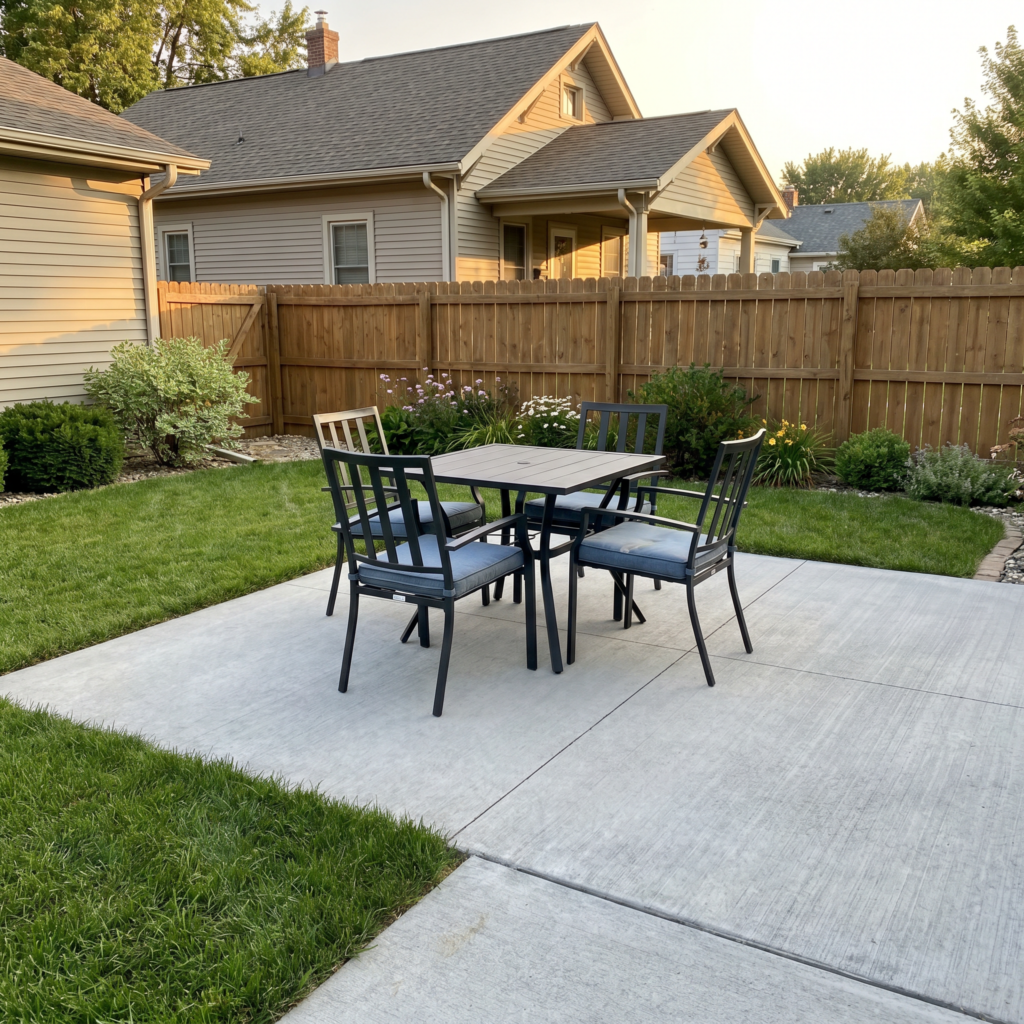
The most-referenced “sweet spot” for a small Iowa yard is 12×14 ft (168 sq ft). It fits a 6-person dining set with 30-inch clearance on all sides and a grill push-back zone. For most Central Iowa suburban backyards (40 to 60 ft deep, 50 to 70 ft wide, roughly 2,000 to 4,200 sq ft usable), a 12×16 ft patio uses only 5 to 10 percent of the available area, leaving significant lawn intact.
Pro Tip 1: The most common patio design mistake is building too small. Industry experts consistently recommend planning 20 to 30 percent larger than your initial estimate. The extra cost at build time is far less than the cost of expanding later.
Pro Tip 2: A 12×14 ft patio that functions perfectly is worth more than a 16×20 ft patio that feels cluttered. Iowa’s 5-month outdoor season (May through September) means you want a patio you actually use.
The Furniture Rule: How to Size a Patio You Can Actually Use
Start with your furniture, not a size number. Measure the dining table and chairs (pulled out for sitting), then add clearance. This is the only sizing method that produces a usable patio.
Traffic clearance: Leave 30 to 36 inches between furniture pieces and the patio edge for normal foot traffic.
Chair pullout: allow at least 2.5 feet from the table edge to the patio edge so chairs can be pushed back normally without hanging off.
Per-person planning: start with 25 square feet per person as a minimum.
The table below translates this into specific patio sizes for common use cases.
| Use Case | Minimum Size | Comfortable Size | Notes |
|---|---|---|---|
| Bistro set for 2 | 6×8 ft (48 sq ft) | 8×10 ft (80 sq ft) | Small table, 2 chairs |
| Dining for 4 | 12×12 ft (144 sq ft) | 12×14 ft (168 sq ft) | All three zones have safe clearances |
| Dining for 4 to 6 | 12×14 ft (168 sq ft) | 14×14 ft (196 sq ft) | Most popular Iowa family size |
| Dining for 6 to 8 | 14×14 ft (196 sq ft) | 14×18 ft (252 sq ft) | Breathing room for guests |
| Multi-zone (dining + lounge) | 14×18 ft (252 sq ft) | 16×20 ft (320 sq ft) | Two distinct functional areas |
| Full outdoor living (dining + lounge + grill) | 16×20 ft (320 sq ft) | 18×22 ft (396 sq ft) | All three zones with safe clearances |
Minimum sizes based on standard furniture clearance guidelines. Add 20-30 percent for comfort.
Pro Tip 3: Before any contractor pours concrete, tape out your furniture on the grass. Use spray paint or landscape flags to mark patio dimensions, then place your actual furniture inside the outline. If chairs cannot pull back, the patio is too small.
Pro Tip 4: A 4-person dining set on a 10×10 ft patio is a frustration factory. Chairs hang over the edge; guests step onto the grass to sit down. The fix is 12×12 ft minimum for any 4-person dining setup.
Iowa Permit Rules for Ground-Level Patios
Most small patios in Iowa do not require a permit. The table below summarizes by project type.
| Project Type | Permit Required in Iowa? |
|---|---|
| Ground-level concrete patio (any size) | No |
| Ground-level paver patio | No |
| Ground-level gravel patio | No |
| Any patio with a roof or solid cover | Yes |
| Raised patio over 30 inches | Yes |
| Patio with electrical (lights, outlets, fans) | Yes (electrical permit) |
| HOA restrictions | Always check HOA covenants separately |
Always confirm with your local building department. Rules vary by city and HOA.
Fort Madison, Iowa, explicitly confirms that no permit is required for driveways and patios, which is consistent with most Iowa jurisdictions for ground-level, uncovered installations. If you are adding any roof or pergola with a solid top, that triggers a full permit review, including 42-inch frost footings. See our Iowa deck and porch permit guide for inspection sequencing.
Iowa law requires calling 811 or 1-800-292-8989 (Iowa One-Call) before any ground excavation, even for a patio. Iowa also requires general contractors earning $2,000 or more annually to register through DIAL (Department of Inspections, Appeals, and Licensing). General contractors are registered; electricians, plumbers, and HVAC technicians hold separate state licenses.
HOA covenants are the most overlooked constraint in small-yard patio planning in Central Iowa. Newer developments in Waukee, Ankeny, Johnston, and Grimes commonly restrict patio size, location, surface material, and setbacks from property lines. Check your covenants before designing.
Pro Tip 5: Call 811 at least 48 hours before any digging. Free, and required by Iowa law.
Pro Tip 6: Patio additions typically increase your home’s assessed value. Contact your county assessor for property tax implications before starting.
Iowa Patio Cost by Size
Most online estimators show $/sq ft figures that do not include Iowa-specific site prep. Iowa clay soil requires excavation and replacement with a compacted gravel base, which adds $500 to $1,500 to the cost of any patio, regardless of size. The table below shows only the surface cost. Site prep is additional.
| Dimensions | Sq Ft | Low ($6/sq ft) | High ($10/sq ft) | Total with Site Prep |
|---|---|---|---|---|
| 8×10 ft | 80 | $480 | $800 | $980 to $2,300 |
| 10×12 ft | 120 | $720 | $1,200 | $1,220 to $2,700 |
| 12×14 ft | 168 | $1,008 | $1,680 | $1,508 to $3,180 |
| 12×16 ft | 192 | $1,152 | $1,920 | $1,652 to $3,420 |
| 14×16 ft | 224 | $1,344 | $2,240 | $1,844 to $3,740 |
| 16×20 ft | 320 | $1,920 | $3,200 | $2,420 to $4,700 |
Planning estimates. Does not include site prep (an added cost of $500 to $1,500). Final cost varies by site conditions, finish, and contractor.
Stamped concrete runs $8 to $25 per square foot in Iowa; for a patio under 200 sq ft, that typically lands in the $2,000 to $5,000 range. Larger patios lower the cost per square foot because fixed costs (mobilization, form setup, site visit) are spread over a larger area. Iowa runs about 14 percent below the national average on construction labor. For a side-by-side comparison of patio surface materials, see our patio or deck cost guide for Iowa.
Pro Tip 7: Get three written estimates with line-item breakdowns. Always ask: What site prep is included in your quote? If excavation, base material, and compaction are not separately itemized, the estimate is incomplete.
Pro Tip 8: Site prep cost does not scale proportionally. Both a 10×10 ft patio and a 14×16 ft patio require full excavation and base prep. Smaller patios have higher site prep as a percentage of total cost.
How to Maximize a Small Iowa Patio
If you are working with a small yard, these design rules separate functional patios from cluttered ones.
Define one primary use. A small patio trying to be a dining area, a lounge, and a grill zone fails at all three. Pick the primary use, then add secondary elements around it.
Scale your furniture. Oversized sectionals and bulky dining sets overwhelm small patios. Bistro sets, loveseats, and slim-profile chairs preserve usable space.
Float furniture slightly inward. Pushing all the furniture against the perimeter of the fence actually makes the space feel smaller. Float furniture slightly inward and anchor with an outdoor rug.
Use vertical space. Wall-mounted planters, a slim pergola, hanging string lights. These draw the eye up and create perceived depth without consuming ground area.
Keep walkways clear. 30- to 36-inch clear paths to entry points. If you cannot walk through naturally, the layout needs to be adjusted.
Use 2 to 3 cohesive materials. Light patio colors and a tight material palette make small spaces feel larger. Mixing too many textures visually fragments the space.
Run conduit before pouring. If you might add lighting, fans, or a gas line later, run conduit during the concrete pour. Retrofitting electrical or gas through a finished slab is expensive.
The quick reference table below summarizes the most useful design rules.
| Rule | Guideline |
|---|---|
| Traffic clearance between furniture | 30 to 36 inches |
| Chair pullout (table edge to patio edge) | 2.5 ft minimum |
| Per-person space minimum | 25 sq ft |
| Patio as % of total yard | 20 to 25% maximum |
| Fire pit safety radius (combustibles) | 10 ft minimum |
| Plan size larger than initial estimate | 20 to 30% larger |
Pro Tip 9: Lighter patio colors visually expand small spaces. Darker-stained or charcoal-colored concrete makes a small patio feel even smaller. This matters more on small patios than large ones.
Pro Tip 10: Vertical elements (string lights, slim pergola, wall planters) give you an outdoor room feel without consuming the floor space you need for furniture.
When Small Isn’t Enough: Knowing Your Tipping Point
Sometimes “small” is the wrong target. Here is when to plan bigger.
If you regularly entertain 6 or more people, a 10×10 ft patio will frustrate you every time. Budget for 12×16 ft minimum.
If you want a grill AND a dining set, add 40-60 sq ft minimum for the grill zone, plus safe clearance from the table.
If you want a fire pit, allow at least 10 to 15 feet from the fire pit center to any combustible structure. Some Iowa cities require more (Marshalltown requires 25 ft for open ground fires). That usually means a separate patio zone or a larger patio of 16×20 ft+. Confirm with your local fire department.
If you have young kids who need run space, the patio and lawn coexist. Do not let the patio consume all your usable yard.
Industry guideline: keep the patio at 20 to 25 percent or less of the total backyard area to maintain visual balance and lawn function.
Industry experts consistently recommend building bigger when you have the space. The cost difference at build time is small. The cost to expand a finished concrete patio later is nearly as expensive as building the extra size from scratch, because you have to break up the edge of the existing slab.
Central Iowa suburban lots typically give you room for a 12×16 to 14×20 ft patio without consuming the yard. The constraint is usually budget, not space. If you are weighing a patio versus a raised deck, our deck-building service page covers what each option offers.
Pro Tip 11: Expanding a finished concrete patio later costs nearly as much as building the additional size from the start. Build right the first time.
Pro Tip 12: If you are uncertain between two sizes, go with the larger one. The recurring industry finding is that homeowners regret building too small far more often than building too large. The marginal cost of an extra 40 to 60 sq ft is rarely more than $400 to $600 at Iowa rates.
Frequently Asked Questions
Q: What is the best patio size for a small Iowa backyard?
For most Central Iowa suburban yards, 12×14 ft (168 sq ft) to 12×16 ft (192 sq ft) is the sweet spot. It fits a 4- to 6-person dining set with 30-inch traffic clearance on all sides, leaves significant lawn space, and costs roughly $1,200 to $2,000 for basic concrete before site prep. Do not go below 10×10 ft for any dining setup. Chairs cannot pull back without falling off the edge.
Q: How much does a small patio cost in Iowa?
Basic concrete in Des Moines: $6 to $10 per square foot. A 12×14 ft patio runs $1,008 to $1,680 for the surface; add $500 to $1,500 for Iowa clay soil base prep, total typical range: $1,500 to $3,200 for a 168 sq ft basic concrete patio. Stamped concrete under 200 sq ft typically runs $2,000 to $5,000. Get three written estimates with site prep itemized separately.
Q: Do I need a permit for a small patio in Iowa?
No, for most ground-level concrete or paver patios on private property in Iowa. Ground-level patios are generally exempt from permit requirements. A permit IS required if you add a covered roof, raise the patio by more than 30 inches, or add electrical work. Confirm with your city and check your HOA covenants. Iowa One-Call (811) is required before any digging.
Q: What is the minimum patio size for a dining set?
For a 4-person dining set, the absolute minimum is 12 ft by 12 ft (144 sq ft). This allows chairs to pull back 2.5 ft from the table edge. For 6 people, 12×14 ft is the practical minimum. Anything smaller will have chairs hanging off the edge or guests squeezing past each other. Always tape out the furniture on the ground before finalizing the size.
Q: How do I make a small patio feel bigger in Iowa?
Five things that work: (1) Float furniture slightly inward from the edges instead of pushing everything to the perimeter. (2) Choose scaled furniture (bistro sets, loveseats, slim-profile chairs). (3) Use vertical elements like a slim pergola, wall planters, and string lights. (4) Stick to 2 to 3 cohesive materials in lighter colors. (5) Define one primary use and design for it rather than fitting every function into the space.
Key Takeaways
Size
- Sweet spot for Central Iowa small yards: 12×14 ft to 12×16 ft
- 4-person dining minimum: 12×12 ft
- 6-person dining minimum: 12×14 ft
- Do not build below 10×10 ft for any dining setup
Cost (Iowa, basic concrete)
- 12×14 ft: $1,008 to $1,680 + $500 to $1,500 site prep
- 12×16 ft: $1,152 to $1,920 + site prep
- Stamped concrete under 200 sq ft: $2,000 to $5,000
- Site prep does not scale with size
Permits
- Ground-level patios: no permit in most Iowa cities
- Covered, raised, or electrical patios trigger permits
- Iowa One-Call (811) is required before digging
- HOA covenants may restrict size and materials
Design Rules
- 30 to 36 inches of traffic clearance between furniture and edges
- 2.5 ft chair pullout from table to patio edge
- Build 20 to 30 percent larger than your initial estimate
- Patio under 20 to 25 percent of the total backyard
Ready to Plan Your Iowa Patio?
You know the right size, the furniture clearance rules, the permit facts, and the real Iowa costs. The next step is to talk with a contractor who knows Central Iowa lot sizes, can properly prep Iowa clay soil, and provides written line-item estimates, with site prep separately called out.
Busy Builders has served over 1,000 Central Iowa homeowners since 2020. We are DIAL-registered, pull every permit when needed, and provide transparent written estimates.
Call: 844-435-9800 Website: https://busybuildersiowa.com/
We serve Des Moines, West Des Moines, Ankeny, Waukee, Johnston, Grimes, Urbandale, Norwalk, and all of Central Iowa. Schedule your free consultation today.
Important note: Cost ranges are planning estimates based on industry data adjusted for Iowa’s regional construction costs. Actual costs vary by site conditions, materials, finish, and contractor. Size and dimension guidelines are industry recommendations, not building code requirements unless specifically noted. Permit rules vary by city; confirm with your local building department before designing. HOA covenants may restrict patio size, materials, and setbacks even when city permits do not require additional review. Property tax implications vary by county in Iowa; consult your local assessor. This article is not financial or legal advice.
Busy Builders | Full-Service Construction and Remodeling | Serving Central Iowa Since 2020