You want a patio, but you are not sure whether gravel is worth a real look or whether concrete is just the obvious choice. This guide walks through real Iowa costs, the freeze-thaw and clay-soil realities that change the math, the permit rules for both, and how to pick the right material for your budget, your yard, and how long you plan to stay.
TLDR: A gravel patio in Iowa costs $2 to $8 per square foot installed, roughly 50 to 75 percent less than a basic concrete slab at $6 to $10 per square foot. Gravel drains well and flexes with Iowa’s 45 to 84 annual freeze-thaw cycles. Concrete is more durable, requires less long-term maintenance, and delivers stronger resale value. Neither requires a permit for a ground-level installation in most Iowa cities. The right choice depends on budget, use, and how long you plan to stay.
Most Iowa homeowners default to concrete without considering gravel. That makes sense for some yards and not for others. The cost gap is real, Iowa’s clay soil and freeze-thaw climate change the durability picture, and the resale math is honest in both directions. Here is what you need to know before you call a contractor.
Cost: Gravel vs. Concrete Patio in Iowa
Gravel runs roughly half to a quarter of the cost of basic concrete. The table below shows Iowa-adjusted ranges, with gravel material prices from HomeGuide adjusted for Iowa labor. Iowa runs about 14 percent below the national average on construction costs.
| Material | $/sq ft Range | 200 sq ft Total (est.) | 300 sq ft Total (est.) |
|---|---|---|---|
| Gravel (materials only, DIY) | $1 to $3 | $200 to $600 | $300 to $900 |
| Gravel (professional install) | $2 to $8 | $400 to $1,600 | $600 to $2,400 |
| Basic concrete (Iowa) | $6 to $10 | $1,200 to $2,000 | $1,800 to $3,000 |
| Stamped concrete (Iowa) | $8 to $25 | $1,600 to $5,000 | $2,400 to $7,500 |
| Pavers (Iowa, for comparison) | $10 to $20 | $2,000 to $4,000 | $3,000 to $6,000 |
These are planning estimates. Final costs vary by site, materials, and contractor.
Site prep adds to both. Gravel patios need geotextile fabric and a compacted base ($200 to $600 added cost). Concrete needs excavation, a gravel base, and forming ($500 to $1,500 in added costs). On Iowa clay soil, neither material works without proper base prep.
Long-term costs flip the picture somewhat. Gravel has no structural replacement cost but needs topping off every 1 to 3 years ($100 to $300). Concrete may need resealing every 2 to 3 years ($200 to $400) and crack repairs that can run $300 to $1,500. For our full side-by-side of all patio surface materials, including pavers and natural stone, see our patio or deck in Iowa cost guide.
Pro Tip 1: Get three written estimates with line-item breakdowns. Both materials have legitimate cost variation; an estimate that does not show site prep, base, edging (gravel), or sealing (concrete) separately is incomplete.
Pro Tip 2: Build during fall or early winter for spring installation. Iowa concrete contractors quickly fill orders from April through October, and gravel deliveries are easier to schedule off-peak.
Iowa’s Freeze-Thaw Reality: Which Material Wins?
Iowa averages 45 to 84 freeze-thaw cycles per year. That is the single biggest variable national gravel-vs-concrete comparisons miss.
Concrete is vulnerable to freeze-thaw. Water infiltrates any small crack, freezes, expands, and widens the damage. Each Iowa winter repeats the cycle. Concrete needs proper protection: a 4-inch slab minimum (6 inches for Iowa clay soil sites), sealing every 2 to 3 years, and no de-icing salt.
Gravel’s advantage is structural simplicity. Loose stones flex and shift with freeze-thaw rather than cracking. There is no monolithic slab to fail. Water drains through the gravel rather than pooling under a slab and creating freeze pressure.
Iowa clay soil compounds the difference. Clay retains water and expands when frozen, which increases freeze pressure on whatever sits above it. A concrete slab on poorly prepared clay can develop cracking within 5 to 10 years. Gravel on properly-prepped clay (geotextile fabric plus 6+ inches of compacted base) handles the same conditions without structural failure because there is no slab to fail.
Drainage is the bonus. Gravel patios reduce runoff by up to 50 percent compared to impervious surfaces. On Iowa clay lots with drainage problems, gravel can solve a problem that concrete would require additional drain tile to address.
Pro Tip 3: Never use de-icing salt on a concrete patio. It accelerates surface scaling and shortens lifespan dramatically in Iowa’s freeze-thaw climate. Use sand for traction instead.
Pro Tip 4: On Iowa clay soil, geotextile fabric between the clay and the gravel base is non-negotiable. Without it, gravel sinks into clay over time, and the patio fails within 2 to 3 years.
Iowa Permit Rules for Gravel and Concrete Patios
Most ground-level patios in Iowa do not require a permit. The table below summarizes by project type.
| Project Type | Permit Required in Iowa? | Notes |
|---|---|---|
| Ground-level gravel patio | No | Generally exempt in most Iowa cities |
| Ground-level concrete patio | No | Generally exempt in most Iowa cities |
| Ground-level paver patio | No | Generally exempt in most Iowa cities |
| Any covered patio (roof above) | Yes | Triggers full permit; 42-inch footings |
| Raised patio over 30 inches | Yes | Treated as a deck or platform |
| Any patio structure over 200 sq ft | Yes | Some Iowa cities trigger review |
Always confirm with your local building department. Rules vary by jurisdiction.
Fort Madison, Iowa, explicitly confirms that no permit is required for driveways and patios, consistent with most Iowa jurisdictions for ground-level, uncovered installations. If you are adding any roof or cover over the patio, that triggers a full permit review, including 42-inch frost footings; for that, see our Iowa deck and porch permit guide.
Iowa law requires calling 811 or 1-800-292-8989 (Iowa One-Call) before any ground excavation, even for a patio. Iowa also requires general contractors earning $2,000 or more annually to register through DIAL (Department of Inspections, Appeals, and Licensing). General contractors are registered; electricians, plumbers, and HVAC technicians hold separate state licenses. Gravel patios are often DIY-feasible for small residential projects.
Even when the city does not require a permit, HOA covenants may restrict the use of gravel as a surface material. Check before starting.
Pro Tip 5: Call 811 at least 48 hours before any digging. Free, and required by Iowa law. This applies to both gravel and concrete patio installations.
Pro Tip 6: Patio additions typically increase your home’s assessed value. Contact your county assessor for property tax implications before starting.
Durability, Maintenance, and the Iowa Long Game
The upfront cost gap is only half the picture. Long-term maintenance and lifespan matter more for a 10- or 20-year horizon.
Concrete lifespan: 25 to 50 years with proper care. Iowa-specific maintenance: seal every 2 to 3 years, avoid de-icing salt, and repair cracks promptly. Faded stamped concrete does not restore well, so picking the right color and stamp pattern matters at install.
Gravel lifespan: indefinite with replenishment. No fixed replacement window. Iowa-specific maintenance: rake periodically to redistribute from low spots, top off every 1 to 3 years, pull weeds or apply pre-emergent, replace edging if it shifts.
Landscape fabric under gravel is standard, but worth honest framing. Research in the landscaping industry suggests fabric loses effectiveness in 3 to 7 years as organic material accumulates on top. It is a short-term weed control measure, not a permanent solution.
Each material has drawbacks that matter for some homeowners:
Gravel drawbacks. Shifts underfoot (especially pea gravel). Not accessible for wheelchairs or strollers. Furniture legs can sink. Tracks into the home and car. Fine pea gravel can blow during high-wind events in Iowa; 3/8-inch or larger stone is more stable.
Concrete drawbacks. Stains are permanent without sealing. Cracks are visible and costly to repair properly. No drainage; runoff has to go somewhere.
In Iowa’s freeze-thaw climate, a concrete patio without proper base prep and regular sealing will show cracking within 5 to 10 years on clay soil. A properly maintained gravel patio can look good indefinitely with minor annual work.
Pro Tip 7: Use 3/8-inch or larger crushed granite, not pea gravel, if furniture stability is a concern. Pea gravel is the worst offender for sinking furniture legs.
Pro Tip 8: Seal a new concrete patio in year one, then every 2 to 3 years after. Skipping the first sealing in Iowa’s climate dramatically shortens the surface lifespan.
ROI and Resale Value: The Honest Iowa Picture
Industry data suggests basic concrete patios deliver roughly 50 to 75 percent ROI at resale. Higher figures exist in some national reports (up to 95 percent per NAR, 109 percent for pavers in one study), but the 50 to 75 percent range is the most consistent and is what we use across Busy Builders content.
The ROI of gravel patios is not formally documented in national studies. Real estate agents and buyers generally treat gravel as a landscaping element rather than a permanent hardscape improvement. The practical implication: a gravel patio adds livability and curb appeal but will not reliably boost an appraisal.
A few honest framings:
- A quality concrete patio is more likely to show up in a buyer’s perception of value than a gravel patio.
- Because gravel costs so much less, the ROI percentage matters less when the total investment ranges from $600 to $2,400. Even a 50 percent dollar return on $1,500 is only $750.
- In competitive Central Iowa suburbs (Waukee, Ankeny, Johnston, Urbandale, Norwalk), a quality concrete or paver patio reads as a polished outdoor living space. A gravel patio reads as budget-conscious, not a negative, just different in buyer perception.
- If selling within 5 years and ROI matters, concrete is the better investment. If budget is the primary constraint, gravel still adds usable outdoor space.
Pro Tip 9: Have a local real estate agent walk your block before committing to high-end concrete or pavers. ROI varies dramatically by neighborhood comps.
Which One Is Right for Your Iowa Yard?
The table below matches situations to materials. Most readers will see one or two strong matches.
| Factor | Better Choice |
|---|---|
| Budget under $2,000 | Gravel |
| Budget $2,000 to $5,000 | Basic concrete or large gravel patio |
| Selling in 1 to 3 years | Concrete |
| Staying 5+ years | Either, depending on use |
| Clay soil drainage concern | Gravel |
| Want wheelchair/stroller access | Concrete |
| Furniture stability priority | Concrete |
| DIY preferred | Gravel |
| Freeze-thaw durability priority | Gravel (or properly-built concrete) |
| ROI at resale priority | Concrete |
For a head-to-head feature comparison:
| Feature | Gravel Patio | Concrete Patio |
|---|---|---|
| Installed cost (300 sq ft) | $600 to $2,400 | $1,800 to $3,000 |
| Iowa freeze-thaw durability | Excellent (flexes) | Good with proper sealing |
| Drainage on clay soil | Excellent | Poor without drain tile |
| Permit required | No (ground-level) | No (ground-level) |
| Lifespan | Indefinite with replenishment | 25 to 50 years |
| Maintenance | Top off every 1 to 3 years | Seal every 2 to 3 years |
| ROI at resale | Not well documented | 50 to 75% (est.) |
| DIY feasibility | High | Low |
| Wheelchair/stroller access | No | Yes |
| Suitable for furniture | Limited (pea gravel sinks) | Yes |
ROI figures are industry estimates. Actual returns vary by market, home value, and design quality.
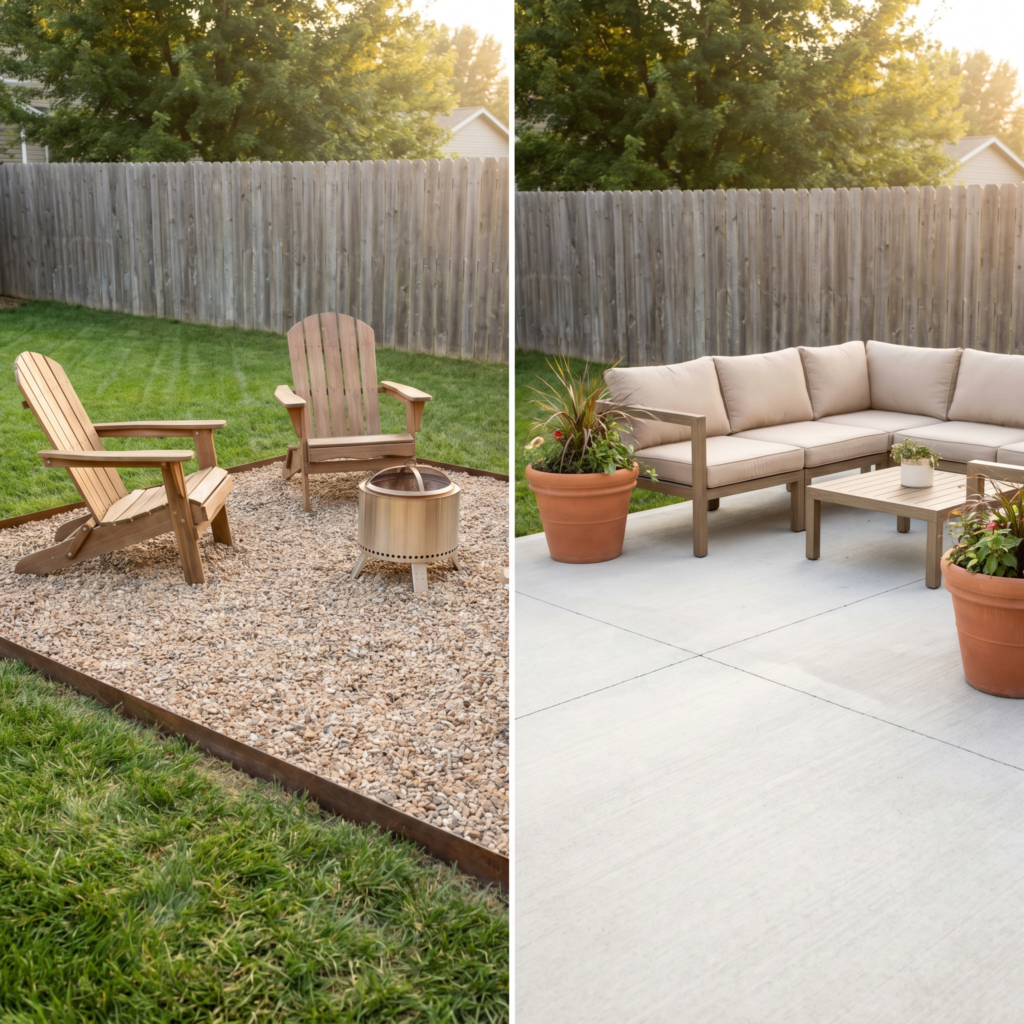
A middle path is worth knowing: pour concrete or set pavers around the perimeter (stable furniture zone, fire pit surround) and fill the interior with gravel. Cheaper than full concrete with better stability than full gravel, and the gravel center retains drainage.
Pro Tip 10: Gravel patios are DIY-feasible for motivated homeowners; concrete patios are not. Hire a DIAL-registered contractor for concrete work. The base prep alone can sink (literally) a DIY concrete job.
Pro Tip 11: Use 3/8-inch or larger gravel for outdoor applications in Iowa. Fine pea gravel blows during high-wind events in Iowa and migrates more aggressively.
Pro Tip 12: Whichever material you pick, do not skip Iowa-specific base prep on clay soil. Minimum 6 inches of compacted gravel base under either surface; 8 inches if you can manage it. Most patio failures in Iowa trace back to inadequate base prep, not to material choice. If you are also weighing a deck instead of a patio, our deck building service page covers what decks add that patios cannot.
Frequently Asked Questions
Q: How much does a gravel patio cost in Iowa?
Materials only: $1 to $3 per square foot. Professional installation: $2 to $8 per square foot. A 200 sq ft gravel patio runs roughly $400 to $1,600 installed. Always include the cost of geotextile fabric, edging, and a compacted base, especially on Iowa clay soil. These add $200 to $600 to the project but are essential.
Q: How much does a concrete patio cost in Iowa?
Basic concrete in Iowa: $6 to $10 per square foot. A 300 sq ft basic concrete patio runs $1,800 to $3,000. Stamped concrete runs $8 to $25 per square foot. Always add $500 to $1,500 for site prep on Iowa clay soil.
Q: Do I need a permit for a gravel or concrete patio in Iowa?
No, for most ground-level gravel or concrete patios on private property in Iowa. Both surface types are generally exempt from permit requirements when ground-level and uncovered. Confirm with your city before starting. Iowa One-Call (811) is required by law before any digging.
Q: Does a gravel patio hold up to Iowa winters?
Yes. Gravel’s loose structure handles Iowa’s freeze-thaw cycles better than concrete in many situations; the stones flex and shift rather than cracking. The risk is shifting and migration, not freeze damage. Proper base prep (geotextile fabric and 6+ inches of compacted gravel on Iowa clay) and adequate edging prevent the most common gravel failures.
Q: Which has better resale value, gravel or concrete?
Concrete. A concrete patio is generally treated as a permanent hardscape improvement by appraisers and buyers; industry data suggests 50 to 75 percent ROI for basic concrete patios. A gravel patio is typically viewed as a landscaping element and delivers less predictable resale impact. If selling within 5 years, concrete is the better investment. If budget is the priority, gravel still adds a livable outdoor space.
Q: Can I put furniture on a gravel patio?
Yes, but with limitations. Furniture legs can sink or wobble in loose pea gravel. Solutions include using furniture pads or pavers under legs, switching to larger crushed granite (more stable), or setting concrete pavers in a furniture zone within the gravel patio. Pea gravel is the worst offender; 3/4-inch crushed granite compacts better and handles furniture more reliably.
Key Takeaways
Cost
- Gravel installed: $2 to $8/sq ft ($600 to $2,400 for 300 sq ft)
- Basic concrete Iowa: $6 to $10/sq ft ($1,800 to $3,000 for 300 sq ft)
- Stamped concrete Iowa: $8 to $25/sq ft
- Site prep adds $200 to $600 (gravel) or $500 to $1,500 (concrete)
Permits
- Ground-level patios: no permit in most Iowa cities
- Covered, raised, or oversized patios trigger permits
- Iowa One-Call (811) is required before digging
- HOA covenants may still restrict materials
Iowa Specifics
- 45 to 84 freeze-thaw cycles per year
- Clay soil requires geotextile fabric and a 6+ inches compacted base
- Gravel drains; concrete needs drainage planning
- Iowa runs ~14% below national construction costs
Resale
- Basic concrete: 50 to 75 percent ROI (industry data, hedged)
- Gravel: not formally documented; treated as landscaping
- Concrete reads as polished outdoor living; gravel reads as budget-conscious
- Concrete is the better resale investment if selling within 5 years
Ready to Add a Patio to Your Iowa Home?
You know the costs, the Iowa-specific durability picture, the permit rules, and the ROI tradeoff. The next step is to talk with a contractor who knows Iowa clay soil base prep, can pour concrete that withstands Iowa freeze-thaw cycles, and provides written line-item estimates.
Busy Builders has served 1,285+ Central Iowa homeowners since 2020. We are DIAL-registered, we know how to prep Iowa clay sites properly, and we provide transparent written estimates with no surprises.
Call: 844-435-9800 Website: https://busybuildersiowa.com/
We serve Des Moines, West Des Moines, Ankeny, Waukee, Johnston, Grimes, Urbandale, Norwalk, and all of Central Iowa. Schedule your free consultation today.
Important note: Cost ranges and ROI figures are planning estimates based on industry data adjusted for Iowa’s regional construction costs. Actual costs and resale value vary by site conditions, materials, contractor, market, and buyer demand. This article is not financial advice. Property tax implications vary by county in Iowa; consult your local assessor. Permit rules vary by city; confirm with your local building department before designing. HOA covenants may restrict patio size, materials, or location, even when city permits do not require additional review.
Busy Builders | Full-Service Construction and Remodeling | Serving Central Iowa Since 2020