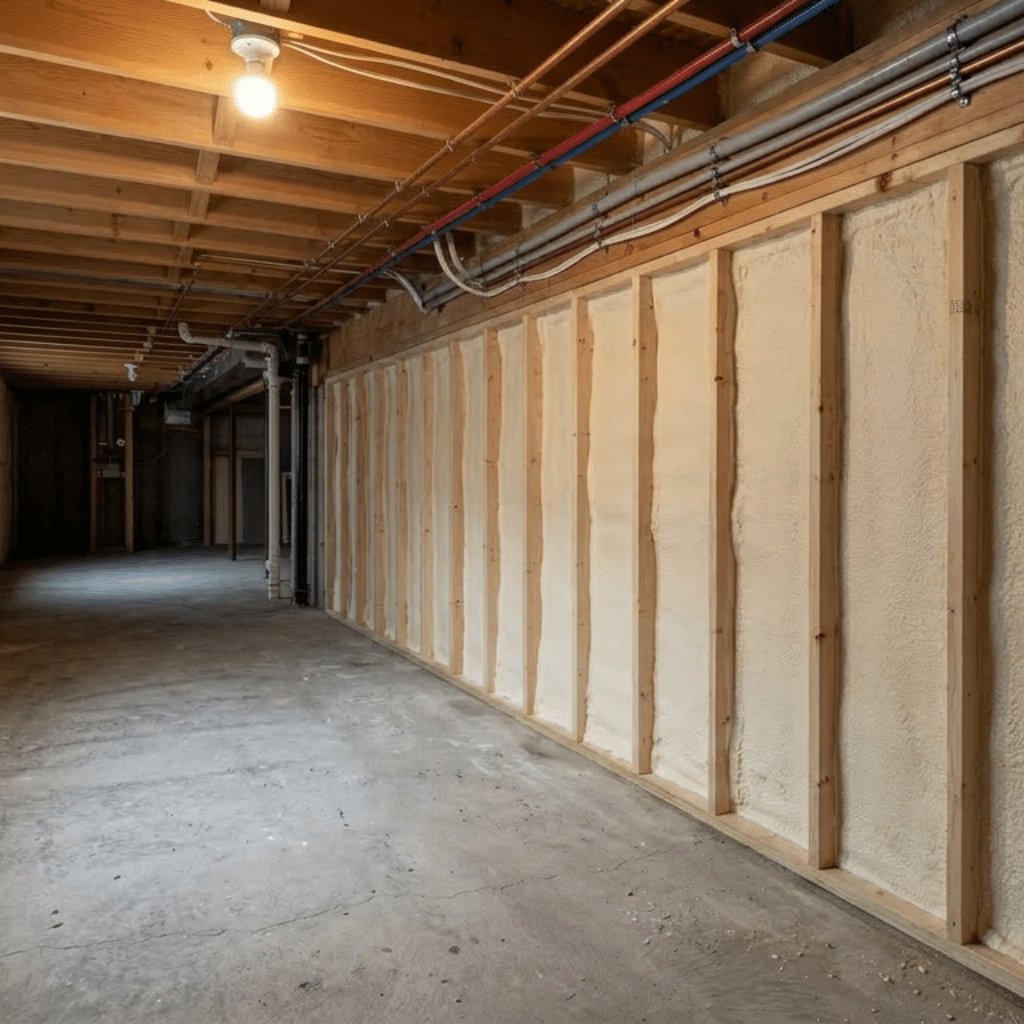
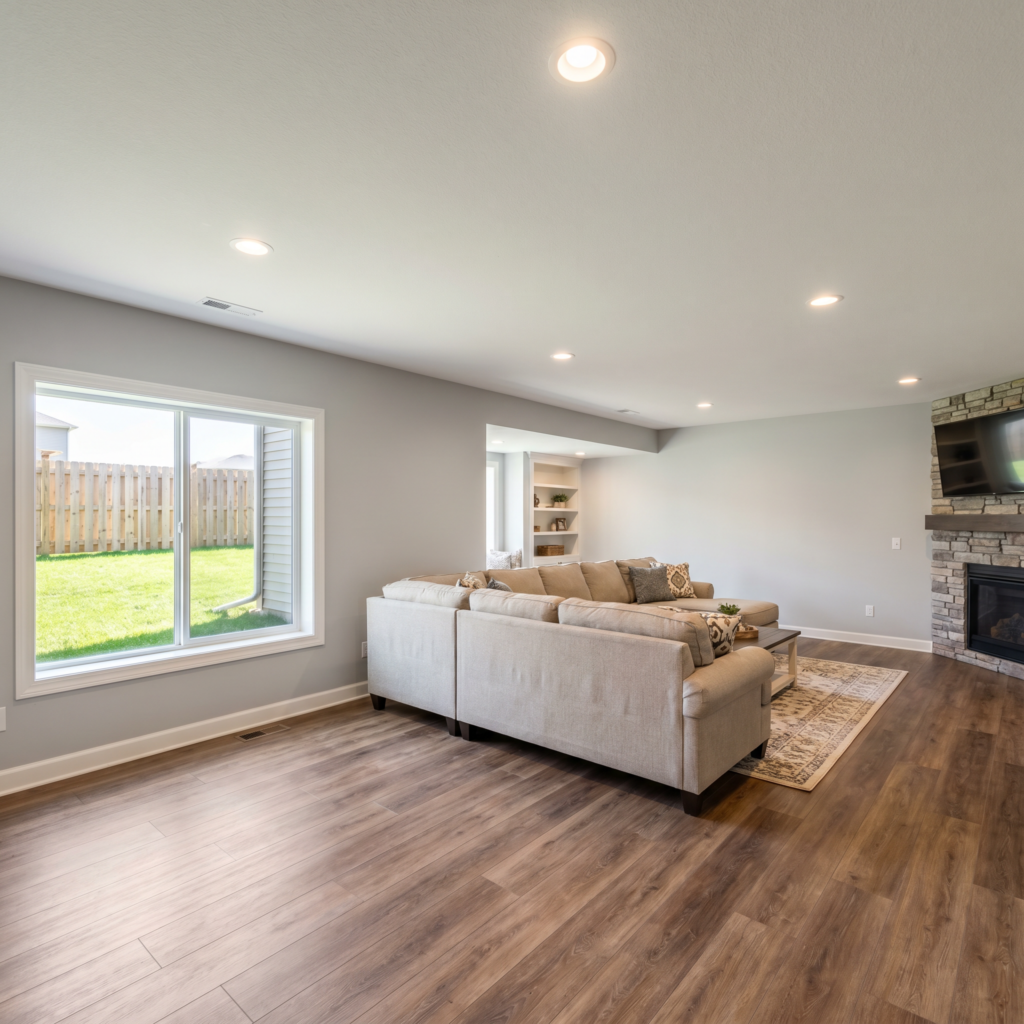
Most Iowa basement ROI articles either oversell the return (“finishing your basement adds instant value!”) or hedge so much that homeowners walk away no closer to knowing whether the project pencils out. This guide does neither. Finishing a basement in the Des Moines metro is one of the highest-return interior remodeling projects available to homeowners in 2026, with the National Association of Realtors’ 2025 Remodeling Impact Report putting national basement conversion ROI at 71% of project cost recovered at resale. In Iowa, the range typically runs 60 to 75% depending on finish quality, scope, and (most importantly) whether you handle three Iowa-specific traps that can quietly destroy the return: radon, unpermitted work, and missing egress windows.
TLDR: Basement finishing in Des Moines typically returns 60 to 75% of project cost at resale, with the national average sitting at 71% per the 2025 NAR Remodeling Impact Report. A basic 800 square foot family room runs $28,000 to $36,000. A full suite with bedroom and bathroom runs $50,000 to $75,000. Three Iowa-specific issues will quietly destroy that ROI if you skip them: radon (Iowa has the worst rate in the nation of homes above the EPA action level), unpermitted work (which can disqualify VA/FHA/USDA financing and trigger disclosure issues at sale), and missing egress windows for basement bedrooms (which costs you $25,000 to $30,000 in appraised value because appraisers cannot legally count the space as a bedroom). Handle these three, and your basement project lands in the strongest ROI band Iowa offers.
The numbers above are planning estimates for the Des Moines metro. Your actual return depends on your specific basement, your finish choices, the quality of compliance work, and market conditions when you eventually sell. The point of this guide is to give you the framework to plan honestly: what the real ROI range looks like, how Iowa appraisers actually value below-grade space (which is different from how buyers perceive it), and what to fix before any finishing work starts. The goal is not to talk you out of finishing your basement. Done right, it’s one of the best investments available. The goal is to make sure you get the return that’s actually possible, not the smaller one you’d get by skipping a few critical steps to save short-term money.
The Real ROI Range: What the Numbers Say
The National Association of Realtors releases a Remodeling Impact Report every two years that surveys both homeowners and Realtors on the cost and resale value of common remodeling projects. The 2025 edition shows basement conversion to living area returning 71% of project cost at resale on a national basis, which ranks among the top remodeling investments in the entire report. That figure outperforms most kitchen and bathroom remodels at the upper tiers, and it’s one of the few projects that consistently produces returns above two-thirds of cost across regions.
The Iowa-specific range typically runs 60 to 75%, with the lower end reflecting markets and finish levels where basement value is less rewarded by appraisers and buyers, and the upper end reflecting competitive Central Iowa suburbs where a finished basement is expected rather than a bonus. In growing markets like Ankeny, Waukee, and Johnston, the finished basement has become close to the local standard, which means unfinished basements actually work against you at listing time. Buyers in those markets walk through unfinished basements and mentally subtract the finishing cost from your asking price, often by more than the finishing would have actually cost.
The practical translation of a 70% ROI is this: spend $50,000 to finish your basement, and you add roughly $35,000 to your home’s resale value. Not all dollars come back, but very few interior remodeling projects return as high a percentage as basement conversion, especially when measured against the alternative of a home addition (where ROI typically runs 30 to 35% per 2025 NAR data). The reason basement finishing outperforms most other interior projects is structural: you’re adding net new living space rather than replacing existing space with nicer finishes. A kitchen remodel improves what’s already counted; a basement finish adds square footage that wasn’t there before.
Table 1: Des Moines Basement Finishing ROI by Scope
| Project Type | Cost Range | Estimated Value Added | ROI % | Best For |
|---|---|---|---|---|
| Basic rec room (800 sq ft) | $28,000-$36,000 | $17,000-$27,000 | 60-75% | Space, not resale planning |
| Mid-range suite with bath | $50,000-$75,000 | $35,000-$56,000 | 70-75% | Balanced investment |
| Full suite (bed + bath + wet bar) | $70,000-$90,000+ | $45,000-$68,000 | 65-75% | Long-stay homeowners |
| Legal rental suite (where zoning allows) | $60,000-$100,000+ | Variable (income offset) | Income-dependent | Buyers who want rental income |
Costs and ROI are planning estimates for the Des Moines metro. Actual returns depend on finish quality, market conditions, scope, and compliance with local codes.
For more detail on what specific scopes cost across the metro, see our basement finishing costs Des Moines 2026 guide, which walks through the full price-per-square-foot breakdown.
The Appraisal Reality: How Iowa Appraisers Value Below-Grade Space
This is the nuance most basement ROI blogs skip, and it’s worth understanding before you commit to a scope. Iowa appraisers follow the ANSI Z765 standard for measuring residential property, which separates above-grade and below-grade square footage. Above-grade square footage (everything at or above ground level on the lowest perimeter point) counts toward Gross Living Area (GLA), which is the primary measurement appraisers use for property comparisons. Below-grade square footage (anything where any portion of the floor sits below the ground line at the foundation) is reported separately and valued separately.
The market-standard adjustment is that below-grade finished space is valued at 50 to 75% of the above-grade rate per square foot, depending on quality, light, ceiling height, and how comparable basement finishes have priced in recent sales in your area. A walkout basement with full windows on one side typically lands at the higher end of that range; a daylight basement at the middle; a fully below-grade basement at the lower end. The appraiser pulls comparable sales of similar homes and works out the local market’s actual adjustment factor rather than applying a fixed percentage.
The practical implication of this math is that a $45,000 basement finish on 1,000 square feet doesn’t add $45,000 to your appraised value, even when the work is excellent. The appraiser credits the finished basement at 50 to 75% of what the same square footage would add as above-grade space, which typically translates to $22,000 to $34,000 in appraised value for that project. This is the technically correct ROI number, and it’s why the 60 to 75% range exists.
Here’s where it gets interesting. Buyers don’t operate on appraiser math. In the competitive Des Moines metro market (homes were going to pending status in roughly 26 days as of April 2026), finished basements function as a major differentiator that attracts more offers, higher offers, and faster offers. The buyer doesn’t read your appraisal before they bid; they walk through your home and compare it to the unfinished basement next door, and they often pay a premium that exceeds what the appraiser will officially credit. This is why homes with finished basements in competitive suburbs frequently sell above asking, even when the asking price reflects an appraisal-adjusted value.
The lesson is that the ROI math from an appraisal perspective is conservative, but the market reality often delivers more. In neither case should you finish a basement assuming you’ll get your money back dollar-for-dollar. In most cases, expect a strong but partial return that still ranks among the best interior remodeling investments available.
Table 2: Appraiser vs. Buyer Perception Gap
| Factor | Appraiser View | Buyer Perception |
|---|---|---|
| Below-grade sq ft value | 50-75% of above-grade rate | Often 80-100% in competitive markets |
| Basement bedroom (with egress) | Counts as bedroom on appraisal | Adds bedroom to listing; higher offers |
| Basement bedroom (no egress) | “Bonus room” not “bedroom” | Difference between 3-bed and 4-bed home |
| Finished vs. unfinished basement | Appraised difference per market | Often the deciding factor in buyer selection |
The Three Iowa-Specific Traps That Destroy Basement ROI
This is the section that justifies the whole blog. Three issues consistently destroy the ROI of basement finishing in Iowa, and all three are entirely preventable. Homeowners who address these get the 60 to 75% return cited above. Homeowners who skip any of them often see returns in the 30 to 45% range, sometimes worse.
Radon: Iowa’s Silent ROI Killer
Iowa has the worst residential radon in the country. Iowa HHS data shows as many as 5 in 7 Iowa homes test above the EPA action level of 4 picocuries per liter (pCi/L), with an Iowa average indoor concentration of 8.5 pCi/L versus the U.S. average of 1.3 pCi/L. Approximately 400 Iowans die from radon-induced lung cancer each year, making radon the leading cause of lung cancer among non-smokers in the state.
The basement finishing connection is direct. Finishing a basement without addressing elevated radon creates two problems simultaneously. The first is a health problem: you’re sealing in a workspace, family room, or sleeping space where measurable radon levels will be experienced by anyone using the room. The second is a transactional problem: Iowa law requires sellers to disclose known material defects, and once a radon test has been performed and shown elevated levels, disclosure becomes mandatory at sale. A buyer who reads “elevated radon, not mitigated” on a seller’s disclosure either walks away or negotiates a price reduction that typically exceeds what the mitigation system would have cost in the first place.
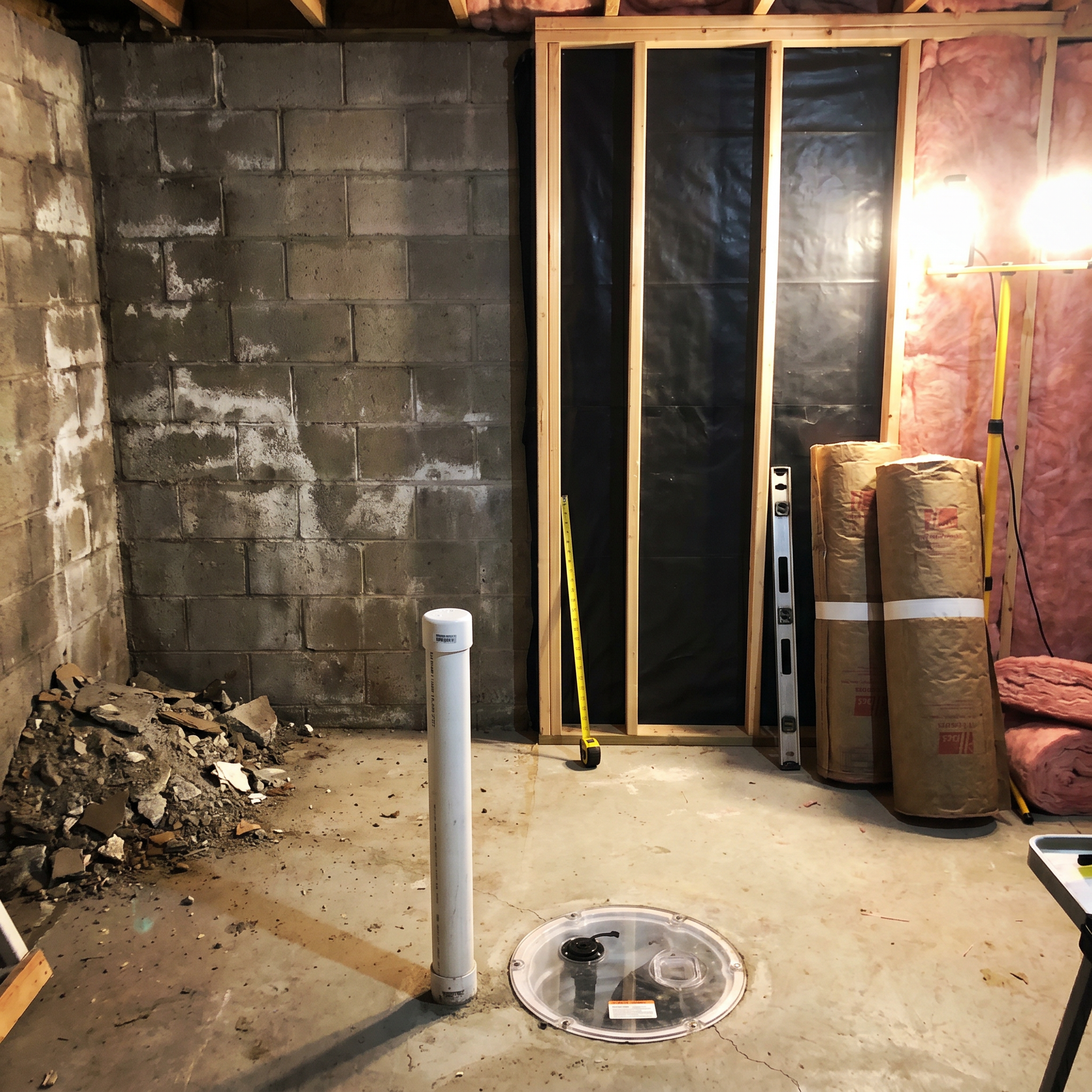
The protocol is straightforward. Test before you finish. Short-term radon test kits cost $15 to $30 from hardware stores, local libraries, or the American Lung Association. The Iowa Radon Hotline at 1-800-383-5992 will direct you to local testing resources and certified professionals. If your test comes back below 4 pCi/L, proceed with finishing without mitigation needed. If it comes back at or above the action level, install a mitigation system before any finish work begins. Retrofit mitigation costs $1,800 to $2,500 in most Central Iowa homes; the same system installed in unfinished space is meaningfully cheaper than retrofitting through finished walls and ceilings.
Iowa HF 2297, currently awaiting the governor’s signature and slated for effect July 1, 2026 if signed, would require passive radon mitigation systems in all new Iowa single-family and two-family home construction. The bill does not retroactively apply to existing homes, but it reflects the regulatory direction Iowa is heading. Building a basement office or finished living space in an existing home should follow the same standard the state is preparing to require of new construction. For more detail on the moisture and radon work that must precede any finishing project, see our guide to fixing basement problems before you finish.
Authoritative information on Iowa radon testing and mitigation is available at the Iowa HHS radon resources page.
Unpermitted Work: The Appraisal and Financing Trap
Finishing a basement in Des Moines and surrounding Central Iowa cities requires permits for the structural and trade work involved. A building permit covers framing, drywall, and HVAC. Separate electrical permits go through the state’s iowaelectrical.gov system rather than the city building permit portal. Plumbing permits cover any new bathroom or wet bar plumbing. Permit fees in Central Iowa typically run $200 to $1,000 combined depending on project scope and valuation, which is genuinely modest compared to the cost of the project itself.
Skipping permits to save those fees is one of the most expensive money-saving moves an Iowa homeowner can make. Unpermitted work creates problems that compound over time and surface specifically when you try to sell the home or refinance it.
The first problem surfaces at appraisal. Appraisers note when work has been done without permits, either through visual inspection (recent finishes without matching permit records on file) or through the seller’s disclosure requirements. Once an appraiser flags unpermitted work, the lender’s underwriting team frequently requires either the permits be obtained retroactively before closing, or the work be removed entirely. Retroactive permit processes can cost $2,000 to $5,000 or more, particularly if walls need to be opened for inspection of concealed work.
The second problem surfaces at financing. VA, FHA, and USDA loans all have strict requirements about unpermitted work, with VA being the strictest. A VA buyer reviewing your home will frequently walk away from a property with documented unpermitted work, because the VA appraisal process can disqualify the loan entirely. You don’t lose just that buyer; you lose every VA buyer in the market, which is a meaningful portion of buyers in Central Iowa.
The third problem surfaces at insurance and at any future claim. Homeowners insurance policies typically exclude coverage for damage caused by unpermitted work, which means a basement flood, electrical fire, or structural failure tied to unpermitted finishing can leave you holding the entire repair bill rather than seeing a claim covered.
The math is straightforward: $500 to $1,000 in permit fees during the project versus $5,000 to $30,000 in lost value or remediation cost at sale. Permits are not optional in Iowa, and they’re not expensive enough to justify the risk. For more detail on what permits a typical basement finishing project requires in Central Iowa, see our basement finishing permit needs guide.
Missing Egress: The Bedroom That Isn’t
This is the most expensive single mistake an Iowa homeowner can make when finishing a basement, and it’s the one that produces the most dramatic ROI destruction. Iowa code, following the International Residential Code (IRC) section R310, requires every basement bedroom to have an egress window meeting specific dimensional requirements: minimum 5.7 square feet of net clear opening, minimum 24 inches of opening height, minimum 20 inches of opening width, and maximum 44 inches of sill height above the floor.
A room without a code-compliant egress window cannot legally be called a bedroom in Iowa. This is not a soft preference; it’s a legal definition that affects how the room is treated at appraisal. The four Central Iowa counties most relevant for Busy Builders (Dallas, Polk, Warren, and Madison) have a local government agreement formalizing this standard. An appraiser counting bedrooms walks the home and applies the legal definition. Rooms without egress get counted as “bonus rooms,” “dens,” or “office space,” not as bedrooms.
The financial impact is enormous. A real Johnston example, which has become an oft-cited cautionary tale in Central Iowa real estate, involved a homeowner who finished their basement with two “bedrooms” using standard basement windows that didn’t meet egress requirements. The appraiser counted the home as having 2 bedrooms (the original above-grade rooms) rather than 4 bedrooms (the above-grade plus the two basement rooms). The home moved from a 4-bedroom comparable bracket to a 2-bedroom comparable bracket at appraisal, losing $25,000 to $30,000 in valued square footage. The egress windows that would have prevented this would have cost $2,500 to $5,000 each. The math is brutal: $5,000 of egress window work would have preserved $25,000 to $30,000 in home value.
The lesson here is not that egress is a nice-to-have. It’s that any basement bedroom plan in Iowa requires an egress window in the budget from day one. Skip the wet bar, skip the upgraded flooring, skip the recessed lighting, but do not skip the egress window if you’re planning a basement bedroom. For complete guidance on egress window requirements and installation in Central Iowa, see our egress windows in basement bedrooms guide.
Table 3: What Each ROI Mistake Costs You
| Mistake | Cost to Prevent | Likely Cost If Skipped |
|---|---|---|
| No radon test/mitigation | $1,800-$2,500 mitigation if needed | Disclosure liability, buyer negotiating power, health exposure |
| Unpermitted work | $200-$1,000 in permit fees | $2,000-$5,000+ retroactive permits; $10,000-$30,000 lost in financing/sale |
| Missing egress on basement bedroom | $2,500-$5,000 per egress window | $25,000-$30,000 lost appraised value |
| Moisture not addressed | $2,000-$12,000 remediation | Project failure, mold, full redo |
Spend Here, Not There: Highest ROI Finish Choices
Beyond the three traps above, the specific finishes and features you include in your basement finish drive the return up or down. Some choices return strongly at resale; others are lifestyle features that you should include only if you’ll be in the home long enough to enjoy them yourself.
The single highest-ROI add-on in any basement project is a bathroom. A basement without a bathroom limits the space’s functionality dramatically (no place to use the restroom without going back upstairs, no support for overnight guests or a basement bedroom). A basement with a bathroom transforms into legitimate living space, which is exactly what appraisers and buyers respond to. Costs vary significantly based on whether your basement has plumbing rough-in already installed (in many newer Central Iowa homes, builders install rough-ins for future basement bathrooms even when the basement is delivered unfinished). With rough-in present, a basement bathroom typically runs $12,000 to $20,000. Without rough-in, you’re trenching the concrete slab to install the necessary plumbing, which adds significant labor and pushes the bathroom cost to $20,000 to $50,000-plus depending on scope.
A legal bedroom, meaning a finished room with a code-compliant egress window, is the second highest-ROI feature. As discussed above, the difference between counting as a bedroom versus a bonus room is $25,000 to $30,000 in appraised value for a relatively small incremental investment in egress.
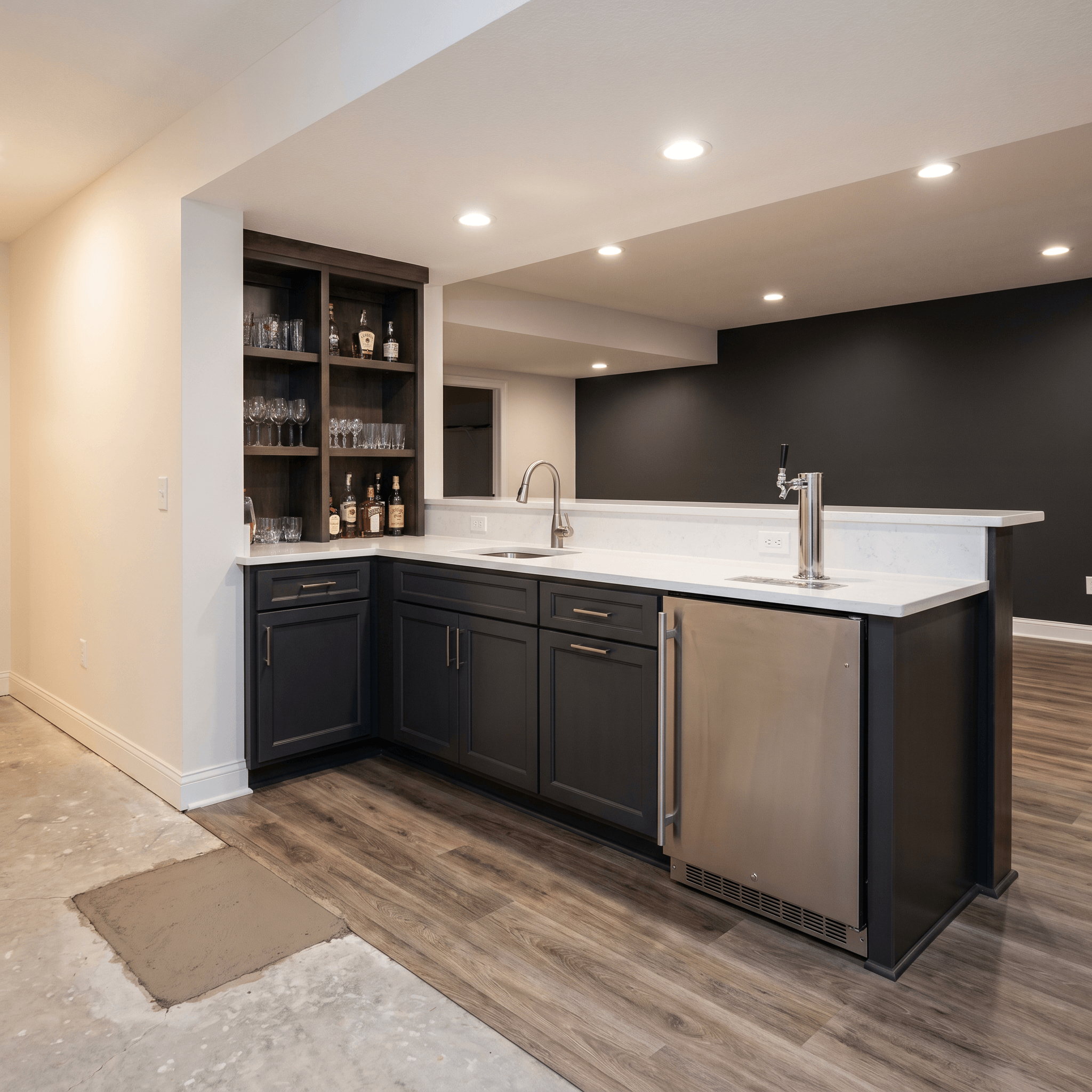
Wet bars, home theaters, custom cabinetry, and luxury finishes are buyer-specific features. Some buyers love them and pay accordingly; others see them as features they’d remove. In a mid-priced Des Moines metro home (median sale price around $208,000 to $302,000 depending on submarket as of early 2026), upgrade finishes typically don’t return their cost at resale. They make the home easier to sell and may attract more offers, but the financial return per dollar spent runs below the basic finish components. If you’re planning to stay in the home for ten-plus years and you want to enjoy the wet bar yourself, include it. If you’re finishing the basement primarily for resale, skip the luxury features and put the money into a bathroom and a legal bedroom instead.
Mid-grade materials are typically the sweet spot for ROI. Luxury vinyl plank flooring (which has improved dramatically and is now standard in mid-range basement finishes) outperforms carpet on durability and moisture resistance. Mid-range cabinetry from a quality manufacturer outperforms entry-level cabinetry on appearance and longevity. Quartz countertops in the bathroom outperform laminate at modest additional cost. The goal at this finish level is durable quality, not luxury showcase.
A rental suite (sometimes called an accessory dwelling unit or ADU) is a distinct category that can change the ROI math substantially. Rental income from a legally permitted basement suite in the Des Moines metro typically runs $800 to $1,200 per month for a one-bedroom unit, which generates $9,600 to $14,400 per year of income against your initial finish cost. Over five to ten years, that income can effectively pay back the project entirely. However, ADU rules vary dramatically across Central Iowa cities. Some allow them with permits; others restrict them; some require owner occupancy of the main home. Before planning any rental scope, verify the specific zoning rules in your city with the local planning and zoning department.
Table 4: Where to Spend for Maximum Basement ROI
| Feature | Typical Cost | ROI Impact | Verdict |
|---|---|---|---|
| Basement bathroom (with rough-in) | $12,000-$20,000 | 80-85% | High priority |
| Basement bathroom (no rough-in, requires trenching) | $20,000-$50,000+ | Moderate | Consider cost vs. benefit |
| Legal bedroom + egress window | $2,500-$5,000 (egress alone) plus framing | $25,000-$30,000 value difference | Essential if adding a bedroom |
| Wet bar | $5,000-$15,000 | Buyer-specific | Lifestyle, not ROI |
| Home theater | $10,000-$50,000+ | Low at resale | Only if staying long-term |
| Mid-grade flooring (LVP) | $4-$8/sq ft | Strong | Standard mid-range choice |
| Radon mitigation system | $1,800-$2,500 | Protects all other ROI | Non-negotiable in Iowa |
| Permits (electrical, building, plumbing) | $200-$1,000+ | Protects financing/sale | Non-negotiable |
Illustrative Scenarios
Illustrative scenario: An Ankeny homeowner with an 1,100 square foot unfinished basement decides to finish a family room area, one legal bedroom with egress window, and a full bathroom (rough-in already present from original construction). Pre-finish radon test reads 5.2 pCi/L, slightly above the action level, so they install a mitigation system for $2,100 before any other work begins. Total project cost including the radon mitigation, the egress window, framing, drywall, LVP flooring, the bathroom finish, electrical and plumbing trades, building and electrical permits, paint, and labor: approximately $62,000. The home moves from a 3-bedroom, 2-bath comparable bracket to a 4-bedroom, 3-bath bracket. Estimated added appraised value at resale: $43,000 to $47,000, putting the ROI at roughly 70 to 75%. In Ankeny’s competitive market, buyer perception likely values the finished basement at the higher end of that range, with the upgraded bedroom count attracting families that the previous configuration would have missed.
Illustrative scenario: A Johnston homeowner skips the radon test, doesn’t pull permits, and adds two basement “bedrooms” using standard basement windows that don’t meet egress code. Total cash cost: $38,000. At listing, three problems emerge in sequence. First, the appraiser cannot count the basement rooms as bedrooms because they lack code-compliant egress; the home appraises as 2 bedrooms (original above-grade) rather than 4. Second, the appraiser notes the unpermitted work; the buyer’s lender requires retroactive permits before closing, which costs $3,200 and requires opening one wall for electrical inspection. Third, the original VA buyer walks because of the documented unpermitted work, and the home goes back on market at a reduced price. Final added appraised value at sale: approximately $14,000. Effective ROI: 37%. The same scope, done with permits, radon mitigation, and code-compliant egress, would have cost approximately $48,000 total and produced an appraised value increase of $35,000 to $37,000 (roughly 75% ROI). The savings from skipping permits and egress cost approximately $25,000 in lost value.
These scenarios are illustrative and not actual Busy Builders projects.
Frequently Asked Questions
Q: Does a finished basement add value in Des Moines?
A: Yes. The 2025 NAR Remodeling Impact Report shows basement conversion to living area returns 71% of project cost at resale nationally, and the Iowa range typically runs 60 to 75%. Basement finishing consistently ranks among the highest-return interior remodeling projects available. The value added depends heavily on finish quality, scope, and whether you include a bedroom (with egress) and a bathroom. In competitive Central Iowa suburbs like Ankeny, Waukee, and Johnston, finished basements have become the local expectation, which makes unfinished basements actively work against you at listing time.
Q: How much does it cost to finish a basement in Des Moines?
A: Typical costs run $30 to $70 per square foot in the Des Moines metro depending on finish level and scope. A basic 800 square foot family room runs $28,000 to $36,000. A mid-range suite with a bathroom runs $50,000 to $75,000. A full suite with a bedroom, bathroom, and wet bar can run $70,000 to $90,000-plus. These are planning estimates; always obtain three written quotes from registered Iowa contractors for your specific project.
Q: Do I need a permit to finish my basement in Iowa?
A: Yes. Iowa requires permits for the electrical, plumbing, HVAC, and structural framing work involved in any basement finish. Permits typically include a city building permit for framing and HVAC, a separate state electrical permit through iowaelectrical.gov for any new circuits, and plumbing permits for any new bathroom or wet bar plumbing. Permit fees in Central Iowa typically run $200 to $1,000 combined depending on scope. Skipping permits creates problems at appraisal, financing, and insurance that can far exceed the original permit fees.
Q: Do I need an egress window for a basement bedroom?
A: Yes. Iowa code, following IRC R310, requires every basement bedroom to have a code-compliant egress window: minimum 5.7 square feet net clear opening, 24-inch height, 20-inch width, and 44-inch maximum sill height. Without a compliant egress window, the room cannot legally be counted as a bedroom on the home’s appraisal. The Johnston case study cited in this guide shows the cost of skipping egress: $25,000 to $30,000 in lost appraised value to save $2,500 to $5,000 in egress installation cost.
Q: Should I test for radon before finishing my basement?
A: Yes, always. Iowa is the worst state in the country for residential radon, with as many as 5 in 7 Iowa homes above the EPA action level and an average indoor concentration of 8.5 pCi/L versus the U.S. average of 1.3. Spending 40-plus hours per week in a basement living space (or even regular family time) creates an exposure profile that elevated radon meaningfully affects. Test before you finish: a short-term test kit costs $15 to $30, and the Iowa Radon Hotline at 1-800-383-5992 will direct you to certified local resources. If your test reads at or above 4 pCi/L, install a mitigation system ($1,800 to $2,500 retrofit) before any finish work begins.
Key Takeaways
The honest ROI picture for basement finishing in Des Moines comes down to a small set of clear principles.
Basement finishing returns roughly 60 to 75% of project cost at resale in Iowa, with the national average at 71% per the 2025 NAR Remodeling Impact Report. This is one of the highest-return interior remodeling investments available, well above most kitchen and bathroom remodels at the upper tiers.
Iowa appraisers value below-grade space at 50 to 75% of above-grade rates per square foot, which is why the ROI math falls short of dollar-for-dollar recovery. Buyer perception in competitive Central Iowa markets often runs higher than appraiser math, especially in growing suburbs where finished basements have become the local standard.
Three Iowa-specific traps will destroy the ROI of any basement finish if you skip them. Test for radon before finishing, because Iowa is the worst state in the country for radon and mitigation in unfinished space is significantly cheaper than retrofit. Pull permits for all electrical, plumbing, building, and HVAC work, because unpermitted work disqualifies financing options and surfaces at appraisal with retroactive costs that exceed the original permit fees by 10-fold. Install code-compliant egress windows in any basement bedroom, because a missing egress can cost $25,000 to $30,000 in lost appraised value to save $2,500 to $5,000 in installation.
Spend money on bathrooms, legal bedrooms (with egress), and mid-grade durable materials. Buyer-specific features like wet bars and home theaters return less per dollar spent and should only be included if you’re planning to stay in the home long enough to enjoy them yourself.
Ready to Plan a Basement Finish That Actually Returns?
You have the framework. Whether your basement project lands at 60% ROI or 75% ROI depends on a small set of decisions made early: testing for radon, pulling the right permits, designing code-compliant egress, and allocating budget to the features that return strongly versus those that are lifestyle-only. Done right, basement finishing remains one of the most reliable interior investments available to Iowa homeowners in 2026.
Busy Builders has completed 1,285+ projects across Central Iowa since 2020. Our basement finishing process begins with a free project consultation that includes a walk-through of your unfinished space, a discussion of any radon or moisture issues that need to be addressed first, and an itemized estimate that distinguishes pre-work from the finish itself. We pull all required permits (city building permit, state electrical permit through iowaelectrical.gov, plumbing permits where applicable), coordinate with the licensed Iowa trades your project requires (electricians, plumbers, HVAC technicians), and back all workmanship with a written warranty (details provided in your contract). You can verify any Iowa contractor’s registration at Iowa DIAL before signing any contract.
We serve Des Moines, Ankeny, Waukee, West Des Moines, Johnston, Grimes, Altoona, Urbandale, Ames, and communities across Central Iowa.
Call: 844-435-9800
Website: https://busybuildersiowa.com/
All cost estimates, ROI figures, and value-added ranges in this guide are planning estimates for the Des Moines metro and reflect industry data including the 2025 NAR Remodeling Impact Report and Busy Builders project experience. Actual costs and returns vary based on basement size, finish quality, market conditions, lot conditions, scope, and compliance with local codes. ROI figures are not guarantees; individual results vary by market and project quality. Radon levels are home-specific and require professional testing; a blog cannot diagnose or remediate radon in any specific home. The Iowa Radon Hotline at 1-800-383-5992 will direct you to certified Iowa radon professionals. Egress, permit, and code requirements vary by city; verify specific requirements with your local building department before planning any scope. Iowa HF 2297, referenced in this guide as a radon-related legislative item, is awaiting the governor’s signature as of mid-May 2026; verify current status at the Iowa Legislature’s official site before planning around any expected provisions. Always obtain three written quotes for any remodeling project. Verify any Iowa contractor’s registration at the Iowa Department of Inspections, Appeals, and Licensing at dial.iowa.gov before signing a contract. Busy Builders is a registered Iowa contractor with the Iowa Department of Inspections, Appeals, and Licensing.
Busy Builders | Full-Service Construction and Remodeling | Serving Central Iowa Since 2020
Local service: Basement finishing in Des Moines, Iowa.