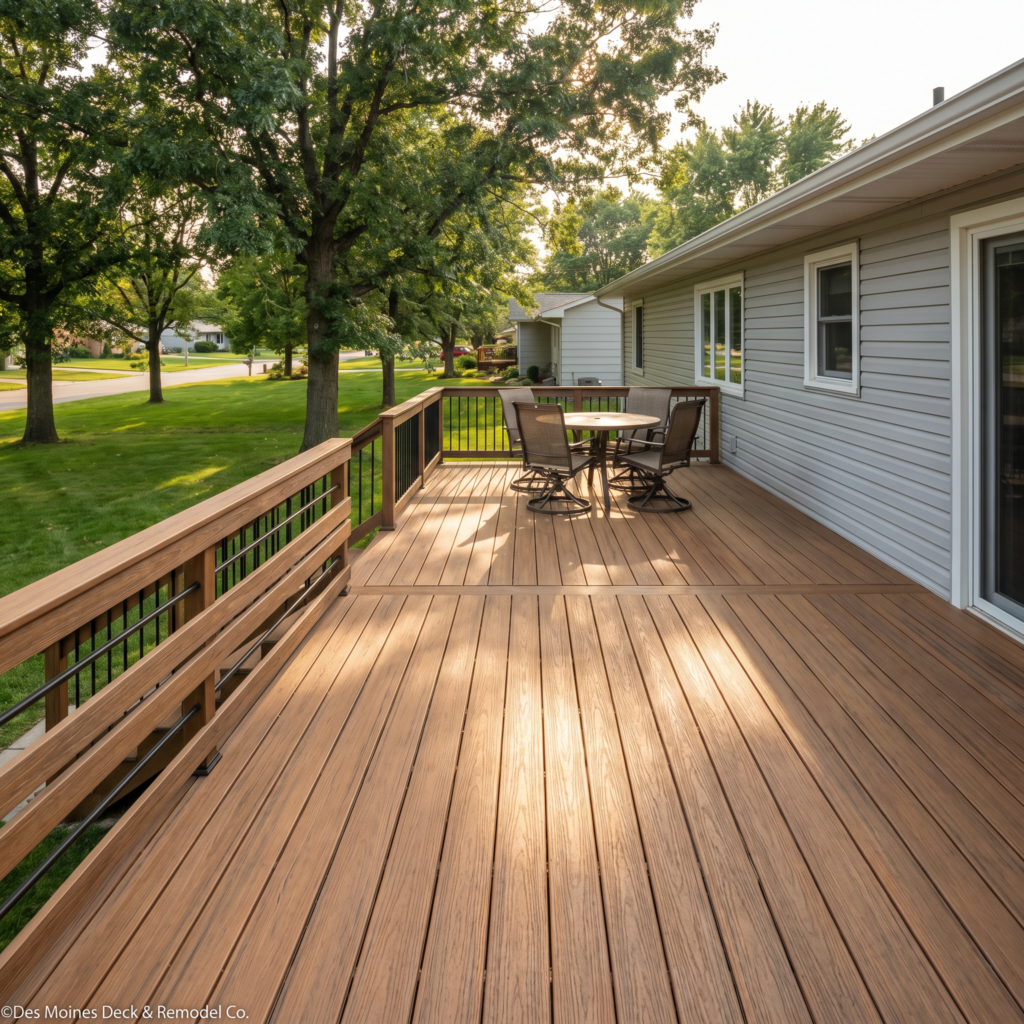
A composite deck in the Des Moines metro costs more than a pressure-treated wood deck up front, and a lot less over ten years once Iowa’s maintenance reality is factored in. This guide covers 2026 Iowa cost ranges by deck size and composite brand tier, the ten-year ownership math that explains why most Iowa homeowners end up ahead on composite despite the higher upfront cost, the 42-inch frost line that makes Iowa deck footings more expensive than national online calculators suggest (and why that cost is physics, not markup), the Iowa permit requirements, the 2025 Zonda Cost vs. Value Report resale ROI data, and the resurfacing-versus-full-replacement decision for homeowners with an existing deck. Cost figures are 2026 Iowa planning estimates. Actual costs vary by composite brand, deck height, site conditions, footing complexity, and contractor.
TLDR: Composite decks in Iowa typically run $25 to $55 per square foot installed depending on brand tier, which puts a standard 12 by 16 deck at $7,680 to $12,500 or more and a 300 square foot deck at $9,000 to $15,000 installed. Composite costs roughly 50 to 80 percent more than pressure-treated wood up front, but wood decks in Iowa cost $300 to $850 per year in maintenance, so total ownership costs typically equalize or favor composite within 5 to 10 years. The 2025 Zonda Cost vs. Value Report shows wood deck additions at 94.9 percent ROI and composite deck additions at 88.5 percent ROI, both top-10 nationally. Iowa’s 42-inch frost line adds $800 to $3,200 to any deck project compared to southern states, and most Iowa jurisdictions require a permit for attached decks, decks over 30 inches above grade, or decks exceeding 200 square feet.
The sections below cover the real Iowa numbers, the brand tiers, the ten-year comparison, the frost line requirement, the permit reality, and the decision framework.
What a Composite Deck Actually Costs in Iowa in 2026
Composite decks in the Des Moines metro typically run $25 to $55 per square foot installed, with variation driven by composite brand tier, deck height, stair count, railing type, and site conditions. Iowa construction costs run approximately 14 percent below the national average, which means national online calculators that return $40 to $80 per square foot typically overstate Iowa cost. Busy Builders’ own pricing pages confirm the Iowa-specific installed range, and a standard 12 by 16 deck at 192 square feet typically runs $7,680 to $12,500 or more. The table below summarizes 2026 Iowa planning ranges by deck size.
| Deck Size | Square Feet | 2026 Iowa Planning Range (Composite Installed) |
|---|---|---|
| 10 by 12 | 120 | $3,000 to $6,600 |
| 12 by 16 | 192 | $7,680 to $12,500 or more |
| 16 by 20 | 320 | $9,600 to $17,600 or more |
| 20 by 20 | 400 | $12,000 to $22,000 or more |
| 20 by 24 | 480 | $14,400 to $26,400 or more |
| Multi-level 400 square foot | 400 | $24,000 to $40,000 or more |
Planning estimates. Iowa costs run approximately 14 percent below national averages. Actual costs vary by composite tier, deck height, site conditions, and contractor. Busy Builders has detailed cost context in its Des Moines deck building costs guide.
Pro Tip 1: The per-square-foot figure does not include railings, stairs, or pergolas. For a deck over 30 inches above grade, add $800 to $2,400 or more for code-required railings. For stairs, add $200 to $2,500 or more depending on height and design. Build these line items into the budget before comparing contractor quotes.
Pro Tip 2: Iowa labor typically adds $15 to $35 per square foot on top of composite material cost, and the total moves based on deck height, stair count, framing complexity, and whether the existing space requires demolition of an old deck first.
Three Composite Brand Tiers: What You Are Actually Paying For
Composite decking in Iowa falls into three clean tiers, and understanding the tier separation is the fastest way to calibrate a quote. Entry composite (Trex Enhance, Fiberon Good Life, TimberTech Edge) uses wood-fiber composite construction and typically runs $5.00 to $7.50 per square foot for boards alone, or $25 to $30 per square foot installed. Mid-range composite (Trex Transcend, TimberTech PRO) is the most common Iowa primary deck choice and runs $7.00 to $12.00 per square foot for boards, or $30 to $40 per square foot installed. Premium composite (TimberTech AZEK, Fiberon Promenade) uses full PVC construction rather than wood-fiber blend, carries the best freeze-thaw resistance of the three tiers, and runs $11.00 to $16.00 per square foot for boards, or $40 to $55 or more per square foot installed. Most composite manufacturers carry 25-year material warranties, and premium lines often extend to 50 years.
| Tier | Brand and Line | Board Cost Per Square Foot | Iowa Installed Estimate | Warranty | Best For |
|---|---|---|---|---|---|
| Entry | Trex Enhance, Fiberon Good Life, TimberTech Edge | $5.00 to $7.50 | $25 to $30 per square foot | 25 years | Budget-focused; solid Iowa performance |
| Mid-range | Trex Transcend, TimberTech PRO | $7.00 to $12.00 | $30 to $40 per square foot | 25 years | Most common Iowa primary choice |
| Premium | TimberTech AZEK, Fiberon Promenade | $11.00 to $16.00 | $40 to $55 or more per square foot | 25 to 50 years | Full PVC; best freeze-thaw resistance; luxury look |
Board costs are materials only. Iowa labor adds $15 to $35 per square foot on top of material cost. Planning estimates; actual costs vary. See Busy Builders’ overview of best decking materials for Iowa for brand selection guidance.
Pro Tip 3: All three tiers perform acceptably in Iowa’s freeze-thaw climate when properly installed, but AZEK and other full-PVC premium lines handle Iowa’s 100-plus annual freeze-thaw cycles with the least long-term surface degradation. For homeowners staying 20 or more years, premium PVC composite is often worth the tier upgrade.
Pro Tip 4: Composite brand and line affect warranty transferability at resale. Check whether the warranty transfers to a subsequent homeowner; some lines allow full transfer, others limit transfer to one owner change.
Composite vs. Pressure-Treated Wood: The Ten-Year Iowa Math
Pressure-treated wood looks cheaper on a first-quote comparison, and it is cheaper up front. Iowa installed cost for pressure-treated wood runs $20 to $35 per square foot, which puts a 300 square foot wood deck at $6,000 to $10,500 installed. Composite at mid-range tier runs $25 to $55 per square foot installed, putting the same 300 square foot deck at $9,000 to $15,000. That is a $3,000 to $5,000 spread in favor of wood on the day the deck is built. The spread does not hold up over ten years. Wood decks in Iowa require annual staining, sealing, and repair of cracked, cupped, or splintered boards. Typical Iowa wood deck maintenance costs run $300 to $850 per year. Over a decade, that adds approximately $3,000 to $8,500 to wood’s lifetime cost. Composite maintenance runs $5 to $15 per year (soap and water plus occasional board cleaner) for a ten-year total of $50 to $150. Iowa wood decks typically last 10 to 15 years before the boards need replacement; composite typically lasts 25 to 50 years.
| Factor | Pressure-Treated Wood | Composite (Mid-Range) |
|---|---|---|
| Iowa installed cost per square foot | $20 to $35 | $25 to $55 |
| Typical Iowa 300 square foot project cost | $6,000 to $10,500 | $9,000 to $15,000 |
| Annual maintenance | $300 to $850 (staining, sealing, repairs) | $5 to $15 (soap and water) |
| 10-year maintenance total | Approximately $3,000 to $8,500 | Approximately $50 to $150 |
| Typical lifespan | 10 to 15 years | 25 to 50 years |
| Manufacturer warranty | None standard | 25 to 50 years |
| 2025 Zonda Cost vs. Value Report ROI | 94.9 percent | 88.5 percent |
Planning estimates. Actual costs vary with use, climate exposure, maintenance diligence, and contractor.
Pro Tip 5: The ten-year maintenance math is the most important single calculation for Iowa deck buyers. Ask any contractor for the written composite-versus-wood ten-year ownership comparison for the specific deck size being built before making the choice. A 300 square foot deck run through the full calculation usually favors composite by year 5 to 7.
Pro Tip 6: The Zonda ROI figures show wood at a higher ROI percentage than composite, which looks favorable for wood at first read. That percentage math breaks down because wood decks typically need full replacement at 12 to 15 years. Once the deck is rebuilt, the ROI calculation resets to zero. Composite does not need replacement within the same window.
Iowa’s 42-Inch Frost Line: Why Iowa Decks Cost More Than National Averages
This is the single most Iowa-specific construction factor in deck building, and it is where national online cost calculators get Iowa cost wrong. The Iowa legally recognized frost line is 42 inches; the Des Moines metro frost depth typically runs 42 inches depending on soil and location. Every deck footing in the Des Moines metro must extend below the frost line. Southern states with 5-inch frost lines require shallow footings that cost a small fraction of Iowa footing work. Iowa footings require mechanical auger excavation to full depth, a bell-shaped concrete base to resist uplift, and 3,000 PSI concrete to handle the freeze-thaw cycling in the surrounding soil. Each footing typically adds $200 to $500 over the equivalent southern-state footing, and a standard Iowa deck needs 6 to 10 footings depending on size and framing design. Net Iowa frost line cost adder over shallow-frost-line construction: $800 to $3,200 per project. This is a code requirement and a physics requirement, not a contractor markup. Footings placed above the frost line heave during Iowa winters as frozen soil expands upward and lifts the footing several inches, then drop unevenly at spring thaw. That damages the deck’s structural integrity and can make a deck unsafe.
Pro Tip 7: When comparing quotes from different contractors, ask each contractor to specify footing depth and footing diameter in the written scope of work. A contractor who quotes shallow footings to come in cheaper on price is quoting work that will fail Iowa inspection and will not last through the first winter.
Pro Tip 8: Concrete cannot safely pour below 40°F without cold-weather additives or heated enclosure. Iowa footing pours typically run April through early November. Winter planning is fine (see the scheduling section below), but winter pours require specific cold-weather protocols that add cost.
Iowa Permit Requirements
Most Iowa jurisdictions require a building permit for decks that are attached to the house, decks that sit more than 30 inches above grade, or decks that exceed 200 square feet. Scott County requires a permit for all decks regardless of size or height. Johnson County requires permits even for same-size replacement decks. In Des Moines, permit fees typically run $75 to $300 and review times typically run 5 to 10 business days when plans are complete. Permit applications typically require a completed application form, a site plan showing deck location and dimensions relative to property lines, construction drawings showing framing dimensions, footing locations, beam and joist sizes, connection details, ledger attachment method, and guardrail specifications. Any deck over 30 inches above grade also requires code-compliant guardrails with a top rail at least 36 inches above deck surface and spindle spacing of no more than 4 inches. See Busy Builders’ guide to Iowa building permits for the broader workflow. Iowa general contractors are registered, not licensed, through the Iowa DIAL contractor registration system. Electricians who install outdoor kitchen circuits or deck lighting hold separate Iowa state licenses.
| Deck Type | Permit Required? |
|---|---|
| Attached deck (any size) | Yes in most Iowa jurisdictions |
| Deck over 30 inches above grade | Yes |
| Deck over 200 square feet | Yes |
| Small freestanding deck under 200 sq ft and under 30 inches | Generally exempt; verify locally |
| Any deck in Scott County | Yes, regardless of size |
| Deck with pergola or roof structure | Yes |
| Replacement or resurfacing of existing deck | Varies; often yes, confirm with local building department |
| Outdoor kitchen or lighting circuit addition | Separate electrical permit required |
Permit requirements vary by Iowa jurisdiction. Confirm current requirements with the local building department before construction begins.
Pro Tip 9: Unpermitted deck work surfaces at resale inspection and can delay or kill a closing. The cost of pulling the permit is always lower than the cost of retroactive permitting plus inspection plus any required corrections. A registered Iowa contractor who pulls the permits is the safest choice.
Resurfacing vs. Full Replacement
For Iowa homeowners with an existing pressure-treated wood deck, the resurfacing option (new composite boards installed on the existing frame) typically runs $25 to $35 per square foot, which puts a 400 square foot resurfacing job at roughly $10,000 to $14,000. A full replacement (new frame plus new composite surface) typically runs $50 to $100 per square foot, which puts the same 400 square foot project at $20,000 or more. Resurfacing is only appropriate when the existing frame passes an on-site structural inspection by a registered Iowa contractor. Rot, soft spots, failed fasteners, or structural damage in the existing frame means full replacement is required for safety. No remote assessment, no online tool, and no quote-without-site-visit can determine whether an existing frame is safe to resurface. See Busy Builders’ ground-level versus elevated deck cost and design guide for more on the decision framework for existing decks.
Pro Tip 10: Before paying for a resurfacing quote, ask the contractor to inspect and document frame condition in writing. The documentation should call out each structural element (ledger, posts, beams, joists, rim, fasteners) and confirm each is sound. For any attached deck, also ask the contractor specifically how they flash the ledger, the connection point where the deck attaches to the house. Improper flashing is the leading cause of structural failure on Central Iowa attached decks and causes rot inside the band joist that is invisible until the deck is already unsafe. If the contractor declines to document frame condition or ledger flashing method before quoting, find a different contractor.
ROI and Resale Value
The 2025 Zonda Cost vs. Value Report is the strongest available benchmark for deck resale value, and both deck types rank in the top 10 nationally. Wood deck additions return 94.9 percent of cost at resale on a national average ($18,263 average cost, $17,323 value added). Composite deck additions return 88.5 percent ($25,096 average cost, $22,199 value added). Both are national averages. Actual Iowa results vary by neighborhood, market, home price band, and comparable sales. This is not financial advice.
Over-improvement is the secondary risk on any Iowa deck project. A $30,000 multi-level composite deck on a home in a $220,000 neighborhood does not typically appraise at full cost because Iowa appraisers use comparable neighborhood sales. The same deck on a home in a $450,000 neighborhood typically does. For lower-median Iowa neighborhoods, staying in the standard-platform composite range ($9,000 to $17,000 for a 300 to 400 square foot deck) is usually the better ROI strategy.
Best Time to Start an Iowa Deck Project
Spring and summer are peak deck-building season in Iowa, which means contractor scheduling typically runs 2 to 4 months from contract signing to construction start and material costs typically peak with demand. Planning and contracting during the winter off-season opens up 10 to 15 percent off-season material discounts at many suppliers and 2 to 4 week contractor availability rather than 2 to 4 months. The planning-contract-build cycle breaks cleanly: sign the contract in winter, lock material pricing before spring demand drives costs up, and start construction when ground conditions and concrete curing temperatures allow (typically above 40°F for concrete pours). Most Iowa composite deck construction happens April through October in the Des Moines metro. Busy Builders has additional context in its guide to benefits of winter deck planning for homeowners considering the off-season scheduling advantage.
Pro Tip 11: Ask the contractor whether material pricing can be locked at contract signing rather than at construction start. Material prices can move 5 to 10 percent between January signing and April construction; locking pricing at signing protects the homeowner from spring cost increases.
Illustrative Iowa Scenarios
Illustrative scenario based on 2026 Iowa market data, not a verified Busy Builders project: a Johnston homeowner wants a 16 by 20 composite deck (320 square feet) attached to the back of a two-story home, 4 feet above grade, with composite railings, one staircase, and a Trex Transcend surface. Iowa planning range: $11,000 to $15,000 for materials and labor including 42-inch footings, composite railings, and stairs. Permit required (attached and over 30 inches above grade), typical $75 to $200 fee in the Des Moines metro. Timeline: 2 to 4 weeks from permit approval in off-season, 6 to 10 weeks in peak spring and summer season.
Illustrative scenario, not a verified Busy Builders project: an Altoona homeowner has a 400 square foot pressure-treated deck built in 2011, now 15 years old. The surface boards show rot but the registered Iowa contractor’s on-site structural inspection confirms the frame is sound. Resurfacing with mid-range composite boards runs $25 to $35 per square foot for a planning range of $10,000 to $14,000. Full replacement would run $20,000 or more. Because the on-site inspection documented frame soundness, resurfacing is the appropriate path for this specific deck. Without the on-site inspection, resurfacing would not have been safe to quote.
Key Takeaways
A composite deck in the 2026 Des Moines metro typically runs $25 to $55 per square foot installed depending on brand tier, with a standard 12 by 16 deck at $7,680 to $12,500 or more and a 300 square foot deck at $9,000 to $15,000. Iowa construction costs run 14 percent below national averages, which means national online calculators typically overstate Iowa cost. Composite tier matters: entry (Trex Enhance, Fiberon Good Life, TimberTech Edge) at $25 to $30 per square foot installed, mid-range (Trex Transcend, TimberTech PRO) at $30 to $40, premium full-PVC (TimberTech AZEK, Fiberon Promenade) at $40 to $55 or more. The ten-year ownership comparison typically favors composite because Iowa wood decks cost $300 to $850 per year in maintenance versus $5 to $15 for composite. The 2025 Zonda Cost vs. Value Report shows wood deck additions at 94.9 percent ROI and composite at 88.5 percent ROI, both top-10 nationally and both presented as national averages. Iowa’s 42-inch frost line requires footings dug to frost depth with bell-shaped concrete bases, which adds $800 to $3,200 to any Iowa deck project compared to shallow-frost-line states; this is physics, not markup. Permits are required in most Iowa jurisdictions for attached decks, decks over 30 inches above grade, or decks over 200 square feet, and Scott County requires permits on all decks. Resurfacing an existing wood-frame deck with composite boards is only appropriate when the existing frame passes an on-site structural inspection by a registered Iowa contractor; no remote assessment can confirm frame condition. Improper ledger flashing is the leading cause of structural failure on Central Iowa attached decks and should be specified in writing with any contractor. Winter planning typically beats spring planning because off-season scheduling offers 10 to 15 percent material discounts and 2 to 4 week contractor availability rather than 2 to 4 months. Busy Builders has completed deck projects for over 1,000 Central Iowa homeowners since 2020, handles permits, footings, framing, composite installation, railings, and stairs under one point of contact, and backs the work with a written warranty on workmanship; warranty details are provided in the contract.
Pro Tip 12: Get a written scope of work before signing any composite deck contract. The scope should name the composite brand and line, specify board thickness and color, call out footing depth and diameter, identify railing and stair specifications, name the permit responsible party, and include warranty terms in writing. A contractor who resists putting these details in writing is not the right contractor for an Iowa composite deck.
Frequently Asked Questions
Q1: How much does a composite deck cost in Iowa in 2026?
Iowa composite decks installed typically run $25 to $55 per square foot depending on brand tier, deck height, and site conditions. A standard 12 by 16 deck (192 square feet) runs $7,680 to $12,500 or more installed. A 300 square foot deck runs $9,000 to $15,000. Iowa construction costs are approximately 14 percent below the national average. Entry composite brands (Trex Enhance, Fiberon Good Life, TimberTech Edge) start lower; premium PVC lines (TimberTech AZEK, Fiberon Promenade) run higher. Footings, railings, and stairs add cost beyond the per-square-foot rate. These are 2026 Iowa planning estimates; actual costs vary.
Q2: Is composite decking worth it versus pressure-treated wood in Iowa?
Composite costs more upfront (roughly 50 to 80 percent more per square foot installed) but Iowa wood deck owners spend $300 to $850 per year in staining, sealing, and repairs, adding approximately $3,000 to $8,500 in maintenance over 10 years. Iowa wood decks typically last 10 to 15 years before the boards need replacement. Composite typically lasts 25 to 50 years with a manufacturer warranty and requires only occasional soap-and-water cleaning at $5 to $15 per year. Total ownership costs typically equalize or favor composite within 5 to 10 years for most Iowa homeowners. The 2025 Zonda Cost vs. Value Report shows wood at 94.9 percent ROI and composite at 88.5 percent ROI, both top-10 nationally. These are national averages. Actual Iowa results vary by neighborhood, market, and home price band. This is not financial advice.
Q3: Why does Iowa’s frost line affect deck cost?
Iowa’s legally recognized frost line is 42 inches, which is the depth to which the ground freezes in a typical Iowa winter. Deck footings must be dug and poured below this depth (typically 42 inches in the Des Moines metro) to prevent frost heave. Frost heave happens when frozen soil expands upward and lifts footings several inches, then drops them unevenly at spring thaw, which damages the deck’s structural integrity. Each Iowa footing requires mechanical auger excavation, a bell-shaped concrete base for uplift resistance, and 3,000 PSI concrete. Iowa footings add $800 to $3,200 to a standard deck project compared to shallow-frost-line states. This is a code requirement and a physics requirement, not a contractor markup.
Q4: Do I need a permit to build a composite deck in Iowa?
In most Iowa jurisdictions, yes. A permit is typically required for any attached deck, any deck over 30 inches above grade, and any deck exceeding 200 square feet. Scott County requires a permit for all decks regardless of size. Johnson County requires permits even for same-size replacement decks. In Des Moines, permit fees run $75 to $300 and review typically takes 5 to 10 business days. Construction drawings, a site plan, footing locations, and guardrail specifications are typically required. Any deck over 30 inches above grade also requires code-compliant guardrails with a top rail at least 36 inches high and spindles no more than 4 inches apart. Unpermitted deck work surfaces at resale inspection and can delay or kill a closing.
Q5: When is the best time to start a composite deck project in Iowa?
Spring and summer are peak building season in Iowa, which means contractor scheduling typically runs 2 to 4 months from signing to construction start, and material costs typically peak with demand. Planning and contracting during the winter off-season typically opens up 10 to 15 percent material discounts, 2 to 4 week contractor availability, and the ability to lock pricing before spring demand drives costs up. The common Iowa strategy: sign the contract in winter, lock material pricing, and begin construction when ground conditions and concrete curing temperatures allow (typically above 40°F for concrete pours). Most Iowa composite deck construction happens April through October in the Des Moines metro.
Ready to Plan Your Composite Deck?
Busy Builders has completed deck projects for over 1,000 Central Iowa homeowners since 2020, across Des Moines, West Des Moines, Ankeny, Waukee, Johnston, Urbandale, and the surrounding metro. Call: 844-435-9800 to talk through deck size, composite brand tier, height, and budget, or schedule a free consultation to get a written scope before committing.
Legal Disclaimer
This article is for general educational purposes only and does not constitute engineering, legal, financial, or construction advice. Cost figures are 2026 Iowa planning estimates; actual costs vary by composite brand, deck height, site conditions, footing complexity, and contractor. ROI figures are national averages from the 2025 Zonda Cost vs. Value Report; actual results vary by neighborhood, market, home price band, and design, and results vary. This is not financial advice. Permit requirements vary by Iowa jurisdiction and change over time; confirm current requirements with the local building department before construction begins. Iowa general contractors are registered, not licensed, through Iowa DIAL; electricians who install outdoor kitchen circuits or deck lighting hold separate Iowa state licenses and should be verified independently before work begins. Iowa frost line footings (42 inches minimum) are a code requirement in the Des Moines metro; decks built without proper footing depth violate building code and create structural and safety risk. Resurfacing an existing wood-frame deck with composite boards is only appropriate when the existing frame passes an on-site structural inspection by a registered Iowa contractor; rot, soft spots, failed fasteners, or structural damage requires full replacement. No remote assessment, online tool, or quote-without-site-visit can confirm existing frame condition. Composite manufacturer warranties vary by brand, line, and warranty terms; transferability at resale varies by manufacturer. Busy Builders provides a written warranty on workmanship; specific terms, exclusions, and coverage details are provided in the project contract.
Related service: our deck building service.