A primary suite bathroom is the most expensive single bathroom a Des Moines homeowner will ever remodel, and it is also the one where decisions made in the first two weeks (layout, tub-or-no-tub, waterproofing, fixture relocation) lock in or lock out 80 percent of the resale value the project could have returned. This guide covers 2026 Iowa cost ranges, the three tiers of scope that most primary suite projects fall into, the five decisions that actually move the budget, the waterproofing standard Busy Builders treats as non-negotiable, Iowa permit and pre-1978 lead paint requirements, and the 2025 Zonda Cost vs. Value Report ROI data that explains why the $22,500 to $35,000 mid-range window is the sweet spot for most Des Moines metro homes. Cost figures are 2026 Iowa planning estimates. Actual costs vary by home, scope, existing conditions, and contractor.
TLDR: A mid-range primary suite bathroom remodel in the Des Moines metro typically runs $22,500 to $35,000 or more for a 130-plus-square-foot bathroom, including full demo, new tile, walk-in shower or tub conversion, semi-custom vanity, new flooring, and updated lighting. Cosmetic-only refreshes run $8,000 to $15,000; luxury build-outs with layout changes, freestanding tubs, and wet rooms reach $70,000 to $100,000 or more. The 2025 Zonda Cost vs. Value Report shows midrange bathroom remodels return approximately 80 percent at resale nationally while upscale remodels return only 42.2 percent, which makes the mid-range tier the ROI-optimal zone for most Iowa homes. Waterproofing behind tile is non-negotiable professional practice. Pre-1978 Iowa homes require a certified lead-safe renovator on any work that disturbs painted surfaces.
The sections below cover the real Iowa numbers, the decisions that drive them, the safety and legal requirements that protect both homeowner and contractor, and the resale data that informs where to set the budget ceiling.
What a Primary Suite Bathroom Remodel Actually Costs in Iowa
The primary suite bathroom is typically the largest and most plumbing-intensive bathroom in the home. Central Iowa planning ranges differ from national averages because Iowa construction costs run roughly 14 to 15 percent below national averages, which means a remodel that quotes at the national $26,138 midrange figure typically lands in the low-to-mid-$20,000s in the Des Moines metro. The table below summarizes the four tiers of scope and what each tier typically includes.
| Tier | Scope | 2026 Iowa Planning Range | Key Features |
|---|---|---|---|
| Cosmetic refresh | Fixtures, vanity, lighting, paint, no layout change | $8,000 to $15,000 | Fastest payback; no plumbing relocation |
| Mid-range full remodel | Full demo, new tile, shower conversion or retile, semi-custom vanity, flooring | $22,500 to $35,000 or more | Primary suite sweet spot; approximately 80 percent national ROI |
| High-end major overhaul | Layout changes, plumbing relocation, freestanding tub, custom cabinetry | $35,000 to $70,000 or more | Full transformation; 42.2 percent national ROI for upscale |
| Luxury build-out | Full expansion, wet room, custom everything, heated floors | $70,000 to $100,000 or more | Premium materials and labor; highest cost, lower ROI percentage |
Planning estimates. Actual costs vary by home, scope, existing conditions, and contractor. Labor accounts for 40 to 65 percent of total project cost. Busy Builders has detailed Iowa pricing in its Central Iowa bathroom remodeling costs guide.
Pro Tip 1: For most Des Moines metro primary suites, the $22,500 to $35,000 mid-range tier is the ROI-optimal zone. Stepping up to a $70,000-plus luxury build-out is a lifestyle choice, not an investment play, because the resale return percentage drops substantially above mid-range scope.
Pro Tip 2: Budget a 10 to 15 percent contingency on top of the quoted project cost. Older homes lean toward the higher end because hidden conditions (failed plumbing, rotted subfloor, obsolete wiring) surface during demo.
The Five Decisions That Drive the Budget
Most primary suite bathroom budgets are decided in five specific calls, and three of them happen before any contractor is hired. Understanding the cost lever on each one prevents scope creep during construction, which is where most disputes between homeowners and remodelers start.
The first decision is tub or no tub. National Association of Home Builders data shows 72 percent of first-time buyers rate having both a shower stall and a tub in the primary bath as essential or desirable. For a home with multiple bathrooms and a large enough primary suite, a freestanding tub paired with a separate walk-in shower is the on-trend 2026 design and shows well at resale. For a home where the primary suite is the only bathroom with a tub, removing the tub can create a resale headwind, especially with buyers who have young children. Consult a licensed Iowa real estate professional familiar with the specific neighborhood before removing the only tub from a home.
The second decision is walk-in shower or tub-shower combo. Walk-in curbless showers are the top primary suite trend for 2026, and wet rooms (shower and freestanding tub inside one waterproofed zone) are now mainstream for larger primary suites. Curbless showers also serve aging-in-place needs that affect resale value in later years.
The third decision is plumbing location. Moving the toilet, shower drain, or tub drain is the single biggest cost adder in any Iowa bathroom remodel, typically adding $1,500 to $5,500 or more for plumbing labor alone. Keeping fixtures in their existing locations is the fastest payback strategy on any mid-range remodel.
The fourth decision is vanity style. Custom cabinetry can run $1,200 to $13,000 or more depending on scope. Semi-custom vanities (stock cabinet with custom countertop) typically land in the $3,000 to $6,000 range for a primary suite double vanity, which is usually the best fit for mid-range projects.
The fifth decision is tile scope. Floor-only tile is the cheapest. Floor plus shower walls is standard for mid-range. Full wet-room tiling with waterproof membrane up the walls and across the ceiling is luxury-tier scope.
| Decision | Lower-Cost Path | Higher-Cost Path | Typical Cost Difference |
|---|---|---|---|
| Plumbing locations | Keep fixtures in place | Move drain, toilet, or supply lines | $1,500 to $5,500 or more |
| Vanity style | Semi-custom stock | Full custom cabinetry | $2,000 to $10,000 or more |
| Shower type | Retile existing footprint | Expand shower or build wet room | $3,000 to $15,000 or more |
| Tile material | Ceramic or porcelain | Natural stone (marble, travertine) | $2,000 to $8,000 or more |
| Floor heating | Standard tile floor | In-floor radiant heat | $600 to $2,500 |
Planning estimates. Actual cost differences depend on bathroom size, scope, and contractor. See Busy Builders’ guide to evaluating bathroom remodeling costs and benefits for additional decision-point context.
Pro Tip 3: The fastest way to blow a primary suite budget is to change plumbing locations mid-design. Lock layout before demo. Moving a toilet drain after the slab is open typically adds $2,000 to $4,000 that was not in the original quote.
Pro Tip 4: Double vanities are a stronger resale feature than a single luxury vanity in a primary suite. For a home with more than one occupant, a 60-inch double vanity typically shows better than an expensive 48-inch single.
Why Waterproofing Is Not Optional
This is the section that protects both the homeowner and the contractor from the most expensive failure in bathroom remodeling. Tile and grout are water-permeable by material. Without a waterproof membrane installed behind the tile before any tile goes up, water works through grout lines over time and reaches the framing, drywall, and subfloor. The damage is invisible for the first 5 to 10 years, then surfaces as cracked grout, loose tile, musty odor, or stained ceiling in the room below the bathroom. By the time it shows, the framing is compromised and the repair typically exceeds the cost of the original tile work.
Modern waterproofing uses bonded sheet membrane (Schluter Kerdi and similar systems), liquid-applied membrane (RedGard and similar), or foamboard systems (Wedi and similar). All three are standard professional products, and all carry 25-year to lifetime manufacturer warranties when properly installed. Any mid-range primary suite remodel that takes a shower down to the studs must include a modern waterproof membrane before tile goes up. This is professional standard, not an optional upgrade. Busy Builders’ own bathroom remodeling services page treats waterproofing as non-negotiable for any shower project. Iowa’s summer humidity and winter freeze-thaw cycles make proper waterproofing more important in Des Moines than in mild-climate markets.
Pro Tip 5: Ask any bathroom contractor which waterproofing system they install behind shower tile and ask to see the manufacturer’s warranty documentation. A contractor who cannot answer that question specifically is not the right contractor for a primary suite remodel.
Pro Tip 6: If an existing shower shows cracked grout, loose tiles, musty odors, or staining on the ceiling below, the waterproofing behind the tile has already failed. A cosmetic retile without removing the existing tile and installing a new waterproof membrane will not solve the problem and typically makes it worse.
Iowa Permits and the Pre-1978 Lead Paint Rule
Two compliance items apply to most primary suite bathroom remodels in the Des Moines metro. The first is permits. Replacing plumbing fixtures (toilet, sink, tub) typically requires a plumbing permit in Des Moines. Moving or adding plumbing requires both a building permit and a plumbing permit. Electrical circuit additions require an electrical permit. Like-for-like cosmetic work (paint, mirror swap, faucet replacement) generally does not require a permit. Iowa general contractors are registered, not licensed, through the Iowa DIAL contractor registration system. Plumbers, electricians, and HVAC technicians hold separate Iowa state licenses that should be verified independently before work begins. A registered Iowa contractor who pulls the permits is the safest approach; unpermitted bathroom work surfaces at future resale inspection and can delay or kill a sale. Busy Builders has written a broader overview in its Iowa building permits guide.
The second compliance item is the Iowa Renovation, Repair, and Painting (RRP) rule for pre-1978 homes. Since April 2010, Iowa law has required that any renovation disturbing painted surfaces in a pre-1978 Iowa home be performed by at least one certified lead-safe renovator following EPA-required lead-safe work practices. This applies to primary suite bathroom demo work, drywall removal, trim removal, and any work that disturbs painted surfaces. Homes in inner-ring Des Moines neighborhoods, Clive, Windsor Heights, and older West Des Moines are frequently pre-1978 and fall under this rule. Verify the contractor’s lead-safe renovator certification through Iowa DIAL before any work begins. The table below summarizes typical permit triggers for a primary suite project.
| Work Type | Permit or Certification Required |
|---|---|
| Like-for-like toilet or faucet replacement | Generally no permit required |
| New tile, demo to studs, no plumbing relocation | Typically no building permit; plumbing permit may apply |
| Replacing plumbing fixtures (toilet, sink, tub) | Plumbing permit required in Des Moines |
| Moving or adding plumbing | Building permit plus plumbing permit required |
| Electrical circuit additions or changes | Electrical permit required |
| Any work disturbing painted surfaces in pre-1978 home | Certified lead-safe renovator required by Iowa law |
Permit requirements vary by jurisdiction. Confirm current requirements with the Des Moines Permit and Development Center or the relevant local building department before work begins.
Pro Tip 7: For any home built before 1978, ask the contractor for written proof of Iowa DIAL lead-safe renovator certification before signing a contract. The certification is verifiable through Iowa DIAL and protects both the family and the contractor legally.
Pro Tip 8: Permits typically cost $50 to $1,000 in Des Moines depending on scope. That is a small fraction of project cost and protects the homeowner’s resale title. A contractor who recommends skipping the permit is not the right contractor for the job.
Resale ROI: What the 2025 Data Actually Shows
The strongest data source for bathroom remodel resale value is the 2025 Zonda Cost vs. Value Report, which tracks national average cost and value-added figures for specific project types and tiers. The table below summarizes the current national averages for the three bathroom tiers. Figures are national averages. Actual Iowa results vary by neighborhood, market, home price band, and design choices. This is not financial advice.
| Project Type | 2025 National Average Cost | Value at Resale | ROI |
|---|---|---|---|
| Midrange bathroom remodel | $26,138 | $20,915 | Approximately 80 percent |
| Universal Design bathroom | $42,183 | $25,812 | 61 to 64.1 percent |
| Upscale bathroom remodel | $81,612 | $34,000 | 36 to 42.2 percent |
National averages from the 2025 Zonda Cost vs. Value Report. Actual results vary by market, neighborhood, home price band, and design. This is not financial advice. See Busy Builders’ Ankeny bathroom remodeling guide for Iowa-specific context and examples.
The pattern in the data is clear. Midrange remodels return nearly 80 percent of cost at resale because they align with practical buyer taste (quartz durability, clean neutral tile, double vanity, walk-in shower, good lighting). Upscale remodels return closer to 42 percent because the luxury finishes that make them expensive (natural stone, freestanding tubs, custom cabinetry, heated floors) are personal preferences that not every buyer shares. There is no Des Moines-specific Cost vs. Value line item for primary suite bathrooms specifically; the national averages are the closest available benchmark.
Over-improvement is the secondary risk. A $70,000 primary suite remodel in a neighborhood where comparable homes sell for $280,000 does not appraise at full cost because Iowa appraisers use comparable neighborhood sales. The same $70,000 remodel in a neighborhood where comparable homes sell for $500,000 or more may return closer to national average ROI. For lower-median Iowa neighborhoods, staying in the $22,500 to $35,000 mid-range zone is the better ROI strategy.
Pro Tip 9: Before committing to a luxury-tier budget, ask a licensed Iowa appraiser to estimate the post-remodel appraised value using comparable neighborhood sales. The gap between project cost and appraised value is the over-improvement risk in dollar terms.
Planning Timelines
Primary suite bathroom remodel timelines run from short-project-range on cosmetic-only work to multi-month on full luxury build-outs. Cosmetic refreshes typically take 2 to 4 weeks. Mid-range full remodels typically take 4 to 8 weeks. Major overhauls with layout changes run 6 to 12 weeks. Wet rooms and luxury build-outs can take 8 to 16 weeks depending on material lead times and scope. Because this is an interior project, Iowa weather is not a scheduling constraint, though tile curing and finish coating require reasonable indoor humidity and temperature.
Families in a single-bathroom home need to plan for limited bathroom access during demo, tile work, and tile curing, which typically runs 3 to 7 days without any bathroom use during core demo. Dual-bathroom homes can typically stay in the home throughout construction with scheduling coordination.
Pro Tip 10: Order all cabinetry, tile, plumbing fixtures, and lighting before demo begins. Material lead times in the Des Moines metro can run 6 to 12 weeks on cabinetry and specialty tile, and scheduling demo before materials arrive causes the most common schedule slip in bathroom remodeling.
Illustrative Iowa Scenarios
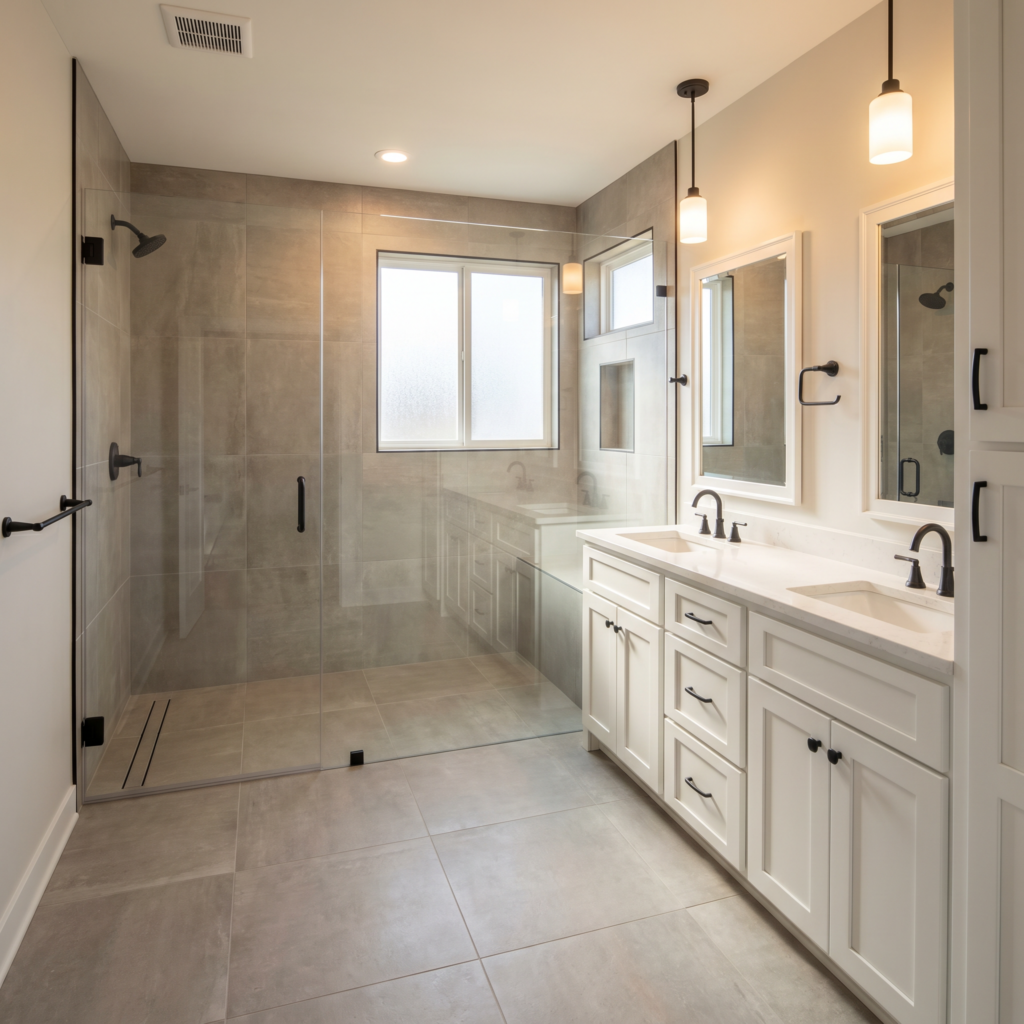
Illustrative scenario based on 2026 Des Moines metro planning data, not a verified Busy Builders project: a Johnston homeowner with a 2001-built ranch has a 140-square-foot primary suite bathroom featuring an original builder-grade tub-shower combo, a single-sink vanity, and 12-inch floor tile. She wants a walk-in shower, a double vanity, and updated tile throughout. A mid-range remodel that removes the tub, installs a curbless tile shower with frameless glass, a 60-inch semi-custom double vanity with quartz top, 12-by-24 porcelain floor tile, and updated lighting (all fixtures in their original locations) typically runs $26,000 to $33,000 in the Des Moines metro. Timeline: roughly 6 weeks. This is a Tier 2 project sitting squarely in the primary suite sweet spot for Iowa ROI.
Illustrative scenario, not a verified Busy Builders project: a Clive homeowner has a 1972-built home (pre-1978) and wants a full luxury primary suite overhaul including a freestanding tub, a wet room, custom cabinetry, and heated floors. The project requires a certified lead-safe renovator under Iowa law, layout changes to accommodate the freestanding tub, and plumbing relocation for the wet-room drain. Planning range: $55,000 to $80,000. The neighborhood median sale price supports the investment without over-improvement risk. Timeline: roughly 10 to 14 weeks with long-lead cabinetry.
Pro Tip 11: If the home is pre-1978, budget the lead-safe renovator protocol into the project timeline. Lead-safe work practices take longer than standard demo and typically add 1 to 3 days to a mid-range project.
Key Takeaways
A primary suite bathroom remodel in the 2026 Des Moines metro typically runs $22,500 to $35,000 or more for a mid-range full remodel, $8,000 to $15,000 for a cosmetic refresh, $35,000 to $70,000 or more for a major overhaul with layout changes, and $70,000 to $100,000 or more for a luxury build-out. The mid-range tier is the ROI-optimal zone for most Iowa homes based on the 2025 Zonda Cost vs. Value Report national figure of approximately 80 percent, compared to 42.2 percent for upscale remodels. Waterproofing behind tile is non-negotiable professional practice, and modern bonded sheet, liquid-applied, or foamboard systems carry 25-year to lifetime manufacturer warranties when properly installed. Permits are required for plumbing fixture replacement, plumbing relocation, and electrical circuit additions in Des Moines; Iowa general contractors are registered through DIAL while plumbers, electricians, and HVAC technicians hold separate state licenses. Any pre-1978 Iowa home requires a certified lead-safe renovator on work that disturbs painted surfaces, which covers most inner-ring Des Moines neighborhoods. Tub-or-no-tub decisions should be checked against local neighborhood buyer preferences with a licensed Iowa real estate professional before removing the only tub from a home. Over-improvement in lower-median Iowa neighborhoods is a real appraisal risk that favors the mid-range tier over luxury build-outs in those markets. Busy Builders has completed bathroom projects for 1,285+ Central Iowa homeowners since 2020, is a registered Iowa contractor through DIAL, treats waterproofing as non-negotiable on every tile shower, and backs the work with a written warranty on workmanship; warranty details are provided in the contract.
Pro Tip 12: Get a written scope of work before signing any primary suite bathroom contract. The scope should name the waterproofing system by manufacturer, specify permit responsibility (who pulls, who pays), identify lead-safe renovator certification for pre-1978 homes, and itemize plumbing relocation costs separately from fixture installation costs.
Frequently Asked Questions
Q1: How much does a primary suite bathroom remodel cost in Des Moines in 2026?
Central Iowa primary suite bathrooms typically run $22,500 to $35,000 or more for a mid-range full remodel (130 square feet and up), including new tile, a walk-in shower or tub conversion, a semi-custom vanity, new flooring, and updated lighting. Cosmetic-only refreshes (fixtures, vanity, paint, no layout change) run $8,000 to $15,000. High-end overhauls with layout changes, freestanding tubs, and custom cabinetry run $35,000 to $70,000 or more. Luxury build-outs can reach $70,000 to $100,000 or more. Labor typically accounts for 40 to 65 percent of total project cost. These are 2026 Iowa planning estimates; actual costs vary by home, scope, and contractor.
Q2: Does a primary suite bathroom remodel add value in Iowa?
The 2025 Zonda Cost vs. Value Report shows midrange bathroom remodels return approximately 80 percent nationally, which is the sweet spot for most Iowa homeowners. Upscale remodels return only 42.2 percent at resale, and over-improving above the neighborhood price ceiling does not appraise at full cost. For most Des Moines metro primary suites, a $22,500 to $35,000 mid-range remodel is the ROI-optimal zone. These figures are national averages from the 2025 Zonda Cost vs. Value Report. Actual results vary by neighborhood, market, and home price band. This is not financial advice.
Q3: Do I need a permit for a primary suite bathroom remodel in Des Moines?
Usually yes, for any mid-range or full remodel. In Des Moines, replacing plumbing fixtures (toilet, sink, tub) requires a plumbing permit. Moving or adding plumbing requires both a building permit and a plumbing permit. Electrical circuit additions require an electrical permit. Like-for-like cosmetic work (paint, mirror swap, faucet replacement) typically does not require a permit. A registered Iowa contractor who pulls the permits is the safest approach. Unpermitted bathroom work surfaces at future resale inspection and can delay or kill a sale.
Q4: What is waterproofing in a bathroom remodel and why does it matter?
Waterproofing is the membrane system installed behind bathroom tile that prevents water from penetrating to the framing, drywall, and subfloor. Tile and grout are water-permeable, which means that without a proper waterproof membrane behind them, water works through grout lines over time and causes mold, wood rot, and structural damage, often invisible for years. When a shower is removed down to the studs (standard in any full primary suite remodel), waterproof membrane installation is non-negotiable professional practice, not an optional upgrade. Modern systems carry 25-year to lifetime warranties when properly installed.
Q5: My Des Moines home was built before 1978. Does that affect a bathroom remodel?
Yes. Iowa law has required, since April 2010, that any renovation disturbing painted surfaces in a pre-1978 Iowa home be performed by at least one certified lead-safe renovator following EPA-required lead-safe work practices. This applies to primary suite bathroom demo work, drywall removal, trim removal, and any work that disturbs painted surfaces. Verify the contractor’s lead-safe renovator certification through Iowa DIAL before any work begins. The certification is verifiable through Iowa DIAL and protects the family legally.
Ready to Plan Your Primary Suite Remodel?
Busy Builders has completed bathroom projects for 1,285+ Central Iowa homeowners since 2020, across Des Moines, West Des Moines, Ankeny, Waukee, Johnston, Urbandale, and the surrounding metro. Call: 844-435-9800 to talk through scope, budget, and timeline, or schedule a free consultation to get a written scope before committing.
Legal Disclaimer
This article is for general educational purposes only and does not constitute engineering, legal, financial, or construction advice. Cost figures are 2026 Iowa planning estimates; actual costs vary by home condition, scope, existing plumbing and electrical systems, material availability, and contractor. ROI and resale value figures are national averages from the 2025 Zonda Cost vs. Value Report; actual results vary by neighborhood, market, home price band, and design, and results vary. This is not financial advice. Permit requirements vary by jurisdiction and change over time; confirm current requirements with the Des Moines Permit and Development Center or the relevant local building department before work begins. Iowa homes built before 1978 are subject to the Iowa Renovation, Repair, and Painting rule; confirm lead-safe renovator certification through Iowa DIAL before any project that disturbs painted surfaces. Tub-versus-no-tub decisions may affect resale value depending on buyer preferences in a specific neighborhood; consult a licensed Iowa real estate professional familiar with the local market before removing the only tub from a home. Iowa general contractors are registered, not licensed, through Iowa DIAL; plumbers, electricians, and HVAC technicians hold separate Iowa state licenses and should be verified independently before work begins. Waterproof membrane systems behind bathroom tile are professional standard, not optional upgrades; warranty terms vary by manufacturer and installer. Busy Builders provides a written warranty on workmanship; specific terms, exclusions, and coverage details are provided in the project contract.