You’ve been staring at that unfinished basement for a while now. Maybe you’ve imagined a wine cellar tucked in the corner, a wet bar for hosting, or a theater room where game nights and movie marathons actually feel like an event. These projects are genuinely exciting, and they add real living space and home value. But Iowa homeowners face a few non-negotiable starting points that out-of-state guides completely miss. This post covers what these spaces actually cost, what permits apply, and what you must do before you spend a single dollar on finishes.
TLDR: Wine cellars, home bars, and home theaters all require building permits in Iowa, plus separate trade permits for electrical and plumbing. Every Iowa basement project must start with a radon test since about 5 in 7 Iowa homes exceed the EPA action level. Iowa wine cellars also need heating capability, not just cooling, because Iowa winters can drop basement temps below wine storage range. Read on for full cost breakdowns, permit requirements, and Iowa-specific planning steps.
If you’ve ever renovated a basement in a warmer state or read a national guide on wine cellars, some of what follows may surprise you. Iowa’s radon levels, clay soil, and winter temperatures change the equation on all three project types. Getting these details right before construction protects your investment and keeps your project on the right side of the permit office.
Before You Build: The Iowa Basement Checklist
This isn’t the fun part, but it is the most important part. Iowa has specific pre-construction requirements that apply to every basement project, regardless of whether you’re finishing 200 square feet or 2,000.
Test for radon first. Iowa has the highest percentage of homes above the EPA radon action level in the country. According to the Iowa Department of Health and Human Services, about 5 in 7 Iowa homes exceed the action level of 4 pCi/L, and Iowa is the only state where every county is classified as EPA Zone 1 for radon risk. Radon is odorless and colorless. You cannot detect it without a test. Finishing a basement seals the space where it accumulates, which makes the problem worse. Test kits run under $20 or are available free through IowaRadon.org. If your results come back above 4 pCi/L, mitigate before you frame a single wall. Iowa mitigation systems typically cost $800 to $2,500 depending on foundation type. Contact the Iowa Radon Hotline at 1-800-383-5992 for referrals to qualified mitigators.
Address moisture before it costs you more later. Iowa’s clay-heavy soils expand when wet and contract when dry, pushing water against foundation walls through every season. A wine cellar in a damp basement becomes a mold problem. A wet bar in a space with active moisture fails inspection. Our guide on fixing basement problems before you finish covers what to look for and when moisture problems require professional remediation, which typically costs $2,000 to $12,000 depending on severity.
Confirm your ceiling height. Iowa’s 2024 IRC requires a minimum 7-foot ceiling height for all habitable basement spaces. Measure your finished ceiling height before designing any layout, especially if you’re planning tiered theater seating. Ductwork and beam clearance eat into that number fast.
Pro tip 1: Do the radon test and moisture inspection before you finalize your design or sign any contracts. Discovering either issue mid-project adds cost and delays that a simple test beforehand would have prevented.
| Step | What to Do | Why It Matters | Cost Range |
|---|---|---|---|
| Radon test | Test in lowest level for 48 hours minimum | about 5 in 7 Iowa homes exceed EPA action level | Under $20 DIY; free at IowaRadon.org |
| Radon mitigation if needed | Hire qualified mitigator before finishing | Finishing seals space; concentrations increase | $800 to $2,500 in Iowa |
| Moisture inspection | Check walls, floor, sump for active water | Clay soil drives moisture in year-round | $2,000 to $12,000 to remediate |
| Ceiling height | Measure finished height (7-foot minimum) | Required for habitable space under Iowa code | $0, confirm before designing |
| Egress if adding bedroom | Window with 5.7 sq ft net clear opening | Iowa code requirement for sleeping rooms | $1,500 to $3,500 to add window well |
Wine Cellars in Iowa: The Cold-Climate Factor You Can’t Ignore
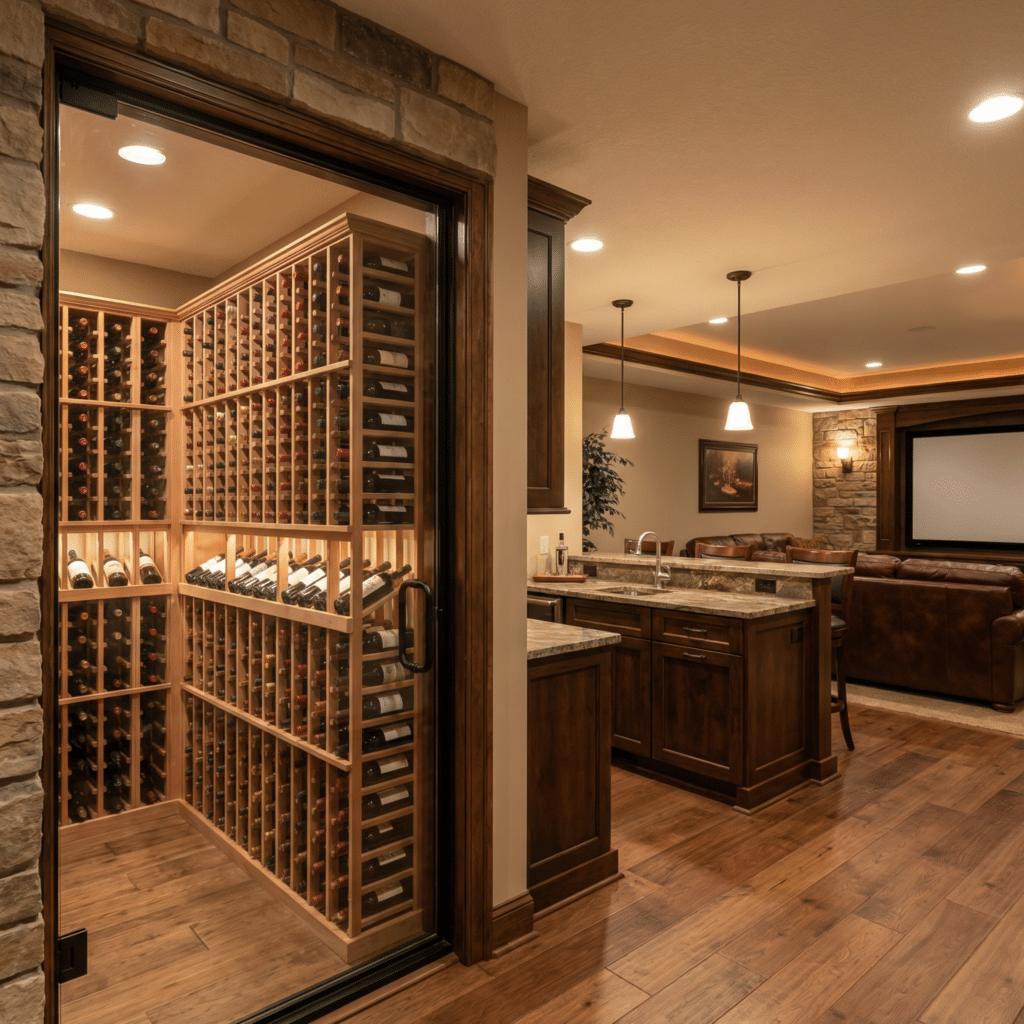
A proper wine cellar holds 55 to 58 degrees Fahrenheit and 50 to 70% relative humidity year-round. Too warm and wine ages too fast. Too cold and it ages unevenly, damaging corks and flavor. Iowa creates a challenge that homeowners in warmer states never face: Iowa basements can drop below 55 degrees in January.
That means Iowa wine cellars need a climate control system with both cooling and heating capability. A cooling-only through-wall unit will protect your wine in July but let it freeze-damage in January. Specify a unit rated for cold-ambient operation, or install a split/ducted system that handles both directions. Split systems run $3,000 to $8,000 installed. Through-wall units rated for cold climates run $1,500 to $4,000 for smaller cellars.
Insulation minimums for a proper wine cellar are R-19 walls, R-30 on the ceiling, and R-10 on the floor. The vapor barrier goes on the warm side of the insulation, facing away from the cellar interior. All wine cellar construction in an Iowa basement requires a building permit, and any electrical work for the cooling unit requires a separate electrical permit.
Pro tip 2: Ask your climate control supplier to confirm the unit’s minimum ambient operating temperature before purchasing. Many residential wine cooling units are only rated to operate down to 55 or 60 degrees ambient. If the room outside the cellar gets colder than that in winter, the unit shuts off and your wine is unprotected.
| Cellar Type | Size | Bottle Capacity | Cost Range |
|---|---|---|---|
| Under-stair or closet conversion | Under 50 sq ft | 100 to 300 bottles | $5,000 to $15,000 |
| Small walk-in cellar | 50 to 100 sq ft | 300 to 1,000 bottles | $15,000 to $40,000 |
| Medium walk-in cellar | 100 to 200 sq ft | 1,000 to 2,500 bottles | $40,000 to $75,000 |
| Large custom cellar | 200+ sq ft | 2,500 to 5,000+ bottles | $75,000 to $150,000+ |
| Prefab wine cabinet system | Varies | Varies | $1,600 to $8,000 |
Cost ranges reflect national benchmarks. Iowa-specific pricing varies. Always request a local estimate for accurate budgeting.
Home Bars: Dry Bar, Wet Bar, and What Each One Requires
The difference between a dry bar and a wet bar is a sink, and that single feature changes your permit requirements significantly.
A dry bar has no plumbing. It includes cabinets, a countertop, storage, and often a mini-fridge or beverage cooler. No plumbing permit is required, though you still need a building permit and an electrical permit for any new circuits or outlets.
A wet bar adds a sink with running water. That requires a separate plumbing permit in Iowa, and the work must be done by a plumber holding a separate Iowa state plumbing license. This is different from contractor registration. A registered general contractor handles the overall project and pulls the building permit. The plumber pulls their own trade permit. The electrician pulls their own electrical permit. All three permits are required for a full wet bar installation.
Iowa’s electrical code requires GFCI protection for basement receptacles and on all outlets within 6 feet of a wet bar sink. AFCI protection is required for circuits in finished basement living areas. Your electrician will confirm which NEC edition applies in your city and what that means for your specific project.
Pro tip 3: If a contractor tells you they can handle plumbing and electrical under their general building permit, that is a red flag. In Iowa, plumbers and electricians hold separate state licenses and pull their own permits. The Iowa DIAL building and licensing page explains how contractor registration works and what each trade requires.
| Bar Type | Cost Range | What’s Included | Permits Required |
|---|---|---|---|
| Prefab dry bar | $1,000 to $5,000 | Cabinets, countertop, storage | Building and electrical |
| Prefab wet bar | $2,000 to $12,000 | Cabinets, sink, countertop | Building, plumbing, and electrical |
| Custom dry bar | $5,000 to $15,000 | Custom cabinetry, stone countertop, display lighting | Building and electrical |
| Custom wet bar | $10,000 to $30,000 | Custom cabinets, stone top, sink, beverage center, ice maker | Building, plumbing, and electrical |
| Luxury basement bar | $40,000 to $80,000+ | Full build-out, premium finishes, media integration | Building, plumbing, electrical, possibly mechanical |
Des Moines area basement finishing runs $30 to $70 per square foot for the surrounding unfinished space. See our full breakdown of Des Moines basement finishing costs for current 2026 pricing context.
Entertainment Rooms and Home Theaters
A basement is the most cost-effective location for a home theater in Iowa’s climate. It naturally provides acoustic separation from the rest of the house, and the below-grade location buffers outside temperature swings. The main Iowa-specific constraint is ceiling height. The 7-foot minimum for habitable space limits tiered floor platforms in basements with lower ceilings or heavy ductwork. Measure finished ceiling height before designing any raised seating section.
Basic setups with a large-screen TV, surround sound, and good seating run around $10,000. Full home theater systems with projection, acoustic treatment, and theater seating run $20,000 to $60,000. A media room combined with a wet bar typically falls in the $35,000 to $75,000 range. Every finished entertainment space in an Iowa basement requires a building permit and an electrical permit.
| Project | Typical Cost Range | Key Features | Iowa Permit Triggers |
|---|---|---|---|
| Basic media room | $10,000 to $20,000 | TV, sound system, seating, basic electrical | Building and electrical |
| Home theater | $20,000 to $60,000 | Projection, surround sound, tiered seating, soundproofing | Building, electrical, possibly mechanical |
| Media room and wet bar combo | $35,000 to $75,000 | Theater plus bar build-out, premium finishes | Building, plumbing, and electrical |
| Wine cellar and bar combo | $25,000 to $80,000+ | Climate-controlled cellar plus custom bar | Building, plumbing, electrical, and mechanical |
What These Projects Do to Home Value
A finished basement overall returns about 70% of its cost at resale in the Des Moines metro. Wine cellars can return 50 to 100% of their investment, but appeal is buyer-specific in Iowa’s mid-range market. Home bars and media rooms add broad entertainment appeal when built with quality finishes.
The honest caveat: highly customized or niche spaces narrow your buyer pool. A well-designed wet bar that doubles as an entertainment focal point converts better at resale than a highly specialized wine cave that requires finding a collector. Build to code, use quality materials, and keep the design flexible enough that it reads as a bonus to most buyers, not a niche feature for a few.
Permit compliance also matters directly to resale. Any unpermitted improvement cannot be legally disclosed as a permitted finished space, and buyers’ lenders may require removal or retroactive permitting before closing. Building correctly protects the full value of the investment.
Frequently Asked Questions
Q: Do I need a permit to add a wine cellar or home bar in my Iowa basement?
Yes. Any change of use in an Iowa basement, including converting unfinished storage to a wine cellar, home bar, or media room, requires a building permit at minimum. Wet bars require a separate plumbing permit because a state-licensed plumber must do the work. Wine cellar cooling units may require a separate mechanical permit. All new electrical circuits and outlets require an electrical permit. Building codes and permit requirements vary by city and county. Always confirm with your local building department before starting.
Q: Why does Iowa radon matter before finishing a basement?
Iowa is the only state where every county is classified as EPA Zone 1 for radon risk, and about 5 in 7 Iowa homes exceed the EPA action level of 4 pCi/L. Finishing a basement seals the space where radon concentrates, which can increase indoor levels. Test before you frame anything. If results come back above 4 pCi/L, hire a qualified mitigator before construction begins. Iowa mitigation systems typically cost $800 to $2,500. Contact the Iowa Radon Hotline at 1-800-383-5992 for qualified mitigator referrals.
Q: How much does a wine cellar cost to build in Iowa?
Small closet conversions start around $5,000 to $15,000. Small walk-in cellars run $15,000 to $40,000. Medium custom cellars range from $40,000 to $75,000. The Iowa-specific cost factor is climate control: your system must handle both Iowa summers and Iowa winters, which requires a unit with both cooling and heating capability. Cooling-only units are not sufficient. Always request a local estimate before budgeting, since Iowa-specific labor and equipment costs vary from national benchmarks.
Q: What is the difference between a wet bar and a dry bar, and does it affect my permit?
A dry bar has no plumbing. A wet bar adds a sink and running water. That single addition requires a separate plumbing permit in Iowa, and the work must be done by a plumber holding a separate Iowa state plumbing license. Your registered general contractor handles the building permit. The plumber and electrician pull their own separate trade permits. All three permits are required for a complete wet bar installation.
Q: Do these spaces add value to an Iowa home?
A finished basement returns about 70% of its cost in the Des Moines metro. Wine cellars can return 50 to 100% of their investment depending on the buyer, though appeal varies in Iowa’s mid-range market. Home bars and media rooms add broad value when built with quality finishes. The most important rule: build to permit and to code. An unpermitted improvement cannot be legally disclosed as permitted finished space, and lenders can require removal before closing.
Ready to Build Your Ideal Basement Space?
You now have a clear picture of what these projects cost, what permits apply, and what Iowa-specific steps protect your investment before construction begins. The next step is talking with a team that knows Central Iowa basements.
Busy Builders has worked on more than 1,000 Central Iowa homes since 2020. Our registered contractors coordinate permit applications, manage the scheduling of separately licensed electricians and plumbers, and handle Iowa’s specific basement conditions from radon pre-planning through final inspection. Learn more about our basement finishing services and schedule a free consultation to discuss your project.
Call: 844-435-9800 Website: busybuildersiowa.com
Disclaimer: This article is for general information and is not project-specific advice. Cost figures are planning estimates that vary by scope, materials, site conditions, and current pricing. Permit requirements vary by city and jurisdiction; verify current requirements with your local building authority before starting any project. No specific outcomes are guaranteed. Consult a registered contractor for guidance specific to your project. ROI and resale figures are illustrative and not financial advice; actual returns vary by market and project quality. Lending terms, draw schedules, and rates vary by lender; this is not lending advice, so consult your lender. Structural changes require evaluation by a qualified professional; do not rely on general guidance for load-bearing decisions. Radon levels vary by home; test before and after finishing work. Below-grade moisture outcomes depend on site conditions; there is no guarantee against water intrusion.
Busy Builders | Full-Service Construction and Remodeling | Serving Central Iowa Since 2020