A new home can keep moving through a Central Iowa winter once the foundation is in and the shell is closed. This guide covers each stage from December to March. It shows what pauses for frozen ground, what keeps going under temporary heat, what the metro cold-weather concrete policy requires, and what waits for spring.
TLDR: Winter home building in Iowa works when the house is framed and closed in before the deep cold. Digging and outdoor concrete are the stages that stall. Framing, rough-ins, insulation, drywall and finishes keep moving with temporary heat. Many metro cities share one cold-weather concrete policy, so winter pours are planned with protection from day one. Sod, final grading and driveways usually wait for spring.
You signed in the fall, and now it is December. Maybe the foundation beat the freeze, maybe not. Will your new home sit idle until April?
It will not. The work shifts from outside to inside. Here is how home building in Polk County and the rest of Central Iowa runs all winter, and which local rules shape it.
Can Home Building Keep Going Through an Iowa Winter?
Yes. Once the foundation is in and the shell is framed, most home building work moves indoors and keeps going. The stages that stop touch frozen dirt or need outdoor concrete to cure.
The National Weather Service Des Moines January climate summary lists a normal January low of 13.8 degrees. In 91 percent of years on record, January has hit zero or below.
The table below shows the official 1991 to 2020 normals for Des Moines.
| Month | Normal high | Normal low | Normal snowfall |
|---|---|---|---|
| December | 35.9°F | 19.5°F | 7.9 in |
| January | 30.9°F | 13.8°F | 9.4 in |
| February | 35.7°F | 18.0°F | 10.2 in |
| March | 49.2°F | 29.6°F | 4.4 in |
Every month in this window averages a low below freezing, so outdoor concrete needs a cold-weather plan.
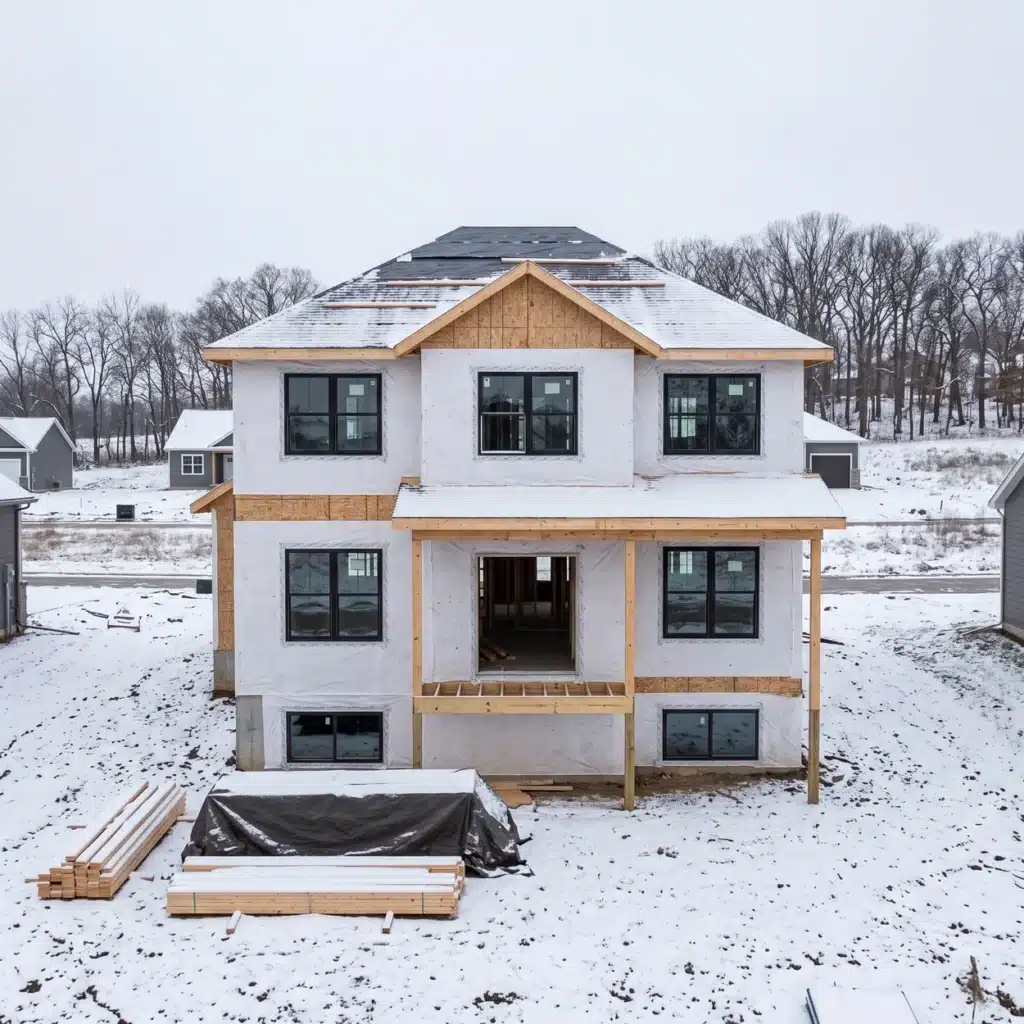
The milestone that matters is the closed shell. One of our job photos shows a new home under construction on a Central Iowa lot at that point, with house wrap and windows installed.
Pro Tip 1: Ask your builder for a “closed in by” date in writing. If wrap, windows and doors are in by mid-December, interior trades work all winter.
Pro Tip 2: If the foundation misses the hard freeze, use the winter for plans, selections, permits and bids.
Which Stages Pause and Which Keep Moving?
Excavation, outdoor concrete and final grading pause or slow down. Framing, rough-ins, insulation, drywall and trim keep moving inside a closed, heated shell.
Busy Builders completes more than 100 projects a year, most of them additions, full remodels and basement finishes, with kitchen and bathroom remodels alongside. Every one plans around the same Iowa winter.
Here is how each stage behaves from December to March.
| Stage | Winter status | Why |
|---|---|---|
| Excavation | Slow or paused | Frozen ground digs slowly |
| Footings and foundation walls | Possible with protection | Metro cold-weather rules apply |
| Framing, wrap, windows, doors | Keeps moving | This work closes the shell |
| Plumbing, electrical, HVAC rough-ins | Keeps moving | Indoor work by licensed trades |
| Insulation, drywall, paint, trim | Keeps moving with heat | Needs steady warmth to dry |
| Exterior masonry, driveway, sod | Usually waits for spring | Needs warmer days |
If your home reaches the third row before the deep cold, most of what remains happens indoors.
Pro Tip 3: Ask who clears snow from the subfloor. Snow left on sheathing melts once the heat comes on and soaks the wood.
Pro Tip 4: Book rough-in inspections early. Ankeny asks for 48 hours’ notice, and holiday weeks fill fast.
What Do the Metro Cold-Weather Concrete Rules Require?
Many Des Moines metro cities share one policy for concrete placed in cold weather. It sets when protection is required, when a pour is not allowed, and how long new concrete must stay warm.
The Metro Cold Weather Concrete Policy, from the Mid-Iowa Construction Code Committee, lists Altoona, Ankeny, Des Moines, Johnston, Waukee and Polk County among its adopters. Ankeny still posts it today.
Here are the main rules.
| Policy rule | Trigger | What it means for you |
|---|---|---|
| Protect wall pours | Forecast low of 25°F or colder | Blankets or heat on basement walls |
| Protect slab pours | Forecast low of 32°F or colder | Slabs get covered or heated |
| No pour allowed | Forecast below 10°F within 24 hours | No inspection; the pour moves |
| No frozen subgrade | Any time | Frost is thawed or removed first |
| Keep concrete warm | First 48 hours | At least 50°F the whole time |
An average December to February night is colder than the 25-degree wall trigger, so winter pours start with protection.
That is why a fall start pays off, as our guide to pouring foundations before the freeze explains. Footings still sit at least 42 inches down, below the frost line, which is how deep a foundation must go to avoid freezing.
Ankeny’s building page lists that 42-inch depth. The state code, Iowa Administrative Code 481-301.8, adopts the 2024 IRC and ties values like frost depth to the project’s location. An Iowa State extension note on soil freezing adds that frost goes deepest when snow cover is thin.
One of our addition photos shows framing on a new poured concrete foundation, stud walls up, before sheathing. After that stage, the cold matters far less.
Pro Tip 5: If the basement slab is still open, pour it after the shell is closed and heated.
Pro Tip 6: Ask about the mix. The metro policy recommends 4,000 psi concrete, up from 3,500, or another high early strength mix.
Illustrative scenario: An Altoona couple’s 2,500-square-foot two-story is wrapped by early December with the basement slab still open. The crew heats the basement and pours in mid-January. The planning budget is about $375,000 to $450,000. Drywall starts two weeks later, and the garage floor waits for April.
How Does Temporary Heat Keep Interior Work Moving?
Once the house is closed in, crews heat it so drywall, paint and trim go in on schedule. That heat has rules, and moisture is the part homeowners rarely hear about.
The Gypsum Association’s standard, GA-216, calls for rooms at 50 degrees or warmer for 48 hours before joint compound goes on. That heat holds until the compound dries. Hanging board needs at least 40 degrees, and temporary heat should stay under 95.
Portable propane or kerosene heaters add water vapor as they burn. The same standard says that humidity must be removed and the area kept ventilated.
This table lists common cold-weather measures.
| Measure | Used for | Cost impact |
|---|---|---|
| Insulated blankets | Fresh footings, walls, slabs | Modest, per pour |
| Heated enclosure or ground thaw | Frozen subgrade | Larger, billed by time |
| Temporary heaters and fuel | Drywall, paint, trim | Ongoing all winter |
| Dehumidifiers and ventilation | Heater moisture | Small, easy to skip |
| Snow removal | Subfloor and site access | Per storm |
Each cost is small alone, so ask to see them together on one written line in your bid.
Pro Tip 7: Ask how the house is heated before the permanent furnace runs, and who pays for fuel.
Pro Tip 8: Make sure someone watches humidity, not just temperature. Damp heater air slows drying.
Pro Tip 9: Bring flooring and trim into the heated house a few days early so it adjusts to the room.
Illustrative scenario: An Adel family’s 1,900-square-foot ranch is closed in the week before Christmas. Heaters and a dehumidifier run into March while drywall, paint and cabinets go in. The planning budget is about $285,000 to $350,000. Exterior stone and final grade wait for April, and the family moves in that month.
What Does a Winter Home Building Schedule Look Like?
A home closed in by early December can finish much of its interior over the winter. The driveway, grading and sod then wrap up in spring.
Here is one sample schedule. Your dates depend on size, selections and weather.
| Month | Work in this sample | Weather risk |
|---|---|---|
| December | Rough-ins and inspections | Holiday weeks, storms |
| January | Insulation, drywall | Coldest month |
| February | Drywall finishing, paint, cabinets | Deep cold snaps |
| March | Trim, flooring, fixtures | Thaw turns the site to mud |
| April to May | Driveway, grading, sod, finals | Rain delays |
The interior often finishes first, so a winter build usually ends in spring.
Spring work can affect move-in, too. Ankeny’s final engineering inspection waits until the lot has sod, or hydroseed at 70 percent germination. Its 2026 fee schedule lists a temporary certificate of occupancy limited to 14 days outside of winter builds.
Other cities differ, so ask yours early. Our home building services start at about $150 per square foot, and final costs vary by scope, materials, complexity and location.
Pro Tip 10: Ask your city how its temporary certificate of occupancy works before you set a move-out date.
Pro Tip 11: Put the spring punch list in writing, with a target month for each item.
Pro Tip 12: Walk the house before insulation goes in. Photos of the open walls show where every pipe, wire and duct runs.
Illustrative scenario: An Ankeny buyer’s 2,200-square-foot ranch is framed by Thanksgiving. Inspections land in mid-December, drywall in January and trim in March. The planning budget is about $330,000 to $410,000. Interior work wraps up in early April, while sod and the final engineering inspection wait for May.
Frequently Asked Questions
Q1: Can you build a house during an Iowa winter? Yes, if the foundation is in and the shell is closed before the deep cold. Framing, rough-ins and drywall keep moving with temporary heat, while excavation and outdoor concrete slow down. Ask your builder for a written “closed in by” date.
Q2: How cold is too cold to pour concrete in the Des Moines metro? The metro policy bars pours when the forecast drops below 10 degrees within 24 hours. Protection starts at a forecast low of 25 for basement walls and 32 for slabs. Ask which pours on your schedule fall in that window.
Q3: Does winter home building cost more in Iowa? Usually somewhat, because of blankets, heat, fuel and snow removal. Our home building starts at about $150 per square foot, and final costs vary. Ask for cold-weather costs as their own line on every bid.
Q4: Can drywall go up in January? Yes, with steady heat. The Gypsum Association standard calls for at least 50 degrees for 48 hours before joint compound goes on, held until it dries. Ask your builder how heat and humidity will be managed.
Q5: Can I move in before the driveway and sod are finished? It depends on your city. Ankeny lists a temporary certificate of occupancy with different limits for winter builds; other Polk County cities set their own terms. Call your city’s building department early and get the answer in writing.
Q6: How deep does a foundation have to be in Central Iowa? At least 42 inches below grade, below the frost line. Ankeny’s building page lists a 42-inch frost depth. Confirm the depth with your city before excavation starts.
Key Takeaways
- Close the shell first: A home wrapped and windowed by December keeps working indoors all winter.
- Concrete follows metro rules: Protection starts at 25 degrees for walls and 32 for slabs, with no pours below 10.
- Heat and humidity both matter: Drywall finishing needs 50 degrees for 48 hours, and heater moisture must go.
- Spring finishes the outside: Driveways, grading and sod usually wait, so ask how your city handles occupancy.
Plan Your Winter Home Build With a Registered Contractor
Busy Builders is a registered Iowa contractor with 1,285+ completed projects across Central Iowa since 2020. We will review your lot, schedule and cold-weather plan in a free consultation and estimate. Written warranty on workmanship (details provided in your contract).
Call: 844-435-9800
Disclaimer: This article is general information, not project-specific advice. Costs are planning estimates that vary by scope, materials, site conditions and pricing. Weather figures are historical normals, not forecasts. Permit, concrete and occupancy rules vary by city; verify them with your local building authority. Temporary heaters and gas work must be handled by licensed professionals under manufacturer and code requirements. No specific outcomes are guaranteed. Consult a registered contractor; plumbing, electrical and HVAC work uses licensed trades.
Busy Builders | Full-Service Construction and Remodeling | Serving Central Iowa Since 2020