
Most homeowners think a deck build means a few weeks of hammering. The reality in Des Moines is a four-to-ten-week process that involves permit filings, footing inspections, material lead times, and multiple city sign-offs before anyone walks the finished boards. This guide walks through the full sequence so you know exactly what to expect, what questions to ask, and what red flags to watch for before you sign anything.
TLDR: A Des Moines deck build takes 1 to 3 weeks on-site and 4 to 10 weeks total, including permits, material orders, and inspections. Iowa’s 42-inch frost line, clay soil, and ledger board flashing requirements make local expertise essential. Verify any builder’s Iowa DIAL registration before signing, and never let a contractor pour concrete before the city inspects the footing holes.
You call a builder, they walk your backyard, and a few weeks later, you are sitting on a finished deck. That is the version homeowners imagine. The version that actually happens involves a permit application, two weeks of city processing, material delivery windows, three separate inspections, and at least one moment where the whole project pauses. At the same time, you wait for an inspector to schedule.
None of that is bad. It is just the reality of deck construction done correctly in Des Moines. Contractors who skip those steps are not saving you time. They are shifting risk onto you.
Our deck-building services in Central Iowa follow the full nine-step process outlined below. Here is what that process actually looks like.
What actually happens between “I called a builder” and “I am on my deck”
The confusion most homeowners run into comes from conflating two different timelines. On-site build time, the actual construction, runs one to three weeks for most Des Moines deck projects. The total project timeline, which includes permitting, material orders, and inspection windows, typically runs four to ten weeks.
Des Moines processes permit applications in approximately two weeks. Ankeny and Waukee run at different speeds. West Des Moines has its own submission requirements. None of that is the builder’s fault, but a contractor who does not build those timelines into the schedule from day one will leave you confused and frustrated.
Material lead times add another variable. Composite decking, cable railing systems, and specialty lighting components sometimes carry one-to-three-week delivery windows. A builder who orders materials the day the permit clears has already lost a week.
Pro tip 1: Ask any builder you consider: “What is your estimated total timeline from signed contract to final walkthrough, including permit processing?” A builder who only quotes on-site build time is setting you up for a surprise.
The 9-step deck construction process in Des Moines
Step 1: Site assessment and design
Before anything is ordered, a thorough site walk should happen. This means assessing grade, soil type, drainage patterns, sun and wind exposure, and how the deck will connect to the home’s structure. Iowa’s soil conditions vary by region and directly affect footing design.
During this phase, the builder should discuss the layout, materials, and budget, and confirm the specific permit requirements for your city.
Step 2: Permits and approvals
Most attached decks and elevated decks in Iowa require permits. Busy Builders pulls all permits, submits structural drawings, and schedules all required inspections. The permit application package for a Des Moines deck typically includes a site plan with setbacks, construction drawings with dimensions and joist layout, a footing detail showing depth and diameter, and a ledger attachment detail with flashing.
The Des Moines Permit and Development Center is located at 1200 Locust Street and can be reached at (515) 283-4200, Monday through Friday, 8 AM to 4:30 PM.
Step 3: Layout and footing excavation
Once the permit clears, the crew stakes the layout and marks footing locations. Iowa’s 42-inch frost line is non-negotiable. Every footing hole must reach that depth before concrete is poured, and Iowa law requires calling 811 before any excavation begins. The city inspector must see the hole depth before the pour. This is not a suggestion.
Pro tip 2: Iowa law requires calling 811 before any excavation. This is not optional. Buried utility lines run through residential backyards across the Des Moines metro, and hitting one creates a far bigger problem than a delayed pour date.
Pro tip 3: Never let any builder pour concrete before the city inspects the footing holes. Once concrete is poured, there is no going back. Every permitted build in Des Moines requires an inspector to verify depth before the pour.
Step 4: Footings and post installation
Concrete is placed into tube forms and cured before posts are set. Posts should never be set directly in concrete, as that traps moisture at the base and causes rot within a few years. Iowa’s clay soil, combined with proper footing depth, keeps the deck level year after year through freeze-and-thaw cycles.
Pro tip 4: Posts set directly into concrete rot from the inside out, often within five to eight years in Iowa’s wet springs. Ask your builder how they handle post base connections. Post bases that sit above the concrete surface and allow airflow underneath are the right answer.
Step 5: Framing
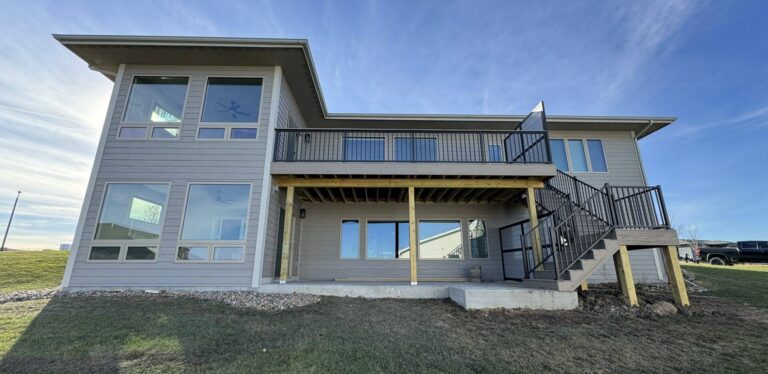
Ledger board attachment is the most critical single step in an attached Iowa deck build. The Johnson County, Iowa, deck code guidelines confirm that improper ledger flashing is the leading cause of rot and structural failure in Iowa decks. It is also the most common defect Des Moines inspectors flag. All framing is pressure-treated, and only galvanized or stainless steel hardware is used. Standard hardware corrodes quickly in Iowa’s outdoor conditions.
Pro tip 5: The most common builder shortcut in Iowa is skipping ledger board flashing. Ask to see the flashing installation before the boards cover it. This single detail is what separates a ten-year deck from a thirty-year one.
Step 6: Decking installation
Boards go down after the frame passes structural inspection. Board spacing is set for drainage and to account for seasonal wood movement. Composite boards follow manufacturer specs closely, because Iowa’s temperature swings from 17 to 86 degrees create more expansion and contraction than most homeowners expect.
Pro tip 6: Ask your builder how they set end gaps for composite boards in Iowa’s climate. The required gap at 40 degrees is different from that at 75 degrees. A builder who does not account for Iowa’s temperature range will install boards that either buckle in summer heat or visibly gap by January.
Step 7: Railings and stairs
Iowa code requires railings on decks 30 inches or more above grade, with a minimum height of 36 inches and a maximum baluster spacing of 4 inches. Stair stringers must be cut to code-compliant riser and tread dimensions. The city inspector checks these at the final walkthrough. Post bases are surface-mounted or through-bolted, never toe-nailed.
Step 8: Lighting, electrical, and custom features
Lighting rough-in happens after framing, so wiring runs cleanly through the structure. Licensed Iowa electricians perform all electrical work with GFCI protection. Pergolas, built-in seating, planters, and fire pit areas are built at this stage.
Step 9: Staining, sealing, and final walkthrough
Bare PT wood left unsealed through an Iowa winter will gray and begin absorbing moisture in the first season. Composite and PVC surfaces receive a final quality check for gapping, fastener seating, and trim details. The project closes with a detailed homeowner walkthrough.
Pro tip 7: If your deck uses PT wood surface boards, seal them before the first winter, not in the spring after. Iowa’s freeze-thaw cycles start working on unsealed wood immediately. The first winter without protection is the most damaging one.
Here is what the full two-timeline picture looks like for a standard Des Moines build.
| Phase | What Happens | On-Site Time | Total Project Time |
|---|---|---|---|
| Design and planning | Site walk, layout, material selection | 1 to 3 days | 1 to 2 weeks |
| Permits and approvals | Application, plan review, approval | Not applicable | About 2 weeks in Des Moines |
| Material ordering | Composite lead times, specialty railings | Not applicable | 1 to 3 weeks, overlaps with permits |
| Footing excavation and inspection | Stake, dig, city inspection before pour | 1 to 2 days | After permit approval |
| Framing | Footings, posts, beams, joists, ledger | 2 to 4 days | Sequential with footing cure |
| Decking, railings, stairs | Boards, railings, stair installation | 2 to 5 days | After framing inspection |
| Electrical and features | Lighting, pergola, custom built-ins | 1 to 3 days | Overlaps with decking |
| Final walkthrough | Stain and seal, final inspection, homeowner walk | 1 to 2 days | After all inspections pass |
| Total on-site build time | 1 to 3 weeks | ||
| Total project timeline | 4 to 10 weeks |
The permit and material ordering phases, not the actual construction, are where most Des Moines deck timelines run longer than homeowners expect.
Des Moines permit requirements: what every homeowner needs to know
A permit is required for most deck projects in Des Moines. Attached decks require a permit regardless of height because the ledger board attachment affects the home’s structure. Freestanding decks require a permit if they sit 30 inches or more above grade. Covered decks and any deck over 300 square feet also require permits. The only exempt category is a freestanding deck not more than 30 inches above grade.
Permit fees run from $100 to $600, depending on project scope. Processing takes approximately two weeks for standard projects. Required documents include the completed application, a site plan showing setbacks from property lines, construction drawings with dimensions and joist layout, a footing detail showing depth and diameter, and a ledger attachment detail with flashing. Des Moines decks typically must sit 5 to 10 feet from property lines.
The Des Moines permit and development process is explained in detail in Permitmint’s Iowa deck permit guide, which covers city-specific triggers and documentation requirements.
Pro tip 8: Permits protect you at resale. Unpermitted decks create real problems when buyers, lenders, and home inspectors find them. A quality builder treats permit filing as standard practice on every project.
Illustrative scenario: An Urbandale homeowner hired a contractor who said he “handled permits.” Six months after the deck was completed, the homeowner attempted to refinance. The appraiser flagged the deck as unpermitted because the contractor had never filed for it. The homeowner had to hire a new contractor, file a retroactive claim, and pass a remediation inspection before the refinance could close. The process costs $2,400 and takes four weeks.
| Requirement | Details |
|---|---|
| Permit trigger, attached deck | Required regardless of height |
| Permit trigger, freestanding | Required if 30 inches or more above grade |
| Permit trigger, covered or large | Required if covered or over 300 sqft |
| Freestanding exemption | Freestanding, not more than 30 inches above grade |
| Fee range | Typicall,y 5 to 10 feet from property lines |
| Processing time | Approximately 2 weeks |
| Required documents | Application, site plan, construction drawings, footing detail, ledger detail with flashing |
| Setback requirement | Typically,y 5 to 10 feet from property lines |
| Inspections required | Footing before pour, framing rough-in, final |
| Contact | Permit and Development Center, (515) 283-4200 |
Each city in the Des Moines metro processes permits on different schedules. Confirm your specific city’s requirements before planning your start date.
Pro tip 9: Request a copy of the footing inspection sign-off from your city before framing begins. This one document confirms that the most critical underground work was done correctly before it was buried under concrete and wood.
6 red flags that tell you to walk away from a Des Moines deck builder
Iowa’s construction market has the same contractor quality issues as those in other markets. The difference here is that Iowa-specific factors, like the 42-inch frost line, ledger board flashing requirements, and city-by-city permit processes, make inexperienced or unregistered contractors more dangerous than they would be in a more forgiving climate.
Red flag 1: Cannot provide an Iowa DIAL registration number immediately. General contractors in Iowa are registered, not licensed. Any legitimate builder has their number ready. Verify at Iowa DIAL contractor registration before your first check clears.
Red flag 2: Requests 50 percent or more upfront. The industry standard is 10 to 25 percent at signing, with milestone-based payments tied to inspection phases and a final payment at the walkthrough.
Red flag 3: Provides a single-line quote with no itemized materials, labor, or permit line. You cannot compare bids without line items, and a contractor who avoids them is often hiding scope gaps.
Red flag 4: Cannot specify footing depth without hesitation. The answer should be 42 inches minimum, every time. A builder who hedges on this will cut corners underground where you cannot see.
Red flag 5: Suggests skipping permits or offers to handle them in a way that is vague or unclear. Permits protect the homeowner. A builder who suggests skipping them is either uninformed or trying to cut their own timeline at your expense.
Red flag 6: Has no Des Moines-area references and will not let you visit a completed project. Iowa winters test deck quality within two to three seasons. If a builder will not show you a deck that has been through at least one Central Iowa winter, find out why.
Pro tip 10: Call Iowa DIAL at 1-800-562-4692 or visit dial.iowa.gov to verify any contractor’s registration. It takes under two minutes and confirms the builder is operating legally in Iowa.
Illustrative scenario: An Ankeny homeowner got the lowest bid from a crew that had not pulled permits, quoted 24-inch footings, and asked for 60 percent upfront. All three major red flags appeared in the first conversation. They chose the second-lowest bid instead: itemized, fully permitted, 42-inch footings specified, 20 percent deposit at signing. The project passed all three inspections on the first attempt.
| Question | What a Good Answer Sounds Like | Red Flag Answer |
|---|---|---|
| What is your Iowa DIAL registration number? | Provides it immediately | Hesitates, deflects, or says it is not required |
| What depth will you set the footings? | 42 inches minimum, every time | “Depends” or anything under 42 inches |
| Will you pull the permit and schedule all inspections? | Yes, included in the project scope | “You can do it yourself” or silence |
| Can I see your itemized estimate? | Materials by brand; labor by phase; permit fee stated | Single total line |
| What is your deposit structure? | 10 to 25 percent at signing; milestone payments | 50 percent or more upfront |
| Can I contact three recent local references? | Provides them without hesitation | Deflects to online reviews only |
A good contractor welcomes every question on this list. Vagueness and deflection are the answers that tell you everything you need to know.
What makes Iowa deck construction different from warmer states
Iowa’s frost line sits 42 inches deep. Most southern and western states require footings at only 12 to 24 inches. That difference means more excavation, more concrete, and more labor hours on every Iowa build. It also means that a contractor who learned their trade in Tennessee or Texas needs to learn your state’s requirements before they set foot in Des Moines.
Iowa sits at the demanding end of footing requirements compared to neighboring and southern states.
| State | Frost Line Depth | What It Means for Your Budget |
|---|---|---|
| Iowa | 42 inches | Maximum excavation, concrete volume, and labor of any Midwest state |
| Nebraska | 36 inches | Shallower than Iowa; less concrete per footing |
| Kansas | 24 inches | Less than half Iowa’s depth; significantly lower footing cost |
| Missouri | 18 inches | Footings barely deeper than a garden bed; far less labor |
Iowa’s frost line requirement is not a technicality. It is the reason footing costs in Des Moines run higher than comparable projects one state south.
Iowa’s clay soil expands when wet and contracts when dry, creating lateral pressure on posts and footings year-round. Combine that movement with 45 to 84 annual freeze-thaw cycles, and the result is a structural environment that punishes shallow footings and cheap hardware fast.
Pro tip 11: Standard zinc-plated hardware corrodes visibly within two to three Iowa winters. Galvanized or stainless steel hardware is not an upgrade on an Iowa deck; it is the baseline requirement. Ask your builder specifically what grade of hardware they use on all fasteners, post bases, joist hangers, and ledger bolts.
Ledger board flashing is the example that matters most. An improperly flashed ledger traps water behind the board and rots the home’s rim joist within three to five years. This is the leading cause of structural failure on attached Iowa decks and the most common defect Des Moines inspectors flag. A local builder who has built through multiple Iowa winters has seen this failure and knows exactly how to prevent it.
Pro tip 12: Ask your builder directly: “How do you handle ledger flashing on attached decks?” The answer should describe flashing that directs water away from the home’s rim board using materials compatible with pressure-treated lumber. If they do not mention flashing when asked about the ledger, keep asking.
Illustrative scenario: A Des Moines homeowner had a deck built by an out-of-area contractor who skipped ledger board flashing entirely. By year four, rot had penetrated the home’s rim board. Fixing it required demolishing the deck, replacing the rim board, and rebuilding. Total remediation cost was $7,800. The original deck build cost $12,000. A properly flashed ledger would have added less than $300 in materials and labor.
Frequently asked questions
Q: Do I need a permit to build a deck in Des Moines?
Yes, for most projects. Attached decks require a permit regardless of height because the ledger connection affects the home’s structure. Freestanding decks require a permit if they sit 30 inches or more above grade. Covered decks and any deck over 300 square feet also require permits. Fees range from $100 to $ 600, and processing takes approximately two weeks. Busy Builders handles all permit filings as a standard part of every project. The only exempt category is a freestanding deck not more than 30 inches above grade.
Q: How long does deck construction take in Des Moines?
There are two timelines to understand. On-site construction takes 1 to 3 weeks for most standard projects. Total project timeline, including permit processing, material delivery, and inspection windows, runs four to ten weeks. Des Moines, Ankeny, Waukee, and West Des Moines all process permits at different speeds. A contractor who only quotes on-site time is not giving you the full picture.
Q: What happens if I build a deck without a permit in Des Moines?
Consequences include fines, stop-work orders, and potentially required demolition. The more common problem shows up at resale: buyers’ lenders and home inspectors flag unpermitted structures, and you may be required to remediate before closing. Retroactive permits are possible but cost more and require a remediation inspection. Permits protect the homeowner first, not the contractor.
Q: What inspections are required for a deck in Des Moines?
Three inspections are required on a standard permitted deck: the footing inspection before concrete is poured, the framing rough-in inspection after the structural frame is complete, and the final walkthrough inspection. The footing inspection is the most common failure point because contractors sometimes try to pour without city sign-off. The city inspector must see the hole depth before any concrete goes in.
Q: How do I verify a deck contractor is registered in Iowa?
Go to dial.iowa.gov or call Iowa DIAL at 1-800-562-4692. Search by the contractor’s name or business name. General contractors in Iowa hold registration, not a license. Electricians and plumbers hold separate Iowa state licenses. Any legitimate builder can give you their DIAL registration number immediately; if a contractor hesitates when you ask for it, that hesitation is your answer.
Q: What is the most common deck construction failure in Iowa?
Ledger board flashing failure is the leading cause of structural damage to attached Iowa decks and the most common defect that Des Moines inspectors flag. Improperly flashed ledgers trap water against the home’s rim board, causing rot within three to five years. Shallow footings set above Iowa’s 42-inch frost line are the second most common failure, causing heaving and structural movement within two to three winters.
Key takeaways
The full process, not just the build
- Total project timeline in Des Moines runs 4 to 10 weeks; on-site construction runs 1 to 3 weeks
- Permits, material lead times, and inspections are where most timelines extend past expectations
- Des Moines, Ankeny, and Waukee all process permits at different speeds; confirm before planning your start date
Iowa-specific requirements that change everything
- 42-inch frost line means deeper footings and more concrete than in warmer states
- Iowa clay soil adds lateral pressure to posts and footings year-round
- Ledger board flashing is the single most important step on any attached deck build in Iowa
The three inspections every permitted build requires
- Footing inspection before concrete is poured; this is the most common failure point
- Framing rough-in inspection after the structural frame is complete
- Final walkthrough inspection before the project closes
How to vet any Des Moines deck builder
- Verify Iowa DIAL registration at dial.iowa.gov before signing anything
- Any legitimate builder provides their registration number immediately
- Ask specifically about footing depth (42 inches minimum) and ledger flashing before agreeing to a contract
- Request the footing inspection sign-off from your city before framing begins
Red flags that tell you to walk away
- Cannot provide the DIAL registration number on the spot
- Requests 50 percent or more upfront
- Will not pull permits or quote a single-line estimate with no breakdown
Ready to start your Des Moines deck project?
You now understand the full construction sequence, the Iowa-specific requirements that separate good builders from risky ones, and the questions to ask before you sign anything.
Busy Builders has completed 1,000+ Check projects in Central Iowa since 2020. We pull permits, handle all inspections, use 42-inch footings and properly flashed ledgers on every attached build, and walk you through every step before the first shovel goes in the ground.
- Free on-site consultation with a fully itemized written estimate
- Iowa DIAL registered, insured, every project permitted and inspected
- Serving Des Moines, West Des Moines, Ankeny, Waukee, and Urbandale
For a full breakdown of what your project might cost, see the deck building costs in Des Moines guide. For a material comparison, see the wood vs. composite deck in the Iowa guide.
Call: 844-435-9800 Website: busybuildersiowa.com
Schedule your free consultation today.
Busy Builders | Full-Service Construction and Remodeling | Serving Central Iowa Since 2020
Local service: Deck building in Des Moines, Iowa.