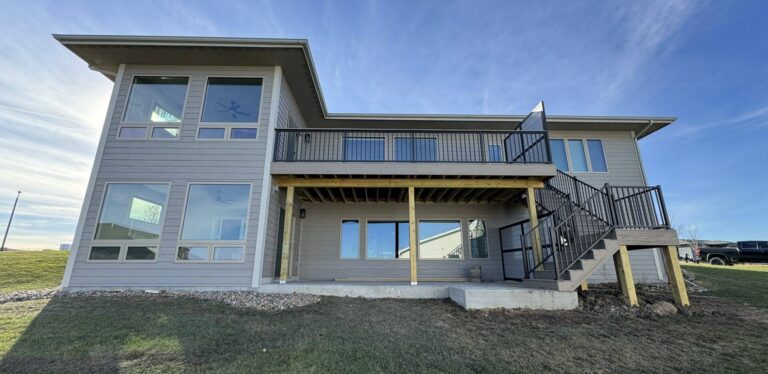
When you get deck quotes in Des Moines, the price gap between pressure-treated wood and composite is the first thing you notice. PT wood runs $4,000 to $8,000 less upfront on a standard deck. Those savings are real. The question is whether it survives contact with Iowa weather. This guide gives you the honest Iowa-specific math so you can decide which material actually costs less for your situation.
TLDR: PT wood costs less on day one, but Iowa’s 45 to 84 freeze-thaw cycles per year shrink its lifespan to 10 to 12 years and require sealing every 1 to 2 years at $550 to $1,400 per session. Over 20 years, total costs often equalize or favor the composite. The right choice depends on how long you are staying and how much maintenance you will realistically do.
You have seen the quotes side by side. PT wood at $15 to $35 per square foot installed. Composite at $35 to $65. On a 12×16 deck, that is a gap of $3,840 to $5,780 in real money sitting right there on paper.
For some homeowners, PT wood is the correct choice. For others, it ends up costing more over time. Iowa’s climate is what makes the math here different from warmer states. The 45 to 84 freeze-thaw cycles Central Iowa homeowners deal with every year do something specific to wood that national comparison guides never explain.
This blog gives you the full picture, starting with what PT wood actually is, running through its real disadvantages in Iowa’s climate, and ending with the honest cases where PT wood still wins.
What treated lumber actually is and what it is not
Pressure-treated wood is standard lumber infused with copper-based preservatives under pressure. Those preservatives push deep into the wood fibers and protect against rot, insects, and moisture damage.
The chemical concerns that many homeowners raise are mostly outdated. The treatment that worried people, chromated copper arsenate (CCA), was banned by the EPA for residential use in 2003. Modern PT wood uses either ACQ (alkaline copper quaternary) or copper azole. Both are copper-based and considered safe for normal outdoor residential use. Sitting on it, walking on it, letting kids play on it, all of that is fine with modern lumber.
The one rule that holds no exceptions: never burn PT wood. Burning releases copper compounds as fumes you do not want to breathe.
Pro tip 1: Even composite decks use pressure-treated framing underneath. The material debate is about the surface boards you walk on. The structure below is PT wood either way, regardless of what goes on top.
Pro tip 2: Never burn pressure-treated wood in a fire pit or outdoor fireplace. Modern treatments are safe to touch and stand on, but burning releases copper compounds that are harmful to breathe.
The other nuance worth knowing: the material debate is specifically about decking surface boards, not structural members. PT wood joists, posts, and beams go under every deck Iowa builds. That is a code requirement, not a preference.
The maintenance disadvantage: what Iowa’s climate actually costs you
This is the core of the comparison. PT wood absorbs water. In Iowa, that absorbed water goes through 45 to 84 freeze-thaw cycles every year. Water expands when it freezes inside the wood fibers. That expansion causes internal cracking and splitting that builds over time, regardless of how good the original installation was.
To slow that process, PT wood requires regular staining or sealing. In warmer states, the standard advice is every two to three years. In Iowa, that interval shrinks to every one to two years because our freeze-thaw load is heavier than most maintenance guides assume. Professional staining and sealing on a standard Des Moines deck runs $550 to $1,400 per session.
Skip two consecutive seasons, and boards begin to gray, cup, and crack. At that point, you are paying for refinishing on top of deferred maintenance, and the costs add up quickly.
Composite decking does not absorb water. Freeze-thaw has minimal effect on boards that do not expand and contract with moisture. Maintenance for the composite is soap, water, and a hose twice a year. The best deck materials for Iowa weather guide breaks this down further if you want to compare material options before getting quotes.
Pro tip 3: In Iowa, plan to seal or stain a PT wood deck every one to two years, not every two to three. Our freeze-thaw cycles put more stress on wood than most maintenance schedules assume.
Pro tip 4: When you price a PT wood deck, add $550 to $1,400 per year for maintenance. That number changes the comparison with composite significantly.
Illustrative scenario: A Boone family built a 250 sqft PT wood deck for $6,250 and skipped annual sealing in year two. By year three, boards were gray and showing surface cracks. They needed a full refinishing job at $900 before the deck had seen its fifth summer.
PT wood maintenance is not optional in Iowa. Here is what it actually costs per year over 10 years.
| Pressure-Treated Wood | Composite | |
|---|---|---|
| Annual staining and sealing | $550 to $1,400 per session, every 1 to 2 years | Not required |
| Annual cleaning | Included in staining cost | $30 to $70 (soap and water) |
| Minor repair frequency | Every 2 to 3 years in Iowa | Rarely needed |
| 10-year maintenance total | $1,500 to $3,000+ | $200 to $300 |
Over 10 years, composite maintenance costs $1,200 to $2,700 less than PT wood, before factoring in early replacement.
The lifespan disadvantage: Iowa’s freeze-thaw math
The national lifespan figure cited for PT wood is 15 to 20 years with maintenance. In Iowa, the realistic number is 10 to 15 years, and often closer to 10 to 12. That gap exists because of the same freeze-thaw mechanism described above, combined with two other Iowa-specific factors: clay soil holds moisture at post bases long after rain stops, and humid summers add mold and surface degradation on top of the freeze-thaw damage.
Cedar sits in the middle at 15 to 20 years in Iowa, but carries an important caveat. Cedar’s reputation for natural rot resistance comes from old-growth lumber, which is rich in tannin. Most cedar sold today is farmed and has significantly less tannin than old-growth wood. It underperforms its historical reputation in Iowa’s climate.
The lifespan of composite in Iowa ranges from 25 to 50 years because the boards do not absorb water. Freeze-thaw cycling, the primary killer of wood decks in Ankeny, Urbandale, and Waukee, barely affects composite surface boards.
Pro tip 5: Iowa PT wood decks often fail at 10 to 12 years, not 15 to 20. That early replacement cycle is not in most homeowners’ budget planning when they choose wood to save money upfront.
Pro tip 6: Cedar’s natural rot resistance comes from old-growth lumber. Most cedar sold today is farmed and has far less tannin. Do not choose it expecting old-growth performance.
Iowa’s climate shortens wood deck lifespans compared to national averages. Here is what to realistically expect from each material.
| Material | Iowa Lifespan | National Average | Why Iowa Differs |
|---|---|---|---|
| Pressure-Treated Wood | 10 to 15 years (often 10 to 12) | 15 to 20 years | Freeze-thaw water absorption; clay soil at post bases |
| Cedar | 15 to 20 years | 20 to 25 years | Modern farmed cedar has less tannin than old-growth |
| Composite (capped) | 25 to 50 years | 25 to 30 years | Minimal water absorption; handles freeze-thaw well |
| PVC (TimberTech AZEK) | 30 to 50+ years | 25 to 30+ years | Best moisture resistance; zero water absorption |
Choosing PT wood to save money upfront means planning for replacement 10 to 12 years earlier than composite in Iowa’s climate.
The 20-year cost comparison: where the math turns
The upfront price gap is real. A 12×16 PT wood deck runs $3,840 to $6,720 installed in Des Moines. Composite on the same footprint runs $7,680 to $12,500 or more. That is a meaningful difference on day one.
But the 10-year math is where the gap closes. For a 300 sqft deck, PT wood total costs, including maintenance, run $2,700 to $4,800 over 10 years. Composite total costs, including minimal upkeep, run $2,600 to $3,900. The materials are essentially at parity within a decade, and that is before the Iowa replacement cycle hits at year 10 to 12.
On the resale question: according to the National Association of Home Builders, wood deck additions return 94.9% ROI, compared to 88.5% for composite, per the 2025 Cost vs. Value Report. Wood’s higher ROI percentage is real, but it does not account for the $1,500 to $3,000 in maintenance costs spent before selling. When full ownership costs are included, the composite often wins on true net return for homeowners who stay 10 or more years.
For a full cost breakdown of local deck projects, the deck building costs in Des Moines guide provides current figures by material and deck size.
Pro tip 7: When comparing PT wood and composite, look at the 20-year total cost, not the sticker price. For a homeowner staying in Iowa for 10 or more years, a composite often costs less.
Pro tip 8: The 94.9% ROI figure for wood decks does not account for the $1,500 to $3,000 in maintenance you spend before selling. Factor that in, and the comparison shifts.
Illustrative scenario: A West Des Moines homeowner compared a PT wood deck at $8,500 installed against a composite deck at $14,400. Over 20 years: PT wood costs $8,500, plus $3,000 in maintenance, plus $6,500 for replacement at year 12, totaling $18,000. Composite costs $14,400 plus $400 in cleaning, totaling $14,800. The composite saved approximately $3,200.
The upfront gap between PT wood and composite is real. Here is what the math looks like over 20 years for a 300 sq ft Iowa deck.
| Cost Category | Pressure-Treated Wood | Composite |
|---|---|---|
| Installed cost (materials and labor) | $4,500 to $10,500 | $10,500 to $19,500 |
| 10-year maintenance | $1,500 to $3,000 | $200 to $300 |
| Expected replacement at year 10 to 12 (Iowa) | $4,500 to $10,500 | Not needed |
| 20-year total estimated cost | $10,500 to $24,000 | $10,700 to $19,800 |
| 20-year maintenance savings vs. PT wood | N/A | $1,200 to $2,700 |
For homeowners staying 10 or more years, the 20-year math often favors composite, even though it costs more on day one.
The installation disadvantage: composite requires more skill in Iowa
This is the section where composite has a real disadvantage, and it is worth being honest about it. PT wood is more forgiving to install. Builders have decades of experience with it, standard tools handle it, and minor gaps and fastener errors are less visible.
Composite requires precise end-to-end gap spacing, and Iowa’s temperature swing from 17 to 86 degrees Fahrenheit makes that more demanding here than the manufacturer’s guides written for national audiences assume. Composite expands and contracts lengthwise with temperature. Boards installed in cold Iowa weather need wider end gaps than boards installed in summer heat. If a builder does not account for this correctly, boards buckle in July or show large gaps by January.
This is not a material flaw. It is an installation competency issue. Hidden fastener clips handle the side-to-side spacing automatically, but end gaps require a builder who has installed composite through Iowa’s full seasonal range. Ask any contractor directly how they set end gaps in our climate. A confident, specific answer is what you want to hear.
Pro tip 9: Composite expands and contracts lengthwise with temperature changes. Ask your builder specifically how they set end gaps in Iowa’s climate. The answer tells you immediately whether they have done this before.
Pro tip 10: Iowa’s swing from 17 to 86 degrees is wider than most composite installation guides assume. Builders who install composite year-round in Iowa know how to adjust for our specific conditions.
Both materials install on the same framing. The differences are in skill requirements and fastener systems.
| Factor | Pressure-Treated Wood | Composite |
|---|---|---|
| Tool requirements | Standard carpentry tools | Standard tools plus composite-specific blades |
| Fastener system | Face screws, pre-drilled | Hidden clips or face screws |
| Thermal expansion handling | Minimal; wood moves with moisture, not just heat | End-to-end gaps required; vary by install temp |
| Iowa temperature consideration | Board-to-board gaps account for moisture expansion | End gaps must account for 17 to 86 degree swing |
| Skill level required | Lower; widely familiar | Higher; requires product and climate knowledge |
| Framing underneath | PT framing required | PT framing required (same as wood) |
Composite installation in Iowa requires a builder who knows the product and the climate. The right contractor makes thermal expansion a non-issue.
When PT wood is still the right choice
This is not a composite sales pitch. There are homeowners for whom PT wood is the correct decision, and being honest about that matters more than steering every reader toward the higher-cost material.
If you are selling in three to five years, PT Wood’s 94.9% ROI and lower upfront cost often win outright. The 20-year composite savings argument does not apply if you are not staying 20 years. If budget is genuinely the constraint and you will commit to sealing every one to two years, PT wood can perform well across a shorter ownership window. For rental or investment properties where longevity is not the priority, a lower upfront cost makes straightforward financial sense.
And, as noted throughout, PT framing goes under every deck, including composite. Nobody builds composite joists or posts. PT wood is always the right material for structural members, period.
Our deck building services in Central Iowa include a free on-site consultation, where we compare options against your specific project size, budget, and timeline before making any recommendations.
Pro tip 11: If you are selling in the next three to five years, PT wood at 94.9% ROI often makes more financial sense than composite. The 20-year savings argument does not apply if you will not own the deck long enough for it to matter.
Pro tip 12: Nobody builds composite framing. PT wood joists, beams, and posts go under every deck, regardless of what surface material goes on top. The material debate is about surface boards only.
Illustrative scenario: An Urbandale homeowner planning to sell in four years chose a 12×16 PT wood deck at $5,200 installed. They maintained it annually and sold it four years later. The deck added approximately $4,900 in resale value. Combined cost was $5,200 plus $1,200 in maintenance, totaling $6,400, for a net cost of $1,500 for four years of outdoor living. That is a strong return for a short ownership window.
The right material depends on your timeline, budget, and maintenance commitment. Here is the honest decision framework.
| Situation | Better Choice | Why |
|---|---|---|
| Tightest budget, selling in 3 to 5 years | PT Wood | 94.9% ROI; lower upfront cost; 20-year composite advantage does not apply |
| Staying 10+ years, low maintenance tolerance | Composite | 25 to 50 year lifespan; $1,200 to $2,700 less maintenance over 10 years |
| Staying 10+ years, will maintain consistently | High-feature deck with lighting, railings, and a pergola | PT wood works if annual sealing actually happens; composite removes the risk |
| Rental or investment property | PT Wood | Lower upfront cost makes more sense when longevity is not the priority |
| High-feature deck with lighting, railings, and pergola | Composite | Protects the larger investment; features add cost that justifies a longer-lasting surface |
| Structural framing (posts, joists, beams) | PT Wood always | Required by Iowa building code regardless of surface material |
There is no universally right answer. The right answer depends on your specific situation, which is exactly why Busy Builders starts every project with an honest on-site conversation before recommending a material.
Frequently asked questions
Q: How long does pressure-treated wood actually last in Des Moines?
With maintenance, PT wood lasts 10 to 15 years in Iowa, but 10 to 12 years is more realistic given our 45 to 84 annual freeze-thaw cycles. Without consistent sealing, failure can come as early as year eight to ten. If you plan to stay more than 10 to 12 years, budget for replacement or factor that cost into your material comparison before signing a contract.
Q: Is modern pressure-treated wood safe for families and pets?
Yes. Modern PT wood uses ACQ or copper azole, not the CCA treatment that was banned in 2003. Normal contact, including children and pets playing on it, poses no meaningful health risk. The one firm rule is never to burn PT wood, since burning releases copper compounds as fumes. For garden beds directly adjacent to the deck, use untreated wood or composite as a border material if you want to be cautious.
Q: What does it actually cost to maintain a PT wood deck in Iowa every year?
Professional staining and sealing runs $550 to $1,400 per session in Des Moines. Iowa’s climate requires this every one to two years, not every two to three as warmer-state guides suggest. Over 10 years, total maintenance costs $1,500 to $3,000 for a standard deck. Composite’s 10-year maintenance cost is $200 to $300 for cleaning alone.
Q: Why does composite cost more upfront, and what am I actually paying for?
Composite is engineered with wood fibers, recycled plastic, and a capped protective layer that resists UV fading, moisture absorption, and freeze-thaw damage. That engineering costs more to produce than treated pine. It also means no staining, no sealing, and 25 to 50 years of use. For homeowners staying 10 or more years, that trade-off is worth calculating against the sticker price difference before making a decision.
Q: Does composite decking have any disadvantages in Iowa I should know about?
Yes: thermal expansion. Iowa’s temperature swing from 17 to 86 degrees requires precise end-to-end gap spacing during installation. A builder who does not account for this will produce boards that buckle in summer or gap visibly in winter. This is an installation skill issue, not a material flaw. Ask any builder specifically how they handle Iowa composite gap spacing and listen for a confident, specific answer before hiring them. Verify any registered contractor’s Iowa DIAL registration at Iowa DIAL before signing.
Q: What is the right material choice for a Des Moines homeowner on a budget?
It depends on your timeline. Selling in three to five years? PT wood at $15 to $35 per square foot installed delivers strong ROI and real upfront savings. Staying 10 or more years? Run the 20-year math. Composite’s lower maintenance and longer lifespan often close the price gap or flip it entirely. Busy Builders can run that comparison against your specific project size and budget at no cost during a free on-site consultation.
Key takeaways
What PT wood is and is not
- Modern PT wood uses copper-based ACQ or copper azole; the arsenic-based CCA treatment was banned in 2003
- It is safe for residential use; normal contact poses no health risk
- Never burn it; copper compounds release harmful fumes
PT Wood’s real disadvantages in Iowa
- Iowa’s 45 to 84 freeze-thaw cycles accelerate cracking and splitting because wood absorbs water
- Lifespan in Iowa runs 10 to 15 years, often 10 to 12, versus the 15 to 20 year national average
- Annual staining and sealing costs $550 to $1,400 per session; Iowa requires it every 1 to 2 years
The 20-year cost reality
- Upfront gap: PT wood is $3,840 to $6,720 for a 12×16 deck; composite is $7,680 to $12,500+
- 10-year total costs essentially equalize when maintenance is factored in
- At years 10 to 12, PT wood in Iowa often needs major repair or replacement; composite is still in the first half of its lifespan
Composite’s one real disadvantage
- Thermal expansion in Iowa’s wide temperature swing requires precise end-to-end gap spacing
- This is a builder skill issue, not a material flaw
- Ask any contractor directly how they handle Iowa composite gap spacing before hiring
When PT wood is still the right choice
- Selling in 3 to 5 years: PT Wood’s 94.9% ROI and lower upfront cost often win
- Structural framing (joists, posts, beams): PT wood is always used here, regardless of surface material
- Tight budget, short ownership timeline: the 20-year composite advantage does not apply
Ready to get a straight answer for your project?
You now have the honest Iowa-specific comparison, not a sales pitch, just the math behind each material. The right choice for your project depends on your timeline, budget, and how much maintenance you will realistically do.
Busy Builders has helped 1,285+ Central Iowa homeowners make this decision since 2020. We will give you a straightforward answer on which material makes the most sense for your project.
- Free on-site deck consultation and material recommendation
- PT wood and composite deck builds across Central Iowa
- Iowa code compliance, permitting, and inspections handled for you
- Transparent itemized estimates with materials, labor, and timeline in writing
- Serving Des Moines, West Des Moines, Ankeny, Waukee, and all Central Iowa communities
Call: 844-435-9800 Website: busybuildersiowa.com
Schedule your free consultation today.
Busy Builders | Full Service Remodeling and Construction Done Right | Serving Central Iowa Since 2020