Last updated October 2026
A $400,000 custom home is realistic in Central Iowa, but the budget has to do more than pay for the house. Land, site work, permits and a contingency all come out of the same number. This guide shows how big a house $400K builds, where the money goes before the first wall goes up, and the choices that make a $400K build work without regret.
TLDR: If $400,000 covers only the house, our $150 per square foot starting point builds about 2,670 square feet, and the upper end of our $150 to $250 planning band builds about 1,600. If the same $400,000 must also buy a $50,000 to $100,000 lot and site work, plan on roughly 2,000 to 2,330 square feet at the starting point. Simple plans, an unfinished basement and early decisions stretch it furthest.
The question Central Iowa homeowners search most before calling about a new build is what it costs to build a house in Iowa. The $400K version of that question is one of the most practical, because it is where many first custom builds start.
The honest answer has two parts. First, how much house the money buys. Second, how much of the money goes somewhere other than the house. This guide covers both, then the decisions that matter most.
If your budget is closer to half a million, our guide on how big a house $500K builds runs the same math at that number.
How Big of a House Can You Build for $400K?
Start with the construction rate. Busy Builders’ published starting point for a custom home is about $150 per square foot, and Central Iowa custom builds commonly run about $150 to $250 per square foot before land. Those are planning estimates.
Then decide what the $400,000 has to cover. This table shows both cases. The lot and site figures are examples, not market data; use your real lot price.
| Construction rate per sq ft | $400K for the house only | $400K including a $50K lot and site | $400K including a $100K lot and site |
|---|---|---|---|
| $150 (our starting point) | About 2,670 sq ft | About 2,330 sq ft | About 2,000 sq ft |
| $175 | About 2,290 sq ft | About 2,000 sq ft | About 1,710 sq ft |
| $210 | About 1,900 sq ft | About 1,670 sq ft | About 1,430 sq ft |
| $250 | About 1,600 sq ft | About 1,400 sq ft | About 1,200 sq ft |
The takeaway: the lot and the finish level move the size more than any single design choice.
Those numbers do not yet include a contingency. Holding back 10 percent for surprises shrinks each figure by about a tenth. On a $75,000 lot at $150 per square foot, a 10 percent reserve leaves room for about 1,970 square feet.
Nationally, the lot is a real slice of a new home’s price. The National Association of Home Builders’ 2024 Cost of Constructing a Home survey found the finished lot averaged 13.7 percent of the sales price, while construction costs made up 64.4 percent.
Pro Tip 1: Price the lot and site work before you fall for a floor plan. They set how much is left for the house.
Pro Tip 2: Ask every builder what their price per square foot includes. Some count only finished living space, while others count the garage or basement.
Where Does the Money Go Before the House?
Several costs sit outside the per-square-foot construction number. Ask your builder which of these are included in their price and which are yours.
| Cost | What it covers | Who usually pays it |
|---|---|---|
| Lot | The land | Buyer, separately or through the loan |
| Site work | Clearing, grading, excavation, driveway base | Varies by builder contract |
| Utility connections | Water, sewer, gas and electric to the house | Varies |
| Design and engineering | Plans, structural details | Varies |
| Permits and fees | City building and trade permits | Usually the builder, inside the price |
| Construction loan interest | Interest during the build | Buyer |
| Contingency | Surprises in soil, weather or selections | Buyer’s reserve |
The takeaway: two quotes with the same per-square-foot number can be far apart once these lines are counted.
Permits are one of the smaller lines. In Des Moines, the 2026 permit fee schedule lists $1,390.50 for a new single-family home with 1,201 to 2,000 square feet of finished floor area, and $1,802.50 above 2,000. New-home trade permits add $231.75 for electrical, $128.75 for mechanical and $206.00 for plumbing. Basement and garage areas do not count toward that floor area.
Pro Tip 3: Talk to a construction lender before you talk to builders. Interest during the build is a real cost, and knowing your loan limit keeps the plan honest. The Consumer Financial Protection Bureau has a good primer.
Pro Tip 4: Ask whether the driveway and final grading are in the price. They are easy to leave out and expensive to add at move-in.
Which Choices Stretch a $400K Budget Furthest?
Five decisions do most of the work. None of them mean building a lesser house.
| Choice | Why it saves | What you keep |
|---|---|---|
| Simple footprint and roofline | Fewer corners and roof changes means less framing and labor | Same square footage |
| Unfinished basement | Concrete and framing now, finishes later | Future living space |
| Standard ceiling heights in most rooms | Less material and simpler framing | A vaulted or tall ceiling where it counts |
| Finish choices by room | Spend on kitchen and primary bath, save elsewhere | The rooms you use most |
| Decisions made before groundbreaking | Fewer change orders | Schedule and budget control |
The takeaway: spend on structure and the rooms you live in; save on complexity.
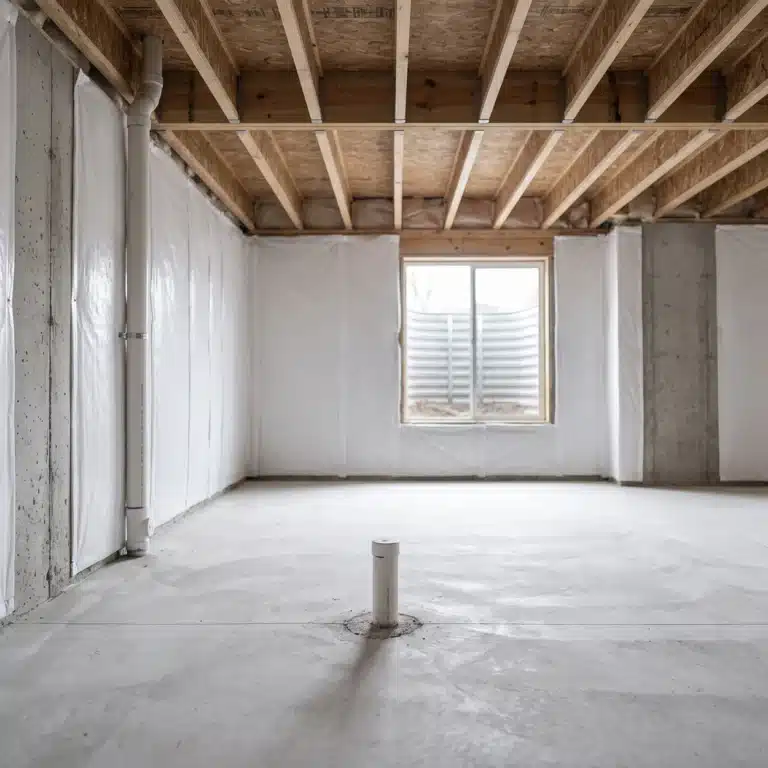
The unfinished basement deserves a closer look. Under Fannie Mae’s appraisal guidance, basement space is reported separately from above-grade living area, so finishing it later does not change the above-grade living area the appraiser reports. Finishing it when your budget allows is often the cheapest square footage you will ever add.
Pro Tip 5: Leave plumbing rough-ins in the basement for a future bathroom. It costs little now and saves trenching later.
Pro Tip 6: Lock your floor plan and finish selections before the first footing. A change on paper is cheap; the same change after framing is not.
What Iowa Rules Shape a New Home Budget?
Three Iowa-specific items affect every new build.
First, footings must reach below the frost line, at least 42 inches deep. Iowa’s state building code adopted the 2024 International Residential Code under Iowa Administrative Code 481-301.8, effective September 10, 2025, and most metro cities adopt their own edition.
Second, radon. Iowa HF 2297 was signed and took effect July 1, 2026; it directs the State Building Code Commissioner to require a passive radon mitigation system in new single-family and two-family homes. The code requirement takes effect once the Commissioner adopts it. Our post on Iowa’s radon law for new homes explains the details.
Third, your builder should be registered. Iowa registers general contractors through DIAL rather than licensing them, and electricians, plumbers and HVAC technicians hold their own licenses.
| Iowa item | What it means for a $400K build |
|---|---|
| Frost line, at least 42 inches | Deeper footings than many national cost guides assume |
| Radon (HF 2297) | Plan a passive radon system into the design now |
| Contractor registration | Check your builder’s DIAL registration before signing |
| City code edition | Ask which code edition your lot’s city enforces |
The takeaway: these are not optional extras. Put them in the first budget.
Busy Builders has completed more than 1,285 projects across Central Iowa since 2020.
Pro Tip 7: Ask the builder to show the radon system on the plans. It is easier to route before walls go up.
Pro Tip 8: Get a soil report or at least ask the builder about soil conditions on your lot. Poor soil can change foundation costs.
How Long Does a $400K Custom Home Take to Build?
“How long does it take to build a new home in Iowa” is the second most common new-home question homeowners bring to our site. The answer depends on design time, permits, season and how many decisions are still open when construction starts.
Our guide on how long it takes to build a custom home walks through each stage. For a $400K build, the practical advice is simple: finish decisions before you break ground, and plan foundation work for a season when the ground is workable.
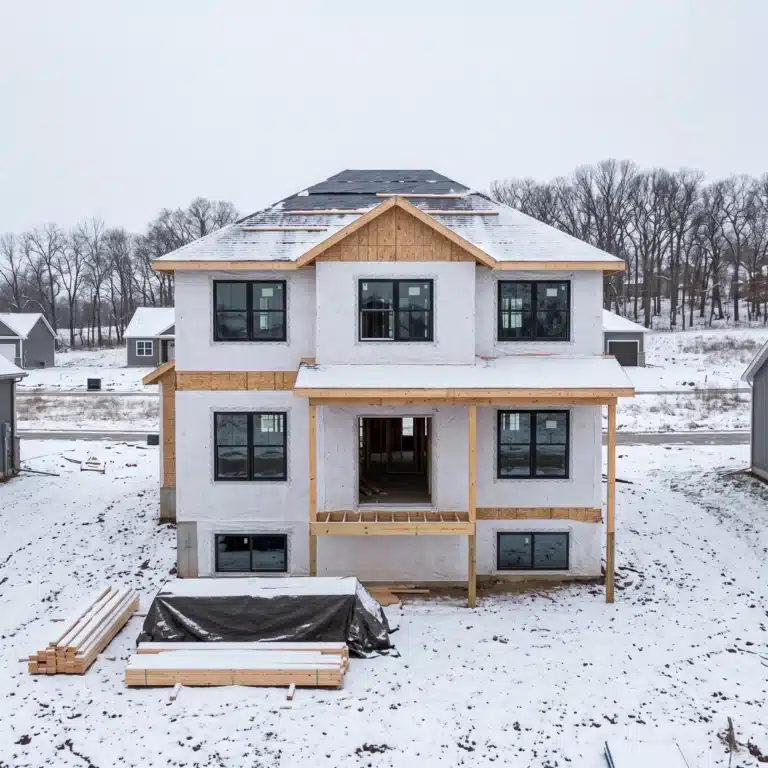
Getting the house wrapped and the windows in before cold weather is one of the milestones that keeps an Iowa build on track.
Illustrative scenario: A Grimes couple owns a lot outright and spends $400,000 on the house alone at about $160 per square foot. They build a two-story of about 2,500 square feet with an unfinished basement and a simple roofline.
Illustrative scenario: An Ankeny family buys a $70,000 lot and sets aside 10 percent for contingency. At about $165 per square foot, the remaining budget builds a ranch of about 1,800 square feet with rough-ins for a future basement bathroom.
Illustrative scenario: A Waukee buyer wants upgraded finishes throughout at about $220 per square foot. After an $85,000 lot, the $400,000 budget builds about 1,430 square feet, so they shrink the plan and keep the kitchen they wanted.
Pro Tip 9: Start design in winter so you are ready to break ground when spring arrives.
Pro Tip 10: Keep a written list of decisions still open. Every open item is a possible delay.
Pro Tip 11: Visit the site at framing and before drywall. Those are the last easy moments to catch a change.
Pro Tip 12: Ask each builder for a sample budget on a recent home near your size. It shows how they think about the lines outside the house.
Frequently Asked Questions
Q1: How big of a house can I build for $400K in Iowa? If $400,000 covers only the house, plan on about 1,600 to 2,670 square feet across a $150 to $250 per square foot planning range. If it must also cover a $50,000 to $100,000 lot and site work, plan on about 2,000 to 2,330 square feet at our $150 starting point. A contingency reduces that by about a tenth. Your lot price and finish level move the number most.
Q2: Can you build a custom home under $400K in Iowa? Yes, with a simple plan, a well-priced lot and early decisions. At about $150 per square foot, $400,000 of construction builds a full-size family home. Adding the lot to the same budget means a smaller house or simpler finishes. Talk to a lender and a builder before you buy land.
Q3: What costs besides construction should I plan for? The lot, site work, utility connections, design, permits, construction loan interest and a contingency. Ask each builder which of these their price includes. In Des Moines, a new home of 1,201 to 2,000 finished square feet carries a $1,390.50 building permit in 2026, plus trade permits. Compare quotes line by line.
Q4: Is it cheaper to leave the basement unfinished? Usually, yes, up front. The foundation and basement walls get built either way, and finishes can come later. Fannie Mae’s guidance reports basement space separately from above-grade living area. Leave rough-ins for a future bathroom.
Q5: Do new Iowa homes need radon systems? Iowa HF 2297 directs the State Building Code Commissioner to require a passive radon mitigation system in new single-family and two-family homes. The requirement takes effect once the Commissioner adopts it. Plan for one in your design now. It is far easier during construction than after.
Q6: What is the first step for a $400K build? Talk to a construction lender to set your real limit, then price the lot and site work. With those numbers, a builder can tell you how much house is left. Bring the lot details to your first meeting.
Key Takeaways
House size:
- About 1,600 to 2,670 sq ft if $400K covers the house only.
- About 2,000 to 2,330 sq ft at $150 per sq ft if a $50K to $100K lot comes out of the same budget.
Outside the house:
- Lot, site work, utilities, design, permits, loan interest and contingency.
Stretch the budget:
- Simple footprint, unfinished basement, spend on key rooms, decide early.
Iowa items:
- Footings at least 42 inches deep, a radon system and a DIAL-registered builder.
Talk Through Your $400K Build
Busy Builders is a registered and insured Iowa contractor with 1,285+ completed projects across Central Iowa since 2020. Bring your lot details and budget, and we will show you how much house is left after everything else. Free consultation and an itemized estimate. Written 5-year warranty on workmanship (details provided in your contract).
See our home building services, our Iowa home building cost guide, or start with Ankeny or Grimes.
Call: 844-435-9800
Disclaimer: This article is for general information and is not financial, lending or project-specific advice. Costs are planning estimates that vary by plan, lot, site conditions, materials and current pricing; lot and site figures above are examples, not market data. Lending terms vary by lender; consult your lender. Permit fees and code editions vary by city; verify them with your local building department. Radon rules depend on state adoption; confirm current requirements before you build. No specific outcome is promised. Consult a registered contractor about your project.
Busy Builders | Full-Service Construction and Remodeling | Serving Central Iowa Since 2020