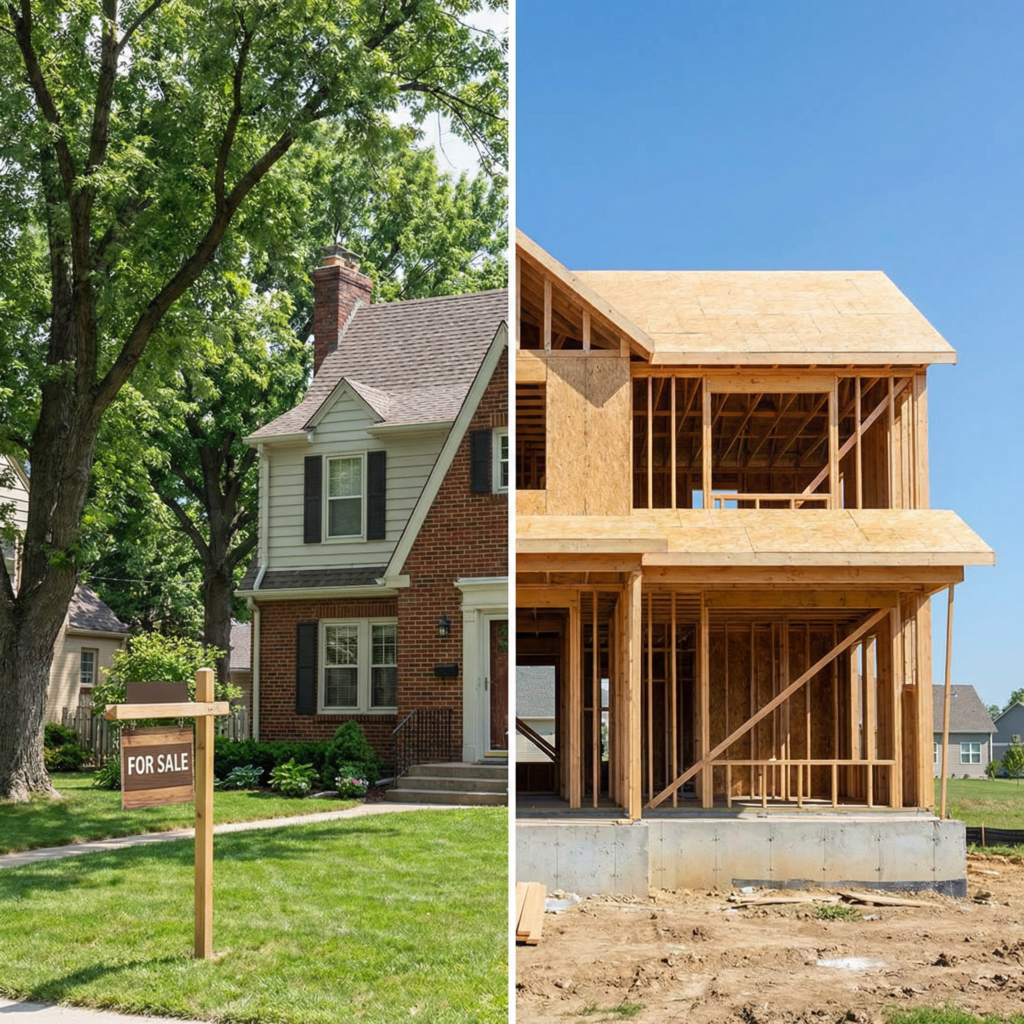
Des Moines homeowners face a genuinely different decision in 2026 than they did two years ago. Inventory has hit a 12-year high, price growth has pulled back significantly from the 2020 to 2022 surge, and custom build costs have stabilized across Central Iowa. This guide breaks down the real numbers for both paths, names the specific situations where each one makes more Sense, and gives you a clear framework for making the call.
TLDR: Des Moines resale inventory is at its highest since 2012, with a metro median sale price of $292,000 (DMAAR, Feb 2026). Custom builds in Iowa run $175 to $400+ per square foot, not including land, and take 8 to 12 months. Neither path is universally better. The right answer depends on your timeline, down payment, and target neighborhood. Read on for the local numbers that actually move the decision.
The “just buy something” advice that worked in 2021 and 2022 does not quite fit the 2026 Des Moines market. Neither does the “building is too expensive” assumption that many buyers carry without checking the actual numbers.
The truth sits between those two positions. The Des Moines inventory is up 11% from a year ago, giving buyers more negotiating power than they have had in years. But in Dallas County, which covers Waukee and the fast-growing western suburbs, the housing shortage remains among the worst in Iowa. Where you want to live shapes which path makes Sense.
This guide uses actual Des Moines market data, not national averages. By the end, you will understand the real trade-offs and the questions to ask before you commit to either path.
The Des Moines Market in 2026: What’s Actually Different
The Des Moines metro has moved into balanced territory after years as a seller’s market. Homes are sitting 68 to 75 days before going under contract. Contingencies are back. Sellers are negotiating. According to DMAAR, active metro inventory reached approximately 3,800 to 3,900 homes across January and February 2026, up 11 to 12% from the year before.
| Metric | Value |
|---|---|
| Median sale price (metro) | $292,000 (Feb 2026, DMAAR) |
| Year-over-year price change | +4.3% |
| Active inventory (Jan to Feb 2026) | ~3,800 to 3,900 homes (+11 to 12% from prior year) |
| Median days on market | 68 to 75 days (Jan to Feb 2026) |
| Homes sold (full year 2025) | ~13,870 |
| 30-year fixed rate (Iowa, April 2026) | ~6.1% to 6.6% depending on lender |
| New construction permits issued in 2024 | 3,434 (down 27.6% from 2021 peak) |
Metro prices are still up nearly 49% since 2019, and last year’s 4.3% growth reflects a meaningful pullback from the double-digit annual gains of 2020 to 2022. The sprint is over, but the market is not stalling.
The exception is Dallas County. According to the Common Sense Institute of Iowa, Dallas County has one of the three worst housing shortages in Iowa, and inventory in Waukee and Johnston is tighter than in Des Moines proper. That local detail matters when you are deciding whether to keep searching or start building.
The Real Costs: Buying vs. Building in Des Moines
Three distinct paths exist here, and understanding the differences matters before you compare price tags.
Buying an existing resale home is the fastest and most familiar option. Buying a spec new-construction home offers the predictability of new systems without the full custom timeline. Building custom gives you complete control, but at a higher starting cost and with a longer runway.
The table below compares all three on the factors that most affect the decision.
| Factor | Buy Existing | Buy Spec New | Build Custom |
|---|---|---|---|
| Starting price range | $208,000 to $425,000+ by tier | Typically above resale median; builder incentives available | $175 to $400+/sqft + land |
| Move-in timeline | 30 to 90 days | 30 days to 6 months | 8 to 12 months |
| Financing type | Conventional mortgage | Conventional mortgage | Construction loan, then mortgage |
| Down payment | 3% to 20% | 3% to 20% | 10% to 25% |
| Financing rate (April 2026) | ~6.1% to 6.6% depending on lender | ~6.1% to 6.6% depending on lender | 6.5% to 9.5% APR |
| Customization | None | Minimal | Complete |
| Hidden cost risk | High: inspection, repairs, systems | Low: new systems, builder warranty | Manageable: scope creep, change orders |
| Iowa radon mitigation | Retrofit if needed: $1,500 to $3,000 | Ask builder | Can be built in from the start |
| IFA down payment help | Yes, for qualifying buyers | Varies | Generally not applicable |
These are general ranges. Your actual costs depend on your credit, down payment, project scope, and specific location within the metro. Talk to a qualified lender before concluding any loan based on a published range.
For a detailed breakdown of what a custom build actually costs in Central Iowa, read our full guide on how much a custom home costs in Iowa in 2026.
What Your Budget Buys in the Des Moines Metro
The table below provides a general overview by price tier. Actual availability shifts by neighborhood, timing, and finish level. These descriptions are not guarantees, and inventory in any category can change week to week.
| Budget | Existing Home | Spec New Construction | Custom Build |
|---|---|---|---|
| $250,000 | Starter-tier resale; 3-bed, 1 to 2 bath in Des Moines proper; may need updates | Very limited in most suburbs | Viable range in Ankeny, Grimes, and parts of Johnston |
| $350,000 | Mid-tier resale; 3 to 4 bed in Ankeny, Grimes, or suburban areas | Limited; some townhomes or entry new construction in outer suburbs | Tight: roughly 1,500 to 1,800 sqft builder-grade on a modest lot in outer suburbs |
| $450,000 | High-mid resale; 4-bed in established suburbs | Upper tier; most of the metro is accessible, including West Des Moines and Ankeny premium areas | Realistic for 2,000 to 2,200 sqft mid-range custom in outer suburbs |
| $550,000+ | Upper tier; most of the metro accessible, including West Des Moines and Ankeny premium areas | Strong options across most suburbs | 2,200 to 2,500 sqft custom with quality finishes in most Central Iowa suburbs |
Pro Tip: Iowa’s construction costs run 15 to 25% below the national average. That gap navs. buy decision differentlydifferently more here than in most U.S. markets, and it is something most national “build or buy” articles completely miss.
Where Building Still Makes Sense in 2026
Building is not the right call for every reader. But for some, it is clearly the smarter path.
You cannot find what you need in the existing market. In Waukee and Johnston, where Dallas County’s housing shortage is concentrated, thin inventory means the few homes that list in your price range may not check your boxes. When the gap between resale and building narrows to under $50,000, and you plan to stay 10 or more years, building looks very different on paper.
You want a forever home. If you plan to stay in the house for 15 years or more, customizing from day one beats a decade of making do with someone else’s floor plan.
Iowa’s radon reality shifts the math. Approximately as many as 5 in 7 Iowa homes test above the EPA action level. New construction can include a passive sub-slab depressurization system from the start for roughly $1,500 to $3,000. In an existing home, you test first and pay a similar amount to retrofit. The mitigation cost is comparable either way, but building it in is cleaner.
You have the down payment and timeline. Construction loans require 10% to 25% down and 8 to 12 months. If both of those work for your situation, the financing path is well established. Our guide on how construction loans work in Iowa walks through the specifics.
Illustrative scenario: A family in Waukee searched for a 4-bedroom home for eight months. Dallas County’s housing shortage kept inventory thin. After calculating inspection costs and deferred maintenance estimates on the few available homes, they found the total gap between resale and building had narrowed to under $50,000 for a home they planned to stay in for 15 years. They chose to build. The timeline was 10 months. The home included a radon system from the start and no deferred maintenance on move-in day. (Consistent with documented Dallas County inventory, Sense from the Common Sense Institute of Iowa.)
Where Buying Makes More Sense in 2026
Building is not the right answer for everyone, and saying otherwise would not serve you well.
You need to move within 90 days. Building takes 8 to 12 months. A tight timeline eliminates custom construction from the conversation.
Your down payment is under 10%. Construction loans typically require 10% to 25% down. IFA down payment assistance programs, which support as little as 3% down on conventional loans, generally do not apply to custom construction financing.
You want an established neighborhood. New construction concentrates in greenfield suburbs. If you want mature trees, walkable streets, and a school district you can visit today, existing homes in established Ankeny, Urbandale, or Des Moines neighborhoods give you that.
You qualify for IFA assistance. The Iowa Finance Authority FirstHome and Homes for Iowans programs can reduce the upfront barrier for qualifying buyers. FirstHome offers a $2,500 grant or a second mortgage up to 5% of the purchase price. A minimum credit score of 640 is required. These programs apply to resale and spec home purchases.
Illustrative scenario: A first-time buyer in Ankeny needed to relocate within 90 days for a new job and had a 5% down payment. Building was off the table on both counts. She used IFA FirstHome assistance for a 3-bedroom resale in Ankeny, with a seller-rate buydown that offset some closing costs. (Consistent with IFA program eligibility guidelines.)
The Hidden Costs Iowa Buyers Often Overlook
These are the numbers that change the build-vs.-Buy math after the initial price comparison. They are also the costs most national articles skip entirely.
| Cost Item | Buying Existing | Spec New | Custom Build |
|---|---|---|---|
| Home inspection | $350 to $600 | $300 to $500 | Not applicable |
| Radon testing and mitigation | $15 to $200 testing; $1,500 to $3,000 if mitigation needed | $0 to $50,000, depending on home age | Include at build: $1,500 to $3,000 |
| Electrical update risk | 2% to 5% of the purchase price | None: new wiring | None: new wiring |
| HVAC update risk | $0 to $15,000 depending on age | None: new system | None: new system |
| Deferred maintenance (first 2 to 3 years) | $10,000 to $30,000 in older homes | Minimal: builder warranty applies | Minimal: builder warranty applies |
| Construction loan interest during build | Not applicable | Not applicable | $15,000 to $35,000 over 8 to 12 months |
| Recommended contingency | 10% to 15% of the build cost | 5% recommended | 10% to 15% of build cost |
Always have any Iowa home you are considering tested for radon before closing. The only way to know the level in a specific home is to test it. A neighborhood average does not tell you anything about the house you are buying.
5 Questions to Answer Before You Decide
These are decision-helping questions, not financial or legal advice. Always consult a qualified lender, real estate agent, and financial advisor before making a final decision. Your credit, income, savings, and local market conditions all affect which Sense makes the most sense for you.
- What is your move-in timeline? Under 6 months? Buying is the practical option. Over 12 months of flexibility? Custom building becomes viable.
- What is your down payment reality? Under 10% of the total project cost? IFA programs fit better on resale purchases. Over 10% to 20%? Construction financing is accessible.
- What does inventory look like in your target area? Thin inventory in Waukee or Johnston? Building may be the path that actually gets you the right home. Good options in your price range? Buying gives you real choices.
- How long are you planning to stay? Under 5 years? The customization premium on a new build is harder to recoup within that time frame. Over 10 years? A well-built custom home pays off in livability and reduced maintenance.
- Is there a home for sale today that checks your boxes? If yes, buy it. If you have been searching for six months and making compromises on things that matter, that is a signal worth paying attention to.
This article does not constitute financial, legal, or real estate advice. Talk to licensed professionals who know your specific situation before deciding on this size.
Frequently Asked Questions
Q: Is it cheaper to build or buy a house in Des Moines in 2026?
The entry price looks lower for resale, with a metro median around $292,000 (DMAAR, Feb 2026). But hidden costs, including deferred maintenance, older systems, and Iowa’s 8.5 pCi/L average indoor radon level, against 1.3 nationally,, can significantly close that gap. Iowa builds for 15 to 25% less per square foot than the national average, narrowing the build vs. buy gap here more than in most markets. The honest answer depends on the specific home, the location, your timeline, and how long you plan to stay. These are general figures; your actual costs depend on your situation, and a qualified lender can help you model the real numbers.
Q: How long does it take to build a custom home in Des Moines?
A typical Central Iowa custom home takes 8 to 12 months from design to move-in, with an average of around 10 months. Pre-construction work, including design, permitting, and financing, takes roughly 2 to 4 months before framing begins. Iowa cities like Ankeny, Waukee, and West Des Moines typically process building permits within a few weeks when plans are complete and drawings are in order.
Q: What is the median home price in Des Moines in 2026?
The metro-wide median sale price was approximately $292,000 in February 2026, up 4.3% year over year, according to DMAAR. Median listing prices run higher at around $338,875. Prices vary significantly by suburb: West Des Moines has a median of around $339,000; starter homes begin near $198,000 in Des Moines proper; the upper tier reaches $769,000 and above in premium areas.
Q: Can I still build a custom home in Des Moines for under $500K?
Yes, with trade-offs. In most Central Iowa suburbs, a 2,200- to 2,500-square-foot home with mid-range finishes is achievable for under $500K if you build in Grimes, outer Waukee, or similar communities rather than West Des Moines proper. Land is the biggest variable. Budget $50,000 to $150,000 for a lot before construction begins. These are general ranges; your actual costs depend on your site, design choices, and timing.
Q: What is the Iowa Finance Authority’s down payment assistance,e and can I use it when building?
The Iowa Finance Authority offers two main programs: FirstHome for first-time buyers and Homes for Iowans for repeat buyers. Both offer a second mortgage up to 5% of the purchase price for down payment help; FirstHome also provides a $2,500 grant option. A minimum credit score of 640 is required. These programs apply to resale and spec home purchases but are generally not available for custom construction loans. Veterans have expanded eligibility. Visit the Iowa Finance Authority’s down payment assistance page for current program details and eligibility requirements.
Q: Should I buy now or wait for mortgage rates to drop in Des Moines?
This is a personal financial decision, and you should discuss it with a qualified lender before acting on any general guidance. What the data shows: Iowa 30-year rates ranged from approximately 6.1% to 6.6%, depending on lender and loan type, as of April 2026. Des Moines is a payment-driven market, which means even a 0.25% rate change has a real monthly impact at local price points. Inventory is at a 12-year high, giving buyers more negotiating power than they have had in years. Waiting while inventory tightens back carries its own cost. This article does not constitute financial advice. Consult a licensed lender and financial advisor about your specific situation.
Key Takeaways
The Des Moines market has shifted. Inventory is at a 12-year high, price growth has pulled back sharply from the pandemic surge to a more sustainable 4.3% year-over-year, and buyers have negotiating power they have not had since 2019. Both the “just buy” and “building is too expensive” assumptions deserve a second look with current numbers.
Building and buying are often closer in cost than people expect. Iowa’s below-average construction costs, combined with the hidden cost risk in older existing homes, narrow the gap more than most buyers realize. Run the full numbers before assuming resale is cheaper.
Your timeline and down payment are the gatekeepers. Under 10% down or under 6 months to move? Buying is the practical path. Both requirements met? The building is worth a serious conversation.
Dallas County is a special case. Waukee and Johnston buyers face tighter inventory than the metro average. The building is more attractive there than in Des Moines proper.
Iowa’s radon rate is not a footnote. Testing is not optional when buying an existing home in Iowa. New construction can include passive mitigation from the start.
Get professional advice before deciding. These are decision-helping factors, not financial advice. A qualified lender, real estate agent, and financial advisor who know your situation are the right people to help you make the final call.
Ready to Talk Through a Custom Build?
You now understand the real numbers behind both paths and the specific situation. Here,e each one makes more sense.
Busy Builders has completed 1,285+ projects across Central Iowa, including custom homes in Waukee, Ankeny, Grimes, Johnston, and the surrounding communities. We build to Iowa code, pull all permits, and give you transparent pricing before work begins. All work is performed by registered contractors, as verified through Iowa DIAL.
Here is what working with us looks like:
- Free consultation to discuss your goals, timeline, and budget
- Transparent cost estimates with no surprises
- Local knowledge of permits, lot requirements, and Iowa code
- Registered contractors and licensed trade partners
- 8 to 1monthsth build timeline from design to move-in
Explore our custom home building in Central Iowa page to learn how we approach every project.
Call: 844-435-9800
Website: https://busybuildersiowa.com/
Busy Builders | Full-Service Construction and Remodeling | Serving Central Iowa Since 2020
Local service: Home building in Des Moines, Iowa.