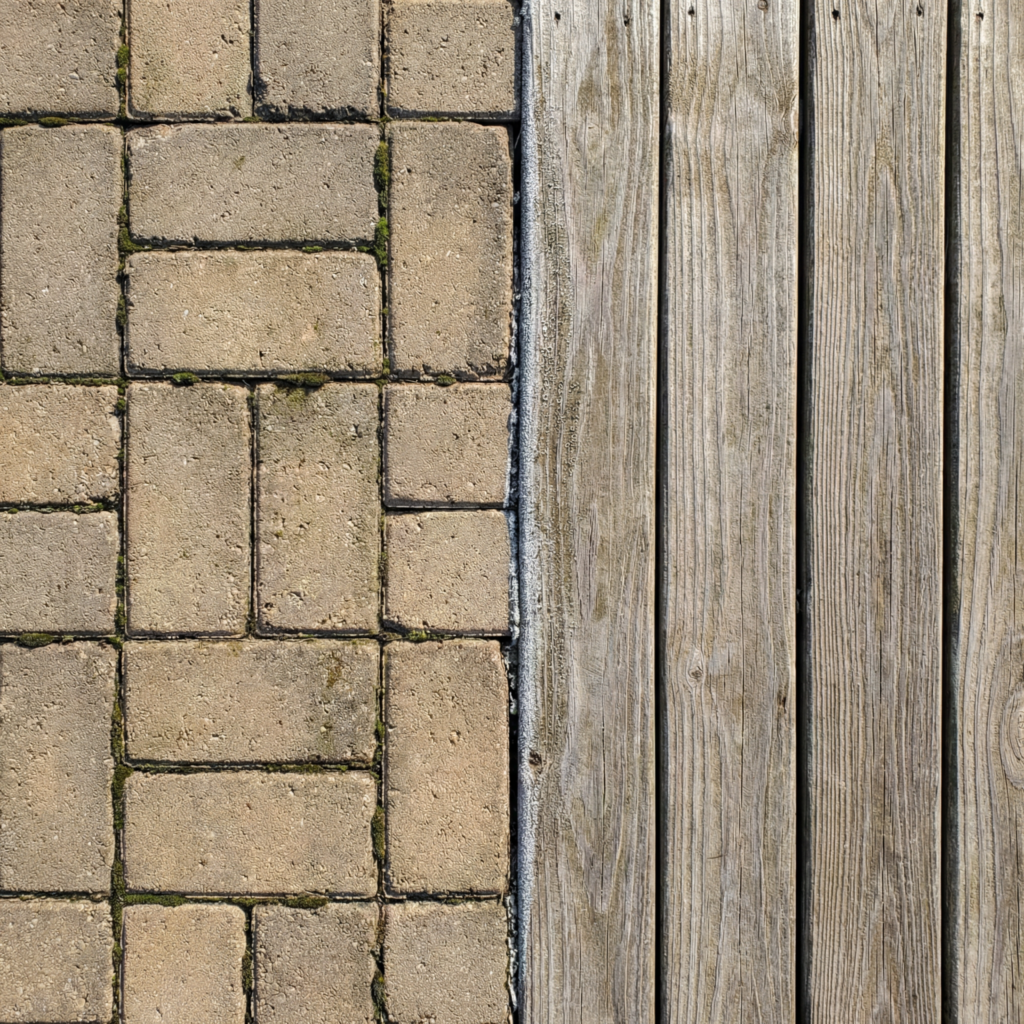
Iowa homeowners trying to decide between a patio and a deck usually find national content that treats the decision like a style preference. It isn’t. Your yard’s topography, your soil, and Iowa’s freeze-thaw cycles make one option genuinely better than the other in most situations. This post covers the real cost difference, what Iowa winters do to each material, and what permits apply, so you can make the right call before any money changes hands.
TLDR: A 300 sqft concrete patio in Des Moines runs $1,500 to $3,000 installed. A deck of the same size, pressure-treated wood, costs $7,500 to $15,000. The deck costs more because it’s structural. Whether that premium is worth it usually comes down to your yard’s slope, your door height, and how long you plan to stay. Read on for the Iowa-specific guidance.
Most national content starts with aesthetics. The better starting point is your backyard.
Patio or Deck? Your Yard Decides More Than You Do
The single most practical way to make this decision is to stand at your back door and look at your yard. If the ground drops more than 8 to 10 inches from your door threshold, a deck will almost always cost less than the excavation and grading a level patio would require. If your yard is flat and your door sits at or near grade, a patio gives you more square footage per dollar.
Iowa’s Des Moines metro has a wide variation in lot topology. Some lots in Waukee and Ankeny are nearly flat. Others slope toward rear drainage easements or drop away from the house. Clay soil throughout Central Iowa drains slowly, which concentrates moisture near the surface and affects base prep requirements for patios and footing conditions for decks.
Pro tip 1: If your back door sits 24 inches or more above the yard, a deck is the practical choice, not a luxury. A patio at that height would require so much fill, grading, or retaining work that it would cost more than the deck and likely drain toward the house.
Pro tip 2: Check your HOA rules before calling anyone. Even when your city doesn’t require a permit for a ground-level concrete patio, your HOA may restrict size, materials, or setbacks. Both boxes need to be checked before you sign a contract.
What a Patio Costs in Des Moines
Basic concrete slab installation in the Des Moines metro runs $6 to $10 per square foot. Stamped concrete runs $8 to $25 per square foot, depending on pattern complexity. Paver patios run $10 to $20 per square foot. Natural stone runs $15 to $30 per square foot. Site prep, which includes grading and base excavation, adds $500 to $1,500 to any patio project and is often omitted from online estimates.
Pro tip 3: Stamped concrete costs less upfront than pavers but carries a higher risk in Iowa’s freeze-thaw climate. When a stamped slab cracks in Iowa’s climate, repairing a section means replacing the entire section. Poured patches never match the original stamp pattern.
Pro tip 4: Pavers cost more upfront and offer better long-term value on Iowa sites. Individual units flex with temperature swings and can be preleveledre-leveled, and reset. A sinking stamped slab costs $1,500 to $3,000 to repair; the same problem in a paver patio costs $300 and a few hours.
Table 1: Patio Cost by Material: Des Moines Metro (2025 to 2026)
| Material | Installed Cost/Sqft | 300 Sqft Total (est.) | Lifespan | Iowa Freeze-Thaw Durability |
|---|---|---|---|---|
| Basic concrete slab | $6 to $10 | $1,500 to $3,000 | 25 to 50+ years | Moderate; vulnerable to cracking |
| Stamped concrete | $8 to $25 | $2,400 to $7,500 | 25 to 40 years | Lower; cracks require full section replacement |
| Paver patio | $10 to $20 | $3,000 to $6,000 | 30 to 50+ years | High; individual units flex and can be reset |
| Natural stone | $15 to $30 | $4,500 to $9,000 | 40+ years | High; individual stones can be releveled |
Estimates include standard site prep. Actual costs vary by site conditions, grade, and current material pricing. Always budget $500 to $1,500 for site prep on top of material costs.
Illustrative scenario: A Waukee homeowner with a flat backyard and a back door at grade level installs a 300 sq ft basic concrete patio at $8 per square foot, for a total of $2,400. The same lot with a 300-sq-ft attached pressure-treated deck would cost $10,500. The patio wins on cost. The homeowner plans to stay 15 years, so either would return value at resale, but the patio’s lower day-one cost and simpler construction made it the right call for this lot.
Pro tip 11: Get a line-item estimate for whichever option you choose. A patio quote should separately show site prep, base material, surface material, and labor. A deck quote should separately show footings, framing lumber, decking, railings, hardware, and permit fees. A bundled number makes it impossible to compare bids or understand where the cost is going.
What a Deck Costs vs. a Patio, and Why the Gap Is Real
Deck building in Central Iowa runs $20 to $65 or more per square foot installed, depending on material, elevation, and complexity. A 300 sq ft pressure-treated wood deck typically costs $7,500 to $15,000. A composite deck of the same size runs $12,000 to $19,500. That premium over a concrete patio exists for a specific reason: a deck is a structural project.
Footings must be set at least 42 to 48 inches below grade to clear Iowa’s frost line. Beams, joists, ledger hardware, and railings all add to the structural cost. A patio’s base prep (compacted gravel and excavation) is dramatically cheaper than six frost-line footings, even before you account for the framing above.
For a full breakdown of deck costs in Des Moines by size and material, see that post for line-item details.
Pro tip 5: Iowa’s 42 to 48-inch frost line adds real cost to deck footings that national pricing calculators miss. Any deck estimate generated from a tool not calibrated to Central Iowa will likely understate the footing cost.
Table 2: Patio vs. Deck Cost and Value Comparison (Des Moines, 2025 to 2026)
| Option | Installed Cost/Sqft | 300 Sqft Total (est.) | Lifespan | ROI at Resale | Permit Required? |
|---|---|---|---|---|---|
| Basic concrete patio | $6 to $10 | $1,500 to $3,000 | 25 to 50+ years | 50 to 75% | Usually no (verify locally) |
| Paver patio | $10 to $20 | $3,000 to $6,000 | 30 to 50+ years | 50 to 75% | Usually no (verify locally) |
| PT wood deck | $20 to $40 | $7,500 to $15,000 | 15 to 20 years in Iowa | 94.9% | Yes |
| Composite deck | $35 to $65+ | $12,000 to $19,500 | 25 to 30 years | 88.5% | Yes |
Deck ROI from the 2025 Zonda Cost vs. Value Report. Patio ROI is a general estimate that varies by project quality and local market. Costs vary by project scope and site conditions.
Illustrative scenario: An Ankeny homeowner has a yard that drops 18 inches from the back door. Grading and filling to create a level patio base would require excavating and hauling 40-plus cubic yards of clay soil, adding $1,500 to $3,000 in site prep before a single square foot of patio is installed. A deck on four posts connects directly to the door for $8,000 to $12,000 total. The deck is the obvious call.
What Iowa’s Climate Does to Patios
Iowa averages 45 to 84 freeze-thaw cycles per year. That number matters more for patios than most homeowners realize. Water infiltrates existing cracks in a concrete slab, freezes, expands, and widens those cracks from the inside. Repeat 60 times in winter, and small surface cracks become structural ones.
Stamped concrete is most vulnerable because the stamping process creates more surface variation for water to collect in. Pavers with 8,000-plus PSI compressive strength are significantly more freeze-thaw resistant than poured concrete at 3,000 to 4,000 PSI. Individual units absorb and release pressure rather than transferring stress across a continuous slab.
Pro tip 6: The base is where patio longevity is won or lost in Iowa. Any contractor installing a concrete or paver patio who doesn’t remove the top soil layer and replace it with at least 6 inches of compacted gravel is setting up a future failure. Iowa clay is not a stable patio base. It expands when wet and contracts when dry, and it will move the surface above it.
Pro tip 7: On Iowa sites with known drainage problems or heavy clay, pavers are the better long-term call, even at a higher upfront cost. They can be pulled up, leveled, and reset for a fraction of the cost of a poured-slab repair.
Illustrative scenario: A Des Moines homeowner installs a stamped concrete patio in spring. The contractor skips a compacted gravel base to save half a day of labor. By year three, two sections crack from Iowa freeze-thaw and clay heave. Repaired sections can’t be stamped to match. Full slab replacement is quoted at $4,200. A proper base prep at installation would have cost $400 more.
Illustrative scenario: An Urbandale homeowner chooses a paver patio over stamped concrete, spending $3,600 more upfront. In year five, one section sinks after a wet spring. A contractor pulls up 1 level and resets the base. Repair cost: $300, two hours. The same problem on a stamped slab would run $1,500 to $3,000 and still leave a visible patch.
Permits: Decks Require Them, Most Patios Don’t
Ground-level concrete and paver patios in rear yards typically don’t require a permit in most Iowa cities. Iowa permit guidance from Neighborhood Finance Corporation confirms this general rule, but requirements vary by jurisdiction. Always verify with your specific city before starting work.
Decks are different. Attached decks and any freestanding deck 30 inches or more above grade require permits in Iowa. Permit fees in Des Moines run from $75 to $300. Deck permits trigger inspections on footing depth, framing, railing height, and ledger attachment. An unpermitted deck will surface at resale.
Pro tip 8: Patio covers, pergolas, and any roofed structure added over an existing patio often do require permits even when the slab below doesn’t. If you’re planning to cover your patio in the future, ask your building department now before you design around that assumption.
Table 3: Iowa Permit Requirements: Patio vs. Deck
| Structure | Permit Typically Required? | Why It Matters |
|---|---|---|
| Ground-level concrete patio (rear yard) | Usually no | Verify with your city; rules vary by jurisdiction |
| Paver patio (rear yard) | Usually no | Same; confirm locally before starting |
| Patio cover or pergola over existing patio | Often yes | Roofed structures typically trigger permit requirements |
| Attached deck, any height | Yes | Freestanding deck under 30.” |
| Freestanding deck 30″+ above grade | Yes | Falls under structural code requirements |
| Freestanding deck under 30″ | Varies | Check locally; some jurisdictions exempt these |
Iowa general contractors are registered, not licensed. Verify any contractor’s current registration through the Department of Inspections, Appeals, and Licensing at dial.iowa.gov before signing anything. The permit should always be in the contractor’s name, not yours.
Illustrative scenario: A West Des Moines homeowner builds an attached composite deck before listing their home. No permit was pulled. The buyer’s inspector flags it. The seller must retroactively permit, document the footing depth, and add compliant 36-inch railings. The rework takes three weeks and costs $2,800 at the worst possible moment in the transaction.
Pro tip 12: Verify your contractor’s DIAL registration before signing anything. Iowa general contractors are registered, not licensed. Ask for the DIAL registration number and confirm the permit will be in the contractor’s name. When the permit is in your name, code compliance liability shifts to you.
Which Has Better ROI: Patio or Deck?
Decks return more at resale. The 2025 Zonda Cost vs. Value Report puts attached wood deck ROI at 94.9 percent and composite deck ROI at 88.5 percent. Concrete patios typically return 50 to 75 percent. The gap exists because buyers notice and value elevated outdoor living that connects to the home’s living area. A patio is often viewed as basic site work in an appraisal.
Pro tip 9: If you’re planning to sell within three to five years, the 94.9 percent wood deck ROI is the stronger financial case. If you’re staying long-term and a flat yard makes a patio the practical choice, the patio’s lower cost means you may get more actual outdoor living for your dollar, even with a lower ROI percentage.
Pro tip 10: A professionally installed paver patio on a flat-lot home in a competitive market like Waukee or Ankeny still adds real selling appeal, even with a lower ROI. Buyers in those markets have come to expect usable outdoor spaces, and a quality patio reads as a finished yard rather than a neglected one.
For a detailed comparison of how wood decks and composite decks perform in Iowa’s climate, including 10-year maintenance cost comparisons, that post covers the numbers in full.
Table 4: Patio vs. Deck Decision Guide for Iowa Homeowners
| Your Situation | Better Choice | Why |
|---|---|---|
| Flat backyard | Patio | Less excavation, lower cost, simpler construction |
| Yard drops 8″+ from back door | Deck | Practical requirement: deck bridges the height difference |
| Back door at grade | Patio | No elevation needed; patio connects flush to yard |
| Back door elevated 24″+ | Deck | Want the lowest long-term maintenance |
| Budget under $8,000 | Patio | Even a quality paver patio fits this range; decks rarely do |
| Plan to sell within 5 years | Deck | 94.9% ROI vs. 50 to 75% for concrete patio |
| An individual unireleveled, leveled; poured slab cannot | Composite deck or paver patio | Both require minimal ongoing care in Iowa’s climate |
| Drainage or clay soil concerns | Paver patio (if patio) | An individual unireleveled, leveled, or poured slab cannot |
Frequently Asked Questions
Q: How much does a patio cost in Des Moines? Basic concrete slab runs $6 to $10 per square foot installed. Stamped concrete runs $8 to $25 per square foot. Paver patio runs $10 to $20 per square foot. Natural stone runs $15 to $30 per square foot. A 300 sqft basic concrete patio typically runs $1,500 to $3,000 installed in the Des Moines metro. Always budget an additional $500 to $1,500 for site prep, which most online estimates leave out entirely.
Q: Which is cheaper in Iowa, a patio or a deck? A patio is almost always cheaper upfront. A 300 sq ft basic concrete patio costs $1,500 to $3,000 installed. A TA deck of the same size, pressure-treated wood, costs $7,500 to $15,000. The deck costs more because it requires structural footings at Iowa’s 42 to 48-inch frost line, framing, ledger hardware, and railings. Whether the premium is worth it depends primarily on your yard’s slope and your door height.
Q: Do I need a permit for a patio in Iowa? For most ground-level concrete or paver patios in a rear yard, no permit is required in most Iowa cities. Rules vary by jurisdiction, so verify with your specific city before starting. Patio covers, pergolas, and any roofed structure added over a patio often do require permits. Decks are a different category: attached decks and any freestanding deck 30 inches or more above grade require permits in Iowa.
Q: Does Iowa’s winter affect patios differently than decks? Yes. Iowa averages 45 to 84 freeze-thaw cycles per year. Poured concrete, especially stamped concrete, is vulnerable to cracking because water infiltrates cracks, freezes, and expands them from the inside. Pavers handle freeze-thaw better because individual units flex and are leveled rather than replaced. Composite decks handle Iowa winters better than wood for similar reasons: their lack of moisture absorption means nothing freezes inside the material.
Q: Which has better ROI, a patio or a deck? Decks return more at resale. The 2025 Zonda Cost vs. Value Report shows that attached wood decks have a 94.9 percent ROI and composite decks have an 88.5 percent ROI. Concrete patios typically return 50 to 75 percent. If you plan to sell within five years, a deck is the stronger financial move. If you’re staying long-term and your lot favors a patio, the lower upfront cost may deliver more overall value per dollar.
Key Takeaways
The Yard-First Decision
- Flat lot at grade = patio almost always wins on cost and simplicity
- Sloped lot with elevated back door = deck is the practical and often cheaper choice
- Iowa clay soil affects both; proper base prep for patios and engineered footings for decks are non-negotiable
Patio Costs in Des Moines
- Basic concrete: $6 to $10/sqft; stamped: $8 to $25/sqft; pavers: $10 to $20/sqft
- Always add $500 to $1,500 for site prep
- Stamped concrete carries a higher Iowa freeze-thaw risk than pavers
Deck Costs in Des Moines
- PT wood: $20 to $40/sqft; composite: $35 to $65+/sqft
- Structural requirements drive the higher cost vs. a patio
- Iowa’s 42 to 48-inch frost line adds to footing cost vs. national estimates
Permits
- Most ground-level rear-yard patios: no permit required (verify locally)
- Attached decks and freestanding decks 30″+ above grade: permit required
- Permit must be in the contractor’s name, not yours
ROI
- Wood deck: 94.9%; composite deck: 88.5% (Zonda 2025)
- Concrete patio: 50 to 75%
- Deck wins at resale; patio wins on day-one cost for long-term owners on flat lots.
Ready to Build a Patio or Deck in Central Iowa?
Busy Builders builds both patios and decks across Des Moines, West Des Moines, Ankeny, Waukee, and Urbandale. We handle all permits, pull them in our name, and provide honest line-item estimates before any contract is signed.
Call: 844-435-9800 Website: busybuildersiowa.com
Schedule your free consultation today.
Disclaimer: Cost estimates reflect general Central Iowa market conditions and vary by project scope, site conditions, material selection, and current pricing. ROI figures from the 2025 Zonda Cost vs. Value Report; actual resale returns vary by market conditions and project quality. Permit requirements vary by city and jurisdiction; verify current requirements with your local building authority before starting any project. No specific outcomes are guaranteed. Consult a registered contractor and your local building department for guidance specific to your project and site.
Busy Builders | Full-Service Construction and Remodeling | Serving Central Iowa Since 2020