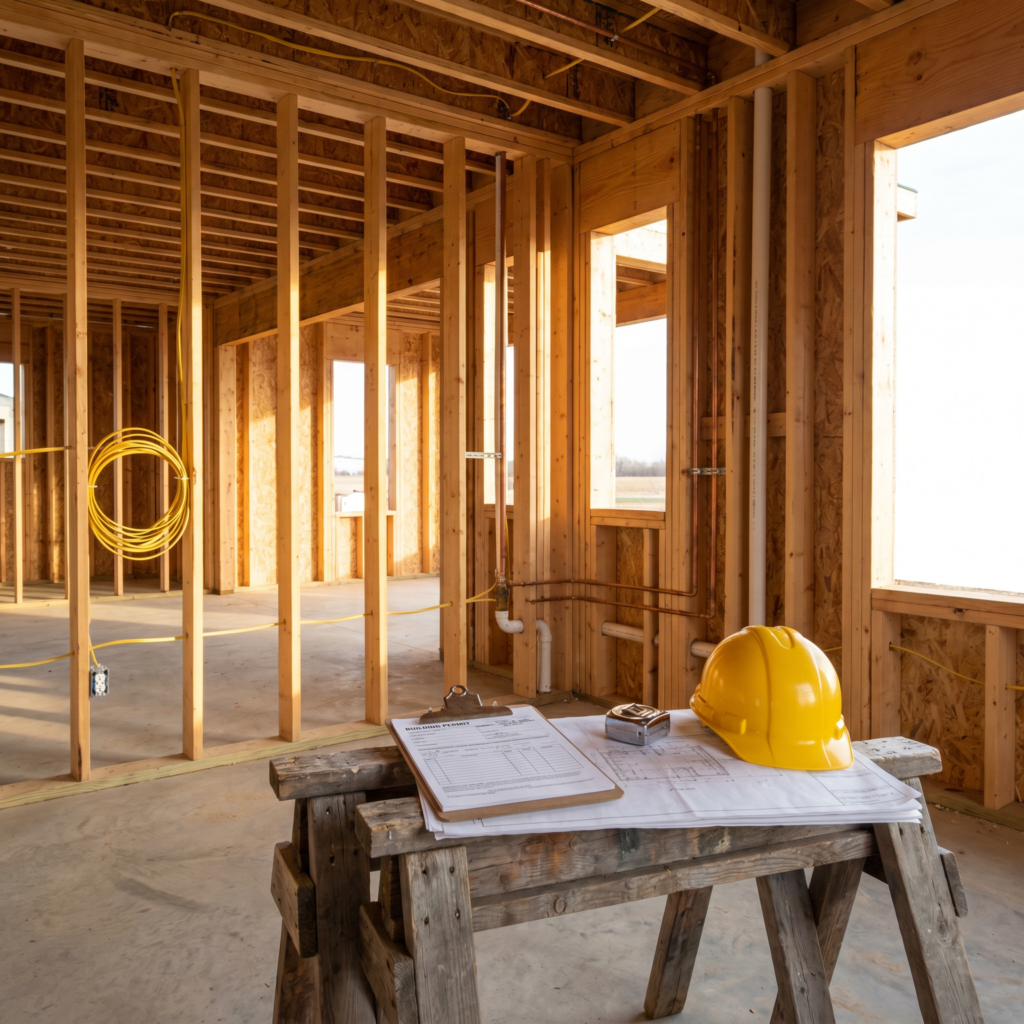
Permits are the part of a home project most people dread and least understand. The truth is they protect your home, your safety, and your investment, and a good contractor handles most of the work for you. This guide explains which Central Iowa projects need a permit, how the process works, what permits cost around the Des Moines metro, and the inspections that come with them.
TLDR: Most construction beyond simple cosmetic work needs a permit in Iowa, from new builds and additions to decks and basement finishes. Your registered contractor pulls the permit, submits drawings, and schedules inspections. Fees usually scale with project value, and timelines run from a few weeks to a couple of months. Skipping a permit can cost far more later, so build the approval window into your plan from the start.
You have a project in mind, maybe a finished basement, a new deck, or a full addition, and someone mentions permits. Suddenly you are picturing forms, fees, and a city office that moves slowly. It feels like a hurdle between you and your project.
Here is the reframe: a permit is not red tape for its own sake. It is the system that confirms your project is safe, structurally sound, and built to code, which is exactly what protects you and the next owner of your home. Unpermitted work can stall a future sale, void insurance claims, and force expensive rework.
Below, we walk through permits the way an Iowa builder does. You will learn which projects need one, who pulls it, how the process and inspections work, what it costs across the metro, and the mistakes that trip homeowners up. By the end, permits will feel like a manageable step, not a mystery.
Why Permits Matter, and What Happens Without One
It helps to understand what a permit actually does before you resent paying for it. A permit is the city’s record that your project was reviewed and inspected.
When you pull a permit, the building authority reviews your plans against the code, then inspects the work at key stages. That process catches problems while they are still cheap to fix, like a footing that is too shallow or wiring that is not safe. It is a second set of expert eyes on the most important asset you own.
Skipping a permit can be costly. Unpermitted work often surfaces when you sell, and buyers or their lenders may demand it be corrected or torn out. An insurance claim tied to unpermitted work can be denied. And a city that discovers unpermitted construction can require you to expose finished work for inspection after the fact.
Iowa adopted the 2024 International Residential Code, effective September 10, 2025, under Iowa Administrative Code 481-301.8. Your city enforces that code, plus its own local rules, through the permit process. Our overview of how to navigate Iowa residential construction regulations explains how the layers fit together.
Pro Tip 1: Keep every permit and final-inspection document in one folder. When you sell, handing a buyer proof that work was permitted and inspected removes a common closing obstacle and protects your asking price.
Who Pulls the Permit: Your Registered Contractor
A frequent question is whether the homeowner or the contractor handles the permit. On most projects, your contractor should.
A registered contractor pulls the permit, submits the required drawings, schedules the inspections, and meets the inspector on site. That is part of what you pay for, and it is a strong signal of how a contractor runs a job. If a quote leaves the permit “to the homeowner,” ask why before you sign.
Iowa does not license general contractors. It requires them to be registered with Iowa DIAL, the Department of Inspections, Appeals, and Licensing, for work above the state threshold. Electrical, plumbing, and heating work is performed by licensed subcontractors who pull their own trade permits. You can verify a contractor’s registration before you hire.
When a homeowner pulls a permit themselves, they take on responsibility for the work meeting code, which is a real risk on anything structural. For most projects, letting your registered contractor own the permit protects you.
Pro Tip 2: Verify your contractor’s DIAL registration yourself before signing. It takes two minutes, and it confirms you are hiring someone the state recognizes to do the work.
Pro Tip 3: Ask the contractor, in writing, to confirm they will pull the permit and coordinate all inspections. Putting it in the contract prevents a finger-pointing problem later.
Which Projects Need a Permit in Iowa
Not every project needs a permit, but more do than most homeowners expect. The general rule: structural work, new systems, and anything that changes the footprint usually needs one.
Cosmetic work like painting, flooring, or swapping a faucet generally does not. But move a wall, add a circuit, build a deck above a certain height, or finish a basement, and a permit almost always applies. When in doubt, confirm with your city before you start.
The table below shows how common Central Iowa projects typically fall.
Table 1: Permit needs by project type (Central Iowa, confirm with your city)
| Project | Permit usually required? | Notes |
|---|---|---|
| New home construction | Yes | Full plan review and phased inspections |
| Home addition | Yes | Structural drawings and energy review |
| Basement finishing | Yes | Egress, electrical, and framing checks |
| Deck building | Usually | Depends on height and attachment |
| Kitchen or bath remodel | Sometimes | Yes if moving walls, plumbing, or electrical |
| Painting or flooring | No | Cosmetic work |
The takeaway: when a project touches structure, electrical, plumbing, or the home’s footprint, plan for a permit. Our service pages for home building, home additions, deck building, and basement finishing each describe how permitting fits that specific project.
Pro Tip 4: Even for a kitchen or bath remodel, call your city before you assume no permit is needed. Moving a sink or adding a circuit can trigger one, and finding out after the work is done is the expensive way to learn.
The Iowa Permit Process, Step by Step
The process is more predictable than its reputation. Knowing the sequence helps you plan your timeline.
First, your contractor prepares drawings and a project description. Second, they submit the permit application to your city’s building or community development department. Third, the city reviews the plans against the code, sometimes with back-and-forth questions. Fourth, the permit is issued and work can begin. Fifth, inspections happen at set stages. Sixth, a final inspection closes the permit and, on larger projects, a certificate of occupancy is issued.
For a deeper look at how this plays out on a new build, our guide to navigating home building permits in Iowa walks through each step, and for below-grade work, our piece on basement finishing permit needs and how they affect costs covers that path. Additions follow their own track, detailed in our guide to home addition permits and what to expect.
Pro Tip 5: Ask your contractor for a realistic permit timeline before the project start date. Review can take a few weeks, and during the busy spring and summer building season it can take longer. Building that window into your schedule prevents a surprise delay.
Permit Costs and Timelines Across the Metro
Permit fees are not the same in every suburb, and they usually scale with the value of your project. Knowing the basis helps you budget.
Most Central Iowa cities calculate building permit fees from the project valuation, so a larger or more finished project carries a higher fee. Some add separate fees for electrical, plumbing, and mechanical trade permits. These are planning estimates, and actual fees vary by city and project, so confirm current amounts with your specific building authority.
The table below shows how fees and timelines generally work across the metro. Treat the figures as planning ranges, not quotes.
Table 2: Permit fee basis and timeline by area (Central Iowa, planning estimates)
| Area | Fee basis | Typical review window |
|---|---|---|
| Des Moines | Valuation-based | A few weeks |
| West Des Moines | Valuation-based | A few weeks |
| Ankeny | Valuation-based, Community Development Department | A few weeks, longer in peak season |
| Waukee | Valuation-based | A few weeks |
| Smaller communities | Valuation-based | Varies by staffing |
The takeaway: budget for permit fees as a real line item, and confirm the exact basis with your city. A registered contractor can usually tell you the local fee structure from experience.
Pro Tip 6: Build permit fees into your project budget from the start, not as an afterthought. On larger projects they add up, and a contractor who itemizes them on the quote is being transparent with you.
Pro Tip 7: If your timeline is tight, ask your contractor to submit the permit application as early as the design allows. The review clock does not start until the application is in, so an early submission can save you weeks.
Inspections: What Gets Checked and When
Inspections are the heart of the permit process. They confirm the work is safe and to code at each stage, before it gets covered up.
On a typical project, inspections happen in a sequence: the footing and foundation before concrete, the framing and rough-ins before insulation and drywall, and a final inspection at the end. Each one has to pass before the next phase proceeds, which is why scheduling matters.
Basement finishes get special attention on egress and electrical. An egress window, which is an emergency exit window, must meet Iowa’s dimensional standards: a 5.7 square foot net clear opening, with set minimums for height, width, and sill height under Iowa IAC 481-301.8. Foundation depth follows the frost-depth rules in the IRC foundation chapter, at least 42 inches in Iowa.
The table below shows the common inspection stages.
Table 3: Common inspection stages
| Stage | What gets checked | When |
|---|---|---|
| Footing and foundation | Depth, rebar, forms | Before concrete pour |
| Framing and rough-in | Structure, wiring, plumbing, ducts | Before insulation |
| Insulation and energy | Insulation, air sealing | Before drywall |
| Final | Complete, code-compliant work | At project end |
The takeaway: each inspection protects you by catching problems while they are still easy to fix. Your contractor schedules and meets each one.
Pro Tip 8: Never let a contractor cover framing, wiring, or plumbing before the rough-in inspection passes. Once it is behind drywall, exposing it later for an inspection is expensive and avoidable.
Pro Tip 9: A finished basement is the natural time to confirm radon protection. All 99 Iowa counties sit in EPA Radon Zone 1, and the Iowa Radon Survey found that as many as 5 in 7 Iowa homes test above the EPA action level, so test before and after the work.
Common Permit Mistakes to Avoid
A few avoidable mistakes cause most permit headaches. Knowing them keeps your project on track.
The most common is starting work before the permit is issued, which can mean stop-work orders and fines. Another is assuming a “small” project does not need a permit, when moving plumbing or adding a circuit actually triggers one. A third is skipping the energy-compliance review on an addition or new build, which Iowa code requires. The Department of Energy’s weatherization guidance explains why insulation and air-sealing standards matter and why inspectors check them.
These illustrative scenarios show how permits play out across the metro. They are examples, not specific Busy Builders projects, and your costs and timelines will vary.
Illustrative scenario, basement finish in Indianola: A homeowner finishes a basement with a bedroom and bath. The permit covers egress, framing, electrical, and plumbing, with inspections at rough-in and final. Approval took about three weeks, and the egress window was sized to code before drywall went up.
Illustrative scenario, deck in Pleasant Hill: A family adds an attached deck. Because it attaches to the house and sits above the height threshold, it needs a permit and a footing inspection at frost depth. The review took under two weeks, and the build followed once the permit was issued.
Illustrative scenario, addition in Carlisle: A couple adds a two-room addition. The permit required structural drawings and an energy-compliance review, with phased inspections from footing to final. Approval ran about five weeks, longer because it was peak building season.
Pro Tip 10: Never start construction before the permit is in hand. A stop-work order can delay you far longer than the few weeks the permit review would have taken.
Pro Tip 11: If you bought a home with finished space you suspect was never permitted, ask a registered contractor how to address it before you remodel further. Resolving it correctly protects you at resale.
Pro Tip 12: Choose a contractor who treats permits as their job, not yours. The way a builder handles permitting and inspections tells you how they will handle the rest of your project. For the full picture of how we manage permits across project types, our service pages and our guide to Iowa residential construction regulations lay out the process.
Frequently Asked Questions
Q: Do I need a permit to remodel my kitchen in Iowa? It depends on the scope. A cosmetic refresh like new cabinets, counters, and paint often does not need a permit, but moving a wall, relocating plumbing, or adding electrical circuits usually does. Because the line is not always obvious, call your city’s building department before you start, or let your registered contractor confirm it. Finding out after the work is done is the costly way to learn.
Q: How much does a building permit cost in Des Moines? Most Central Iowa cities, including Des Moines, base building permit fees on the value of the project, so a larger or more finished job carries a higher fee. Separate trade permits for electrical, plumbing, and mechanical work may add to the total. These are planning estimates, so confirm the current fee basis with your specific city. A registered contractor can usually tell you the local structure from experience.
Q: Who is responsible for pulling the permit, me or the contractor? On most projects, your registered contractor should pull the permit, submit the drawings, and schedule the inspections. That is part of what you hire them to do, and it keeps responsibility for code compliance with the professional. If a contractor asks you to pull the permit yourself, treat it as a warning sign and ask why. Confirm permit responsibility in the contract before work begins.
Q: How long does permit approval take in Iowa? For many residential projects, review takes a few weeks, though it runs longer during the busy spring and summer building season and on complex projects that need structural or energy review. The clock starts when the complete application is submitted, so an early, complete submission speeds things up. Ask your contractor for a realistic window for your specific city and project, and build it into your schedule.
Q: What happens if I do work without a permit? Unpermitted work can lead to stop-work orders, fines, and a requirement to expose finished work for inspection after the fact. It can also stall a future home sale, since buyers and lenders may demand corrections, and it can complicate insurance claims. The cost of fixing an unpermitted project almost always exceeds the cost of permitting it correctly. When in doubt, permit it.
Q: Do I need a permit for a deck or a basement finish? Usually, yes for both. A deck typically needs a permit once it attaches to the house or rises above a set height, and it requires a footing inspection at frost depth. A basement finish needs a permit for egress, framing, electrical, and plumbing work. Confirm the specifics with your city, and let your registered contractor handle the application and inspections.
Key Takeaways
Permits protect your home and your investment
- They confirm work is safe, structural, and code-compliant.
- Unpermitted work can stall a sale, void insurance, and force rework.
- Iowa enforces the 2024 IRC under IAC 481-301.8, plus local rules.
Your registered contractor owns the permit
- They pull it, submit drawings, and schedule inspections.
- Iowa requires DIAL registration, not licensing, for general contractors.
- Verify registration before you hire, and put permit duty in the contract.
Most structural and system work needs one
- New builds, additions, basements, and most decks require permits.
- Cosmetic work usually does not; plumbing or electrical changes often do.
- When in doubt, confirm with your city before starting.
Plan for fees, timelines, and inspections
- Fees usually scale with project value; confirm the local basis.
- Review takes a few weeks, longer in peak season.
- Inspections happen at footing, framing, insulation, and final stages.
Avoid the common mistakes
- Never start work before the permit is issued.
- Never cover rough-in work before it passes inspection.
- Test for radon when finishing a basement; all 99 counties are Zone 1.
Ready to Start Your Project the Right Way?
You now understand which projects need a permit in Iowa, who pulls it, how the process and inspections work, and what to expect on cost and timeline. The next step is a builder who treats permitting as their responsibility, not a task they hand back to you.
Busy Builders has completed 1,285+ projects across Central Iowa since 2020. We bring transparency, local code knowledge, and straight answers to every project. Here is what working with us looks like:
- Free consultation to talk through your project and timeline
- Clear, itemized estimates that include permit fees
- A registered Iowa contractor pulling permits and meeting every inspection
- Coordination with licensed subcontractors for electrical, plumbing, and heating work
- Written warranty on workmanship (details provided in your contract)
Ready to move forward? Contact us today.
Call: 844-435-9800
Website: https://busybuildersiowa.com/
We serve West Des Moines and communities across Central Iowa, including Ankeny and Waukee.
Disclaimer: This article is for general information and is not project-specific advice. Cost figures, including permit fees, are planning estimates that vary by scope, materials, site conditions, and current pricing. Permit requirements vary by city and jurisdiction; verify current requirements with your local building authority before starting any project. Radon levels vary by home; the Iowa Radon Survey reports that as many as 5 in 7 Iowa homes test above the EPA action level, and testing before and after below-grade work is recommended. No specific outcomes are guaranteed. Consult a registered contractor, and the appropriate licensed subcontractors for electrical, plumbing, and heating work, for guidance specific to your project.
Busy Builders | Full-Service Construction and Remodeling | Serving Central Iowa Since 2020