Building a home in Central Iowa starts with a choice most people do not know they are making: semi-custom or fully custom. The two paths look similar in a brochure, but they differ in price, how much you control, and how long the build takes. This guide explains what each one really means here, what it costs around the Des Moines metro, and how to pick the path that fits your budget and your patience.
TLDR: A semi-custom home lets you personalize a builder’s existing floor plan, which keeps cost and timelines more predictable. A fully custom home starts from a blank page, giving you full control but a higher price and a longer schedule. In Central Iowa, semi-custom often runs near the lower end of build costs, while custom climbs well above it. The right path depends on how much you want to decide yourself.
You have probably toured a few homes and pictured your own. Maybe you love a layout you saw but want a bigger kitchen, or you have a piece of land and a plan in your head that no stock design matches. Either way, one question shapes everything that follows: do you start from a builder’s plan, or from a blank sheet of paper?
That single decision drives your budget, your timeline, and how many choices land on your plate. Semi-custom keeps things guided and more predictable. Fully custom hands you the wheel, along with the longer ride and the larger bill. Neither is better. They are different tools for different homeowners.
Below, we break down both paths the way an Iowa builder does: what each term means, what each costs locally, how much design control you get, how long each takes, the Iowa-specific factors that shape both, and how financing works. By the end, you will know which path fits how you actually want to build.
What “Semi-Custom” and “Fully Custom” Mean in Iowa
The words get used loosely, so start with what they mean in practice. The difference comes down to where your home design begins.
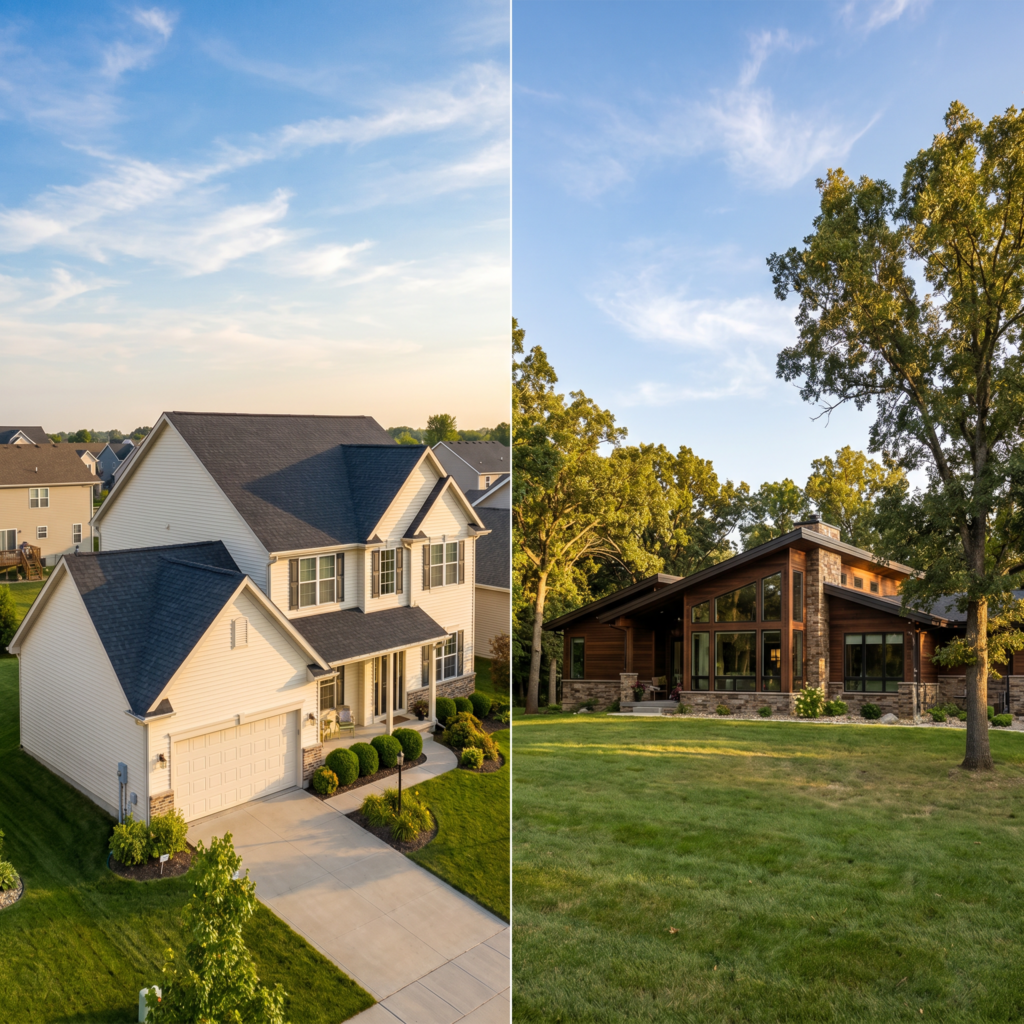
A semi-custom home starts from a builder’s existing floor plan. You choose from a set of layouts the builder already knows how to build, then personalize finishes, fixtures, cabinets, and some structural options. You might move a wall, add a bedroom, or extend the garage, but the bones of the plan stay in place. Because the builder has built that plan before, pricing and scheduling are more predictable.
A fully custom home starts from a blank page. You work with a designer or architect to draw a plan around your land, your lifestyle, and your budget. Every choice is yours, from the roofline to the window placement to the exact ceiling height in the basement. That freedom is the point, and it is also why a custom build costs more and takes longer.
Think of it like buying a suit. Semi-custom is a quality suit tailored to fit you well. Fully custom is bespoke, cut from scratch to your exact measurements and preferences. Both can be excellent. One simply involves far more decisions and a bigger investment.
Pro Tip 1: Before you talk price, decide how many design decisions you actually want to make. Some homeowners love choosing every detail. Others find 200 selection meetings exhausting. Be honest about which one you are.
The Cost Difference: What You Pay for Each Path
Cost is where the two paths separate most clearly. More custom work means more design, more unique materials, and more labor that has not been done the same way before.
Busy Builders lists home building starting from $150 per square foot as a published starting point. Semi-custom builds tend to sit closer to that lower end because the plan and process are known. Fully custom builds climb higher, since every element is designed and priced from scratch. National new residential construction data from the U.S. Census Bureau shows how build costs have trended upward in recent years, a pattern Central Iowa has followed. These are planning estimates, and actual costs vary by scope, materials, site conditions, and current pricing.
The table below shows how the two paths generally compare on a per-square-foot basis around the Des Moines metro.
Table 1: Semi-custom vs. custom cost factors (Central Iowa, planning estimates)
| Cost factor | Semi-custom | Fully custom |
|---|---|---|
| Typical cost per square foot | Lower end of the range | Higher end and up |
| Design and architecture fees | Minimal, plan already exists | Significant, drawn from scratch |
| Material predictability | High, builder buys familiar materials | Variable, unique selections |
| Change-order risk | Lower | Higher |
Use this as a starting point, not a quote. A heavily personalized semi-custom home can approach custom pricing, and a modest custom plan can land closer to semi-custom than you expect.
The biggest hidden cost driver is change orders. On a custom build, a mid-project change can ripple through the design and add cost. On a semi-custom plan, the builder has solved most problems already, so surprises are fewer. To see how design choices move the number, our guide to what it costs to build a custom home breaks the drivers down in detail.
Pro Tip 2: Get three written, itemized quotes for either path, and make sure each one lists design fees separately. On a custom build, design and engineering can be a real line item, and a quote that hides it is hard to compare fairly.
Pro Tip 3: Ask each builder what a typical change order costs on your chosen path. The answer tells you how much financial room you have if you change your mind once construction starts.
Design and Control: How Much Say Do You Get?
This is the trade-off at the heart of the decision. More control sounds purely good until you see how many choices it brings.
On a semi-custom home, you control the finishes and many of the options, but the floor plan guides you. You pick cabinets, counters, flooring, paint, fixtures, and often a few structural upgrades from a curated menu. The builder narrows the field, which speeds decisions and reduces the chance of a costly mismatch.
On a fully custom home, you control everything. Room sizes, ceiling heights, window placement, the kitchen island shape, the exact spot the morning light hits. If you can picture it and the budget allows, you can build it. That is powerful for homeowners with a clear vision and a specific lot.
The table below shows what you typically decide on each path.
Table 2: What you choose on each path
| Decision area | Semi-custom | Fully custom |
|---|---|---|
| Floor plan | Choose from existing plans, modify some | Draw from scratch |
| Finishes and fixtures | Full choice from a menu | Unlimited choice |
| Room sizes and ceiling heights | Limited adjustments | Fully adjustable |
| Exterior style | Set options | Fully designed |
The takeaway: semi-custom gives you meaningful personalization with guardrails, while custom gives you total freedom and total responsibility for the choices.
For inspiration on what is possible when you start from scratch, our roundup of Iowa custom home design ideas shows how far the design can go.
Pro Tip 4: If you choose custom, build a clear priority list before design starts: the three things you will not compromise on, and the three you will flex on if the budget tightens. It keeps the design process from drifting over budget.
Pro Tip 5: On a semi-custom build, ask to see the full options menu up front. Knowing every upgrade available, and its price, helps you plan a realistic budget instead of getting surprised at each selection meeting.
Timeline: How Long Each Path Takes in Iowa
Time follows the same pattern as cost. The more you design from scratch, the longer the road from idea to move-in.
A semi-custom home moves faster because the design phase is short. The plan exists, the builder knows it, and permitting is more straightforward. A fully custom home adds months on the front end for design, engineering, and the permit review that comes with a one-of-a-kind plan.
Iowa weather affects both paths. Our frozen winter ground slows excavation and foundation work, and concrete needs moderate temperatures to cure. A build that breaks ground in spring usually moves more smoothly than one starting in deep winter.
The table below shows a typical timeline range for each path around Central Iowa.
Table 3: Typical build timeline by path (Central Iowa)
| Phase | Semi-custom | Fully custom |
|---|---|---|
| Design and planning | 1 to 2 months | 3 to 6 months |
| Permitting | 3 to 6 weeks | 6 to 10 weeks |
| Construction | 5 to 8 months | 7 to 12 months |
| Total, idea to move-in | About 8 to 12 months | About 12 to 18 months |
These are planning ranges, not promises. Weather, material lead times, and design complexity all shift the schedule. Our guide to how long it takes to build a custom home walks through what drives each phase.
Pro Tip 6: Plan to break ground in spring or early summer when you can. An Iowa winter start can add weeks to excavation and foundation work, no matter which path you choose.
Pro Tip 7: Order long lead-time items, like windows and certain cabinets, as early as your builder allows. Material delays are one of the most common reasons a build runs past its target date.
Iowa-Specific Factors That Shape Both Paths
No matter which path you choose, Iowa’s climate and code shape the build. A good builder bakes these into the plan from day one.
Foundations here must reach below the frost line, which is the depth the foundation must go so it does not shift when the ground freezes. In Iowa that depth is at least 42 inches. That requirement, set out in the IRC foundation chapter, adds cost compared with shallow southern footings and applies to every new home.
Iowa adopted the 2024 International Residential Code, effective September 10, 2025, under Iowa Administrative Code 481-301.8. Your builder designs to that code plus your city’s own rules. Whoever builds your home should be a registered contractor. Iowa does not license general contractors. It requires them to be registered with Iowa DIAL.
Radon deserves attention in any new Iowa home. All 99 Iowa counties sit in EPA Radon Zone 1, the highest category, and the Iowa Radon Survey found that as many as 5 in 7 Iowa homes test above the EPA action level. A new build is the cheapest time to install a passive radon-resistant system, so ask your builder to include one.
If your plans include an accessory dwelling unit, Iowa law changed recently. Under Iowa Senate File 592, effective July 1, 2025, a permitted ADU can be up to 1,000 square feet or 50% of the primary dwelling, whichever is larger. That ceiling matters if you want a custom build with an in-law suite or rental unit.
Pro Tip 8: Ask your builder to include a passive radon system in the original plan. Adding one during construction costs far less than retrofitting after you move in, and Iowa’s radon levels make it worth it.
Pro Tip 9: If an ADU is part of your vision, confirm the size math early. The 1,000-square-foot-or-50% ceiling, whichever is larger, can change your design before you fall in love with a plan that does not fit the rule.
Financing a Custom or Semi-Custom Build
Financing a new build works differently from buying an existing home, and both paths usually use the same kind of loan. Knowing how it works prevents surprises.
Most new builds use a construction loan, which releases money in stages called draws as the home reaches each milestone. You pay interest only on the money drawn so far, then the loan often converts to a regular mortgage once the home is complete. Lending terms, draw schedules, and rates vary by lender, so this is not lending advice. Talk with your lender about the specifics.
A custom build can complicate financing because the final cost is harder to lock early, when the design is still evolving. A semi-custom build, with its known plan and price, tends to be simpler to underwrite. The federal Consumer Financial Protection Bureau offers plain-language guidance on the home-financing process that is worth reading before you apply.
The table below compares how the two paths tend to affect financing.
Table 4: How each path affects financing
| Financing factor | Semi-custom | Fully custom |
|---|---|---|
| Cost certainty at loan application | Higher | Lower, design still evolving |
| Draw schedule | Standard, predictable phases | May need more detail |
| Contingency reserve advised | 10 to 15 percent | 15 to 20 percent |
| Underwriting complexity | Lower | Higher |
The takeaway: a semi-custom build is generally easier to finance, while a custom build asks for a larger contingency and a closer working relationship with your lender. Our overview of financing a custom home build in Iowa covers the steps in more depth, and our look at whether you can build a custom home under $500k shows how budget shapes the path.
Pro Tip 10: Build a contingency reserve into your loan from the start. A 10 to 15 percent cushion on a semi-custom build, or 15 to 20 percent on a custom build, covers the surprises that come once the ground opens up.
Which Path Is Right for You?
The honest answer is that it depends on three things: how much you want to control, how much you want to spend, and how long you are willing to wait.
Choose semi-custom if you want a quality home with meaningful personalization, a more predictable budget, and a faster move-in. Choose fully custom if you have a specific lot, a clear vision, the budget for it, and the patience for a longer, decision-heavy process. There is no wrong answer, only the one that fits you. For a closer look at one common custom decision, our guide to a ranch versus a two-story custom home shows how layout shapes both cost and lifestyle, and our piece on what sets Des Moines custom home builders apart helps you vet a builder.
These illustrative scenarios show how the choice plays out across the metro. They are examples, not specific Busy Builders projects, and your costs will vary.
Illustrative scenario, semi-custom in Grimes: A family in Grimes chooses a builder’s four-bedroom plan, extends the garage, upgrades the kitchen, and selects finishes from the options menu. The build runs about 9 months from contract to move-in, with costs near the lower end of the range because the plan was already proven.
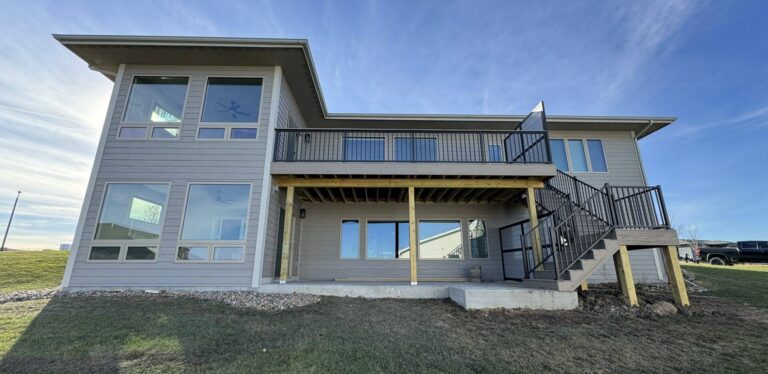
Illustrative scenario, fully custom in Ames: A couple in Ames works with a designer to draw a one-of-a-kind home around a sloped lot, with a walkout basement and a vaulted great room. Design and permitting take about 5 months, construction another 10, and the cost lands well above the semi-custom range because nearly every element was designed from scratch.
Illustrative scenario, budget-conscious build in Adel: A first-time builder in Adel keeps costs down by choosing a smaller semi-custom plan, holding finishes to the standard menu, and breaking ground in spring. The project comes in near the low end of the per-square-foot range and finishes in about 8 months.
Pro Tip 11: Tour two or three homes a builder has completed on your chosen path. A builder who does semi-custom well may approach a fully custom project differently, so match the builder to the path you want.
Pro Tip 12: Whichever path you choose, get the full scope in writing before you sign: plan, allowances for finishes, the change-order process, and the draw schedule. A clear contract is what keeps a build on budget and on schedule. For the full picture of how a build comes together, our home building service page explains how we approach new construction across Central Iowa.
Frequently Asked Questions
Q: What is the real cost difference between semi-custom and custom in Iowa? Semi-custom builds tend to sit near the lower end of local per-square-foot costs because the plan and process are already known, while fully custom builds climb higher because every element is designed and priced from scratch. The gap widens with design fees, unique materials, and change orders. These are planning estimates, so get three written quotes for your specific plan and lot to see your real number.
Q: Is a semi-custom home lower quality than a fully custom home? No. Quality comes from the builder, the materials, and the workmanship, not from whether the plan was custom-drawn. A well-built semi-custom home can match or beat a poorly managed custom one. The difference is in design freedom and personalization, not in how well the home is built. Focus on the builder’s track record and warranty rather than the label.
Q: How long does a custom home take to build in Iowa? A fully custom home typically takes about 12 to 18 months from idea to move-in, including 3 to 6 months of design and engineering up front. A semi-custom home usually runs about 8 to 12 months because the design phase is much shorter. Iowa winters can stretch both timelines, so a spring start helps. Ask your builder for a phase-by-phase schedule before you commit.
Q: Can I add an ADU to a custom build in Iowa? Yes, and a custom build is a natural time to plan one. Under Iowa Senate File 592, effective July 1, 2025, a permitted accessory dwelling unit can be up to 1,000 square feet or 50% of the primary dwelling, whichever is larger. Confirm your city’s specific rules, since local zoning still applies. Plan the ADU into the design early so the size math works from the start.
Q: Do I need a registered contractor for a custom build? Yes. Iowa requires general contractors to be registered with Iowa DIAL, not licensed, for work above the state threshold. Electrical, plumbing, and heating work on your build is handled by licensed subcontractors your builder coordinates. Always verify a contractor’s registration before signing, and ask for proof of insurance. A registered, insured builder protects your investment.
Key Takeaways
The starting point defines the path
- Semi-custom starts from a builder’s existing plan you personalize.
- Fully custom starts from a blank page drawn around your lot and vision.
- Neither is higher quality; they differ in freedom and cost.
Cost and timeline rise with customization
- Semi-custom sits nearer the lower end of local build costs and finishes in about 8 to 12 months.
- Fully custom climbs higher and runs about 12 to 18 months.
- Change orders and design fees are the biggest custom cost drivers.
Iowa factors shape both builds
- Frost-depth footings of at least 42 inches apply to every new home.
- All 99 Iowa counties are EPA Radon Zone 1; include a passive radon system.
- ADUs can be up to 1,000 square feet or 50% of the primary home, whichever is larger.
Financing differs by path
- Most builds use a construction loan with staged draws.
- Semi-custom is generally easier to finance; custom needs a larger contingency.
- Lending terms vary by lender; talk to yours early.
Hire a registered contractor
- Iowa requires DIAL registration, not licensing, for general contractors.
- Get the full scope, allowances, and draw schedule in writing.
Ready to Plan Your Build?
You now understand the real differences between semi-custom and fully custom home building in Iowa, and how each affects your budget, your timeline, and your stress level. The next step is a conversation with a builder who knows Central Iowa homes and can match the path to your goals.
Busy Builders has completed 1,285+ projects across Central Iowa since 2020. We bring transparency, local code knowledge, and straight answers to every project. Here is what working with us looks like:
- Free consultation to talk through your goals, budget, and timeline
- Clear, itemized estimates with no surprises
- A registered Iowa contractor handling permits and inspections
- Coordination with licensed subcontractors for electrical, plumbing, and heating work
- Written warranty on workmanship (details provided in your contract)
Ready to move forward? Contact us today.
Call: 844-435-9800
Website: https://busybuildersiowa.com/
We serve West Des Moines and communities across Central Iowa.
Disclaimer: This article is for general information and is not project-specific advice. Cost figures are planning estimates that vary by scope, materials, site conditions, and current pricing. Permit requirements vary by city and jurisdiction; verify current requirements with your local building authority before starting any project. ROI and resale figures are illustrative and not financial advice; actual returns vary by market and project quality. Construction lending terms, draw schedules, and rates vary by lender; this is not lending advice, so consult your lender. Radon levels vary by home; the Iowa Radon Survey reports that as many as 5 in 7 Iowa homes test above the EPA action level, and testing before and after construction is recommended. No specific outcomes are guaranteed. Consult a registered contractor, and the appropriate licensed subcontractors for electrical, plumbing, and heating work, for guidance specific to your project.
Busy Builders | Full-Service Construction and Remodeling | Serving Central Iowa Since 2020