A beautiful new deck starts in your backyard, before a single board goes down or a footing hole gets dug. Most homeowners spend weeks choosing materials and design details and almost no time on the steps that actually determine whether a project starts on schedule. This guide covers everything you need to do before construction begins, in the right order, for Central Iowa’s specific rules, climate, and permit requirements.
TLDR: Deck prep in Des Moines isn’t just clearing the grass. It means HOA approval first, then a building permit, a utility locate through Iowa’s 811 law, setback verification, and physical site clearing. Get that sequence wrong and you risk permit delays, stop-work orders, or worse. Busy Builders handles permits and inspections for you, but the prep steps below are yours to start now.
You’ve probably already pictured the deck. Now picture the homeowner who didn’t check their HOA rules before calling a contractor, skipped the 811 call before the first footing hole, or built 18 inches over a setback line they didn’t know existed. Those are real situations that create real costs, forced demolition, fines, and insurance complications at resale.
The good news is that every one of those problems is completely avoidable. The steps below walk you through the process in the correct sequence for a custom deck in Des Moines or anywhere across Central Iowa.
Tip: Deck prep isn’t just about clearing the yard. It includes HOA paperwork, permit applications, utility locates, setback checks, and drainage assessment. Starting those early is how you stay on schedule and avoid the most expensive surprises.
Step 1: Check HOA Rules Before Anything Else
If you live in a subdivision in West Des Moines, Waukee, or Ankeny, there’s a good chance your neighborhood has a Homeowners Association with an Architectural Review Board that must approve your deck before the city sees a single piece of paper. This is the step people most often get backward, and it stalls more projects than anything else.
Submit your project description, proposed deck dimensions, and materials to your HOA’s review board and get approval in writing. HOAs in many Central Iowa communities restrict deck colors and materials, so confirm those details before you finalize your design. Most HOA reviews take 2 to 4 weeks, though some boards can take up to 60 days, start this step as early as possible. When you apply for your city building permit, you’ll include that HOA approval letter with your application. Both processes are separate, and skipping the HOA step doesn’t exempt you from city requirements.
If your neighborhood doesn’t have an HOA, skip to Step 2. Check your deed documents or call your subdivision’s property management company if you aren’t sure.
Step 2: Pull Your Permit Early
Permits aren’t optional in Des Moines, and starting construction without one can cost far more than the permit itself. Des Moines requires a permit for any deck attached to the house regardless of height, any deck more than 30 inches above grade, and any covered deck or deck over 300 square feet. The only exemption is a freestanding deck not exceeding 30 inches above grade, but all conditions of IRC R105.2 must be met for that exemption to apply. This exemption has multiple conditions beyond height alone, never assume it applies without a direct confirmation from the Permit and Development Center at (515) 283-4200.
Never assume you’re exempt. Contact the Des Moines Permit and Development Center at (515) 283-4200 or permits@dmgov.org to confirm the requirements for your specific project and address before you finalize anything. Permit fees and rules vary by city: Des Moines deck permits typically run $100 to $600, while West Des Moines runs $90 to $540. Most standard projects get approval in about two weeks. Busy Builders handles permit applications on your behalf for every project, so you don’t have to navigate the process alone.
The stakes for skipping a permit are serious. Fines often run two to ten times the original permit fee, stop-work orders can shut down a project mid-build, and unpermitted decks create complications at resale and may affect homeowner’s insurance claims.
| Project Type | Permit Required? |
|---|---|
| Deck attached to house (any height) | Yes |
| Deck more than 30 inches above grade | Yes |
| Covered deck or deck over 300 sq ft | Yes |
| Freestanding deck not more than 30″ above grade | Exempt per IRC R105.2 (verify all conditions with your building dept) |
| Surface replacement with structural changes | Yes |
Step 3: Verify Your Property Setbacks
Every property in Des Moines has setback lines, minimum distances your structure must be from property lines. Those numbers vary by zoning district, which means there’s no single rule that applies to every address. Do not publish or act on any general setback number you find online without confirming your property’s specific setback with your local building or zoning office first.
Setback requirements in West Des Moines vary by zoning district and deck height. Contact the West Des Moines Building Department to confirm your property’s specific requirements before finalizing your deck location.
If your lot is narrow or your planned deck sits close to a property line, a property survey in the range of $300 to $500 is money well spent. Tearing down a partially built deck because it crossed a setback line costs dramatically more. Show the setback distances on your site plan when you submit your permit application.
Step 4: Call 811 Before You Dig
This is not a recommendation. It is Iowa law.
Iowa requires both homeowners and contractors to call 811 at least 48 hours before any digging begins, not counting weekends or holidays. The Iowa Utilities Commission enforces this requirement under Iowa’s One Call law. Call Iowa One Call{:target=”_blank”} at 811 or 1-800-292-8989, or submit your request online at IowaOneCall.com.
Once you notify them, utility companies will come to your property and mark buried lines with color-coded paint or flags at no charge. The ticket is valid for 25 calendar days from the time of the call. Red marks indicate electric lines, yellow marks gas, orange marks communications, blue marks water, and green marks sewer. Confirm that all utilities have responded before any footing work begins.
Hitting a buried utility line can interrupt service to your neighbors, cause serious injuries, and create thousands of dollars in repair costs that you can be held liable for. The call takes less than five minutes and costs nothing.
Step 5: Walk the Yard and Clear the Site
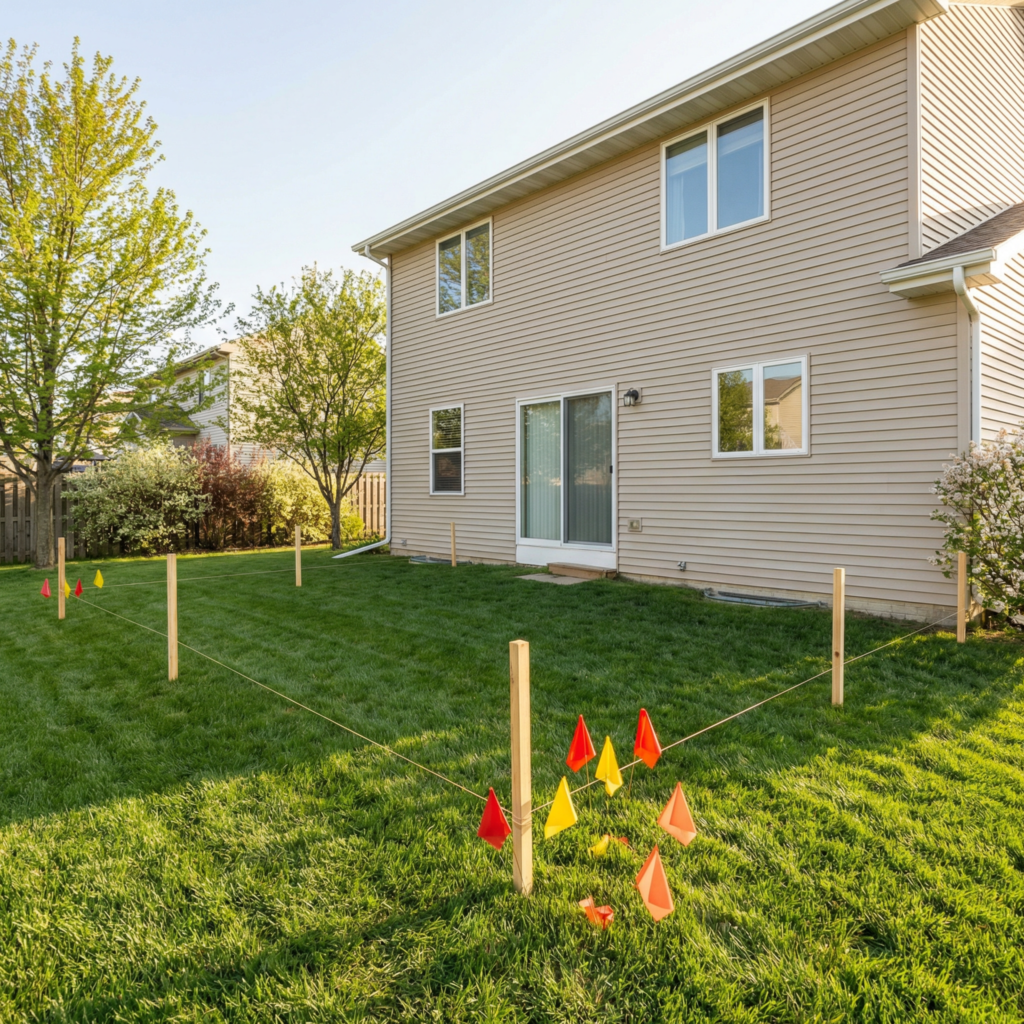
With permits in process and utility locates completed, the physical prep begins. Outline your deck footprint using a garden hose, stakes, or string so you can see how the placement works in your actual yard before anything gets built.
Check for slopes and drainage. Water should move away from your house foundation, not pool in the area where footings will be poured. Poorly drained or unstable soil may require additional grading or foundation work, your contractor will assess conditions before footing work starts, especially in early spring after Iowa’s freeze-thaw cycles have loosened the soil.
Clear grass, weeds, and vegetation from the deck footprint. Remove any trees or shrubs that fall within the build zone, budgeting $200 to $1,500 per tree or shrub depending on size and root depth. Clear a path for material delivery and crew access, and identify any obstacles near the footprint: AC units, gas meters, drainage systems, or utility boxes that could affect placement. Costs vary by site conditions; always get multiple written quotes.
| Step | Who Does It | When |
|---|---|---|
| HOA approval (if applicable) | Homeowner | Before permit application |
| Building permit application | Busy Builders on your behalf | 4 to 6 weeks before build |
| Verify setbacks | Homeowner or contractor | Before finalizing deck location |
| Call 811 utility locate | Required by Iowa law | At least 48 hours before digging |
| Clear vegetation from footprint | Homeowner or crew | Before construction begins |
| Confirm drainage flows away from house | Homeowner and contractor review | Site assessment |
| Remove obstacles (trees, shrubs) | Homeowner or hired crew | Before construction |
| Clear material delivery access | Homeowner | Before delivery day |
What Goes Under the Deck
Once footings are poured and pass inspection, the area under the deck gets prepared before decking boards go down. Landscaping fabric laid directly on the soil prevents weeds while still allowing moisture to pass through, avoid plastic sheeting under decks because it traps water and accelerates rot. Cover the fabric with about 3 inches of granular stone or pea gravel.
Proper sub-deck drainage is not optional in Central Iowa. The Des Moines area gets about 35 to 40 inches of rain annually plus significant snowmelt. Standing water under a deck damages framing and footings over time.
Iowa Frost Line and Deck Footing Inspections
In the Des Moines area, deck footings must extend 42 inches below finished grade to reach below the frost line. Soil in Central Iowa freezes solid in a typical winter, and footings above the frost line get pushed upward during freeze-thaw cycles, a process called frost heave that can crack deck framing. Confirm the required footing depth for your specific address with your contractor and building department, as local conditions can vary.
Des Moines requires three inspections per the Iowa Department of Inspections, Appeals, and Licensing{:target=”_blank”} and local building code. Never pour concrete before the footing inspection. If you cover it up before the inspector signs off, you may be required to expose it again at your own expense.
| Inspection | When | What’s Checked |
|---|---|---|
| Footing | After holes are dug, BEFORE concrete is poured | Hole depth (42 inches), diameter, location vs. plan |
| Framing | After framing complete, BEFORE decking is installed | Ledger attachment, joist hangers, beam sizes, hardware |
| Final | After ALL work is complete | Railing height (36 inches minimum), baluster spacing (4 inches maximum), stair dimensions |
Schedule inspections at least 24 to 48 hours in advance at (515) 283-4200.
When Is the Best Time to Build a Deck in Des Moines?
March is the best time to start the planning process. By late April and May, Des Moines-area deck builders are often booked weeks out. Construction windows that work well in Central Iowa are late April through May in the spring and September through October in the fall. Summer builds are possible, but peak demand affects contractor availability and scheduling. Plan for a realistic full timeline of 6 to 16 weeks from design through completion, accounting for permit approval, material lead times, and inspection scheduling. Choosing the right decking material for Iowa’s climate early in the process keeps things moving rather than stalling at the material selection stage.
FAQs
Q: Do I need a permit to build a deck in Des Moines?
Most likely yes. Any deck attached to your house requires a permit regardless of how tall it is. Decks over 30 inches above grade require one. Freestanding decks under 30 inches may qualify for an exemption under IRC R105.2, but all conditions must be met, don’t assume your project qualifies without confirming. Call the Permit and Development Center at (515) 283-4200 or email permits@dmgov.org before you finalize your plans. Permit fees typically run $100 to $600 in Des Moines, and approval takes about two weeks.
Q: Do I have to call 811 before digging my deck footings?
Yes, this is Iowa law, not a suggestion. You must call at least 48 hours before any digging, not counting weekends or holidays. Call 811, dial 1-800-292-8989, or submit your request at IowaOneCall.com. The utility locate service is free, it takes minutes, and skipping it creates serious legal and financial exposure if you hit a buried line.
Q: How deep do deck footings need to be in Iowa?
In the Des Moines area, footings must extend 42 inches below finished grade to go below the frost line. Shallower footings get pushed upward by frost heave during Iowa winters, which cracks the deck structure. Your contractor and local building department can confirm the exact depth requirement for your address. The footing inspection happens before concrete is poured, do not pour before the inspector signs off.
Q: What should I do with my yard before the deck crew arrives?
Clear vegetation from the deck footprint, confirm that drainage flows away from your house foundation, and remove any trees or shrubs within the build zone. Budget $200 to $1,500 per tree or shrub depending on size. Make sure there’s a clear path for material delivery and crew equipment, and flag any utility boxes, AC units, or drainage features near the build area. Your contractor will assess soil conditions and drainage during the site visit.
Q: My neighborhood has an HOA. Do I need their approval before getting a permit?
Yes, HOA approval typically needs to come before the permit application. Submit your project description, deck dimensions, and proposed materials to the Architectural Review Board and get their approval in writing. Include that letter when you apply for your city building permit. HOA review can take up to 60 days, so start this process as early as possible. HOA approval and a building permit are separate requirements, one doesn’t substitute for the other.
Key Takeaways
The sequence matters. HOA approval comes first, then the building permit, then the 811 utility locate, then physical site prep. Get it out of order and you risk delays or worse.
811 is Iowa law. Call at least 48 hours before any digging. It’s free, it takes five minutes, and hitting a buried utility line is dangerous and expensive.
Permits protect you. Unpermitted decks create problems at resale and may void insurance claims. Always confirm your specific requirements with your local building department before assuming you’re exempt.
Setbacks vary by address. There is no universal setback rule for all of Des Moines. Check with your building or zoning office before finalizing your deck’s location, a property survey ($300 to $500) is far cheaper than tearing down a built structure.
Footings go deep in Iowa. The frost line in the Des Moines area requires footings at 42 inches below grade. Never pour concrete before the footing inspection.
Plan early. Start the process in March. By late spring, Des Moines-area deck builders are typically booked weeks out. A full project timeline runs 6 to 16 weeks from start to completion.
Ready to Start Your Des Moines Deck Project?
You now know exactly what needs to happen before the first footing hole gets dug. The next step is working with a team that knows Des Moines permitting, Iowa’s frost requirements, and how to coordinate the whole process without surprises.
Busy Builders has completed 1,000+ projects across Central Iowa since 2020. We handle permit applications, coordinate inspection scheduling, and work within HOA guidelines on your behalf, you don’t have to figure any of it out alone. For a full look at what to expect on deck construction estimates and project costs, we’ve put it all in one place.
Call us at 844-435-9800 or visit busybuildersiowa.com to schedule your free consultation. We serve Des Moines, West Des Moines, Ankeny, Urbandale, Johnston, Waukee, Grimes, Clive, Bondurant, and communities throughout Central Iowa.
Busy Builders | Full-Service Construction and Remodeling | Serving Central Iowa Since 2020
Related service: our deck building service.