Homeowners in Central Iowa often assume basement finishing is a spring and summer project. It is not. Winter is one of the best times to finish a basement in the Des Moines metro, with a few real trade-offs around egress windows, moisture, deliveries and scheduling. This guide walks through what changes when the work happens between December and March.
TLDR: Yes, you can finish a basement in an Iowa winter, and crews are often more available. The work is indoors and the house is heated. The three things that change are the egress window cut, which needs a thawed or protected excavation, material deliveries in snow, and the moisture picture, which is actually easier to read in a dry winter. Most winter finishes run on the same eight to twelve week schedule as summer.
Why winter is a good time to go downstairs
A basement finish is interior work. Framing, electrical rough-in, plumbing, drywall, paint, flooring and trim all happen inside a house that is already heated. Cold outside changes very little about the work itself.
What does change is the calendar. Contractors in Central Iowa run their outdoor work from April to November. Winter is when the schedule opens up. Homeowners who ask about a basement finish in December often get a January start instead of a June one.
Busy Builders has completed more than 1,285 projects across Central Iowa since 2020, and a good share of the basement work has run through the cold months. One customer who came to us after a bad experience with another company had her basement remodeled and a deck built, and wrote in her review that the crew came through on everything promised.
What changes in winter, and what does not
Pro Tip 1: Ask the contractor which tasks are affected by cold. If the answer is “none,” they have not thought about the egress window.
The table below separates the two.
| Task | Winter effect | How it is handled |
|---|---|---|
| Framing, drywall, paint, trim | None; interior and heated | Standard schedule |
| Electrical and plumbing rough-in | None | Licensed subcontractors, standard inspections |
| Egress window cut and well | Frozen soil at the cut | Excavate before hard freeze, or thaw and protect |
| Concrete work (bath drain, slab patch) | Slow cure if the slab is cold | Interior heat, small pours, cure time in the schedule |
| Deliveries | Snow, ice, short days | Scheduled around storms, materials kept under cover |
| Moisture reading | Winter is dry | Good time to spot true water issues versus humidity |
| Radon test | Closed-house conditions | Winter gives the most accurate test |
Two of those rows are advantages, not problems. A dry winter shows whether a wet spot is groundwater or summer humidity, and a closed house gives the most accurate radon test you will ever run.
Pro Tip 2: Run the radon test in winter before the walls go up. About 5 in 7 Iowa homes test above the EPA action level, according to Iowa HHS, and a passive mitigation pipe is cheap to add while the slab is exposed.
The egress window is the one real winter issue
A basement bedroom needs an egress window with a 5.7-square-foot net clear opening, a sill no higher than 44 inches, and a window well at least 9 square feet with 36 inches of projection, under Iowa’s R319 substitution in Iowa Administrative Code 481-301.8.
Cutting that opening means excavating outside the foundation wall down to the sill, which in winter means frozen ground.
Pro Tip 3: If you know a winter finish is coming, have the egress excavation and window installed in November. Everything else can wait.
Here are the three ways it gets handled.
| Approach | When | Added cost |
|---|---|---|
| Install the egress window before freeze-up | October to mid-November | None beyond the window itself |
| Thaw and excavate mid-winter | December to February | About $800 to $2,500 for ground thaw and protection |
| Finish everything but the bedroom, cut the egress in spring | December to March | None, but the bedroom is not legal until the window is in |
The third path is common and sensible. The family room, bath and storage are finished in winter, and the bedroom is completed once the ground thaws.
Pro Tip 4: Do not let anyone call a room a bedroom without the egress window. An inspector will not, and neither will an appraiser.
Cost and schedule in winter
Winter does not change the price of a basement finish much. The same Des Moines metro planning ranges apply: about $35,000 to $75,000 for a full finish with a bath, depending on scope. These are planning estimates; actual costs vary by scope, materials, site conditions and current pricing.
Pro Tip 5: Ask whether the contractor offers winter start dates. Open schedule time is the real winter advantage.
| Phase | Typical duration | Winter note |
|---|---|---|
| Design, permit, materials ordered | 3 to 5 weeks | Plan review in most metro cities is quick in winter |
| Framing and rough-ins | 2 to 3 weeks | Unchanged |
| Inspections, insulation, drywall | 2 to 3 weeks | Drywall mud dries slower in a cold basement; run heat |
| Paint, flooring, trim, fixtures | 2 to 3 weeks | Flooring must acclimate; keep it inside 48 hours first |
| Final inspection and punch list | 1 week | Unchanged |
Eight to twelve weeks total, the same as a summer project. The drywall and flooring rows are where a winter crew earns its keep.
Pro Tip 6: Basement walls in Iowa need R-15 continuous or R-19 cavity insulation under the energy code for Climate Zone 5. The Department of Energy’s Energy Saver guide covers why below-grade insulation matters. Winter is when you feel the difference.
Illustrative scenario: A Grimes family starts a 900-square-foot finish the second week of January. The egress window went in during November. Family room, bedroom, three-quarter bath and storage are done by the end of March, about $56,000.
Illustrative scenario: A couple in Indianola decides in December. They finish the family room and bath through February for about $38,000 and add the egress window and bedroom in April for about $9,000 more.
Illustrative scenario: A homeowner near Altoona insists on a January egress cut. Ground thaw and excavation protection add about $1,600 to the project.
Moisture, radon and the dry season
Winter air in Iowa is dry. That makes it the easiest time to tell real water intrusion from summer condensation on cold walls.
Pro Tip 7: Look for efflorescence, the white mineral crust, on the foundation walls in winter. It marks where water has moved through the concrete in the past.
Pro Tip 8: Test the sump pump and check the discharge line before framing. A frozen discharge line in February is a flooded basement in March.
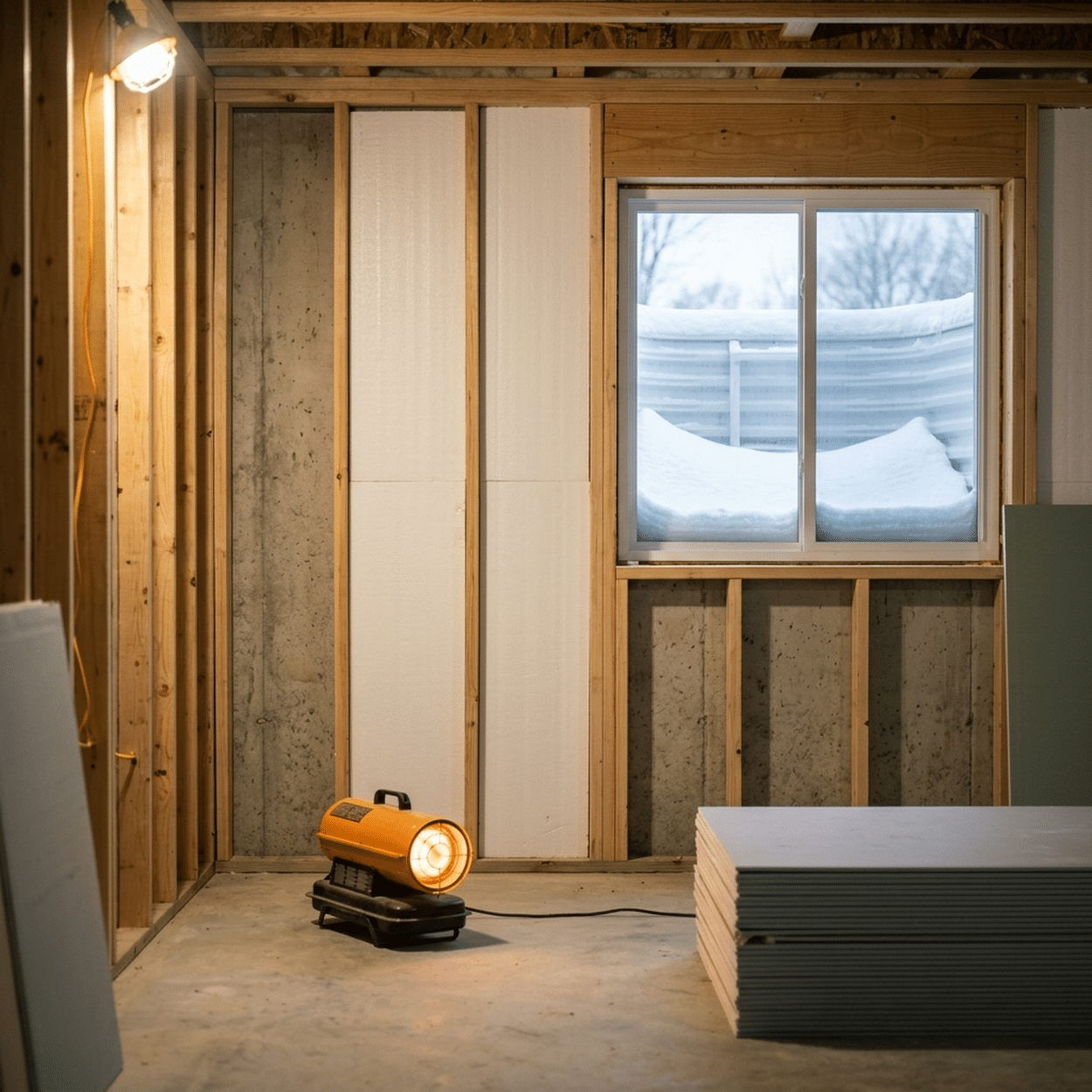
Pro Tip 9: Keep the basement above 55 degrees during drywall and paint. Cold slows curing and can leave a finish that fails by summer.
Pro Tip 10: Acclimate flooring inside the house for at least 48 hours. Vinyl plank delivered at 10 degrees and installed the same day will gap.
Pro Tip 11: Schedule deliveries in the morning after a storm, not during one. Wet drywall is scrap.
Pro Tip 12: Communication is what customers mention most in our reviews; in winter, ask for a text the night before every crew day so you know who is coming.
The table below sums up what a winter finish needs.
| Item | Why it matters in winter |
|---|---|
| Egress window in before freeze, or planned for spring | Frozen soil at the cut |
| Radon test with the house closed | Most accurate reading of the year |
| Sump and discharge line checked | Freeze risk |
| Interior heat held above 55 degrees | Drywall, paint and flooring cure |
| Deliveries scheduled around weather | Materials stay dry |
None of these is a reason to wait. All of them are reasons to plan.
Frequently Asked Questions
Q1: Can a basement be finished in the winter in Iowa? Yes. The work is indoors in a heated house, and contractor schedules are more open from December to March. The egress window cut is the one task affected by frozen ground. Plan it in the fall or for spring.
Q2: Does a winter basement finish cost more? Not in most cases. Interior work prices the same year round. A mid-winter egress excavation can add about $800 to $2,500 for ground thaw and protection. These are planning estimates; actual costs vary.
Q3: Is winter a bad time to check for basement moisture? It is the best time. Winter air is dry, so any moisture you see is coming through the foundation, not condensing out of humid summer air. Efflorescence and staining tell you where water has traveled.
Q4: Should I test for radon before finishing my basement? Yes, and winter gives the most accurate result because the house is closed. About 5 in 7 Iowa homes test above the EPA action level. Adding a passive mitigation pipe before the walls go up is inexpensive.
Q5: How long does a winter basement finish take? Eight to twelve weeks for a full finish with a bath, the same as summer. Drywall and flooring need a warm basement to cure and acclimate, so ask how the crew keeps the space above 55 degrees.
Q6: How soon can I start? Call: 844-435-9800. Winter slots fill in November and December, so the earlier you call, the better the start date.
Key Takeaways
Winter works
- Interior, heated, same eight to twelve week schedule.
- Open contractor calendars.
Plan the egress
- Install before freeze, thaw and cut, or add in spring.
- No bedroom without it.
Use the dry season
- Read moisture honestly, run the radon test, check the sump.
Get a Winter Start Date
Busy Builders is a registered Iowa contractor with 1,285+ completed projects across Central Iowa since 2020. We finish basements year round and will tell you exactly what a winter schedule changes for your house. Free consultation. Written warranty on workmanship (details provided in your contract).
Call: 844-435-9800
Disclaimer: This article is for general information and is not project-specific advice. Cost figures are planning estimates that vary by scope, materials, site conditions and current pricing. Permit requirements and code editions vary by city and jurisdiction; verify current requirements with your local building authority before starting any project. Below-grade moisture outcomes depend on site conditions; no guarantee against water intrusion is made. Radon levels vary by home; test before and after, and attribute statistics to Iowa HHS. No specific outcomes are guaranteed. Consult a registered contractor; electrical and plumbing work is performed by licensed subcontractors.
Busy Builders | Full-Service Construction and Remodeling | Serving Central Iowa Since 2020