In Central Iowa, $15,000 is a meaningful bathroom remodel budget, enough to transform a dated bathroom into something you’re proud of, as long as you understand what the money can and can’t do. The two biggest budget traps are moving plumbing and hidden water damage. This guide breaks down what $15K actually buys in Iowa and how to protect every dollar of it.
TLDR: A $15K budget covers a full cosmetic-to-moderate remodel on a standard 40 to 60 square foot Iowa bathroom, provided you keep the existing plumbing layout. Half baths fit comfortably under $15K with room to spare. Moving fixtures adds $2,000 to $4,000 minimum. Hidden water damage behind tile is common in older Iowa homes and can add $1,300 to $6,000. Budget bathroom remodels also deliver the highest ROI in the entire bathroom category, returning 75 to 85% at resale.
If you have $15,000 set aside for a bathroom remodel, you have a real budget by Iowa standards. The challenge is that the answer to “what can I get for $15K?” depends almost entirely on three decisions: whether you move plumbing, what your current bathroom is hiding behind the tile, and where you spend versus where you save. This guide walks through each of those honestly, so you go into the project with clear expectations rather than discovering them the hard way mid-construction.
What $15,000 Can Actually Do in Iowa
Iowa construction costs run below the national average, which means your $15,000 budget stretches further here than it would in Chicago, Denver, or Minneapolis. For a standard 40 to 60 square foot bathroom keeping the existing plumbing layout, $15K is enough to do a full cosmetic-to-moderate remodel that genuinely transforms the space.
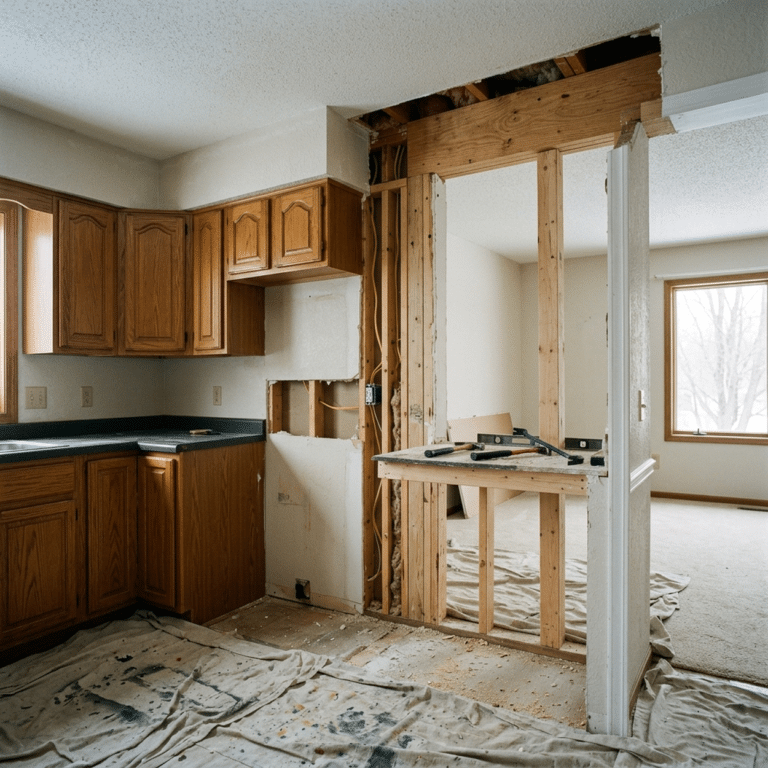
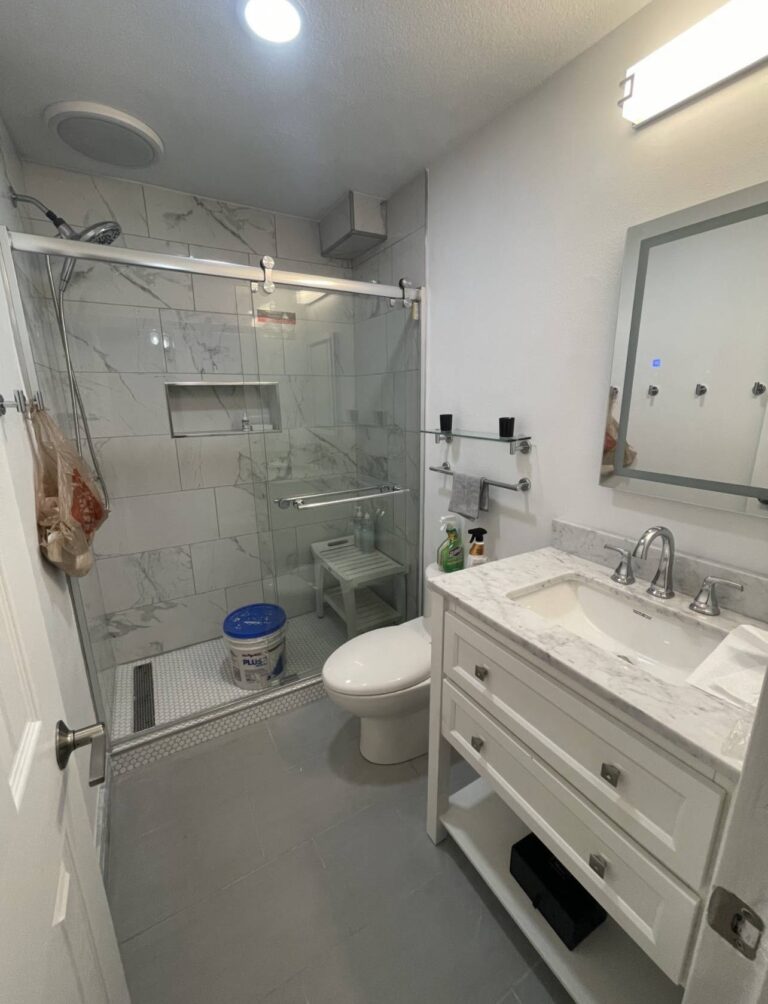
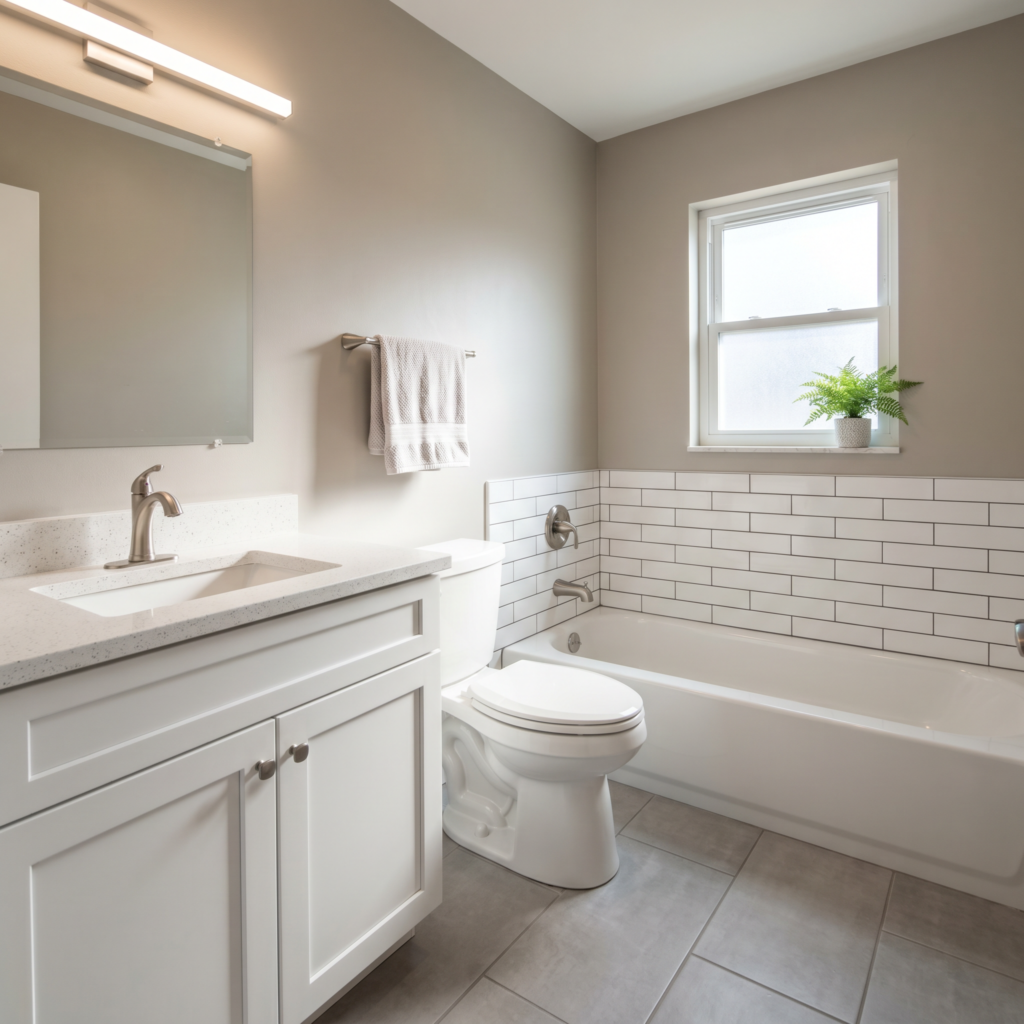
A realistic scope for this budget includes complete demolition and disposal of the existing bathroom, a new vanity in the stock to low semi-custom range, a new toilet, a new tub or shower with a fresh tile surround (or tub refinishing on a tighter budget), new flooring in porcelain or luxury vinyl plank, updated lighting and an exhaust fan, fresh paint and trim, new caulk and grout, and updated faucets and hardware. Permits and a reasonable contingency fit within the budget as well.
What $15K typically does not include is moving plumbing, custom cabinetry, luxury natural stone tile, radiant heated floors, a freestanding soaking tub, or layout changes that involve removing or moving walls. Any one of those upgrades pushes the project past $15,000. Two or three of them push it well past $20,000.
The math is different for half baths and powder rooms. A typical Central Iowa half bath remodel runs $6,500 to $16,000, which means $15K is more than enough for a quality powder room upgrade with room to spare. If you’re working with a half bath rather than a full bath, your budget gives you more flexibility to upgrade individual elements like vanity, lighting, or wallpaper.
For the broader Iowa cost picture across all bathroom types and scopes, see our bathroom remodeling costs in Central Iowa guide.
Table 1: What Fits in a $15K Iowa Bathroom Budget
| Category | Budget Range | What It Buys |
|---|---|---|
| Demo and disposal | $500-$1,500 | Full tear-out of existing surfaces and fixtures |
| Vanity and sink | $600-$1,800 | Stock to low semi-custom; single sink |
| Toilet | $200-$500 installed | Mid-grade comfort height, water-efficient |
| Tub or shower | $1,500-$4,500 | Tub refinish, tile surround, or basic walk-in shower |
| Tile flooring (40 sq ft) | $800-$2,000 | Porcelain; materials and labor |
| Lighting and exhaust fan | $400-$900 | Modern vanity light, properly vented fan |
| Faucet and hardware | $300-$700 | Mid-grade fixtures |
| Paint, trim, caulk | $300-$600 | Full repaint, new trim, fresh caulk |
| Permits | $100-$600 | Varies by city and scope |
| Contingency (10-15%) | $1,200-$2,000 | Hidden water damage, outdated wiring |
| Realistic Total | $5,700-$15,100 | Standard full bath, existing layout |
Budget ranges are estimates for Central Iowa. Every bathroom is different. The only way to know what your specific project will cost is a professional scope review and written estimate. Always get three written quotes.
The Layout Rule That Protects Your Budget
The single most important budget-protection decision in any bathroom remodel is whether you keep the existing plumbing layout. Keeping the toilet, sink, and shower in their existing locations protects more of your budget than any other choice you make.
Moving a single fixture requires opening the subfloor to access drain lines, rerouting drain and supply pipes, potentially relocating vent stacks, and then repairing the subfloor and finished floor afterward. The cost runs $2,000 to $4,000 for one fixture, and more if multiple fixtures move. On a $15,000 budget, even one plumbing move usually consumes the cushion you need for everything else.
This matters in Iowa specifically because the older housing stock often complicates plumbing moves. Cast iron drain lines are common in homes built before 1980 and are expensive to alter. Finished basement ceilings below the bathroom limit how easily contractors can access plumbing from underneath. Subfloors weakened by decades of moisture exposure sometimes need partial replacement just to support the new fixture, even before the plumbing work begins.
The good news is that a bathroom can look dramatically different without moving anything. A new vanity in a different color and shape, updated fixtures, a different tile pattern in the shower surround, new flooring, and fresh paint genuinely transform a bathroom even when the underlying layout stays identical. If you don’t love the existing layout, there are partial solutions that don’t require moving drains: a smaller vanity opens up floor space, converting a tub to a walk-in shower keeps the drain in the same zone, and removing an awkward built-in cabinet can change the room’s feel without touching plumbing.
The practical conclusion is that moving plumbing on a $15K project usually means giving up something else you wanted. Going in with that understanding lets you make the trade-off intentionally rather than discovering it halfway through construction.
The Hidden Cost That Derails Iowa Bathroom Budgets
The second major budget risk is what your contractor finds behind the tile during demolition. In Iowa bathrooms built before 1990, there is a meaningful chance of finding water damage, rotted subfloor, or substrate issues that need repair before the new bathroom can go in.
The reason is straightforward. Iowa bathrooms in homes that age have absorbed 30 to 50 years of shower steam, slow faucet drips, and imperfect caulk lines. When tile comes off a shower or tub surround during demolition, contractors frequently find water-damaged drywall (regular drywall was often used behind tile in older homes instead of moisture-resistant cement board), rotted subfloor around the toilet base or shower pan, failed shower pan liners, and sometimes mold growth behind tile. None of this is visible before demolition begins. It is a pre-demo unknown.
Water damage repair runs anywhere from roughly $1,300 to $6,300 depending on the extent. A $3,000 repair on a project you budgeted at $14,000 pushes the total to $17,000. This is exactly the scenario your contingency budget exists to absorb. A 10 to 15% contingency, which translates to $1,500 to $2,250 on a $15K project, is enough to handle most realistic surprises without derailing the whole job.
The correct response when water damage is found at demo is to fix it properly and completely before closing walls back up. Covering water damage with new tile creates a mold problem and future structural failure that costs far more to address later than dealing with it now. The U.S. Environmental Protection Agency is clear on this point: mold needs the moisture source fixed, not just the visible mold cleaned. Cutting corners on water damage repair is the single most expensive mistake a homeowner can make in a bathroom remodel.
There is also one Iowa-specific issue worth flagging that competitors rarely discuss: the exhaust fan. Many Central Iowa bathrooms in homes built before 1990 have undersized exhaust fans, or fans that vent into the attic rather than outside. Venting into the attic is a code violation in most Iowa cities and drives year-round moisture buildup that produces mold both in the bathroom and in the attic above. A properly sized exhaust fan that vents to the exterior, including labor, runs about $150 to $300. It is one of the highest-value upgrades in any budget bathroom remodel, and most homeowners don’t know to ask about it.
For older homes specifically, two further notes apply. Homes built before 1978 should have lead paint testing before disturbing painted surfaces. Homes built before 1980 should have asbestos testing before disturbing floor tile, ceiling tile, or pipe insulation. Both tests are inexpensive and routine; they protect both your contractor’s crew and your family from exposure during demo.
Where to Spend and Where to Save
Within a $15K budget, allocating money wisely matters more than the budget itself. Some line items are non-negotiable; others are places where the budget-tier choice looks nearly identical to the premium-tier choice once installed.
Spend money on waterproofing. This is the most important investment in the entire project. Proper waterproofing means cement board (not regular drywall) behind tile in wet areas, membrane waterproofing at all seams and corners, and appropriate grout sealing. A shower that isn’t properly waterproofed produces mold and structural damage within three to five years, with repair costs that can far exceed the original cost of doing it right. Cutting corners here is the most expensive mistake possible. Any contractor who shrugs off the waterproofing details is the wrong contractor for this job, regardless of how attractive the bid looks.
Spend appropriately on shower floors and pans. Shower floors take constant water exposure and foot traffic. Cheap shower floor materials crack, allow water intrusion, and fail. Quality matters here.
Spend on mid-grade plumbing fixtures. Faucets and valves from Delta, Moen, or American Standard mid-range product lines typically last 15 to 20 years. Builder-grade fixtures fail in 5 to 8 years. The cost difference is $100 to $300 per fixture, and the longevity difference is significant.
Spend on the exhaust fan. As discussed above, this is cheap insurance against mold and the most commonly underspecified item in budget bathroom remodels. A bath fan with a humidity sensor that turns on automatically when moisture spikes runs $80 to $150 and is worth every dollar.
Save on the vanity. Stock vanities at major retailers have improved dramatically over the past decade. A quality pre-assembled vanity with solid wood doors and a stone or stone-look top runs $400 to $800 and is visually indistinguishable from a semi-custom unit costing twice as much. Save the semi-custom budget for a primary suite renovation later.
Save on the shower door. A quality shower curtain and rod look clean and modern for $80 to $200. A glass shower door adds $700 to $2,000 to the project. If the budget is tight, choose a curtain now and add a door later when finances allow. The curtain decision doesn’t lock you out of the door upgrade later.
Save on the toilet. A mid-grade Kohler or American Standard toilet at $200 to $400 performs identically to a $900 model for nearly all households. The difference is mostly aesthetics and brand cachet, not function.
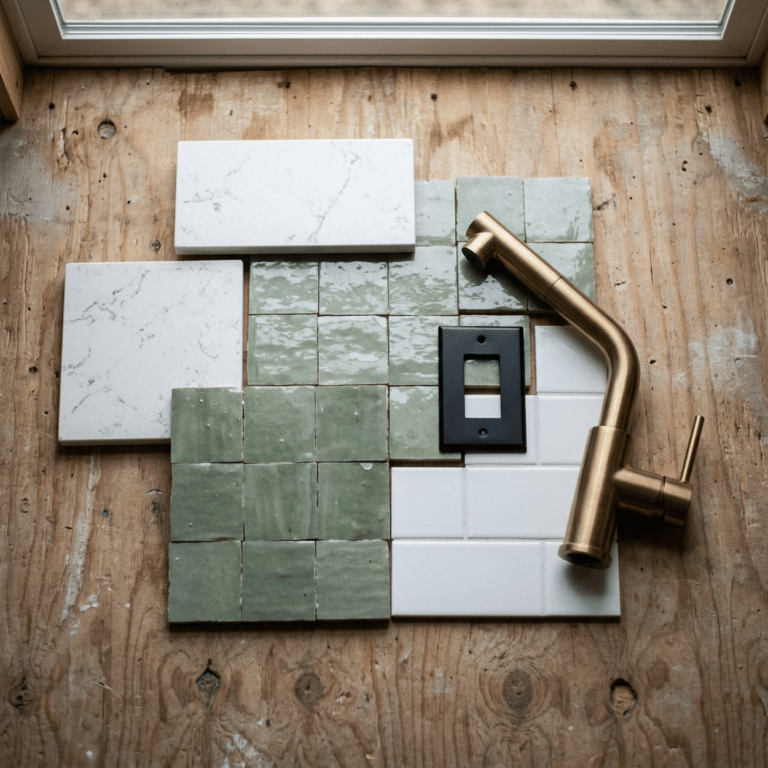
Save on accent tile. Use an affordable porcelain field tile for the bulk of the shower surround and reserve a modest accent tile or mosaic inset for one feature area. Materials cost drops significantly, and the visual effect is usually similar.
Save on the vanity light. LED vanity lights in current finishes (matte black, brushed nickel, brushed gold) are available for $60 to $150 at major retailers and look current and clean. This is not where the $15K should go.
Table 2: Spend vs. Save Decisions for a $15K Iowa Bathroom
| Item | Recommendation | Why It Matters |
|---|---|---|
| Waterproofing | Spend appropriately, non-negotiable | Failure costs far more than doing it right |
| Shower floor | Spend appropriately, non-negotiable | Constant water exposure and foot traffic |
| Plumbing fixtures | Mid-grade (skip builder-grade) | 15-20 year lifespan vs. 5-8 |
| Exhaust fan | Spend on properly sized, properly vented | Moisture and mold prevention |
| Vanity | Save: stock vs. semi-custom | Look nearly identical installed |
| Shower door | Save: curtain first, door later | $700-$2,000 savings |
| Toilet | Save: mid-grade is sufficient | Function identical to premium |
| Field tile | Save: standard porcelain | Add one accent area for impact |
| Vanity light | Save: LED big-box option | Looks current for $60-$150 |
Permits in Iowa
Iowa permit requirements vary by city, so the most accurate guidance is to check with your local building department before assuming anything. That said, the general pattern is consistent across most Central Iowa municipalities.
Work that typically does not require a permit includes painting, replacing a vanity mirror, swapping a toilet in the same location, installing new hardware, and changing out fixtures that don’t involve modifying supply or drain lines. Work that typically does require a permit includes any electrical work beyond simple fixture swapping, any plumbing work beyond basic fixture replacement, exhaust fan installation in some cities, and any structural changes such as removing or modifying walls. Each trade (plumbing, electrical, mechanical) usually has its own permit and its own inspection.
Permit fees in Iowa typically run $100 to $1,000 depending on scope and city. In Iowa, plumbers and electricians are licensed separately by the Iowa Department of Inspections, Appeals, and Licensing. General contractors are registered with the same agency but not licensed in the same sense. When a contractor manages your project end to end, they coordinate the licensed trade work and pull the permits, which keeps the homeowner from having to navigate the system directly. For more detail on how Iowa permits work, see our Iowa building permit guide.
ROI: The Good News About Budget Remodels
Here is the counterintuitive finding that most homeowners don’t know: budget and cosmetic bathroom remodels deliver the best return on investment in the entire bathroom category. Modest bathroom updates return 75 to 85% of project cost at resale nationally. A $15,000 Iowa bathroom remodel can add roughly $11,250 to $12,750 to home value on average using that range.
The 2025 Cost vs. Value Report puts the midrange bathroom remodel at approximately 80% ROI nationally, with an average $26,138 project cost adding $20,915 to home value. Upscale and luxury bathroom remodels return only 45 to 55% at resale. You spend more on a luxury bathroom and get proportionally less back. The budget-friendly zone is also the best-ROI zone, and that is not a coincidence.
The reason is that bathrooms are primarily functional spaces, and buyers respond to clean, updated, neutral finishes more than to personalized luxury choices. Neutral colors, durable materials, and broad-appeal design choices outperform bespoke or trend-specific selections at resale.
Two caveats are important. First, all ROI figures are national averages, not Iowa-specific guarantees. Your actual return depends on your neighborhood, your home’s value, and your local market conditions. Second, the highest-ROI improvements are not always the ones that make your home most enjoyable to live in. ROI matters most when you’re selling within 5 years; daily quality of life matters most when you’re staying longer. Most homeowners care about both, but the relative weight depends on your situation.
Table 3: Iowa Bathroom Remodel Scope and ROI
| Scope | Typical Iowa Cost | National ROI | Notes |
|---|---|---|---|
| Cosmetic refresh (paint, fixtures, hardware) | $6,000-$10,000 | 75-85% | Best ROI tier |
| Standard full remodel, same layout | $10,000-$18,000 | ~80% | Iowa sweet spot |
| Major remodel with layout changes | $18,000-$30,000 | 70-75% | Layout changes lower percentage |
| Upscale/luxury remodel | $30,000-$70,000+ | 45-55% | Lifestyle choice, not financial |
ROI figures are national averages from the 2025 Cost vs. Value Report. Actual Iowa results vary by home and market.
Illustrative Scenarios
Illustrative scenario: An Ankeny homeowner has a 1988 full bath, 50 square feet, with original builder-grade everything: beige tile, low vanity, outdated lighting. Budget: $14,500. The scope keeps the existing plumbing layout. The project breakdown ends up roughly: demo $800, new vanity with quartz top $1,400, new toilet $250 installed, porcelain floor tile $1,200, tub surround with cement board waterproofing $4,200, vanity light and properly vented exhaust fan $600, paint and trim $500, faucet and hardware $450, permits $350, and contingency used for minor subfloor repair around the toilet $750. Total: approximately $10,500, under budget with room left for a quality shower curtain and new mirror. The bathroom looks 25 years newer.
Illustrative scenario: A Johnston homeowner wants to move the toilet to the opposite wall in their 45 square foot bathroom to open up more floor space. Budget: $15,000. After a contractor consults, the estimate includes $2,800 to move the toilet drain and supply line (opening the subfloor, extending lines, patching drywall). That leaves $12,200 for everything else. Midway through demo, the contractor finds water-damaged subfloor around the original toilet location, repaired for $1,600. Total: $15,600, over budget by $600. Keeping the toilet in place would have brought the project in at $11,000 to $12,000 with money left over for an upgraded vanity.
Frequently Asked Questions
Q: Can I really remodel a bathroom in Iowa for under $15,000?
A: Yes, for a standard 40 to 60 square foot bathroom keeping the existing plumbing layout. Iowa construction costs run below the national average, and $15K typically covers full demo, new vanity, toilet, tub or shower update, new tile flooring, updated lighting, a properly vented exhaust fan, fresh paint, and all permits. The budget gets tight when plumbing moves or significant water damage is found at demo.
Q: What is the biggest mistake homeowners make on a $15K bathroom remodel?
A: Two issues tie for first place. The first is planning to move plumbing without accounting for the cost. Moving one fixture adds $2,000 to $4,000 minimum. The second is not setting aside a contingency for hidden water damage. Iowa bathrooms in older homes frequently reveal damage behind tile at demo, and a 10 to 15% contingency keeps a $2,000 to $3,000 surprise from derailing the entire project.
Q: Do I need a permit for a bathroom remodel in Iowa?
A: It depends on scope and city. Purely cosmetic work typically doesn’t require a permit, but any electrical, plumbing, or structural changes require permits in Iowa cities. Each trade has its own permit and inspection. Check with your local building department and confirm that permit management is included in your contractor’s project scope.
Q: What gives the best ROI in a budget Iowa bathroom remodel?
A: Waterproofing protects the entire investment. Mid-grade plumbing fixtures pay back in longevity. New vanity, toilet, and tile deliver the highest visual impact per dollar. Skip the luxury upgrades. Upscale remodels return only 45 to 55% nationally while budget and cosmetic updates return 75 to 85%. Neutral colors and timeless finishes outperform trendy or highly personalized choices at resale.
Q: How long does a $15K Iowa bathroom remodel take?
A: For a cosmetic to moderate remodel with the existing layout, most $15K projects take 2 to 4 weeks of active construction. Planning, material ordering, and permitting add 3 to 6 weeks before construction starts. Hidden conditions can extend the timeline by 1 to 2 weeks if significant water damage or wiring updates surface at demo.
Key Takeaways
$15K is real in Iowa. Iowa construction costs run below the national average, and a $15,000 budget covers a full cosmetic-to-moderate remodel on a standard 40 to 60 square foot bathroom keeping the existing plumbing layout. Half baths fit comfortably under $15K with room to spare.
Don’t move plumbing. The single most important budget decision is keeping fixtures in their existing locations. One plumbing move adds $2,000 to $4,000 minimum, which usually consumes the cushion needed for everything else.
Budget a contingency. Iowa’s older housing stock frequently surfaces water damage at demo. A 10 to 15% contingency, roughly $1,500 to $2,250 on a $15K project, absorbs most realistic surprises. Pre-1978 lead paint testing and pre-1980 asbestos testing are inexpensive and worth doing.
Spend on waterproofing, save on aesthetics. Cement board behind tile, membrane waterproofing, mid-grade fixtures, and a properly vented exhaust fan are non-negotiable. Stock vanities, mid-grade toilets, standard field tile, and LED big-box lighting all deliver budget-friendly results that look essentially identical to premium options once installed.
Budget remodels return the most. Cosmetic and budget bathroom updates return 75 to 85% at resale nationally, compared to 45 to 55% for upscale remodels. The less-is-more pattern is real.
Ready to Plan Your Iowa Bathroom Remodel?
You now have a clear picture of what $15,000 can and cannot do in a Central Iowa bathroom remodel. The next step is a conversation with a contractor who will tell you honestly whether your specific bathroom can be completed within your budget rather than discovering it midway through construction.
Busy Builders has completed 1,285+ projects across Central Iowa since 2020. Our process begins with a free project consultation and an honest scope review. We provide itemized estimates that distinguish necessary work from optional upgrades, manage permits and inspections when required, and coordinate with the licensed trade contractors (electricians, plumbers) your project needs. All work is performed by registered Iowa contractors with the Iowa Department of Inspections, Appeals, and Licensing, and backed by a written warranty on workmanship (details provided in your contract). For our full bathroom services overview, see bathroom remodeling in Central Iowa.
We serve Des Moines, West Des Moines, Ankeny, Waukee, Urbandale, Johnston, Grimes, Ames, Altoona, Newton, and communities across Central Iowa.
Call: 844-435-9800
Website: https://busybuildersiowa.com/
All cost estimates, ranges, and timelines in this guide are for planning purposes only. Every bathroom is different. The only way to know what your specific project will cost is a professional scope review and written estimate, not an online calculator. Actual costs vary by home age and condition, scope, materials, contractor, and market conditions. ROI figures are sourced from the 2025 Cost vs. Value Report and reflect national averages, not Iowa-specific guarantees. Permit requirements vary by city; always confirm with your local building department before starting work. For pre-1978 homes, lead paint testing is recommended before disturbing painted surfaces. For pre-1980 homes, asbestos testing is recommended before disturbing floor tile, ceiling materials, or pipe insulation. Always obtain three written quotes for your specific project. Busy Builders is a registered Iowa contractor with the Iowa Department of Inspections, Appeals, and Licensing. Plumbers and electricians involved in any project hold separate state licenses.
Busy Builders | Full-Service Construction and Remodeling | Serving Central Iowa Since 2020