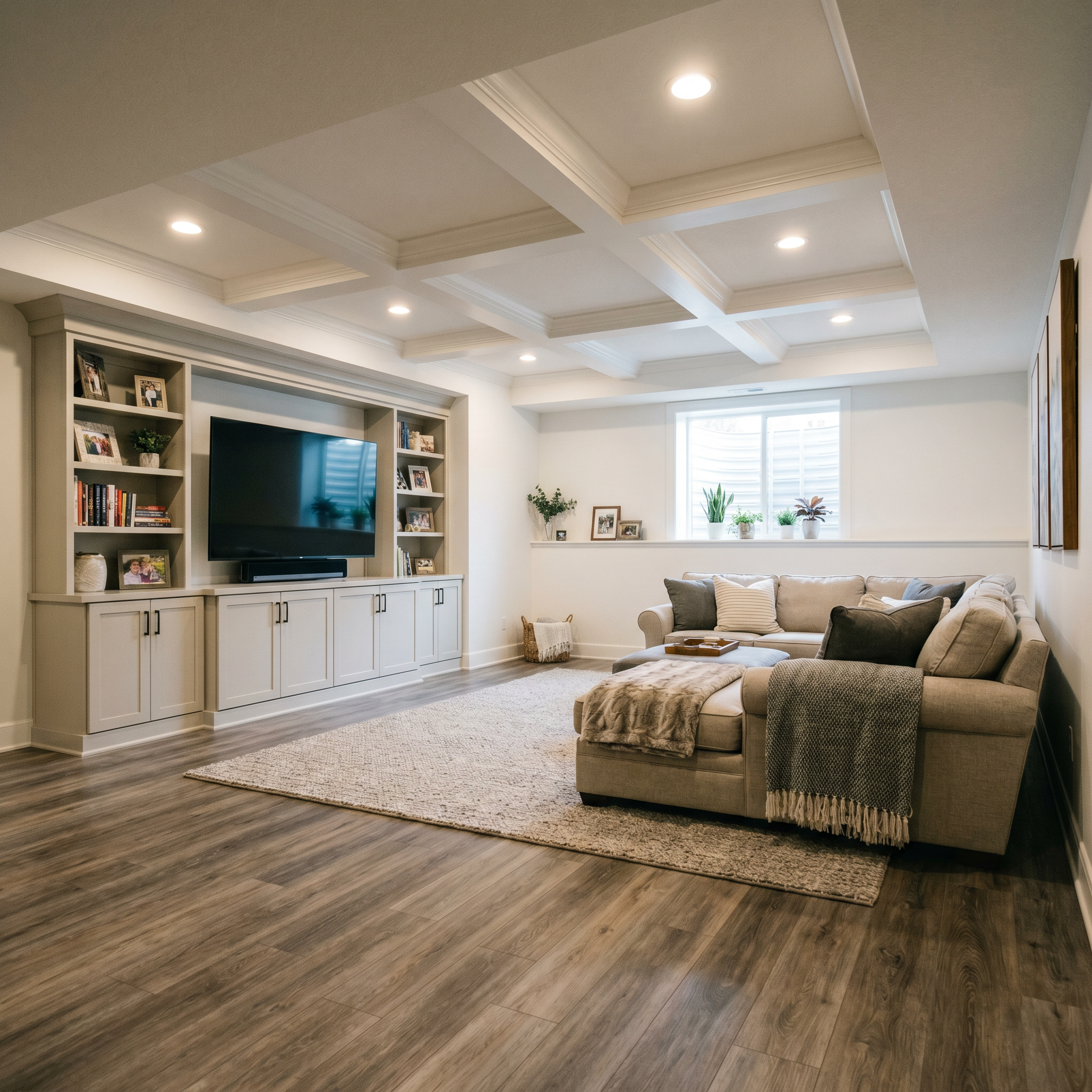
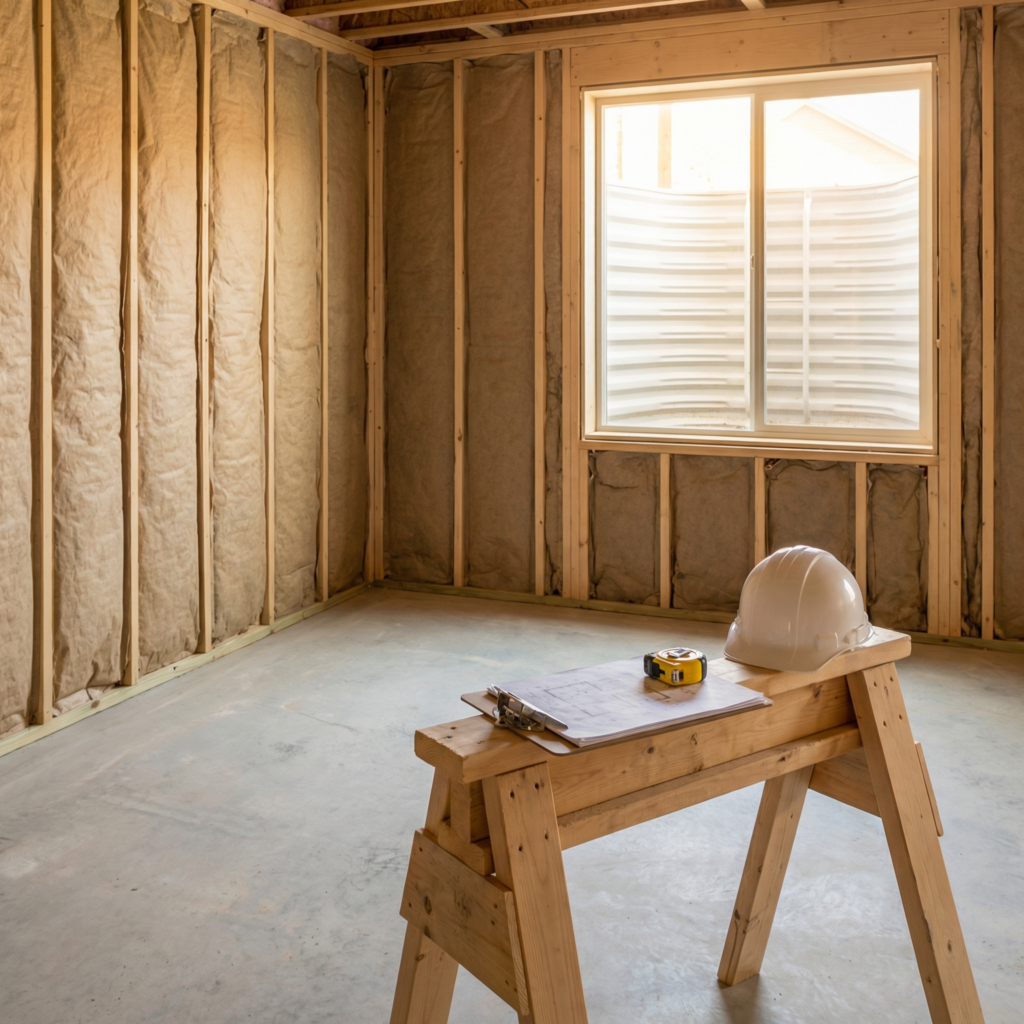
Finishing a basement is one of the best investments a Central Iowa homeowner can make, but only if the work is done right. This guide covers what separates a qualified Des Moines basement contractor from one who will cost you far more than their low bid promised. By the end, you will know the credentials to verify, the questions to ask before signing anything, the red flags that should send you to the next contractor, and what the work actually costs in the Des Moines market.
TLDR: Hiring the right basement contractor in Des Moines starts with one step most homeowners skip: verifying Iowa DIAL registration. Iowa registers general contractors, it does not license them. Asking the right questions about permits, moisture, and radon before anyone touches your basement separates good contractors from bad ones. Read on for the full checklist.
You have been thinking about your basement for months. Maybe you picture an extra bedroom, a family room, or a home office that finally makes sense. You have a budget in mind, maybe a few contractor names from a neighbor, and you are ready to move forward. That is exactly the moment when homeowners get burned.
One in ten Americans has experienced a contractor scam, with average losses around $2,426. But the bigger risk in Iowa is not outright fraud. It is hiring someone who does not know the local code requirements, skips the moisture work to save time, or pulls no permits because they are not properly registered. The result looks fine on day one and becomes a serious problem at inspection, at resale, or within the first wet season.
This guide gives you a practical framework for finding a qualified basement contractor in Des Moines and the surrounding Central Iowa area. You will see the right questions to ask, the credentials to verify in under a minute, what the work actually costs, and what a lowball bid is almost always hiding.
Why Hiring Local Matters More Than Homeowners Realize
Iowa has building code requirements that out-of-state and inexperienced contractors routinely miss. The gaps are not small.
Iowa’s Radon Problem Is Not Optional
According to Iowa HHS, 71.6% of Iowa homes test above the EPA radon action level of 4 pCi/L. Iowa is designated EPA Zone 1 statewide, the highest-risk category in the country. Any Des Moines basement contractor who does not raise radon before proposing a single wall is already a concern.
Radon mitigation does not have to be expensive. A passive system installed during finishing often runs $500 to $2,500. But it has to be planned before framing starts, not added as an afterthought.
Des Moines Clay Soil Makes Moisture Control Mandatory
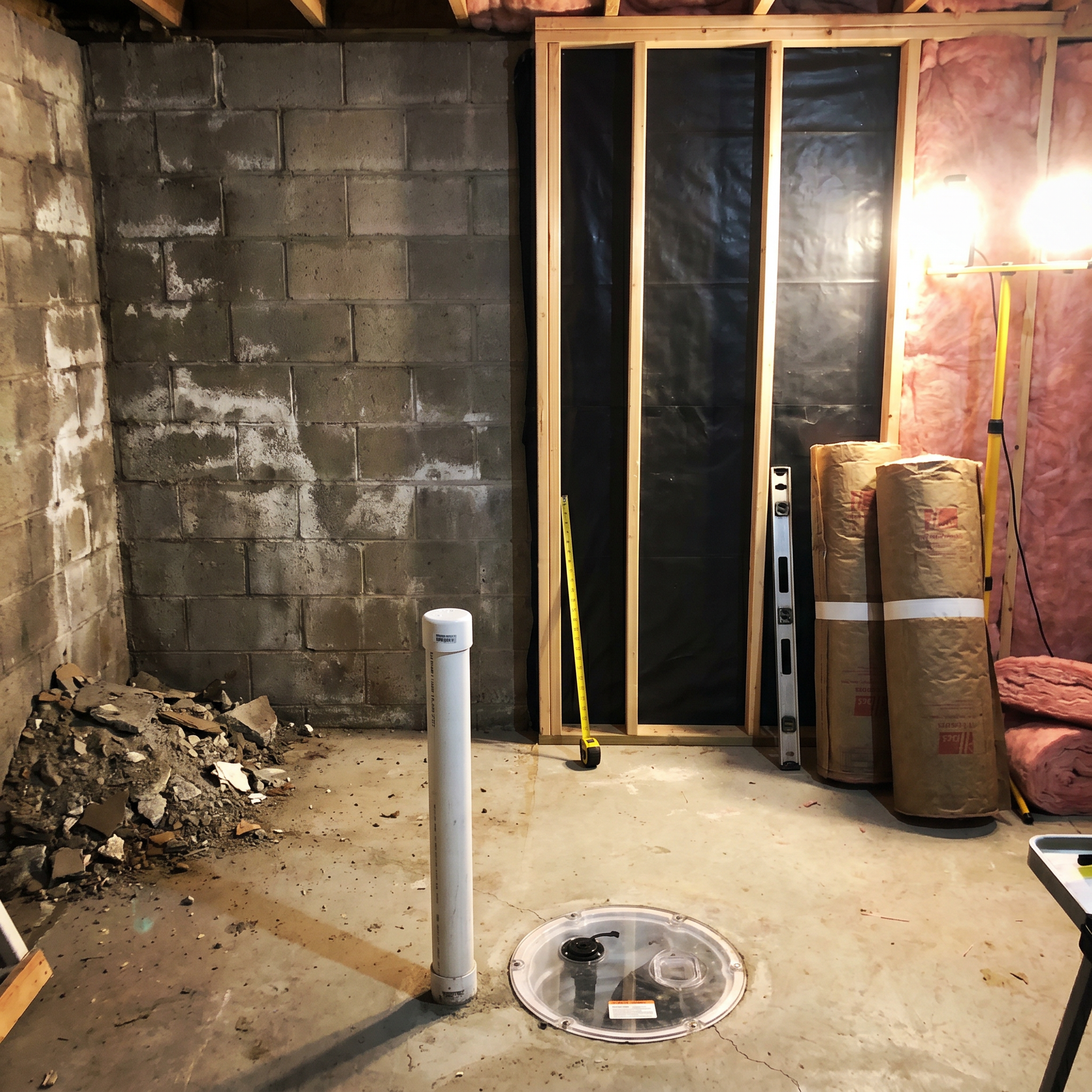
Des Moines sits on clay-heavy soil that holds water against foundations. Moisture prep is not a finishing detail. It is a prerequisite. A contractor who frames walls over a wet basement in Central Iowa is setting up a mold problem within months.
Illustrative scenario: A Des Moines homeowner accepted a basement bid that skipped the vapor barrier to save $800. Within six months, moisture had worked through the framing and mold appeared. Remediation cost $8,000, ten times the original savings.
Tip: Ask every contractor what moisture work they plan to do before any framing or drywall goes up. The right answer includes a vapor barrier assessment, a sump pump check, and a radon plan. No answer is a disqualifier.
Iowa Code Has Its Own Specific Requirements
Iowa uses NEC 2023 with state amendments, and Iowa adopted the 2024 IRC effective September 2025. Several requirements differ from what national contractors expect. A contractor trained elsewhere may simply not know them. The table below covers the requirements most commonly missed in Central Iowa basement projects.
Use this as a baseline checklist when evaluating any basement contractor in Des Moines. These are minimum requirements under Iowa code, not optional upgrades.
| Requirement | Iowa Standard | Why It Matters |
|---|---|---|
| GFCI outlets | Every 125V, 15/20A outlet in the basement | Iowa requires GFCI on all basement outlets, not just those near water. Most out-of-state contractors miss this. |
| Egress windows | 5.7 sq ft net clear, 20″ wide, 24″ tall, 44″ max sill height | Required for any basement bedroom; non-compliant egress fails inspection and blocks occupancy |
| Ceiling height | 7 feet minimum for habitable space | Below this, the space cannot be legally classified as living area |
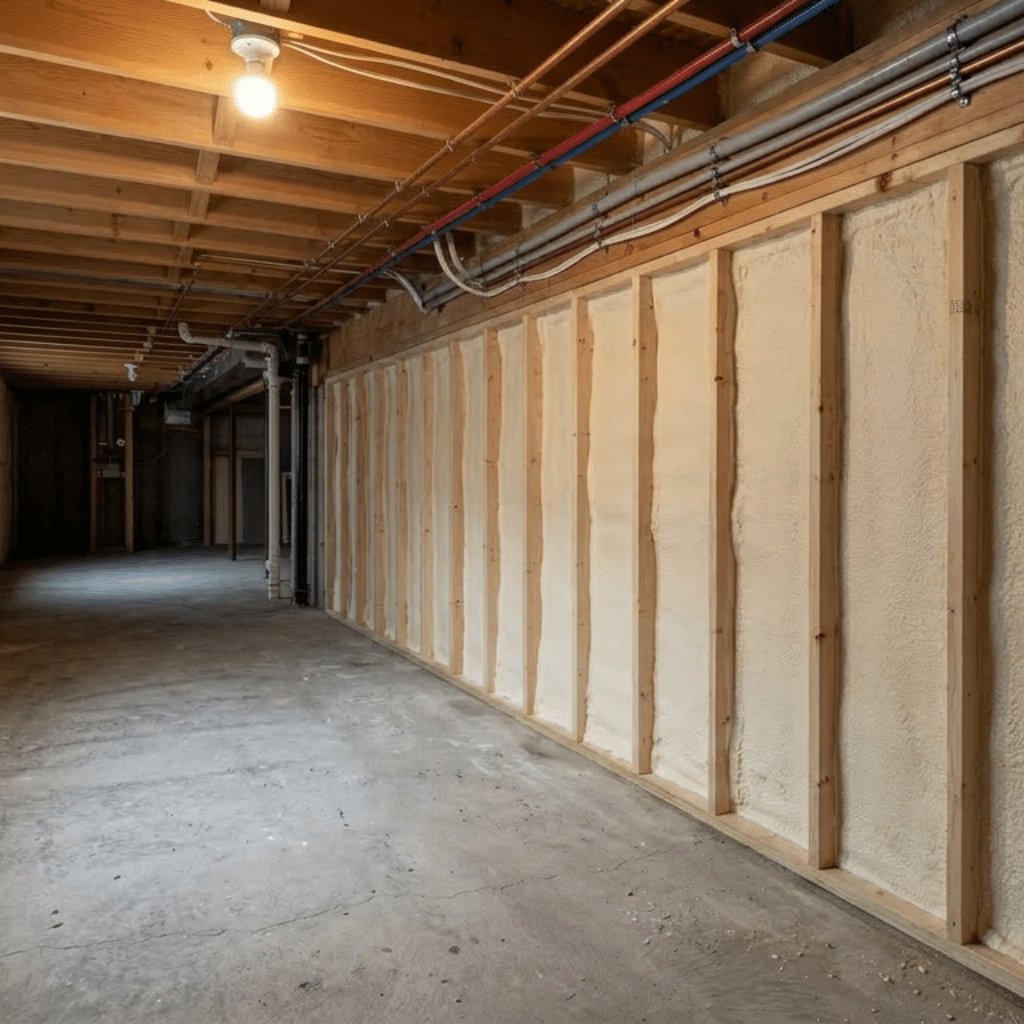
| Wall insulation | R-15 continuous minimum, Climate Zone 5 | Iowa Energy Code requirement; cheaper contractors often underinsulate |
| Radon | Mitigation plan recommended for all Zone 1 homes | Iowa has the highest residential radon rate in the country |
A contractor who can walk through each row of this table without hesitation knows Iowa basements. One who cannot has not done enough of them here.
Tip: Ask any contractor to explain Iowa’s GFCI rule for basements. It covers every outlet in the space, not just those near water. Most out-of-state contractors do not know this, and it is one of the most commonly failed residential electrical inspections in the state.
The One Credential Most Iowa Homeowners Do Not Know to Ask For
Most homeowners searching for a Des Moines basement contractor ask whether the company is “licensed.” In Iowa, that question has the wrong answer built into it.
Iowa Registers Contractors. It Does Not License Them.
Iowa does not issue licenses to general contractors. Instead, the state requires DIAL registration through the Iowa Department of Inspections, Appeals, and Licensing. Any contractor earning $2,000 or more annually must register and carry both workers’ compensation and unemployment insurance.
Verification takes about 30 seconds at dial.iowa.gov. Ask for the contractor’s DIAL registration number before you sign anything. If they cannot provide one, walk away.
What Your Trade Partners Need
Electricians and plumbers are different from general contractors in Iowa. They require separate state licenses. A qualified basement finishing contractor will have their own DIAL registration and licensed trade partners for all electrical and plumbing work.
Failing to carry workers’ comp is a Class D felony in Iowa. You might think that is the contractor’s problem, but if an uninsured worker is injured on your property, you can be named in the lawsuit.
Illustrative scenario: A West Des Moines homeowner hired a basement contractor who assured them the crew was “all covered.” When a subcontractor was injured on site, the homeowner discovered the general contractor had let their workers’ comp lapse. The resulting dispute cost the homeowner over $40,000. A 30-second check at dial.iowa.gov before signing would have revealed the gap.
The table below summarizes what Iowa requires, what to ask for, and where to verify for each trade type you will encounter on a basement project. Run all three checks before any contract is signed.
| Trade | What Iowa Requires | What to Ask For | Where to Verify |
|---|---|---|---|
| General Contractor | DIAL registration, workers’ comp, unemployment insurance | DIAL registration number | dial.iowa.gov |
| Electrician | Iowa electrical contractor registration | License number | iowaelectrical.gov |
| Plumber / HVAC | DIAL license for plumbing and mechanical trades | License number | dial.iowa.gov |
Tip: Request a copy of the contractor’s DIAL registration certificate and their workers’ comp insurance certificate before any work begins. Any legitimate contractor will have these ready. Hesitation or pushback on this request is a red flag on its own.
The Questions That Separate Good Contractors From Bad Ones
A qualified basement contractor in Des Moines will answer these questions directly and without hesitation. Vague answers or pressure to move past them are signals worth paying attention to.
The table below gives you five questions to ask before you sign, with a clear breakdown of what a good answer looks like and what a concerning one sounds like. Print it and bring it to every contractor walkthrough.
| Question | Green Flag | Red Flag |
|---|---|---|
| Who pulls the permits? | “We pull all permits.” | “You can pull them to save money.” |
| Can I see your DIAL registration? | Provides the number immediately | “We are covered, don’t worry about it.” |
| How do you handle moisture and radon? | Describes vapor barriers, sump check, radon plan | “We have never had an issue.” |
| What egress does a basement bedroom require? | Cites 5.7 sq ft, 20″ wide, 24″ tall, 44″ max sill | Vague or no answer |
| What does your payment schedule look like? | 10 to 20% down, milestone payments | Large upfront cash demand |
If a contractor stumbles on more than one of these, you have learned something important before any money changed hands.
Iowa law gives you three business days to cancel any contract signed in your home. A trustworthy contractor will not pressure you to sign on the spot.
Red Flags That Should Send You to the Next Contractor
The FTC documents contractor scam patterns that show up consistently in home improvement fraud. Several are especially common in basement work.
The Permits Red Flag
Asking you to pull your own permits is the most serious warning sign. Legitimate contractors pull their own permits. When a contractor asks you to handle it, they are either unregistered with DIAL or planning work they do not want inspected.
Illustrative scenario: A Des Moines homeowner skipped permits entirely on a basement finishing project, per the contractor’s suggestion. When they sold the home two years later, the buyer’s inspector flagged every unpermitted element. The sale fell through. Resolving the situation cost over $12,000, far more than proper permits would have cost.
Other Warning Signs to Watch For
Cash-only payment with no written contract, no Iowa basement project references specifically, and skipping a moisture inspection before proposing any framing are all additional red flags. So is a contractor who arrives with a contract ready and asks you to sign before the end of the first meeting.
Illustrative scenario: A Norwalk homeowner received three bids for a 900-square-foot basement. The lowest came in 40% below market, wanted 60% down in cash, had no DIAL registration, and said permits were “not necessary for a basement.” The homeowner walked and hired a registered contractor who delivered the same scope on time and on budget.
Tip: If a contractor asks you to pull your own permits, do not assume it is a cost-saving shortcut. It is almost always a sign that they cannot legally pull permits themselves. The permit process protects you, not just the contractor.
What Basement Finishing Actually Costs in Des Moines
Understanding realistic cost ranges is one of your best defenses against lowball bids. Bids that fall significantly below these ranges almost always mean skipped permits, missing moisture work, or unlicensed trade partners. Estimates vary by scope, materials, and location within the service area.
The table below shows typical Des Moines basement finishing costs by project type. Use these ranges to anchor your expectations before the first contractor call.
| Scope | Typical Size | Cost Range | Notes |
|---|---|---|---|
| Basic family room | 800 sq ft | $28,000 to $36,000 | Open layout, no bathroom |
| Mid-range with bathroom | 800 to 1,000 sq ft | $40,000 to $55,000 | One bath, standard finishes |
| Full suite with bed and bath | 900 to 1,200 sq ft | $50,000 to $75,000 | Bedroom, bath, egress window |
Permit fees in Des Moines typically run $350 to $2,100-plus depending on scope. An egress window install in Central Iowa adds $2,500 to $5,000 per window. A bid that does not account for these line items is not a deal. It is an incomplete budget that collapses mid-project.
Finished basements typically return 60 to 86% of project cost at resale, depending on finish quality and market conditions. That return depends on the work being permitted, inspected, and done to code. An unpermitted basement is a liability at closing, not an asset.
Illustrative scenario: An Ankeny homeowner received bids ranging from $31,000 to $59,000 for an 800-square-foot basement. The lowest bidder had no DIAL registration, excluded permits from the estimate, and quoted no moisture work. The homeowner chose the mid-range bid at $47,000. That contractor pulled full permits, performed a moisture inspection, and brought a licensed electrician. When the homeowner sold two years later, the finished basement supported a listing price $38,000 higher than comparable homes without finished basements in the neighborhood.
Tip: Ask every contractor for an itemized bid that separates labor, materials, permits, and subcontractor costs. A single lump-sum bid makes it nearly impossible to understand what you are buying or to compare quotes accurately.
How to Hire a Basement Contractor: Your Step-by-Step Checklist
Most homeowners treat contractor hiring as a single decision. It is actually a process with several checkpoints. Working through each one protects your investment and makes the project far more likely to finish on time and on budget.
- Define your scope before you call anyone. Know what you want in the space: a bedroom, bathroom, entertainment area, or storage. Have a rough square footage in mind. Vague requests lead to vague bids that are impossible to compare.
- Get at least three written, itemized bids. One bid gives you a number. Three bids give you a market. Bids should break out labor, materials, permits, and subcontractor work separately.
- Verify DIAL registration for every contractor. Go to dial.iowa.gov and confirm registration and current workers’ comp before you discuss scope, timeline, or price.
- Ask the five questions from the questions table. Do this in person, not over email. How a contractor responds in the moment tells you more than any written proposal.
- Check Iowa basement project references specifically. Ask for two or three Iowa homeowners whose basements they finished in the last two years. Call them. Ask about permits, moisture prep, and whether the final cost matched the estimate.
- Review the contract line by line before signing. Confirm it includes a full scope of work, a milestone-based payment schedule, a permit-pulling commitment, and a written completion timeline. Iowa gives you three business days to cancel if you sign at home.
- Confirm the permit is pulled before work begins. Do not allow framing to start without a posted permit. If the permit is delayed, the start date moves. That is fine. Unpermitted work is not.
Frequently Asked Questions
Q: Does a basement contractor in Iowa need to be licensed?
A: Iowa general contractors are not licensed. They are registered through DIAL, and you can verify any contractor at dial.iowa.gov in about 30 seconds. Electricians and plumbers do require separate state licenses, so ask for trade license information for anyone doing that work on your project.
Q: Do I need permits to finish my basement in Des Moines?
A: Yes. A finished basement typically requires building, electrical, and plumbing permits, with combined fees ranging from $350 to $2,100-plus depending on scope. Skipping permits creates real problems at resale and can make a space legally non-conforming. Pull permits on every project.
Q: What makes Iowa basement finishing different from other states?
A: Three things stand out. Iowa has the highest radon risk in the country, with 71.6% of homes above the EPA action level. Des Moines clay soil makes moisture control essential before any framing starts. Iowa’s NEC 2023 amendment also requires GFCI protection on every basement outlet, not just those near water. These are requirements a local contractor knows and an outside one often does not.
Q: How much should I put down when hiring a basement contractor?
A: A deposit of 10 to 20% is standard. Anything above 30 to 40% upfront, especially in cash with no written contract, is a warning sign. Iowa law gives you three business days to cancel any contract signed in your home, so do not let pressure override your due diligence.
Q: How do I know if a basement bid is too low?
A: Anchor to $30 to $70 per square foot in Des Moines depending on finish level. Bids well below that range almost always mean something is missing. Ask directly what the bid excludes, specifically permits, moisture work, and licensed trade partners.
Q: How long does basement remodeling take in Central Iowa?
A: Most projects run 6 to 12 weeks depending on scope. Adding a bathroom or egress window extends the timeline. Permit approval times vary by city and can add one to three weeks, so build that into your schedule from the start rather than treating it as a surprise.
Key Takeaways
Verify Iowa credentials before you do anything else
- Iowa registers general contractors through DIAL, it does not license them
- Verify at dial.iowa.gov in 30 seconds and ask to see current workers’ comp
- Electricians and plumbers hold separate state licenses; check those too
Iowa has basement-specific requirements most contractors miss
- GFCI protection is required on every basement outlet in Iowa, not just near water
- Radon mitigation planning is essential; Iowa is EPA Zone 1 statewide with the highest residential radon rates in the country
- Egress windows for bedrooms must meet specific Iowa code dimensions: 5.7 sq ft net clear, 20″ wide, 24″ tall, 44″ max sill
The permit question separates qualified contractors from everyone else
- Your contractor should pull all permits; if they ask you to handle it, walk away
- Unpermitted work creates serious problems at resale, often costing far more than permits would have
- A posted permit before work begins is your baseline protection on every project
Know the cost floor before you accept any bid
- $30 to $70 per square foot is the realistic range in Des Moines, depending on finish level
- Permits and egress windows add real costs that belong in any legitimate bid
- Bids well below market almost always mean something important has been cut
Hire through a process, not a gut feeling
- Get three written, itemized bids and run DIAL verification on all three contractors
- Use the five-question table to evaluate every contractor in person
- Ask for Iowa basement references specifically, not general remodeling reviews
Know your legal protections as an Iowa homeowner
- Iowa law gives you three business days to cancel any contract signed in your home
- Never sign under pressure, and never let a contractor skip the permit
- A contractor who will not give you time to review the contract is counting on you not reading it
Ready to Talk to a Basement Contractor in Des Moines You Can Trust?
You now know exactly what to verify, what to ask, and what to walk away from. The next step is finding a registered contractor who will answer every one of those questions without hesitation.
Busy Builders has served over 1,000 Central Iowa homeowners since 2020. We pull all permits, address moisture and radon before framing starts, and bring licensed trade partners to every basement project. We will provide our DIAL registration number before you ask for it.
Here is what you get when you reach out:
- Free consultation with no pressure to sign on the spot
- Transparent, itemized pricing with full permit handling included
- Iowa DIAL registration you can verify in 30 seconds
- Licensed electricians and plumbers on every project
- A written project timeline broken down by phase
Explore our basement finishing service or request a free estimate. You can also call us at 844-435-9800 or visit us at busybuildersiowa.com.
We serve Des Moines, West Des Moines, Norwalk, Ankeny, Waukee, and communities across Central Iowa. Iowa’s late fall and winter slow season is a great time to get your basement on the schedule before spring demand picks up.
Busy Builders | Full Service Remodeling and Construction Done Right | Serving Central Iowa Since 2020
Local service: Basement finishing in Des Moines, Iowa.