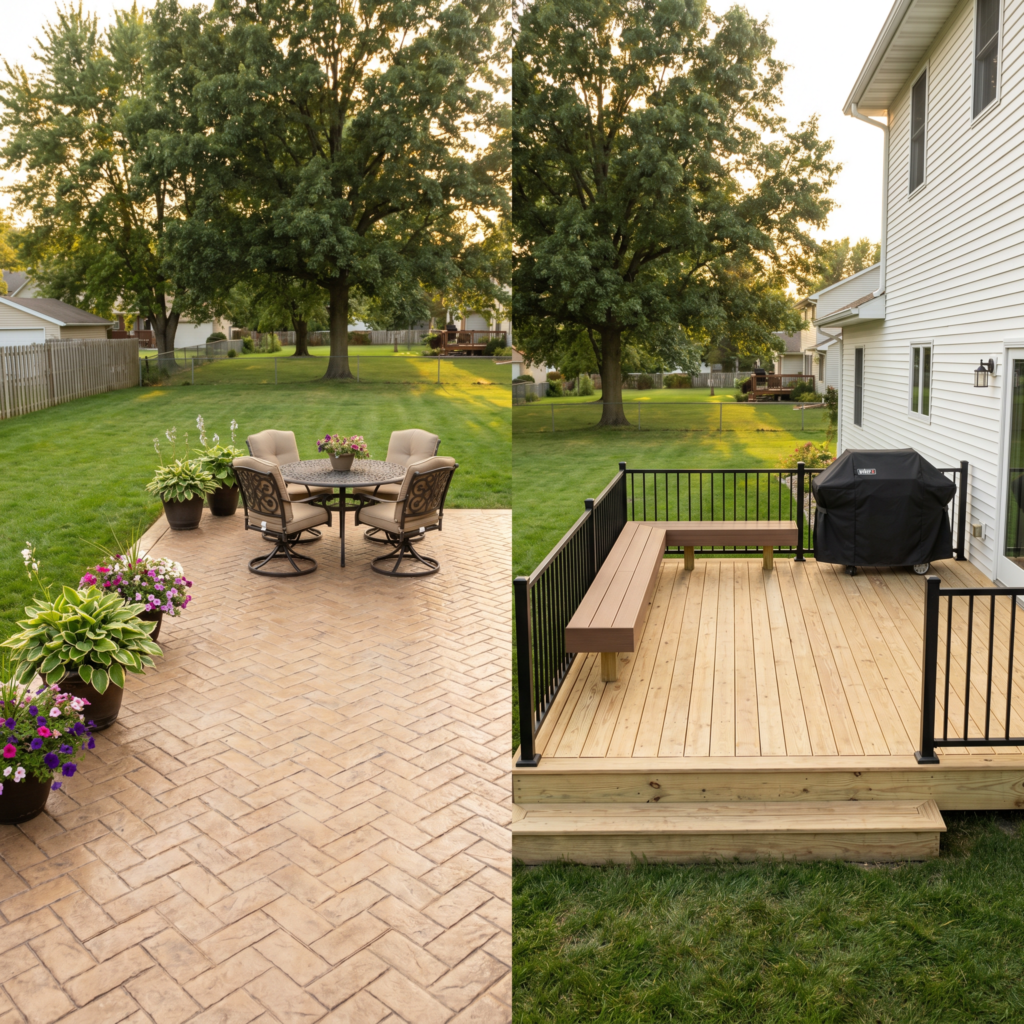
Choosing between a patio and a deck in Central Iowa is not just a style decision. Iowa’s freeze-thaw cycles, clay-heavy soil, and 42-inch frost requirement push the two options in different directions on cost, durability, and permitting. This guide goes past the surface comparison to the Iowa-specific factors that should actually drive your choice.
TLDR: A concrete patio in Central Iowa starts at $6 to $12 per square foot installed, while a wood deck starts at $25 to $45 per square foot. Iowa’s freeze-thaw cycles and clay soil affect the long-term durability of each differently, and the permit rules are not the same. This guide covers costs, permits, resale value, and which option fits Iowa yards best.
Most homeowners start this decision with a picture in their head, a deck off the back door or a patio under a pergola, and a rough budget. Then the bids come in, and the gap between a patio and a deck is wider than expected. That gap is mostly about what sits underneath.
A patio rests on the ground. A deck stands on posts and footings, and in Iowa those footings have to reach below the frost line. That single structural difference ripples through cost, permitting, and how each one ages in Iowa weather. We already cover the high-level question in our posts on patio or deck real cost and materials and deck versus patio costs, permits, freeze-thaw, and ROI. This guide goes deeper on the Iowa conditions that tip the decision.
The Core Difference Between a Patio and a Deck in Iowa
A patio is a ground-level surface, usually poured concrete, pavers, or stamped concrete, sitting on a compacted and graded base. A deck is an elevated structure built on a frame supported by footings. In Iowa, those footings must extend at least 42 inches deep to sit below the frost line, which is far deeper than the shallow footings used in southern states.
That depth requirement is the first reason decks cost more here. Each footing means excavation, concrete, and labor that an at-grade patio simply does not need. Iowa’s clay soil makes it harder still, because clay holds water, expands when it freezes, and shifts as it thaws.
The permit picture differs too. A deck with any meaningful elevation needs a permit in Iowa, and an attached deck always does regardless of size. An at-grade patio often does not require a permit at all, though you should always verify with your city.
Pro Tip 1: Before you compare prices, decide whether you want elevation. A raised deck off a second story carries a much higher footing and railing cost than a ground-level patio, and that one choice can double your budget before you pick any materials.
Freeze-thaw is the long-term factor. Concrete patios can crack and heave if the base is not prepared for Iowa’s roughly hundred-plus freeze-thaw cycles a year. Decks flex with temperature swings, which is gentler on the structure but harder on fasteners and surface boards over time.
Patio Costs in Central Iowa 2026
Patios are the more budget-friendly option per square foot, but the range is wide depending on material and finish. The table below shows typical installed cost. Treat these as planning estimates that vary by site, base prep, and current pricing.
| Patio type | Cost per sq ft installed | 300 sq ft project | 500 sq ft project |
|---|---|---|---|
| Poured concrete | $6 to $10 | $1,800 to $3,000 | $3,000 to $5,000 |
| Stamped concrete | $10 to $18 | $3,000 to $5,400 | $5,000 to $9,000 |
| Paver patio | $14 to $24 | $4,200 to $7,200 | $7,000 to $12,000 |
Those figures usually include base prep, the surface, and standard finishing. What is often extra includes extensive grading on a sloped lot, drainage solutions for clay soil, decorative borders, and built-in features like seat walls or fire pits. The takeaway is that material choice drives most of the patio cost, and the base prep is where Iowa clay can add unexpected dollars.
Pro Tip 2: On Iowa clay, insist that your contractor specify the base depth and compaction in writing. A patio poured on poorly prepared clay is the single most common reason a slab cracks or heaves within a few winters.
Deck Costs in Central Iowa 2026
Decks cost more per square foot because of the frame, the footings, and the railing. Material is the biggest lever, and Iowa’s frost depth adds to the foundation cost compared with warmer states. The table below shows typical installed ranges.
| Decking material | Cost per sq ft installed | 300 sq ft project | Lifespan in Iowa |
|---|---|---|---|
| Pressure-treated | $25 to $35 | $7,500 to $10,500 | 15 to 20 years with upkeep |
| Cedar | $30 to $42 | $9,000 to $12,600 | 15 to 25 years with upkeep |
| Composite (such as Trex) | $35 to $60 | $10,500 to $18,000 | 25 to 30 years, low upkeep |
Pressure-treated lumber is the budget standard and holds up well when sealed regularly. Cedar offers a natural look and good rot resistance. Composite costs the most up front but resists Iowa’s moisture and freeze-thaw with minimal maintenance, which many homeowners find worth the premium. For a deeper material breakdown, see our guide to the best deck materials for Iowa weather and our Des Moines deck building cost guide.
Pro Tip 3: Ask whether your deck quote includes the cost of frost-depth footings or assumes shallow piers. A bid that lowballs the footings is not comparable to one that prices them correctly, and in Iowa shallow piers invite frost heave.
A covered deck costs more than an open one but extends your usable season, a tradeoff we cover in our post on covered versus open decks in Iowa.
Permit Requirements: Patio vs. Deck in Iowa
This is where the two diverge sharply, and getting it wrong is expensive. The table below summarizes the common rules. Always confirm with your specific city, because thresholds vary between Ankeny, Waukee, Johnston, and rural Polk County.
| Project type | Permit usually required? | Why |
|---|---|---|
| At-grade concrete patio | Often not | No structural elevation, no footings |
| Paver patio at grade | Often not | Same, but verify locally |
| Attached deck (any size) | Yes | Structural connection to the house |
| Freestanding deck over 200 sq ft | Typically yes | Size and structural load threshold |
| Deck with a roof | Yes | Structural and load considerations |
At-grade patios typically fall outside permit requirements because they add no structure and no elevation. Any deck attached to the house requires a permit in Iowa regardless of size, because it connects to the home’s structure. Freestanding decks usually cross into permit territory once they pass a size or height threshold. The takeaway is simple: patios are usually permit-light, decks rarely are. Our Iowa deck building codes guide walks through the inspection points.
Iowa adopted the 2024 International Residential Code, and the rules a deck must meet are set under Iowa Administrative Code 481-301.8. Footing depth follows the IRC foundation chapter. Iowa requires all construction contractors to be registered with DIAL, and you can verify a contractor’s registration before you sign.
Pro Tip 4: If you are adding a deck, build the permit and inspection time into your schedule from the start. Homeowners who skip the permit to save weeks often pay far more later, when an unpermitted deck surfaces during a home sale.
Pro Tip 5: A patio does not seal a below-grade space, so radon is not a patio concern. If your project ever expands into an enclosed or below-grade room, remember that all 99 Iowa counties sit in EPA Radon Zone 1, and testing becomes important then.
Which Adds More Value to an Iowa Home
Both a patio and a deck can add resale appeal, but they behave differently at appraisal and on the market. Outdoor living is a strong selling point across the Midwest, where buyers value usable yard space in the warm months.
National cost-recoupment data from Zonda’s remodeling research has historically shown a wood deck addition recouping a high share of its cost at resale, often cited near 94.9 percent nationally, with composite decks closer to 88.5 percent. For broader context on residential construction costs, the U.S. Census Bureau tracks characteristics of new housing nationwide. Those are national figures, not Iowa guarantees. Iowa-specific resale behavior tends to be more conservative, and a realistic Iowa return on a deck is better thought of in the range of roughly 80 to 83 percent for wood and 65 to 70 percent for composite. These are industry-informed estimates, not financial advice, and actual returns vary by market, neighborhood, and project quality.
| Feature | Resale impact in Iowa | Notes |
|---|---|---|
| Permitted wood deck | Strong | Recoups a high share of cost; broad buyer appeal |
| Permitted composite deck | Moderate to strong | Lower recoup percentage but low-maintenance appeal |
| Concrete or paver patio | Moderate | Adds appeal; lower cost basis means lower dollar return |
| Unpermitted deck | Negative | Becomes a liability and disclosure issue at sale |
The single most important resale factor is permitting. An unpermitted deck can become a liability at sale, forcing disclosure, appraisal complications, or even required removal. The takeaway is that a permitted structure protects value while an unpermitted one erodes it. Our post on boosting home value with deck remodeling before selling is a useful companion if resale is your goal.
Pro Tip 6: If resale is part of your reasoning, keep every permit and inspection record. Buyers and appraisers reward documented, code-compliant work, and the paperwork is what separates an asset from a liability.
Iowa Yard Conditions That Drive the Decision
Your lot often decides the question before budget does. A flat yard suits a patio well, since grading is straightforward and drainage is easy to control. A sloped lot frequently favors a deck, because building up on a frame can be cheaper than the extensive fill and retaining work a patio would need on a grade.
Clay soil drainage is the Iowa wild card. Clay sheds water slowly, so a patio on poorly drained clay can pool water, heave in winter, and crack. A deck sits above the soil, which sidesteps surface drainage but demands footings that resist frost movement in that same clay.
Sun orientation matters for how you will actually use the space. A south or west-facing patio bakes in Iowa summer afternoons, while a deck can carry a pergola or roof more easily to add shade. Think about when you will use the space before you commit.
Pro Tip 7: Walk your yard after a heavy rain before you decide. Where water sits and how long it lingers tells you more about whether a patio or a deck fits your lot than any brochure will.
Pro Tip 8: On a sloped lot, get bids for both options. The intuitive choice is not always the cheaper one, and a deck can sometimes beat a patio on a grade once retaining and fill costs are counted.
How the Two Compare for Iowa Climate
The table below lays out the practical pros and cons for our specific climate, so you can weigh durability against maintenance and cost.
| Factor | Patio | Deck |
|---|---|---|
| Upfront cost | Lower per sq ft | Higher per sq ft |
| Frost-heave risk | Higher if base is poor | Lower with proper footings |
| Maintenance | Low, occasional sealing | Higher for wood, low for composite |
| Best lot type | Flat, well-drained | Sloped or elevated |
| Permit burden | Usually light | Usually required |
Neither option is universally better. A patio wins on upfront cost and low maintenance for a flat, well-drained lot. A deck wins on a slope, on a second-story walkout, and where the homeowner wants the look and resale strength of a finished structure. The takeaway is to match the structure to the lot and the budget rather than to a default preference.
Pro Tip 9: Composite decking costs more up front but its low maintenance often wins the long-run math in Iowa, where wood needs regular sealing to survive freeze-thaw and UV exposure.
Pro Tip 10: For patios, stamped concrete gives the look of pavers at a lower installed cost, though pavers are easier to repair if a single section is damaged. Weigh appearance against future repairability.
3 Illustrative Scenarios
The scenarios below show how lot, material, and scope combine. These are illustrative planning examples, not quotes for specific past projects, and actual costs vary.
Illustrative scenario, budget stamped concrete patio in Ankeny: A homeowner pours a 320 square foot stamped concrete patio on a flat, well-drained lot, with a decorative border and proper clay-soil base prep. No permit required for the at-grade slab. Estimated cost around $7,500, completed in roughly one to two weeks. For local context, see our Ankeny deck building page.
Illustrative scenario, mid-range composite deck in Waukee: A 400 square foot composite deck on frost-depth footings, with aluminum balusters and a single stair run, attached to the home. Permit and inspections handled by the contractor. Estimated cost around $22,000, completed in roughly three to five weeks. Our Waukee deck building page covers the local process.
Illustrative scenario, premium paver patio with pergola in Johnston: A 500 square foot paver patio with a seat wall, integrated lighting, and a cedar pergola for shade, on a gently sloped lot needing added drainage. Estimated cost around $28,000, completed in roughly four to six weeks.
Pro Tip 11: Budget a contingency of 10 to 15 percent on any outdoor project. Iowa clay, drainage surprises, and footing conditions are the most common sources of mid-project change orders.
Pro Tip 12: Schedule outdoor builds for spring or early summer when possible. Iowa’s frozen ground in deep winter complicates excavation for deck footings, and concrete cures best in moderate temperatures.
Frequently Asked Questions
Q: Do I need a permit for a patio in Iowa? An at-grade concrete or paver patio often does not require a permit in Iowa, because it adds no structural elevation and sits on the ground. That said, rules vary by city, and features like an attached roof, a fire feature, or a raised edge can change the answer. Always confirm with your local building department before you start, and remember that a registered contractor can verify the requirement for your specific project and address.
Q: Which lasts longer in Iowa weather, a patio or a deck? Both can last decades when built correctly for Iowa conditions. A concrete or paver patio can last 25 years or more if the clay-soil base is properly prepared to resist frost heave. A composite deck on frost-depth footings can also reach 25 to 30 years with minimal upkeep, while a wood deck needs regular sealing to reach 15 to 25 years. The deciding factor is base and footing quality, not the material alone.
Q: Does a patio or deck add more value in Iowa? A permitted deck generally returns a higher percentage of its cost at resale than a patio, with industry data suggesting roughly 80 to 83 percent for a wood deck in Iowa, though actual returns vary by market and project quality. A patio has a lower cost basis, so it returns fewer dollars even at a similar percentage. The most important factor is permitting: an unpermitted structure becomes a liability at sale rather than an asset.
Q: What is the cheapest patio option in Des Moines? Poured concrete is the most affordable patio option in the Des Moines metro, typically running $6 to $10 per square foot installed, which puts a 300 square foot patio in the rough range of $1,800 to $3,000. Stamped concrete and pavers cost more but add visual appeal. Whatever you choose, the base preparation on Iowa clay is what protects your investment, so do not let a low bid skip it.
Q: How does Iowa clay soil affect a patio’s longevity? Iowa clay holds water and expands when it freezes, which can heave and crack a patio that sits on a poorly prepared base. The fix is proper base depth, compaction, and drainage so water does not collect under the slab. A patio built on well-prepared clay can last decades, while one poured on raw, undrained clay may crack within a few winters. Insist on a written base specification in your contract.
Key Takeaways
Cost: Patios are cheaper per square foot; decks cost more because of frame and footings.
- Patios run $6 to $24 per square foot depending on material; decks run $25 to $60.
- Iowa’s at-least-42-inch frost depth adds to every deck’s footing cost.
Permits: Patios are usually permit-light; decks rarely are.
- Any attached deck requires a permit in Iowa regardless of size.
- At-grade patios often need no permit, but always verify with your city.
Durability in Iowa: Base and footing quality matter more than material choice.
- Patios crack and heave on poorly prepared clay; proper base prep prevents it.
- Composite decks resist freeze-thaw with low upkeep; wood needs regular sealing.
Resale: Permitted structures protect value; unpermitted ones erode it.
- A permitted wood deck recoups a strong share of its cost in Iowa.
- Keep every permit and inspection record to protect resale value.
Trying to decide between a patio and a deck for your Iowa yard? Busy Builders is a registered Iowa contractor serving Central Iowa since 2020, with more than 1,285 completed projects and a 99% satisfaction rate. We will walk your lot, assess your clay and drainage, and price both options honestly. Explore our deck building services, then call: 844-435-9800 or visit https://busybuildersiowa.com/ for a free consultation. Every project includes a written warranty on workmanship, with details provided in your contract.
Disclaimer: This article is for general informational purposes only and does not constitute professional construction, legal, or financial advice. Cost figures are planning estimates that vary by scope, materials, site conditions, and current market pricing; obtain at least three written quotes before making decisions. Permit requirements vary by city and jurisdiction, so verify current requirements with your local building authority before starting any project. Resale and ROI figures, including cost-recoupment percentages, are drawn from national and industry sources, are illustrative, and are not financial advice; actual returns vary by market, neighborhood, and project quality. Always work with a contractor registered with the Iowa Department of Inspections, Appeals, and Licensing, and verify registration status before signing. Busy Builders makes no guarantee regarding outcomes, timelines, costs, or returns for any individual project.
Busy Builders | Full-Service Construction and Remodeling | Serving Central Iowa Since 2020