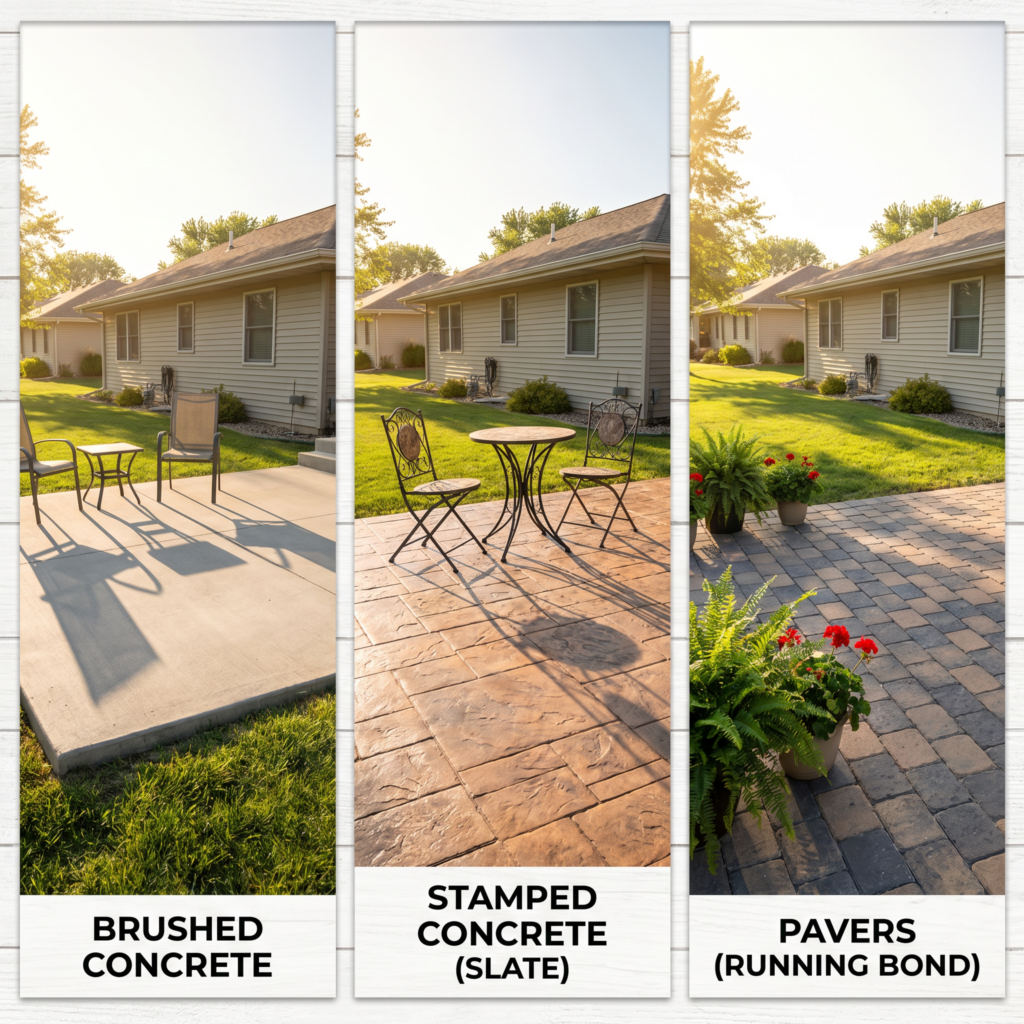
You have decided on a patio instead of a deck, and now the real choice begins: plain concrete, stamped concrete, or pavers. This guide compares all three for Iowa homeowners, focusing on upfront cost, how each holds up to Iowa’s freeze-thaw winters, long-term maintenance, and repair realities. All figures are planning estimates based on Central Iowa market data, not project quotes.
TLDR: Plain concrete is the cheapest to install, stamped concrete offers the best value for the money, and pavers cost the most upfront but handle Iowa’s freeze-thaw cycles best and are the cheapest to repair. The right choice depends on your budget, your soil, and how long you plan to stay. Keep reading for Iowa cost ranges, a freeze-thaw durability comparison, and honest guidance on which material fits your situation.
Why Iowa’s Climate Changes Everything
This is not a generic comparison. Iowa’s weather makes patio material choices more consequential than they are in warmer states.
Central Iowa experiences dozens of freeze-thaw cycles every year, often ranging from 45 to 84. Each cycle works the same way: water seeps into tiny pores, freezes, expands, and stresses the surface. Repeat that 60 times a winter, and weak materials fail fast. On top of that, Iowa’s clay soil swells when wet and shrinks when dry, so the ground under your patio is always moving.
A material that performs fine in Georgia can fail in three Iowa winters. The single biggest factor in whether a patio lasts is the base beneath it, which we cover below.
The Three Options at a Glance
Plain concrete slab. Poured reinforced concrete, usually 4 to 6 inches thick, finished smooth, broomed, or as exposed aggregate. It is one continuous surface with no joints. It is the cheapest to install, but any future repair patch will always be visible.
Stamped concrete. The same poured base, with patterns pressed in and color added before it cures to mimic stone, brick, or slate. It looks high-end for less than the cost of pavers. The trade-off: more surface texture means more places for water to collect, and a cracked section is nearly impossible to patch invisibly.
Pavers. Individual concrete, brick, or stone units set on a compacted gravel-and-sand base. They cost the most upfront. Their advantage is flexibility: individual units shift with freeze-thaw cycles rather than cracking, and a damaged unit lifts out and resets. Concrete pavers typically have a compressive strength of around 8,000 PSI, compared with roughly 3,000 to 4,000 PSI for a poured residential slab.
Cost Comparison: Central Iowa 2026
Here is what each material runs on in the Des Moines metro. These ranges assume professional installation on a typical residential site.
Table 1: Patio Cost by Material (Des Moines Metro, 2026)
| Material | Installed Cost Per Sq Ft | 300 Sq Ft Estimate | 400 Sq Ft Estimate |
|---|---|---|---|
| Plain concrete slab | $6 to $10 | $1,800 to $3,000 | $2,400 to $4,000 |
| Stamped concrete | $8 to $25 | $2,400 to $7,500 | $3,200 to $10,000 |
| Concrete pavers | $10 to $20 | $3,000 to $6,000 | $4,000 to $8,000 |
| Brick pavers | $10 to $25 | $3,000 to $7,500 | $4,000 to $10,000 |
| Natural stone pavers | $15 to $30 | $4,500 to $9,000 | $6,000 to $12,000 |
Note: Add $500 to $1,500 for site prep, such as excavation and gravel base, which most online estimates leave out. Planning estimates based on Central Iowa market data. Actual costs vary by site conditions, design complexity, and contractor.
The Long-Term Cost Nobody Shows You
Upfront price is only part of the picture in Iowa. Maintenance and repair costs over a decade can flip the ranking.
Plain concrete is the cheapest to install and only needs periodic sealing, but a cracked section repair costs $500 to $2,000 or more, and the patch always shows. Stamped concrete needs resealing roughly every 2 to 4 years in Iowa, at about $150 to $300 per service. A cracked or sunken section is the worst case to fix, because a new stamp rarely matches the original. Pavers cost the most to install but the least to maintain: individual units reset for a small fraction of a concrete repair.
Table 2: 10-Year Cost Direction (400 Sq Ft Iowa Patio)
| Material | Install (Est.) | Ongoing Maintenance | Repair Reality | 10-Year Direction |
|---|---|---|---|---|
| Plain concrete | $2,400 to $4,000 | Seal every 2 to 3 years | Patches always visible | Lowest total, plainest look |
| Stamped concrete | $3,200 to $10,000 | Reseal every 2 to 4 years | Section repairs rarely match | Highest upkeep, best looks |
| Concrete pavers | $4,000 to $8,000 | Minimal, occasional reset | Units reset invisibly | Higher install, lowest repair |
Note: Lifecycle figures are illustrative and based on published industry data. Actual maintenance and repair costs vary by site, climate exposure, installation quality, and contractor.
Freeze-Thaw Durability: Head-to-Head
This is the Iowa-specific factor most national comparisons skip.
Table 3: How Each Material Handles Iowa Freeze-Thaw
| Material | Structure | Iowa Freeze-Thaw Performance | Most Common Failure | Repairability |
|---|---|---|---|---|
| Plain concrete | Rigid slab, 3,000 to 4,000 PSI | Moderate when sealed | Surface cracks | Depends on the stone and sealing |
| Stamped concrete | Rigid slab, textured | Lower, sealing is the main defense | Cracks and surface flaking | Poor, stamp rarely matches |
| Concrete pavers | Flexible units, 8,000+ PSI | High | Individual unit shift | Excellent, reset units |
| Brick pavers | Dense fired clay units | High | Occasional unit lift | Excellent |
| Natural stone | Varies by stone | Moderate to high | Depends on stone and sealing | Good |
Pavers outperform poured concrete in Iowa, specifically because their joints and individual units absorb ground movement rather than resisting it.
The Base Matters More Than the Surface
Every Iowa patio sits on clay, so the base decides whether it lasts. The minimum standard is to remove the topsoil and replace it with at least 6 inches of compacted gravel. Skip that step, and the clay heaves in wet weather and shrinks in dry weather, taking the surface with it.
Proper drainage matters too. The surface should slope away from the house, roughly 1/8 to 1/4 inch per foot, so water never pools. On problem sites, drainage correction can add $500 to $1,500. Iowa’s frost line is at least 42 inches, which matters for any footings tied to steps or attached structures. Always call 811 before any digging.
Illustrative scenario: A Grimes homeowner has stamped concrete installed in spring, and the crew skips a full compacted gravel base to save half a day. By year three, two sections crack from freeze-thaw and clay movement. Because a new stamp cannot match the original pattern, the only fix is a full slab replacement, quoted at about $4,200. Proper base prep at installation would have cost roughly $400 more.
Do You Need a Patio Permit in Iowa?
Permit rules vary by city and are easy to get wrong, so this is one to verify rather than assume.
In Ankeny, covered patios with a solid roof and elevated patios or platforms 30 inches or more above grade require permits and are treated like structural additions or decks. New driveways and approaches require their own permit. Requirements for a simple ground-level slab can vary, so confirm your specific project with the city before you build. Setbacks, impervious-surface limits, and zoning rules apply even when no structure permit is needed.
A few rules that hold across Iowa: covered or roofed patios almost always require a permit; elevated platforms generally require one; and any patio attached to the home should be verified with your city first. Iowa uses “registered contractor” for general contractors, verifiable at dial.iowa.gov. Even when the city does not require a permit, your HOA may restrict patio size, material, or placement, so check both.
Table 4: Iowa Patio Permit Guide
| Project Type | Permit Likely Required? | What to Do |
|---|---|---|
| Ground-level uncovered patio slab | Sometimes, the scope is dependent | Confirm with your city |
| Covered or roofed patio | Yes | Apply as a structural addition |
| Elevated platform or raised patio | Yes | Treated like a deck |
| Patio attached to the home | Usually | Verify before building |
| Driveway or approach (Ankeny) | Yes | Separate permit |
Note: Rules vary by city and are subject to change. Verify current requirements with your local building department before starting any project.
Which Option Is Right for Your Iowa Patio?
Choose plain concrete when budget is the top priority, you like a clean, modern look, your timeline is tight, and you are willing to seal it every couple of years. It is the fastest to install and has the lowest upfront cost.
Choose stamped concrete when you want a stone or brick look for less than pavers, your lot has good drainage and a stable base, and you commit to resealing every 2 to 4 years. Go in understanding that any future crack repair will be visible.
Choose pavers when you are on Iowa clay, have drainage concerns, plan to stay in the home long term, and value easy, invisible repairs and freeze-thaw durability over the lowest upfront price. For many Iowa sites, pavers are the best long-term call.
FAQs
What is the best patio material for Iowa’s climate? Pavers handle Iowa’s freeze-thaw cycles best because individual units flex with ground movement and can be reset rather than cracking. Stamped concrete is the most vulnerable because cracks require full-section replacement, and patches rarely match the original. Plain concrete is a solid middle ground when it is regularly sealed and installed over a properly compacted base.
How much does a patio cost in Iowa in 2026? Plain concrete runs about $6 to $10 per square foot installed, stamped concrete $8 to $25, and concrete pavers $10 to $20. A typical 300-square-foot patio costs roughly $1,800 to $6,000, depending on the material. Always add $500 to $1,500 for site prep, which many estimates leave out.
How long does stamped concrete last in Iowa? With proper installation and regular resealing every 2 to 4 years, stamped concrete can last for decades. Without that sealing in Iowa’s freeze-thaw climate, surface damage can show within a few years. Base prep quality matters as much as the sealing schedule.
Do I need a permit for a patio in Ankeny, Iowa? It depends on the patio. A simple ground-level slab may carry only a low flat fee or fall outside the scope of structural permitting. In contrast, covered and elevated patios are treated as additions or decks and require permits and inspections. Setback and zoning rules apply either way, so always verify current requirements with Ankeny Development Services before you start.
Are pavers worth the extra cost over concrete in Iowa? For most Iowa sites, yes. The upfront premium is real, but the gap narrows over 10 years because paver repairs cost a small fraction of concrete repairs, and the maintenance is minimal. On clay soil with drainage concerns, pavers are usually the better long-term investment.
Key Takeaways
- Upfront cost: Plain concrete is the cheapest, stamped is mid-range, and pavers cost the most to install.
- Freeze-thaw: Pavers handle Iowa’s dozens of annual cycles best; stamped concrete is the most vulnerable.
- Long-term cost: Stamped needs resealing every 2 to 4 years; paver repairs are cheap and invisible.
- The base wins or loses: At least 6 inches of compacted gravel over Iowa clay is non-negotiable.
- Permits: Covered and elevated patios require permits; verify with your city first.
- Contractor terminology: Iowa uses “registered contractor,” verifiable at dial.iowa.gov.
Plan Your Iowa Patio With Busy Builders
Since 2020, Busy Builders has served 1,285+ Central Iowa homeowners with full-service construction and remodeling. We give honest guidance on which patio material fits your site and your budget, not a one-size-fits-all pitch. Every project starts with a free consultation, an assessment of your soil and drainage, and a fully itemized estimate before any work begins. We serve Des Moines, West Des Moines, Ankeny, Waukee, Johnston, Grimes, Urbandale, Clive, Norwalk, and all of Central Iowa.
Call: 844-435-9800 Website: https://busybuildersiowa.com/
Written warranty on quality (details provided in your contract).
Disclaimer: All cost figures are planning estimates based on 2026 Central Iowa market data and are not project quotes; actual costs vary by project size, material selections, site conditions, and contractor. Lifecycle cost estimates are illustrative based on published industry data and are not financial projections; actual maintenance and repair costs vary. Permit requirements vary by city and are subject to change; always verify current requirements with your local building authority before starting any project. In Ankeny, contact the Development Services Department at 515-963-3550. Consult a registered Iowa contractor before making decisions about your specific project.
Busy Builders | Full-Service Construction and Remodeling | Serving Central Iowa Since 2020
Related service: deck building in Central Iowa.