Your remodel is hands-down the best time to take a hard look at your HVAC system. Walls are open, crews are already on site, and adding ductwork or swapping out equipment now costs far less than coming back after everything is buttoned up. This guide walks you through the key decision factors, helps you read the signals your system sends, and explains why an Iowa remodel and an HVAC upgrade often belong on the same project timeline.
TLDR: Iowa’s Climate Zone 5A puts heavy strain on HVAC equipment. Central AC units typically last 10 to 15 years, and furnaces 15 to 20 years, but Central Iowa’s hot summers and 6,600+ annual heating degree days accelerate wear and tear. A quick decision tool, multiply your system’s age by the repair quote and compare to $5,000, helps you know when repair still makes sense and when replacement is the smarter investment. Read on for Iowa-specific costs, permit requirements, and the one window you don’t want to miss.
Why Your Remodel Timeline Matters for HVAC
Most HVAC content treats repair vs. replacement as a standalone decision. It almost never mentions the remodel context, and that’s a mistake.
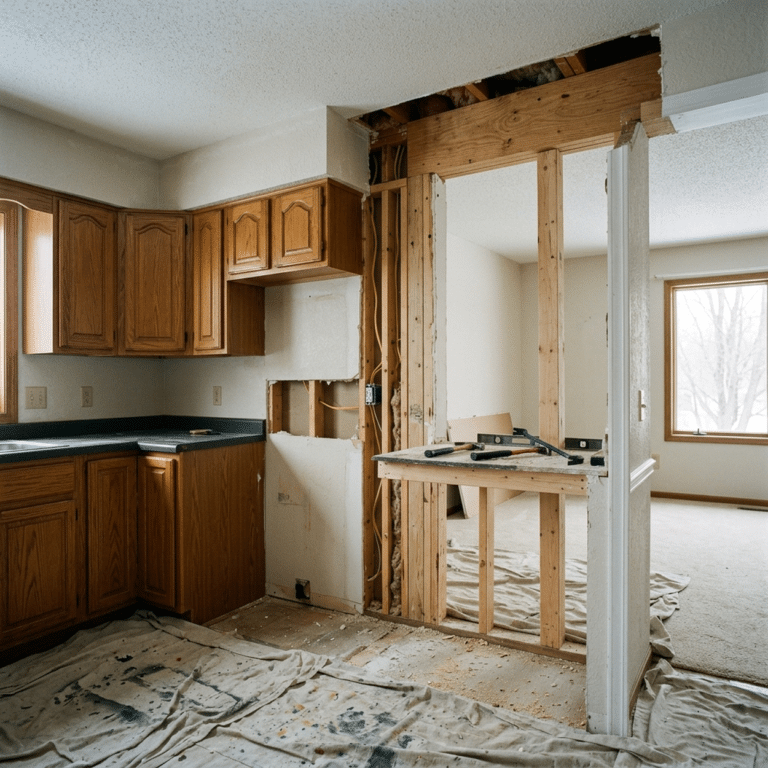
Here’s why timing matters. When Busy Builders opens walls for a whole-home remodel or a basement finish, ductwork is already accessible. Adding a new run, sealing leaks, or swapping out equipment during active construction costs a fraction of what it would once drywall is back up and paint is on the walls. Waiting until after a remodel to discover your HVAC can’t handle the added square footage means tearing into finished surfaces you just paid for.
Tip: Ask your remodel contractor to flag HVAC concerns at the very start of the project. Catching capacity issues before ductwork is extended saves time, money, and frustration.
How Long Should Your HVAC System Last in Iowa?
Iowa’s Climate Zone 5A, with over 6,600 heating degree days annually, puts above-average demand on both heating and cooling equipment. Central Iowa AC units wear faster than average because summers here are hot and humid, running systems at high capacity for months at a time.
Here are the typical life expectancies for common system types, along with what Iowa conditions mean in practice.
Before the table, keep this in mind: these are averages. Maintenance history, equipment brand, and how hard your system works all affect actual lifespan. An 11-year-old AC in Ankeny that has never been serviced may be closer to end-of-life than a 13-year-old unit in Urbandale that has been tuned every spring.
| System Type | Average Lifespan | Iowa Consideration |
|---|---|---|
| Central Air Conditioner | 10 to 15 years | Wears faster in Central Iowa’s hot, humid summers |
| Gas Furnace | 15 to 20 years | 6,600+ heating degree days per year accelerate wear |
| Heat Pump | 10 to 15 years | Climate Zone 5A demands reduce effective lifespan |
| Thermostat | About 10 years | Often overlooked; upgrade to a smart thermostat with any replacement |
If your system falls within 3 to 5 years of end-of-life and you’re planning a significant remodel, the decision math shifts strongly toward replacement. The cost savings from catching it now are real.
The $5,000 Rule: A Quick Decision Tool
The HVAC industry uses a simple formula that homeowners find genuinely useful. Multiply your system’s age (in years) by the estimated repair cost (in dollars). If the result exceeds $5,000, replacement is usually the better investment. Under $5,000, a repair often still makes sense.
This is a guideline, not a guarantee. A licensed Iowa mechanical contractor should always confirm the recommendation before you proceed.
The following examples show how the math plays out in practice.
| System Age | Repair Quote | Calculation | Recommendation |
|---|---|---|---|
| 5 years | $500 | $2,500 | Repair |
| 10 years | $600 | $6,000 | Consider replacement |
| 12 years | $450 | $5,400 | Consider replacement |
| 15 years | $400 | $6,000 | Replace |
A 12-year-old AC with a $450 repair quote crosses the $5,000 threshold. A 5-year-old furnace with a $500 repair quote doesn’t come close. The math gives you a rational starting point before emotions or inconvenience drive the decision.
Signs It’s Time to Replace
Repair or replace decisions often feel murky until you look at the full picture. These are the clearest signals that replacement is the better call.
Your system is 10 to 15 years old. A major component has failed, compressor, heat exchanger, or evaporator coil. You’ve had more than one breakdown in a single season. Energy bills have risen without any other clear explanation. Some rooms are comfortable, while others stay too hot or too cold. Your repair cost would exceed 50% of the price of a new system.
There’s also a refrigerant issue worth understanding. If your system is roughly 14 years old or older, it likely uses R-22 refrigerant. R-22 has been phased out, and repair costs for these systems keep rising because parts are increasingly scarce. Systems from about 2010 to 2024 used R-410A. Starting January 1, 2025, new HVAC equipment can no longer be manufactured using R-410A, but existing R-410A systems can still be repaired using reclaimed refrigerant. If your current system uses R-410A, it is fully legal to keep running and repair, only new equipment manufacturing is restricted. Repair costs for R-410A systems will gradually increase as supply shrinks, but there is no ban on servicing existing equipment.
The table below summarizes the key factors side by side.
| Factor | Lean Toward Repair | Lean Toward Replace |
|---|---|---|
| System age | Under 10 years | 10 to 15+ years |
| Repair cost | Minor, under $500 | Major component ($1,000+) |
| Repair history | First major issue | Repeated breakdowns |
| Energy bills | Stable | Rising without explanation |
| Warranty | Still active | Expired |
| Refrigerant | R-410A (still repairable) | R-22 (parts scarce and costly) |
| Comfort | Consistent throughout home | Hot and cold spots, humidity problems |
Why a Remodel Is the Best Window for an HVAC Upgrade
This is where the remodel context becomes critical. Whether you’re finishing your basement or adding a new room, your heating and cooling load changes. A system that was correctly sized for your original home may not be sized for the expanded square footage.
Basement finishing is a clear example. A finished basement typically adds 500 to 1,500 square feet of heated and cooled space. Iowa basements naturally stay cooler in summer and retain heat in winter because they sit below the frost line, but only if your HVAC system is sized to handle the added zone. Extending ductwork into a basement without confirming your system’s capacity first is a common and costly mistake.
Home additions carry the same risk. A good HVAC contractor will run a Manual J load calculation, the industry-standard method for sizing heating and cooling systems, before any ductwork gets extended. This calculation accounts for your home’s square footage, insulation, window placement, and local climate data. Skipping it is how homeowners end up with a beautiful addition that never gets comfortable.
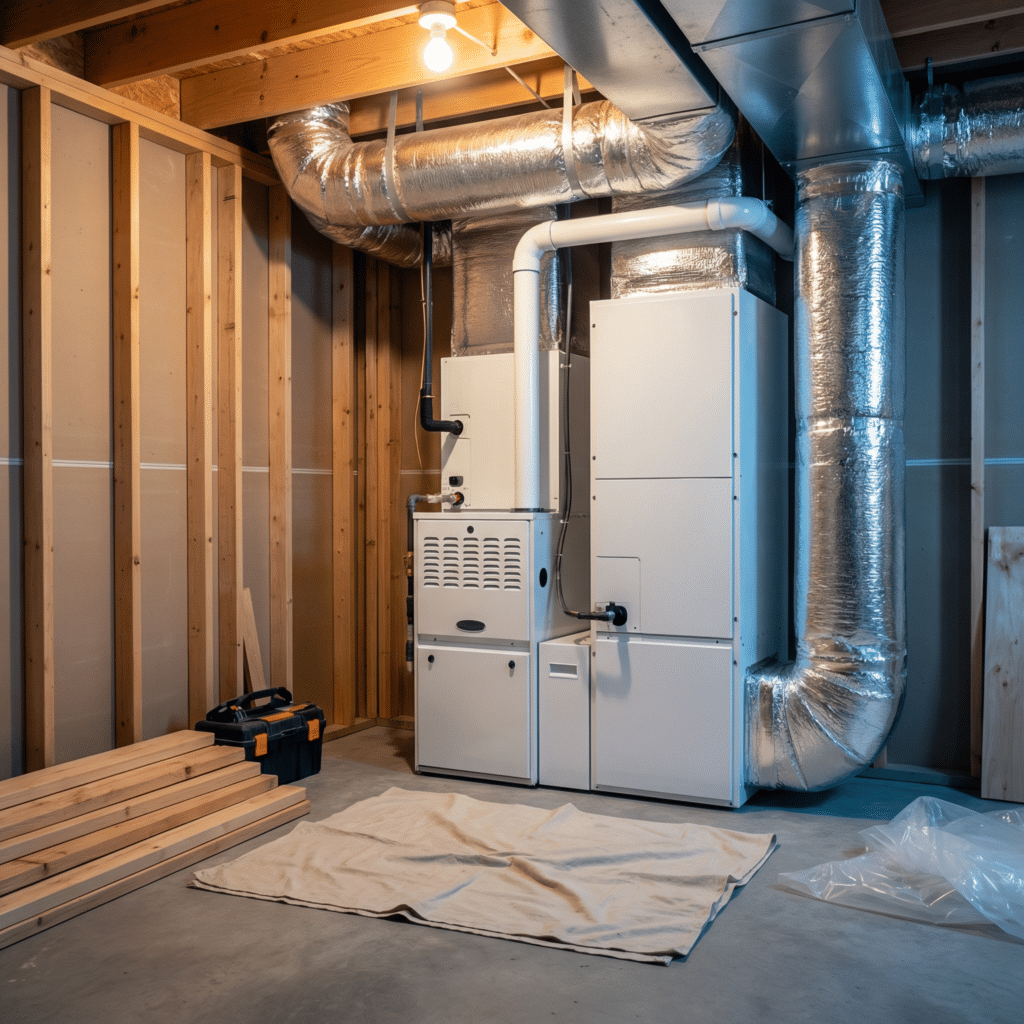
Ductwork itself also deserves attention during a remodel. Older ducts can lose up to 30% of their airflow over time due to leaks and deterioration. When walls are open, sealing or replacing duct runs costs a fraction of what it would in a finished home.
Illustrative scenario based on typical Central Iowa project data: A family in Ankeny planned a major basement finish, adding a bedroom, bathroom, and recreation room. During the remodel, the HVAC contractor discovered the 14-year-old furnace was undersized for the added square footage and used R-22 refrigerant. Rather than extend the ductwork, which would stress an aging system, they replaced both the furnace and the air conditioner while the walls were open. Total HVAC cost: about $9,800, roughly $3,000 less than it would have been after the project was complete. Estimates vary by project; always get written quotes from licensed mechanical contractors.
Iowa HVAC Costs: What to Expect in 2026
Iowa HVAC costs track below coastal markets but above rural national averages. The Des Moines metro has skilled mechanical contractors without extreme labor premiums. That said, summer demand can push repair and replacement prices 10 to 20% higher than spring or fall. If your system is approaching end-of-life, scheduling replacement in spring or fall gives you better contractor availability and potentially better pricing.
The following ranges reflect typical Iowa project costs. Prices vary based on system size, brand, labor rates, and your location within the service area. Always get multiple written quotes before proceeding.
| Work Needed | Estimated Cost Range |
|---|---|
| AC repair (Iowa average) | $100 to $3,000 |
| Refrigerant recharge | $150 to $600 |
| Compressor replacement | $1,000 to $3,000 |
| Evaporator coil replacement | $600 to $2,500 |
| New central AC (installed) | $4,500 to $8,500 |
| New gas furnace (installed) | $3,800 to $6,500 |
| Full system, AC and furnace | $7,500 to $12,500 |
| Heat pump system | $6,000 to $13,000 |
| Ductwork addition or repair | $1,000 to $2,700 |
Pro tip: If both your furnace and AC are within a few years of the end of life, replacing them together during a remodel often saves money. You pay labor overlap only once, not twice, and matched systems can qualify for better efficiency ratings and extended warranties.
Iowa Permits and Licensing: What You Need to Know
Iowa law requires that a licensed mechanical contractor perform all HVAC work through the Iowa Plumbing and Mechanical Systems Board. This is separate from general contractor registration. Busy Builders’ registered contractors coordinate with licensed mechanical contractors during remodel projects, HVAC is not something a general contractor handles directly, and any company claiming otherwise is worth investigating.
Des Moines and most surrounding cities require mechanical permits for HVAC replacements and new installations. Skipping permits creates problems at resale and may affect homeowners’ insurance claims. Always confirm your HVAC contractor pulls the required permit before work begins. Your local building department can verify this.
Tax Credits and Rebates: Check Before You Buy
Federal energy efficiency tax credits for HVAC upgrades have been subject to legislative changes. Before purchasing, check the current IRS guidance at IRS.gov, Energy Efficient Home Improvement Credit and consult a licensed tax professional. Do not rely on manufacturer websites, HVAC company blogs, or older articles, many haven’t been updated to reflect the latest rules. ENERGY STAR also maintains guidance on qualifying heat pump tax credits that is worth reviewing alongside IRS guidance.
Iowa state rebate programs through utilities and the Iowa residential energy efficiency programs may also offer incentives for qualifying high-efficiency systems. MidAmerican Energy and Alliant Energy have historically offered rebates on qualifying HVAC equipment. Contact your utility directly to confirm current programs before purchasing.
Modern high-efficiency systems can typically reduce annual heating and cooling costs by 15 to 30% compared to older models, but actual savings vary by home, usage patterns, and system selection. Conservative estimates are always the safer planning tool.
FAQs
Q: How do I know if my HVAC system can handle my remodel’s added square footage?
A licensed Iowa mechanical contractor will run a Manual J load calculation before extending any ductwork. This calculation factors in your current and future square footage, insulation levels, window placement, and local climate data. Finishing a basement typically adds 500 to 1,500 square feet of conditioned space, a significant change that your current system may not be sized for. Never extend ductwork without confirming the system can handle the increased load; the result is a comfort problem that’s expensive to fix after the fact.
Q: Should I replace my furnace and air conditioner at the same time?
Replacing both at once isn’t required, but it often makes financial sense when both are nearing the end of their lives. You pay for one mobilization and one set of labor costs rather than two. Matched systems, a furnace and AC from the same manufacturer and efficiency tier, also tend to qualify for better warranties and can achieve higher combined efficiency ratings than mismatched equipment. If one is significantly newer than the other, replacing just the older unit is usually the right call.
Q: Does my HVAC system use R-22 refrigerant, and does that matter?
If your system is roughly 14 years old or older, it probably uses R-22. R-22 has been phased out under the AIM Act, and while existing R-22 systems can still be repaired using reclaimed refrigerant, parts are increasingly scarce and expensive. This isn’t an emergency, there’s no deadline by which you must replace an R-22 system, but repair costs will keep rising. Systems made between about 2010 and 2024 use R-410A, which is still serviceable using reclaimed refrigerant. New systems manufactured after January 1, 2025, use lower-GWP refrigerants like R-32 or R-454B.
Q: When is the best time to replace an HVAC system in Iowa?
Spring and fall are the best windows. Contractor availability is higher, pricing is often better, and you avoid the rush that comes with summer breakdowns or January furnace failures. Summer demand in Central Iowa can push prices 10 to 20% higher and stretch scheduling by weeks. If your system is aging, don’t wait for an emergency, plan the replacement on your timeline rather than the system’s.
Q: Do I need a permit to replace my HVAC system in Central Iowa?
Yes, in most Iowa cities. Des Moines requires mechanical permits for HVAC replacements and new installations, and most surrounding communities have similar requirements. Permits protect you at resale and ensure the work is inspected for safety. Work performed without a permit can complicate homeowner’s insurance claims. Always confirm your contractor pulls the permit before work begins.
Key Takeaways
Know Your System’s Age and Condition. Central AC units last 10 to 15 years and furnaces 15 to 20 years, but Iowa’s climate accelerates wear and tear. If your system is 10 years old or older, evaluate it before starting any remodel that adds square footage.
Use the $5,000 Rule as a Starting Point. Multiply the system age by the repair cost. If the result exceeds $5,000, replacement is usually the better investment. A licensed mechanical contractor should always confirm the final recommendation.
Remodels Are the Best Window for HVAC Upgrades. Walls are open, trades are on site, and coordination costs are lower. Waiting until after a project is complete means paying more and potentially tearing into finished work.
Load Calculations Aren’t Optional. Any time you add square footage, basement finish, home addition, kitchen expansion, a Manual J load calculation should be performed before the ductwork is extended. Skipping this step is how comfort problems get built in.
Permits and Licensed Contractors Are Required in Iowa. HVAC work requires a licensed mechanical contractor under Iowa law. Permits are required in Des Moines and most surrounding cities. Confirm both before any work begins.
Tax Credits and Rebates Require Verification. Federal efficiency credits that were available through 2025 may have changed. Check current IRS guidance and consult a tax professional before making purchasing decisions based on expected credits.
Ready to Coordinate Your HVAC and Remodel?
You now have the framework to make a confident HVAC decision, and you know that your remodel is the right time to make it. The next step is getting the right team involved early, before walls close and options narrow.
Busy Builders has completed 1,285+ projects across Central Iowa since 2020. Our registered contractors flag HVAC concerns at the start of every basement finish, home addition, and whole-home remodel. We coordinate directly with licensed Iowa mechanical contractors, so you don’t have to manage two separate conversations.
Here’s what working with Busy Builders looks like:
- Free consultation to discuss your remodel goals and HVAC concerns
- Early-project HVAC load review before ductwork decisions are made
- Coordination with licensed Iowa mechanical contractors
- Transparent timelines and honest cost expectations
- Serving Des Moines, West Des Moines, Ankeny, Urbandale, Grimes, Johnston, Waukee, Clive, and communities throughout Central Iowa
Call us at 844-435-9800 or visit busybuildersiowa.com to schedule your free consultation. If you’re thinking about a home addition or any project that changes your home’s footprint, let’s talk about HVAC before you break ground.
Busy Builders | Full-Service Construction and Remodeling | Serving Central Iowa Since 2020