Clive runs along the Walnut Creek greenbelt on the west side of the metro, and many lots here back to mature trees or sloped ground. That topography shapes deck costs more than square footage does. This guide covers 2026 pricing by material, how Clive handles permits, what Iowa’s frost line requires, and where deck budgets get away from people.
TLDR: Most Clive decks run $10,000 to $38,000. Elevation and railing drive cost more than deck size. Clive handles permits and licenses through the city at 515-223-6220. Iowa’s frost line requires footings 42 inches deep, and shallow footings are the reason older decks heave.
Why Height Costs More Than Size
A deck quoted per square foot sounds comparable across bids. It is not.
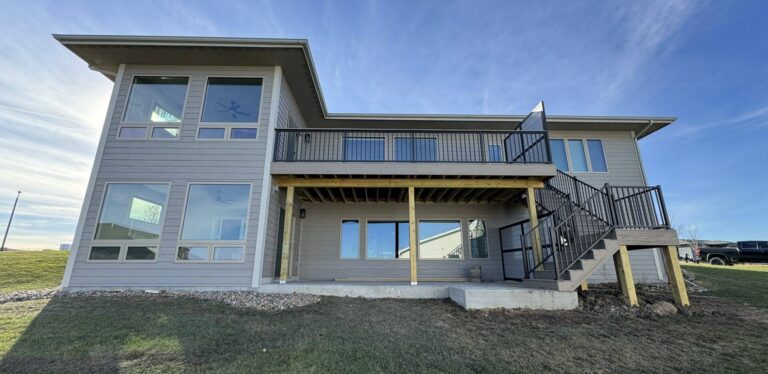
A 300 square foot deck sitting two feet off the ground needs footings, framing, and a walking surface. The same 300 square feet twelve feet up needs taller posts, lateral bracing, guardrails on every open side, and a code-compliant stair with consistent rise and run plus a graspable handrail.
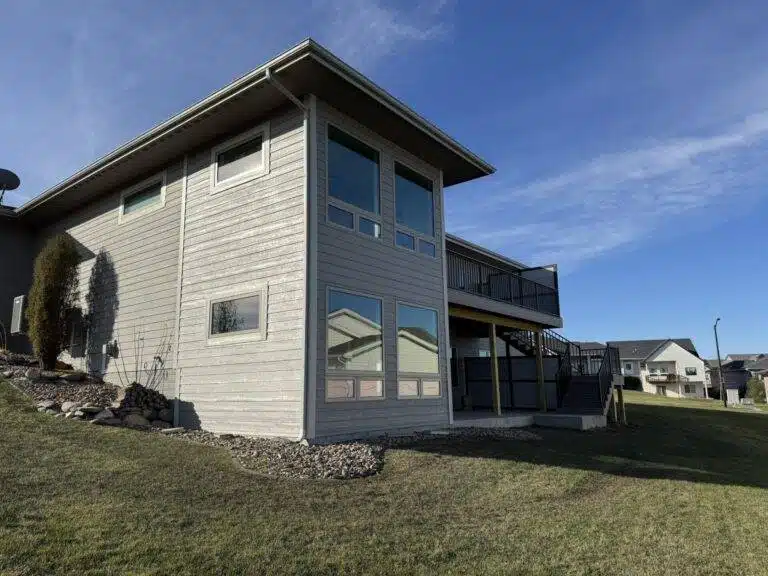
On sloped Clive lots backing to the greenbelt, that elevated condition is common rather than exceptional.
Pro Tip 1: Measure from finished grade to your door threshold before requesting quotes. That single number moves pricing more than the footprint does.
Deck Cost in Clive by Material
Pressure-treated pine is the least costly at $30 to $52 per square foot installed. Composite runs $58 to $98 and PVC $68 to $115, and both last far longer than wood.
| Material | Installed cost per sq ft | 350 sq ft deck | Service life |
|---|---|---|---|
| Pressure-treated pine | $30 to $52 | $10,500 to $18,200 | 15 to 20 years with maintenance |
| Cedar | $42 to $68 | $14,700 to $23,800 | 15 to 25 years with maintenance |
| Composite | $58 to $98 | $20,300 to $34,300 | 25 to 30+ years |
| PVC / capped polymer | $68 to $115 | $23,800 to $40,250 | 30+ years |
Those assume a rectangular deck at moderate height. Multi-level designs, wrapped posts, built-in seating, and integrated lighting push well past them.
Pro Tip 2: Price pressure-treated and composite against the identical design. It is the only honest way to see the tradeoff.
Wood or Composite in Iowa
Pressure-treated costs roughly half of composite up front. In Iowa’s freeze-thaw cycles and summer humidity it needs cleaning and resealing every two to three years to reach its expected life. Skipped maintenance shortens that considerably.
Composite costs more initially and needs washing rather than sealing. It will not rot or splinter. It runs warmer in direct sun, and lower-tier products can fade.
| Consideration | Pressure-treated | Composite |
|---|---|---|
| Up-front cost | Lower | Higher |
| Maintenance | Seal every 2 to 3 years | Wash periodically |
| Freeze-thaw durability | Good if maintained | Very good |
| Surface heat in sun | Cooler | Warmer |
| Total cost over 25 years | Converges with composite | Converges with wood |
Over a full service life the two often land close, because sealing a deck ten times is not free. The real question is whether you would rather spend money now or weekends later.
Pro Tip 3: If you honestly will not reseal on schedule, buy composite. Self-assessment saves more here than any spec sheet.
Clive Permits and Setbacks
Clive handles permits and licenses through the city, reachable at 515-223-6220, and publishes permit and license information through its website.
Decks generally require a permit. Attached decks almost always do, because attaching to the house is a structural connection to existing framing. Freestanding decks above a certain height typically require them as well.
Setbacks matter more in Clive than in many communities because of greenbelt adjacency and easements on creek-side lots. A deck that encroaches on a setback or easement has to be redesigned.
Iowa’s statewide residential floor moved to the 2024 International Residential Code effective September 10, 2025 under Iowa Administrative Code 481, chapter 301. Cities adopt building and fire code editions on their own schedules, so confirm current local adoption before designing.
Pro Tip 4: Pull your plat and confirm easements before designing, especially on a greenbelt-adjacent lot. Drainage and utility easements are not always obvious from the yard.
Pro Tip 5: Call 811 before any digging. Footing holes reach utility depth, and the call is free and legally required.
Frost Line and the Details That Matter
Deck footings must sit below the frost line, generally 42 inches, to prevent frost heave. The ledger attachment to the house is the most common failure point and needs proper flashing and solid framing.
| Element | Requirement | Why it matters |
|---|---|---|
| Footing depth | Below frost line, generally 42 inches | Prevents frost heave |
| Footing diameter | Sized to the load carried | Prevents settling |
| Post-to-footing connection | Approved metal connector | Prevents movement and rot |
| Ledger attachment | Properly flashed, fastened to solid framing | The most common failure point |
| Guardrails | Required above a certain height | Life safety |
| Stair rise and run | Consistent within tight tolerance | Life safety and inspection |
The ledger row is the one that matters most. Deck failures overwhelmingly begin where the deck meets the house. Correct flashing, correct fasteners, and attachment to solid framing rather than sheathing are what separate a safe deck from a hazard.
Pro Tip 6: Ask any contractor to describe their ledger flashing detail specifically. A vague answer is disqualifying.
Pro Tip 7: Never accept footings that were poured without inspection. Depth cannot be verified after concrete goes in.
What Drives Clive Deck Costs
Elevation above grade adds the most, at $1,800 to $9,000 compared with a ground-level deck. Railing runs $40 to $150 per linear foot, and a multi-level design adds $3,000 to $12,000.
| Driver | Typical impact |
|---|---|
| Elevation above grade | $1,800 to $9,000 versus ground level |
| Stairs and landings | $1,200 to $4,500 |
| Railing material and style | $40 to $150 per linear foot |
| Multi-level design | $3,000 to $12,000 |
| Sloped or difficult site access | $800 to $3,000 |
| Built-in seating or planters | $1,500 to $6,000 |
| Integrated lighting | $800 to $3,500 |
| Under-deck drainage system | $2,000 to $6,000 |
Railing surprises people most. On a large elevated deck, railing can approach the cost of the surface itself, and cable or glass systems escalate fast.
Pro Tip 8: Price railing separately and by linear foot. It is the easiest lever for adjusting budget without shrinking the deck.
Illustrative Scenarios
Illustrative scenario: A Clive family built a 300 square foot ground-level pressure-treated deck off their kitchen with a short stair and wood railing. The project came in near $13,500 across roughly two weeks.
Illustrative scenario: A Clive couple on a greenbelt-backing lot built a 420 square foot composite deck about ten feet above grade with a full stair, black aluminum railing, and post-cap lighting. Elevation, stairs, and railing brought the project to roughly $33,000 over four and a half weeks.
Illustrative scenario: A Clive homeowner replaced a heaving twenty-year-old deck. The original footings had not reached frost depth, so the frame could not be salvaged. Demolition, new footings, and a composite surface came to about $27,500, more than the original deck cost new.
Pro Tip 9: Replacing an older deck? Have the footings evaluated before assuming you can reuse the frame. Shallow footings are the usual reason a deck cannot be resurfaced.
Pro Tip 10: Build in late spring or early fall. Iowa summer heat slows crews and frozen ground makes footing excavation harder and costlier.
Pro Tip 11: Confirm the quote states how many footings are planned and includes concrete. Vague footing counts are where cheap bids hide.
Pro Tip 12: Read the warranty. Material warranties and workmanship warranties are different documents with different terms.
Our deck building service page explains how we approach these projects. For local work, see deck building in Clive. For metro-wide ranges, our Des Moines deck cost guide goes broader.
For primary sources, Iowa’s residential building requirements are published as Iowa Administrative Code 481-301. Wood construction and connection guidance comes from the American Wood Council. Contractor registration is administered by the Department of Inspections, Appeals, and Licensing.
Frequently Asked Questions
How much does a deck cost in Clive? Most run $10,000 to $38,000. A 350 square foot pressure-treated deck at ground level starts near $10,500. The same footprint in composite, elevated, with a full stair and upgraded railing can exceed $35,000. Elevation and railing drive cost more than square footage.
Do I need a permit to build a deck in Clive? Generally yes, particularly for attached decks. Clive can be reached at 515-223-6220. Confirm setbacks and easements before finalizing a footprint, which matters especially on greenbelt-adjacent lots where drainage and utility easements are common.
How deep do deck footings need to be in Iowa? Below the frost line, generally 42 inches. Shallower footings heave during freeze-thaw cycles and pull a deck permanently out of level. Footings should be inspected before concrete is poured, since depth cannot be verified afterward.
Is composite worth the extra cost? It depends on maintenance tolerance. Composite runs roughly twice pressure-treated up front but needs washing rather than sealing every two to three years. Over a full service life the totals often converge. If you will not reseal wood on schedule, composite is the better purchase.
Can I reuse my old deck frame? Sometimes, but have footings evaluated first. Decks built before current frost-depth practice often have shallow footings, and a heaved frame cannot be corrected by replacing the surface. Do that evaluation before budgeting a resurfacing project.
What is the most common cause of deck failure? The ledger connection where the deck attaches to the house. Improper flashing, incorrect fasteners, or attachment to sheathing instead of solid framing are the leading causes. Ask every contractor to explain their ledger detail.
Key Takeaways
Cost
- Most Clive decks run $10,000 to $38,000
- Elevation and railing drive cost more than size
- Price railing separately by linear foot
Materials
- Pressure-treated is cheapest up front, needs sealing every 2 to 3 years
- Composite costs more initially, needs washing only
- Totals often converge across 25 years
Iowa requirements
- Footings below frost line, 42 inches
- Inspect footings before concrete is poured
- Ledger flashing is the critical safety detail
Clive specifics
- City at 515-223-6220
- Confirm setbacks and easements, especially greenbelt lots
- Call 811 before digging
Ready to Build in Clive?
We have completed 1,285+ projects across Central Iowa since 2020, including elevated decks on sloped and greenbelt-adjacent lots. We will walk the yard, talk through elevation and material honestly, and give you a written scope.
Free consultation, no pressure, no obligation.
Call: 844-435-9800
Written warranty on workmanship (details provided in your contract).
Disclaimer: This article is for general information and is not project-specific advice. Cost figures are planning estimates that vary by scope, materials, site conditions, and current pricing. Permit requirements, setback and easement rules, and adopted code editions vary by city and change over time; the Clive details cited here were verified in July 2026 and should be reconfirmed with the city before you rely on them. Footing depth, guardrail, stair, and ledger attachment requirements must be confirmed against current Iowa administrative rules and local amendments for your specific project. Structural work requires evaluation by a qualified professional. Contact 811 before any excavation. No specific outcomes are guaranteed. Consult a registered contractor for guidance specific to your project.
Busy Builders | Full-Service Construction and Remodeling | Serving Central Iowa Since 2020