Families across Central Iowa face the same challenge at different moments. A new baby is coming and the nursery has nowhere to go. An aging parent needs a safe place to live close by. A college student is moving back home. A home office is about to become permanent, and it would help if the room legally counted as a bedroom at resale. The question is always the same. How do you add a bedroom to an Iowa home in a way that is legal and worth the money? This guide covers every path, Iowa’s legal requirements, Des Moines permit costs, and how the four main methods compare.
TLDR: Adding a bedroom in Iowa ranges widely by method. Room division starts at $3,200. A full custom addition with Busy Builders in the Des Moines metro can run $150,000 or more. Full bedroom and bath additions average around $120,000 or higher. Every legal bedroom in Iowa needs a compliant egress window, at least 70 square feet, and a 7-foot ceiling over half the room. Iowa’s new ADU law effective July 1, 2025 gave every single-family homeowner the right to add at least one accessory dwelling unit.
Why Iowa Families Are Adding Bedrooms
Demand for bedroom space in Central Iowa reflects real shifts in how families live. Multi-generational households are growing. Returning adult children often need private space. Home offices are now permanent features. Owners want them counted toward bedroom totals at resale.
Ankeny, Waukee, and Johnston rank among Iowa’s fastest-growing cities. Iowa construction costs run 20 to 25 percent below the national average. Bedroom additions here are a stronger financial move than in most other states.
Iowa also passed Senate File 592, effective July 1, 2025. The law gave every single-family homeowner the right to add at least one accessory dwelling unit. That opens options that did not exist a year ago, especially for families housing an aging parent or seeking rental income.
What Makes a Room a Legal Bedroom in Iowa?
This is the most important section of this guide, and the one most homeowners skip until they hit a problem. A room is not a bedroom because you say it is. A room is a bedroom because it meets specific code requirements. Iowa adopts these requirements from the International Residential Code, or IRC.
Adding a sleeping space that does not meet these requirements creates three problems. You cannot legally call it a bedroom at sale. An appraiser will not count it as a bedroom. And a missing egress window creates a genuine life-safety hazard.
The IRC requires the following for any habitable bedroom in Iowa.
A bedroom must have at least 70 square feet of floor area. Closet space does not count toward this minimum. The room must have a minimum dimension of 7 feet in one direction. A 7-by-10 foot room qualifies. A 3.5-by-20 foot hallway-shaped room does not. The ceiling must be at least 7 feet tall over 50 percent of the required floor area. For attic bedrooms with sloped ceilings, only areas with at least 5 feet of ceiling height count toward the minimum.
The bedroom must have direct access from a common area like a hallway or living room. You cannot pass through one bedroom to reach another. The room needs a permanent door, not a curtain. It must also have either a window for natural light and ventilation or mechanical ventilation that meets code.
The most important requirement is the egress window.
The Egress Window: Why It Matters and What It Requires
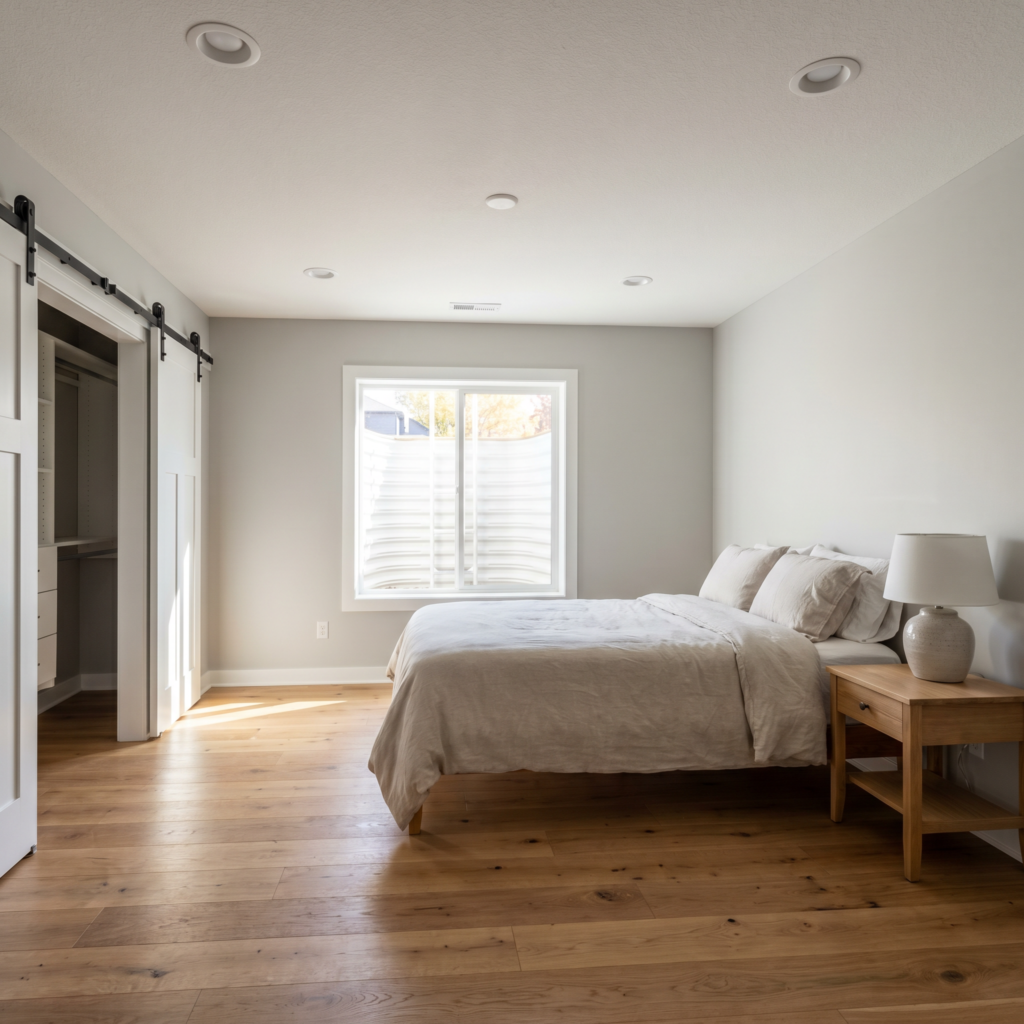
Every sleeping room in Iowa must have an egress window or a door that opens directly outside. The purpose is simple. In a fire, the occupant needs a way out that avoids the rest of the house. Firefighters need a way in that avoids burning hallways. The minimum dimensions are not arbitrary. They are the smallest opening a firefighter in full gear can fit through.
| Egress Window Requirement | Specification |
|---|---|
| Minimum net clear opening | 5.7 square feet |
| Minimum opening height | 24 inches |
| Minimum opening width | 20 inches |
| Maximum sill height from floor | 44 inches |
| Window well (if below grade) | Minimum 9 sq ft horizontal area, 36-inch projection |
| Permanent ladder | Required if window well is deeper than 44 inches |
| Window well grate | Must be removable without tools |
For basement bedrooms, the window typically sits below grade, which requires a window well. The well must allow a person to climb out. That is why the 9-square-foot minimum and 36-inch projection exist. A well deeper than 44 inches needs a permanent ladder. Any grate or cover must open from the inside without tools. A person escaping a fire will not have time to find a screwdriver.
Installing a compliant basement egress window typically costs $3,000 to $6,000 in Central Iowa. Excavation adds more when needed. This is not a place to cut corners. A bedroom without compliant egress is not a bedroom at all. It is a legal liability and a life-safety risk.
The Closet Question: Where Iowa Counties Differ
Iowa building code does not require a closet for a room to be classified as a bedroom. The IRC does not list a closet as a habitable-space requirement. Polk, Dallas, Madison, and Warren counties cover the Des Moines metro. They effectively expect a closet for a room to be marketed as a bedroom at resale. Linn County does not.
If you are adding a bedroom in the Des Moines metro, plan for a closet. Real estate listings routinely decline to call a closet-less room a bedroom. A room you spent $30,000 creating could appear in the MLS as an “office.” A 4-foot reach-in closet adds roughly $1,347 to $1,475 in Iowa. Small price to ensure the room counts at sale.
Bedroom requirements can vary by county and municipality. Always confirm what qualifies as a legal bedroom in your specific location with the City of Des Moines Permit and Development Center at (515) 283-4200 or your local building department before starting work.
The Four Ways to Add a Bedroom in Iowa
Every bedroom addition in Iowa falls into one of four categories. Each has a different cost profile, permit burden, timeline, and resale return. The right choice depends on your home’s layout, budget, and how much square footage you actually need.
Option 1: Build a True Home Addition
A true home addition adds new square footage by extending the existing footprint outward or building upward. It is the most expensive option and the one that adds the most resale value. It increases the actual size of the home as measured by appraisers.
Iowa home addition costs vary widely depending on who does the work. Statewide averages for standard-grade construction run $79 to $140 per square foot. That puts a 200 to 300 square foot bedroom addition in the $24,000 to $56,000 range as a broad planning reference. That figure includes rural and budget-tier builders across all 99 counties.
For a full-service custom contractor in the Des Moines metro, real pricing runs higher. Busy Builders home additions start at $250 to $500 per square foot depending on finish level and complexity. A typical 200 to 300 square foot bedroom addition with us lands in the $50,000 to $150,000 range. Adding a full bathroom pushes the Des Moines metro average to roughly $120,000 or more. Plumbing rough-in, fixtures, tile, and venting add significant cost.
The reason for the gap is not markup. It is scope. Custom contractor pricing reflects registered GC oversight, licensed trade coordination, full permit management, code compliance, and a written warranty. Budget-tier averages do not include those protections. The same square footage can cost dramatically less on paper and create problems at inspection, resale, or insurance.
Building out (single-story) generally costs less per square foot than building up. A second story requires removing or reinforcing the existing roof and often reinforcing walls and foundation below. Iowa’s frost line sits at 42 inches. Any footings must extend below that depth to prevent frost heave. Inspectors verify footing depth before concrete is poured. This is non-negotiable.
Timeline for a Des Moines home addition runs 4 to 8 months from first design meeting to final walkthrough. Construction itself takes 3 to 6 months. Permit approval adds roughly 3 weeks. Our home additions service covers the full range, including extra stories, ADUs, sunrooms, tornado shelters, and garage additions.
Option 2: Finish an Existing Unfinished Space
The second option does not add square footage. It converts space that already exists but is unfinished into a legal bedroom. Iowa has an advantage here because most Central Iowa homes have full basements, and many have unfinished attic or bonus-room space. For homeowners with these spaces, conversion is almost always the best value per dollar spent.
A basement bedroom in Eastern Iowa typically costs $15,000 to $30,000 if the basement already has the right conditions. The biggest cost variable is the egress window at $3,000 to $6,000 installed (more with excavation). Basement ceiling height needs to meet the 7-foot rule over half the floor area. Most modern basements do. Older basements sometimes do not.
An attic bedroom typically costs $7,500 to $35,000. Cost depends on the attic’s existing condition, access route, and ceiling slope. Walk-up stairs are dramatically cheaper than pull-down ladders, because a proper bedroom needs a proper staircase. Sloped ceilings reduce usable floor area under the IRC calculation. An attic that looks spacious may not meet the 70-square-foot requirement once the 5-foot ceiling height cutoff is applied.
A garage conversion runs $6,026 to $27,516. The tradeoff is permanent loss of garage space, which affects resale for buyers who need covered parking. Garage conversions require insulation upgrades, floor raising (since garage floors slope for drainage), and often a new HVAC system. Our guide on finished basement vs. home addition covers the tradeoffs in detail.
Option 3: Divide an Existing Room
The third option is the least disruptive and the cheapest. Some homes have a large bonus room, oversized bedroom, or finished basement rec room that can be divided into two separate rooms. Cost runs $3,201 to $10,768 in Iowa. Typical line items:
- Non-load-bearing interior wall: $974 to $3,168
- Door: $420 to $1,200
- Closet: $1,500 to $2,500
- Window: $235 to $2,500
- Basic electrical work: $70 to $1,150
The new room still has to meet all IRC bedroom requirements. Being inside an existing room does not exempt it from the 70-square-foot minimum, the 7-foot ceiling, or the egress window requirement. That last one is a common surprise. A room carved from interior space may not have access to an exterior wall for a window. If that is your situation, division may not work.
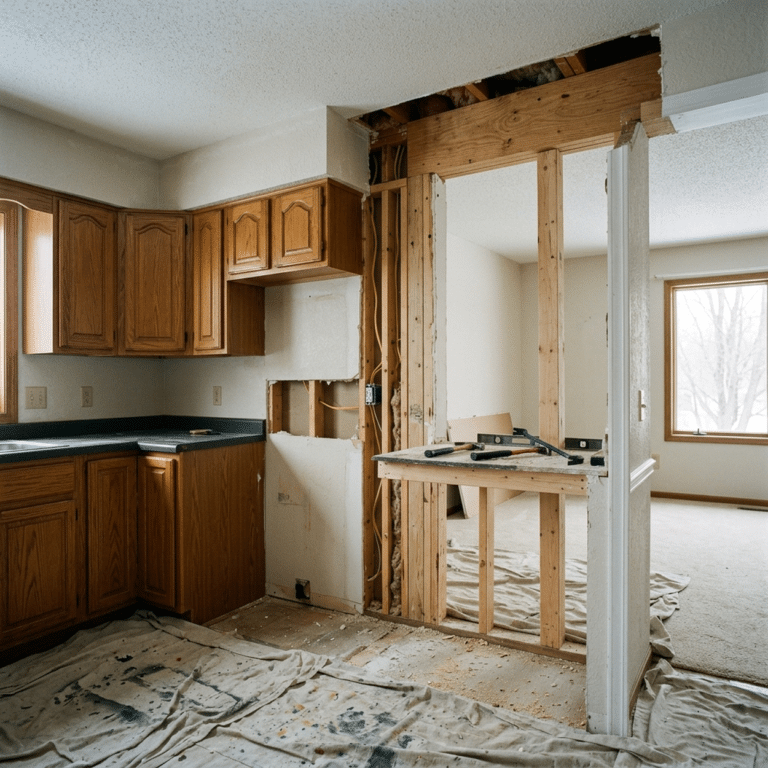
The biggest risk with room division is hitting a load-bearing wall unexpectedly. A load-bearing wall cannot be divided without structural engineering input. What looked like a $5,000 project can turn into a $20,000 project the moment framing opens up. Start any division project with a professional assessment of which walls are load-bearing before demolition begins.
Option 4: Build an ADU (Iowa’s New Senate File 592)
The fourth option is the newest. Iowa Senate File 592 was signed May 1, 2025, and took effect July 1, 2025. It gave every single-family homeowner in Iowa the legal right to add at least one accessory dwelling unit, or ADU. An ADU is a separate, self-contained living unit. It can be attached to the main house, detached as a backyard cottage, or built as an interior conversion. An example is a basement apartment with its own entrance.
Under SF 592, an ADU can be up to 1,000 square feet or 50 percent of the primary home’s square footage, whichever is larger. The full text is available on the Iowa Legislature’s website. Cities cannot require owner-occupancy, mandate extra parking beyond what the primary home uses, or impose restrictive aesthetic matching rules. Des Moines allows up to 3 ADUs per lot for a maximum of 4 total units.
ADU costs nationally run $100 to $300 per square foot. A typical Iowa ADU lands toward the lower end. A 600-square-foot detached ADU with a bedroom, full bath, and kitchenette might run $60,000 to $90,000 in Central Iowa. That makes it competitive with a bedroom-and-bath addition while often providing more functional value.
ADUs must still comply with all building codes, setbacks, and permit processes. State law sets the floor. Local rules fill in the details. Verify your city’s ADU regulations before designing or budgeting.
How the Four Methods Compare
| Method | Typical Iowa Cost | New Square Footage | Permit Required | Timeline | Best For |
|---|---|---|---|---|---|
| Home addition (build out) | $50,000 to $150,000+ Busy Builders; $24,000 to $56,000 statewide average | Yes | Yes, full plans | 4 to 8 months | Families wanting max resale impact |
| Basement conversion | $15,000 to $30,000 | No | Yes | 2 to 4 months | Best ROI per dollar in Iowa |
| Attic conversion | $7,500 to $35,000 | No | Yes | 2 to 4 months | Homes with walk-up attic |
| Garage conversion | $6,000 to $27,500 | No | Yes | 1 to 3 months | Lower cost, loses parking |
| Room division | $3,200 to $10,800 | No | Likely yes | Weeks to 2 months | Homes with oversized rooms |
| ADU (detached or attached) | $60,000 to $180,000 | Yes | Yes, full plans | 4 to 10 months | Multi-gen families, rental income |
Des Moines Permits and What to Expect
Every bedroom addition in Des Moines requires a building permit if it adds square footage or changes the footprint. Trade permits for electrical, mechanical, and plumbing work are also required. Skipping permits creates problems at resale, with insurance carriers, and with mortgage lenders, who can call loans if unpermitted work is discovered.
Des Moines permit fees scale with project size. A small addition under $50,000 pays $500 to $1,500 for the building permit. A standard addition between $50,000 and $150,000 runs $1,000 to $3,000. Large or second-story additions above $150,000 pay $2,000 to $5,000 or more. Each trade permit (electrical, mechanical, plumbing) adds $75 to $500. A plan review fee of roughly 65 percent of the building permit fee applies for projects requiring architectural and structural review.
Additions over 200 square feet require full documentation. Required items include:
- Architectural drawings
- Structural engineering plans stamped by a licensed engineer
- Site plan showing setbacks
- Foundation plan showing footing depth
- Energy code compliance paperwork
Additions under 200 square feet go through a simpler review. Permit approval typically runs about 3 weeks for standard projects. Complex projects take longer. Plan the permit timeline as a buffer, not an afterthought.
Des Moines requires inspections at footing (before concrete), framing (before insulation), insulation (before drywall), and final (at completion). Each must be passed to move forward.
Iowa state law requires calling 811 or visiting iowaonecall.com at least 48 business hours before any excavation. This is free, mandatory, and failure to call can result in fines plus the real risk of hitting underground utility lines.
Setbacks matter too. Every Des Moines lot has required minimum distances between structures and property lines. These vary by zoning district. A home addition cannot violate them. Before spending on design, confirm setbacks for your zoning district with the Des Moines Permit and Development Center. It is a free call that can save a homeowner from discovering mid-design that the addition will not fit on the lot.
Permit requirements vary based on project scope and location. Always confirm current requirements with the Des Moines Permit and Development Center at (515) 283-4200 before starting any work.
Does Adding a Bedroom Increase Home Value in Iowa?
Honest information matters more than optimistic marketing here. Adding a bedroom can increase home value, but the mechanism is not as simple as most homeowners assume.
Appraisers primarily value added square footage, not bedroom count. Two homes with identical square footage (one with 3 bedrooms, one with 4) often appraise for very similar amounts. The bedroom count adjustment is typically small. Converting an existing room into a bedroom without adding square footage has less appraisal impact than a true addition.
Industry estimates suggest bedroom additions can add 10 to 20 percent to existing home value. Some sources cite $30,000 to $50,000 per bedroom. These numbers are highly market-dependent. A fourth bedroom in a neighborhood where all comparable homes have four adds limited marginal value. A fourth bedroom in a neighborhood dominated by three-bedroom homes can shift which comparable sales the appraiser uses. That can meaningfully lift the appraised value.
Des Moines ROI reality: a full home addition returns about 30 to 35 percent of its cost at resale. A basement conversion with a bedroom returns about 70 percent. The basement number is higher because the baseline cost is lower. A finished basement with a legal bedroom is also a major marketing feature in Iowa.
| Method | Typical Cost | Estimated ROI |
|---|---|---|
| Full bedroom addition | $50,000 to $150,000+ Busy Builders | Roughly 30 to 35% |
| Basement bedroom conversion | $15,000 to $30,000 | Roughly 70% |
| Room division | $3,200 to $10,800 | Varies widely |
| Bedroom + full bath addition | ~$120,000 Des Moines | Roughly 30 to 35% |
The honest conclusion: basement conversion typically returns the best ROI per dollar in Central Iowa. A full addition produces more total value but at a lower percentage return. The right choice depends on whether you need the square footage functionally and how long you plan to stay. Neighborhood price ceiling also matters. Over-improving past what comparable homes support means the addition’s cost will not fully return at resale.
ROI figures are industry estimates for planning purposes, not financial advice, and actual returns vary by home, neighborhood, market conditions, and quality of construction.
Frequently Asked Questions
What makes a room a legal bedroom in Iowa? Under Iowa’s adopted IRC, a bedroom must meet several requirements. It needs at least 70 square feet of floor area, excluding closets. It needs a minimum 7-foot dimension in any direction. It needs a 7-foot ceiling over at least half the room. It needs a compliant egress window and direct access from a common area rather than through another bedroom. In the Des Moines metro, a closet is also effectively expected for resale listing purposes, even though code does not strictly require one. Confirm requirements for your specific location with (515) 283-4200.
How much does it cost to add a bedroom in Iowa? Costs vary widely by method. Dividing an existing room runs $3,200 to $10,800. A basement conversion runs $15,000 to $30,000. For a full-service Des Moines metro contractor like Busy Builders, a true home addition runs $250 to $500 per square foot. A 200 to 300 square foot bedroom addition lands in the $50,000 to $150,000 range. Bedroom and bath additions average around $120,000 or higher. These are planning estimates and actual costs vary.
Do you need a permit to add a bedroom in Des Moines? Yes. Any addition that adds square footage requires a building permit, and trade permits for electrical, mechanical, and plumbing work are required separately. Additions over 200 square feet require full architectural and structural engineering plans. Permit fees range from $500 to $5,000 or more depending on scope. Approval typically takes about 3 weeks.
Does an egress window really matter for a bedroom? Yes. The egress window is a life-safety requirement, not a bureaucratic formality. It is the escape route in a fire and the entry point for firefighters. Iowa requires every sleeping room to have either a compliant egress window or a door that opens directly outside. Minimum specifications include a 5.7-square-foot net clear opening, a 24-inch minimum opening height, a 20-inch minimum width, and a maximum sill height of 44 inches from the floor.
Does adding a bedroom increase home value in Iowa? It can. Appraisers primarily adjust for square footage rather than bedroom count alone. True additions that add square footage produce more total value gain than conversions of existing space. Industry estimates suggest 10 to 20 percent value increases or $30,000 to $50,000 per bedroom. Actual returns vary significantly by neighborhood and market. Basement conversions typically return around 70 percent ROI in Central Iowa. Full additions return roughly 30 to 35 percent.
Can I add an ADU or separate bedroom suite under Iowa’s new law? Yes. Iowa Senate File 592, effective July 1, 2025, gives every single-family homeowner the right to add at least one ADU. ADUs can be detached, attached, or interior conversions. The size limit is 1,000 square feet or 50 percent of the primary home, whichever is larger. ADUs still require all applicable permits and must meet code. Local ADU rules still apply within the state law framework.
Key Takeaways
Legal requirements come first. Every legal bedroom in Iowa needs at least 70 square feet of floor area. It needs a 7-foot minimum dimension, a 7-foot ceiling over half the room, a compliant egress window, and direct access from a common area. Skipping any of these means the room is not a legal bedroom.
Method determines cost and ROI. Room division runs $3,200 to $10,800. Basement conversions run $15,000 to $30,000 and return roughly 70 percent at resale. Busy Builders home additions in the Des Moines metro start at $250 to $500 per square foot. ADUs typically run $60,000 to $180,000.
Permits are not optional. Des Moines requires a building permit for any addition. Trade permits for electrical and mechanical work are separate. Full plans are required for projects over 200 square feet. The Des Moines Permit and Development Center at (515) 283-4200 confirms requirements.
Iowa’s new ADU law opens options. Senate File 592 effective July 2025 gives every single-family homeowner the right to add at least one ADU. The size cap is 1,000 square feet or 50 percent of the primary home, whichever is larger.
Basement conversions typically win on ROI. A well-executed basement bedroom conversion with a compliant egress window returns more per dollar spent than a full addition. Full additions produce more total value at a lower percentage return.
Ready to Plan Your Bedroom Addition?
Busy Builders has served Central Iowa since 2020 with 1,285+ completed projects. We work across Des Moines, West Des Moines, Ankeny, Waukee, Johnston, Urbandale, Grimes, and Clive. Every project gets honest pricing, a written plan, and a registered general contractor on site from first footing to final walkthrough. Licensed trade work is coordinated from one point of contact.
Our full range of remodeling services handles every bedroom addition method covered in this guide. We cover room divisions, basement conversions, full home additions, and ADUs across our Des Moines service area. We handle permit filing and coordinate structural engineering when load-bearing walls come into play. We manage egress window installation and inspection for basement bedrooms. We stay on the job through every Des Moines inspection milestone.
Call: 844-435-9800
Website: https://busybuildersiowa.com/
Cost and ROI figures are industry estimates for planning purposes, not financial advice, and actual returns vary. Permit requirements vary based on project scope and location. Confirm current requirements with the Des Moines Permit and Development Center before beginning work. Load-bearing wall removal or modification requires a structural engineer’s assessment. Bedroom requirements vary by county and municipality. Egress window specifications are life-safety requirements enforced by Iowa code. Written warranty on workmanship is provided with every Busy Builders project, with details in your contract.
Busy Builders | Full-Service Construction and Remodeling | Serving Central Iowa Since 2020