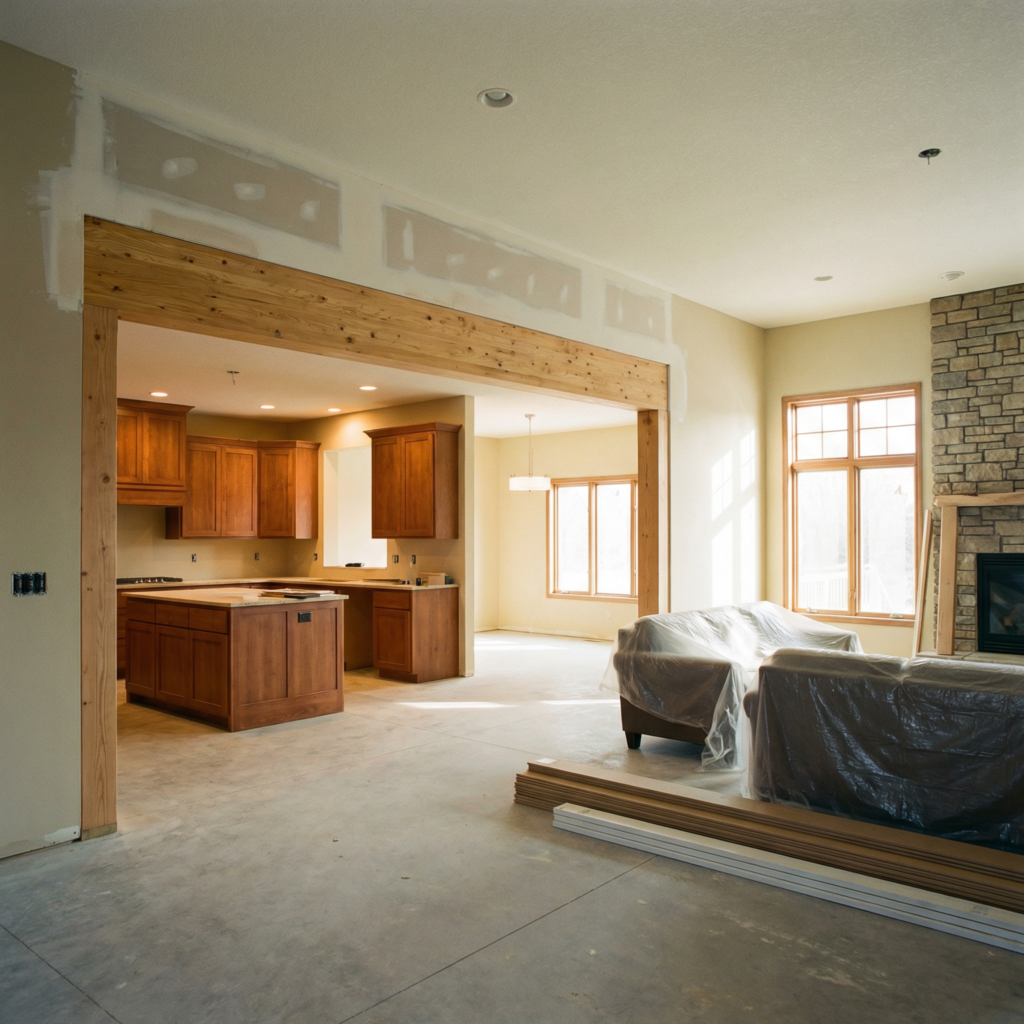
An open floor plan can change how your home feels and functions. Removing a wall between a cramped kitchen and a disconnected living room is one of the most impactful remodeling moves a homeowner can make. But if that wall is load-bearing, the project involves structural engineering, a building permit, a properly engineered beam installation by a registered Iowa contractor, and careful coordination with licensed trade contractors. This guide walks Central Iowa homeowners through what the process actually looks like, what it costs, and what happens when the proper steps get skipped.
TLDR: Removing a load-bearing wall in Iowa requires a structural engineer, a building permit, and a registered contractor. Total project costs for most Central Iowa single-story homes range from $4,000 to $15,000+, depending on beam type, utility rerouting, and finish work. Skipping permits creates fines, forced demolition, and resale problems. Read on for the full Iowa-specific process, cost breakdown, and beam selection guide.
Last updated September 2026.
Your neighbor just opened up their kitchen, and it looks incredible. Now you’re staring at the wall between your dining room and living room,m wondering how hard it could really be. The honest answer is: it depends entirely on what that wall is doing.
Partition walls divide rooms. They carry no structural load and are relatively simple to remove. Load-bearing walls carry the weight of the roof, upper floors, or both, and channel that load down through the framing into the foundation. Remove a load-bearing wall without proper support in place, and you risk ceiling sag, cracked drywall, uneven floors, and, in serious cases, structural failure.
This is not a project to figure out as you go. Here is what Central Iowa homeowners need to know before touching a single stud.
What Is a Load-Bearing Wall?
A load-bearing wall transfers structural weight, typically from the roof or upper floors, downward through the framing to the foundation. A partition wall divides the space. It carries no load and can generally be removed without major engineering work.
Confusing the two is the most dangerous mistake in structural remodeling. Many Central Iowa homes built between the 1960s and 1990s, including the ranch, split-level, and tri-level styles common in suburban Des Moines, Ankeny, and West Des Moines, have center walls that run parallel to the roof ridge and carry significant structural load. These walls are easy to misjudge from a visual inspection alone.
Table 1: Load-Bearing Wall Indicators vs. Partition Wall Indicators
| Signs It Is Load-Bearing | Signs It Is NOT Load-Bearing |
|---|---|
| Runs perpendicular to floor joists | Runs parallel to floor joists |
| Has a beam, post, or wall directly below it in the basement | No corresponding structure below |
| Located near the center of the home | The wall is 6+ inches thick |
| The wall is standard 3.5-inch framing | The foundation post or column aligns beneath it |
| Original blueprints show structural notation | Blueprints show no structural designation |
| Foundation post or column aligns beneath it | No foundation support aligns below |
These indicators give you a starting point. They are not a final determination. Only a licensed structural engineer or registered contractor with structural experience can confirm whether a wall is load-bearing. Do not begin any removal work based solely on visual inspection.
How to Check Before You Call Anyone
Iowa’s near-universal basement construction is actually an advantage here. Most Central Iowa homes offer direct access to the unfinished basement framing for a pre-call visual check.
Go to the basement and look at which direction the floor joists run. If the wall above sits perpendicular to those joists, it is likely load-bearing. If a beam, post, or column in the basement aligns directly beneath the wall, that is a strong indicator of a load path. For a deeper reference on identifying wall types and the removal process, This Old House offers a thorough walkthrough from experienced structural professionals.
If you have original blueprints, load-bearing walls are typically drawn with thicker lines or structural notations. Your local building department may have a copy on file if you don’t.
These steps help you ask better questions when you hire an engineer. They do not replace the engineer.
The Right Order of Operations in Iowa
Iowa’s residential building code (2024 IRC with state amendments) requires engineered structural calculations for any permit application involving structural alterations. Cutting corners on the sequence below creates problems at inspection, at resale, and potentially in the structure itself years later. Busy Builders has managed this process for 1,285+ Central Iowa homeowners since 2020, and the sequence never changes regardless of project size.
- Consult a structural engineer first, before pricing, planning, or contacting contractors. The engineer confirms whether the wall is load-bearing and specifies beam size, post placement, and foundation requirements.
- Get stamped engineered drawings. Iowa permit applications for structural alterations require stamped calculations from a licensed engineer.
- Pull the building permit. Iowa law requires a permit for all load-bearing wall removal. Des Moines charges $150 for the renovation permit plus $75 per applicable trade sub-permit. Verify your municipality’s specific fee schedule before budgeting. You can check contractor registration status and permit requirements through the Iowa DIAL portal at dial.iowa.gov.
- Hire a registered Iowa contractor. Iowa requires general contractors to be registered through DIAL. Electricians, plumbers, and HVAC technicians hold separate state licenses and must be brought in for any utility rerouting under their own sub-permits.
- Install temporary walls on both sides before demolition begins. These carry the load while the original wall is removed.
- Remove the wall and install the beam and posts. The beam spans the new opening. Posts carry the load to the floor below and down to the foundation.
- Schedule rough-in inspections for any electrical, plumbing, or HVAC work before drywall is closed.
- Pass final inspection before the project is considered complete.
Table 2: Iowa Permit Costs and Review Timelines by Jurisdiction
| Jurisdiction | Base Permit Fee | Trade Sub-Permit | Typical Review Time | Notes |
|---|---|---|---|---|
| Des Moines (Polk County) | $150 | $75 each | 5-7 business days | Online portal available |
| Waukee / West Des Moines (Dallas County) | Contact city building department. directly | Varies | Contact the city directly | Contact the city building department. directly |
| Scott County | Varies | $75 each | 3-5 business days | Lists load-bearing walls explicitly as requiring permits |
| Ankeny / Grimes | Contact city directly | Varies | 5-7 business days | Follows Polk County IRC adoption |
| General Iowa range | $100-$800 | Varies by trade | 3-10 business days | Fees set locally; always verify before budgeting |
Permit fees and timelines are subject to change. Contact your local building department to confirm current rates before finalizing your project budget.
What Does Load-Bearing Wall Removal Actually Cost in Iowa?
Total project cost depends on how many stories your home has, how long the wall span is, whether utilities run through the wall, and what type of beam the engineer specifies. These figures combine engineering, permitting, demolition, beam installation, and finish work.
Table 3: Iowa Load-Bearing Wall Removal Cost Breakdown by Component
| Cost Component | Range | Notes |
|---|---|---|
| Structural engineer inspection | $150-$300 | Basic wall confirmation |
| Structural engineer stamped plans | $1,000-$2,500 | Each trade is billed and permitted separately |
| Building permit (Des Moines) | $150 | Renovation/interior remodel |
| Trade sub-permits (each) | $75 | Electrical, plumbing, or HVAC |
| Wall demolition | $0.30-$6.40/sq ft | Depends on size and finishes |
| LVL beam installed | $800-$2,500 | Most common for Iowa ranches |
| Steel I-beam installed | $1,200-$4,200 | Used for longer spans |
| Utility rerouting (if needed) | Varies widely | Each trade billed and permitted separately |
| Debris disposal | $900-$1,750 | Average $1,325 |
| Drywall, paint, and finish repair | $1,000-$5,000 | After beam installation |
| Total typical range | $4,000-$15,000+ | Single-story Iowa home, no utility rerouting |
All cost figures are estimates. Actual costs vary by project scope, structural conditions, and contractor rates.
Once you know your total is in range, the next decision is which beam type your engineer specifies. Most Central Iowa ranch homes use LVL. Longer spans and split-level projects often require steel.
Table 4: LVL Beam vs. Steel I-Beam for Iowa Open Floor Plans
| Factor | LVL (Laminated Veneer Lumber) | Steel I-Beam |
|---|---|---|
| Installed cost (typical) | $800-$2,500 | $1,200-$4,200 |
| Material cost per linear foot | $3-$12 | $6-$20 |
| Ideal span | Up to 20-26 feet | 26+ feet |
| Ceiling height impact | Deeper beam for long spans | Shallower profile, more headroom |
| Installation complexity | Lighter, no crane needed | Heavier, may require special handling |
| Best Iowa use | Single-story ranch removals | Long spans, great rooms, split-level |
| Engineer required? | Yes | Yes |
Table 5: Total Project Cost by Iowa Home Type
| Home Type | Typical Total Range | Beam Type | Engineer Required | Permit Cost Range |
|---|---|---|---|---|
| Single-story ranch | $4,000-$9,000 | LVL | Yes | $150-$300+ trades |
| Two-story home | $6,000-$15,000+ | LVL or steel | Yes | $150-$500+ trades |
| Split-level | $7,000-$18,000+ | Steel (often) | Yes | $150-$500+ trades |
Ranch-style homes in Waukee, Ankeny, and West Des Moines typically land at the lower end. Split-level and two-story homes, common in older Johnston, Clive, and Urbandale neighborhoods, generally cost more because their structural load paths are more complex and often require steel.
Illustrative scenario based on Iowa cost data: A Waukee homeowner removes a 12-foot load-bearing wall between the kitchen and living room in a single-story ranch. The project includes structural engineering, an LVL beam installation, an electrical reroute, the building permit, plus an electrical sub-permit, and drywall finish, total cost: $8,500 to $11,000. The open layout increases buyer appeal, and the home appraises $15,000 to $18,000 higher at resale.
Illustrative scenario based on Iowa cost data: An Ankeny homeowner removes an 18-foot load-bearing wall in a 1970s split-level. The longer span requires a steel beam. An HVAC duct runs through the wall and must be rerouted. With stamped engineering plans, steel beam installation, permit, a mechanical sub-permit, HVAC reroute, and finish work, the total ranges from $ 18,000 to $18,000, and the project timeline is approximately six weeks, including permit review.
For a broader picture of what whole-home structural remodeling costs in this market, our Des Moines whole-house remodeling cost guide provides a detailed breakdown.
What Happens If You Skip the Permit?
Iowa’s residential building code (2024 IRC with state amendments), adopted statewide, explicitly requires building permits for all structural alterations, including the removal of load-bearing walls. Every Central Iowa municipality enforces this. No Iowa city or county exempts this work from permit requirements.
Skipping the permit does not make the problem disappear. It creates these specific risks.
Fines and forced demolition. Local building authorities can issue fines and require you to demolish completed work, expose the framing, and redo the project from scratch with proper inspections. Retroactive permitting, when available, typically charges two to three times the original permit fee.
Resale disclosure. Unpermitted structural work must be disclosed at sale. A buyer’s inspector who identifies an unpermitted wall removal can kill a transaction or require remediation before closing. Buyers are warier of structural issues than almost any other remodeling red flag.
Insurance denial. Homeowner insurance policies may deny claims for damage resulting from unpermitted or improperly performed structural work.
Delayed structural failure. A wall removed without proper engineering may appear sound for years. The signs, cracked drywall, doors that won’t latch, and floors that start to slope often appear gradually and are expensive to diagnose and repair. For a closer look at the permitting process across Central Iowa, our Iowa home building permits guide covers what to expect by project type and jurisdiction.
Pro Tip: Before any work starts, ask your contractor to show you the pulled permit and the permit number. A contractor who resists that request is a contractor worth replacing before the first cut is made.
Will Opening Up Your Floor Plan Add Value in Iowa?
Open-concept layouts are consistently among the most requested features by Iowa homebuyers. When the work is done correctly, and the project costs align with the home’s price range, the return is real.
Iowa falls in the West North Central region for Cost vs. Value reporting purposes. Kitchen remodels in this region have historically recouped approximately 94.5% of project costs at resale, with mid-range kitchen remodels that include structural work running $45,000 to $80,000 in the Des Moines market. The ROI case for structural remodeling is strongest when the open plan adds genuine functional value and the project cost is proportional to the neighborhood. Overspending on custom finishes in a mid-tier neighborhood compresses returns.
The value case is straightforward in most Central Iowa suburbs: buyers in Waukee, Ankeny, Johnston, and West Des Moines expect open-concept living in homes at mid- to upper-price points. A properly permitted and finished wall removal that delivers that layout is a competitive advantage, not just an aesthetic preference. For more on how Busy Builders approaches remodeling projects across Central Iowa, visit our home remodeling services page.
Frequently Asked Questions
Q: How do I know if my wall is load-bearing in my Iowa home? Start in the basement. Look at which direction the floor joists run. If the wall above sits perpendicular to those joists, it is likely load-bearing. If a beam, post, or column aligns directly beneath the wall, that is a strong additional indicator. Center walls in Iowa ranch and split-level homes commonly carry a significant roof load. These checks help you ask better questions, but only a structural engineer or registered contractor with structural experience can confirm with certainty. Do not begin any removal work based solely on a visual check.
Q: Do I need a permit to remove a load-bearing wall in Iowa? Yes, always. Iowa’s residential building code (2024 IRC with state amendments) requires permits for all structural alterations, and every Central Iowa municipality enforces this. Des Moines charges $150 for the base renovation permit plus $75 per applicable trade sub-permit. The consequences of skipping the permit include fines, forced demolition of completed work, retroactive triple-fee permitting, and resale disclosure obligations. National cost guides also explain why structural work always requires permits and what the process looks like nationwide.
Q: How much does it cost to remove a load-bearing wall in Central Iowa? Total project cost, including engineering, permitting, beam installation, demolition, and finish work, runs $4,000 to $15,000 or more for most Central Iowa single-story homes. Removing a single-story wall alone runs $1,200 to $3,000, separate from engineering fees. Structural engineering fees typically range from $500 to $2,500 for a full project with stamped plans. Multi-story homes and split-levels run $3,200 to $10,000 or higher, depending on span length, beam type, and utility rerouting.
Q: Do I need a structural engineer for load-bearing wall removal in Iowa? Yes. Iowa’s residential building code requires engineered structural calculations for any permit application involving structural alterations. The engineer specifies beam size, post placement, and foundation requirements. Stamped drawings from a licensed engineer are not optional. Skipping the engineering step creates both legal risk when you apply for the permit and structural risk if the beam is improperly sized for the load.
Q: LVL beam or steel beam: which is better for an Iowa open floor plan? LVL works for most single-story Iowa ranch-style removals with spans up to 20 to 26 feet. It is lighter, easier to install, and generally less expensive. Steel is typically required for longer spans, multi-story load paths, or situations where a shallower profile is needed to preserve ceiling height. Your structural engineer specifies which is correct for your project based on span length, load conditions, and the home’s framing. You do not choose the beam; the engineer does.
Q: What happens if a contractor removes a load-bearing wall without a permit? The homeowner bears legal responsibility, not only the contractor. Consequences include fines from the local building authority, an order to demolish the completed work and redo it with inspections, retroactive permit fees at two to three times the standard rate, insurance denial for related damage, and a mandatory disclosure requirement when the home is sold. Always ask for the permit number before any structural work begins. You can verify a contractor’s registration status through Iowa DIAL at dial.iowa.gov.
Q: Will removing a load-bearing wall increase my home’s value in Iowa? Generally, yes, when the project is done correctly, and the cost matches the home’s price range. Open-concept layouts are among the top buyer preferences in Central Iowa’s suburban markets. Iowa falls in the West North Central region, where kitchen remodels that include structural work have historically recouped a strong portion of project costs at resale. ROI is strongest when the open plan adds real functional value. Overspending on premium finishes in a mid-tier neighborhood reduces the return.
Key Takeaways
Know what you have before you plan. Load-bearing walls carry structural load. Partition walls do not. The basement joist check gives you a starting point, but only a structural engineer or a registered contractor can confirm with certainty.
The sequence matters in Iowa. Engineer first, stamped drawings second, permit third, registered contractor fourth. Skipping any step creates risk at inspection, at resale, and in the structure itself.
Budget for the full project, not just the demo. Engineering, permitting, beam installation, utility rerouting, and finish work all add cost. Total project cost for most Central Iowa single-story homes runs $4,000 to $15,000 or more.
LVL handles most Iowa ranch removals. Steel is required for longer spans and split-level complexity. Your engineer makes the call.
The permit protects you more than it costs you. Fines, forced demolition, resale disclosure, and insurance denial all create far greater expenses than the $150 to $500 a permit typically costs.
The value case is real when done right. Open-concept layouts are a consistent buyer preference across Central Iowa’s growth markets. A properly permitted and finished wall removal is a competitive advantage at resale.
Ready to Talk Through Your Open Floor Plan?
You now understand what load-bearing wall removal involves in Iowa, what it costs, and what the permitting process looks like. The next step is a conversation with a team that has done this work across Central Iowa and can walk your home to give you an honest assessment.
Busy Builders has worked on structural remodeling projects for 1,285+ Central Iowa homeowners since 2020. We identify load-bearing walls before any layout changes are planned, coordinate structural engineering, pull permits correctly, and manage the full project from demo through finish work.
Call: 844-435-9800 Website: https://busybuildersiowa.com/
We serve Des Moines, West Des Moines, Ankeny, Waukee, Johnston, Clive, Urbandale, and all surrounding Central Iowa communities. Contact us to schedule a consultation.
All cost figures in this post are estimates based on published data as of 2026. Actual project costs vary by scope, structural conditions, site factors, and market rates. This post is for informational purposes only and does not constitute professional structural, engineering, legal, or financial advice. Always consult a licensed structural engineer and a registered Iowa contractor before beginning any structural remodeling project.
Busy Builders | Full-Service Construction and Remodeling | Serving Central Iowa Since 2020