You want more space without moving. Before you call a contractor, you need real numbers, not national averages that ignore Iowa’s frost line, clay soils, or the Polk County permit process. This guide breaks down what home additions actually cost in Des Moines in 2026, how the type of addition drives price, what permits look like, and how to budget with confidence.
TLDR: Home additions in Des Moines metro start at about $300 per square foot for quality construction, with total projects typically running $40,000 for a simple room addition up to $300,000 or more for a full second story. The biggest cost drivers are addition type, foundation depth, finish level, and structural complexity. Iowa’s 42-inch frost line, clay soil, and DIAL contractor registration rules all affect the final price. Read on for real 2026 numbers and a clear budgeting framework.
Every Des Moines homeowner asking about additions runs into the same problem. National cost guides throw out big ranges that mean nothing in Iowa. Local contractors quote starting prices that sound high until you see what they include. And nobody explains why the Iowa number is different from the national number.
This guide fixes that. You will see real 2026 pricing, learn how each addition type changes the math, and walk through the Iowa-specific factors that actually drive your total cost.
The Starting Point: What Additions Cost in Des Moines
Home additions in Des Moines start at about $300 per square foot for quality construction. That number includes foundation, framing, roofing, exterior blending, trades coordination, and finishes. Iowa construction costs generally run below the national average, which helps Des Moines homeowners get more value per dollar than buyers in higher-cost markets.
So why does Des Moines metro pricing land at or above the higher end of national ranges? A few reasons. Iowa’s statewide cost averages include rural projects with simpler scopes. The Des Moines metro reflects stronger labor demand, full compliance with permits and inspections, and higher quality construction standards. National addition data shows ground-floor builds at $80 to $200 per square foot and second-story additions at $300 to $500 per square foot. A quality Des Moines addition sits in the higher end of both bands.
The biggest driver of your total cost is the type of addition. A simple bedroom bump-out behaves very differently from a second-story build or a primary suite.
Busy Builders handles every type of home addition across Central Iowa, from small rooms to full second stories. Here are the common types’ costs.
| Addition Type | Typical Cost Range | Timeline | Complexity |
|---|---|---|---|
| Simple room addition | $40,000 to $80,000 | 10 to 14 weeks | Medium |
| Bedroom addition | $35,000 to $70,000 | 10 to 14 weeks | Medium |
| 4-season sunroom | $45,000 to $85,000 | 8 to 12 weeks | Medium |
| Home office or flex room | $40,000 to $70,000 | 8 to 12 weeks | Medium |
| Primary suite addition | $75,000 to $150,000 | 12 to 18 weeks | High |
| In-law suite or ADU | $75,000 to $175,000 | 14 to 20 weeks | High |
| Second-story addition | $100,000 to $300,000+ | 16 to 24 weeks | Very High |
These ranges assume full-quality construction with permits, inspections, and a finished interior. Your actual quote will depend on size, site conditions, and finish selections.
Pro Tip 1: Ask any contractor for a starting-price benchmark before you share your budget. Honest numbers build trust. Vague starting prices hide the cost later.
What Drives the Price: Six Biggest Cost Factors
Six factors explain why addition estimates vary so widely. Understanding each one helps you plan and compare bids.
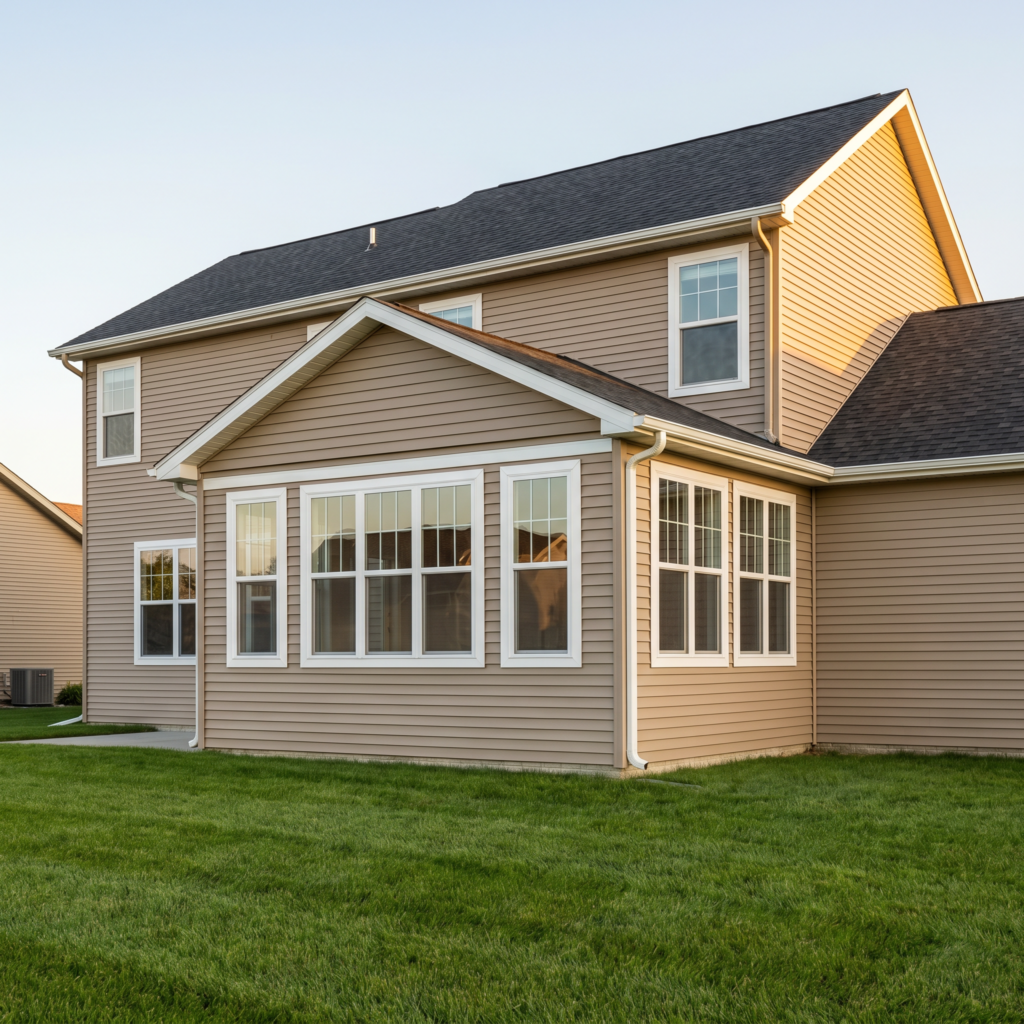
The addition type is the single biggest factor. A simple ground-floor bedroom needs a new foundation, framing, and a roof over a small area. A second story requires structural engineering, load verification of your existing foundation, and often reinforcement of the first-floor walls. Second stories cost more per square foot for good reason.
Foundation depth is non-negotiable in Iowa. Every addition footing must reach below the 42-inch frost line. Shallow footings shift and crack. Clay soils in Central Iowa add waterproofing and drainage costs to basic footing work.
Size scales most material and labor costs directly. Larger projects pick up small economies on overhead, but framing alone runs $25 to $35 per square foot in Iowa. Roofing, siding, windows, and insulation all grow with the footprint.
Finish-level changes per square foot cost vary dramatically within the same addition type. The economy finishes last in every range. Premium fixtures, custom cabinetry, and tile work can double the per-foot number on an otherwise similar project.
Structural complexity drives cost on second stories and large additions. A structural engineer must verify that your existing foundation and walls can carry the new load. Reinforcement before visible construction can add $10,000 to $30,000 or more.
Tie-in complexity is the hidden factor most homeowners miss. Every addition connects to your existing roofline, siding, electrical panel, HVAC, and plumbing. Older homes often need panel upgrades, duct extensions, or plumbing reroutes. Matching exterior materials to your current home also adds skilled labor.
Pro Tip 2: Budget 10 to 15 percent contingency on every addition. Iowa projects routinely uncover structural surprises, utility conflicts, or drainage issues once work begins.
Pro Tip 3: Ask about HVAC load before adding conditioned space. Many older Des Moines furnaces cannot support a new bedroom or suite. A load calculation before signing saves budget surprises.
Addition Type Deep Dives: What Each One Actually Costs
Different additions solve different problems. Here is what each one actually costs in Des Moines.
A simple room addition, whether a bedroom, family room, or office, runs $40,000 to $80,000 for a ground-floor build at quality construction levels. Costs include a foundation below 42 inches, framing, roofing, exterior siding matched to your home, windows, insulation, drywall, flooring, and electrical work. Standard finishes land at the lower end, upgraded finishes push the top. Timeline runs 10 to 14 weeks from permit to completion.
A 4-season sunroom is a full home addition, not a screened porch. It is insulated, HVAC-integrated, and built for Iowa winters. Busy Builders builds these starting at $300 per square foot, with typical project costs ranging from $45,000 to $85,000. A small 120-square-foot room runs about $36,000 to $45,000. A larger 280-square-foot space runs $75,000 to $95,000.
A primary-suite addition costs $75,000 to $150,000 and is one of the more complex single-floor builds. It typically includes a bedroom, a walk-in closet, and a full bathroom. Plumbing rough-in, tile work, and often a separate HVAC zone all add cost. National 2025 Cost vs. Value data show midrange primary-suite additions return about 35.5 percent at resale. Results vary by neighborhood, market, and finish level.
An in-law suite or ADU runs $75,000 to $175,000. These accessory dwelling units often need separate utility connections, zoning review, and additional permit categories. Iowa municipalities vary on ADU rules, so confirm local zoning before planning.
A second-story addition is the most expensive type. Second stories run $100,000 to $300,000 or more and take 16 to 24 weeks. Structural engineering and foundation verification happen before visible construction begins. Building up avoids setback limits but adds complexity and cost that building out does not.
Pro Tip 4: Check setbacks, easements, and HOA rules before you plan any addition. These can eliminate ground-floor options and push you toward a second-story build.
Pro Tip 5: Verify ADU zoning in your city before scoping an in-law suite. Iowa municipalities each handle ADU rules differently, so confirm local requirements before planning.
Where the Money Goes: A Budget Breakdown
Knowing where the money goes helps you evaluate contractor bids and spot estimates that leave out real costs. The table below shows typical allocations of $150,000 addition in Des Moines.
| Component | Typical Share of Budget | Example Dollar Range |
|---|---|---|
| Foundation, site prep, footings | 10 to 15% | $15,000 to $22,500 |
| Framing, sheathing, structural | 15 to 20% | $22,500 to $30,000 |
| Roofing and exterior blending | 10 to 12% | $15,000 to $18,000 |
| Windows, doors, insulation | 8 to 12% | $12,000 to $18,000 |
| Electrical | 8 to 10% | $12,000 to $15,000 |
| Plumbing (if bathroom included) | 10 to 15% | $15,000 to $22,500 |
| HVAC integration | 5 to 8% | $7,500 to $12,000 |
| Drywall, flooring, paint, trim | 10 to 15% | $15,000 to $22,500 |
| Permits and inspections | 2 to 5% | $3,000 to $7,500 |
| Contingency (always plan this) | 10 to 15% | $15,000 to $22,500 |
The contingency line is not optional. Treat it as part of the real budget, not a buffer you can cut later.
Pro Tip 6: Get three itemized estimates for any addition over $50,000. Lump-sum bids obscure where the money goes and make side-by-side comparisons almost impossible.
Pro Tip 7: Confirm panel capacity before planning new circuits. Many 1970s and 1980s Des Moines homes have 100-amp panels that cannot support added square footage without an upgrade.
Iowa-Specific Factors That Change the Math
These Iowa factors are the reason national cost guides miss the mark for Des Moines homeowners. Each one changes your total cost, your timeline, or both.
| Iowa Factor | Energy compliance documentation for all conditionedspacese | Cost Effect |
|---|---|---|
| Frost line (42 inches) | Footings must reach below 42 inches, deeper than many warmer-climate guides | Adds cost vs. national benchmarks |
| Clay soil | Drainage, waterproofing, and backfill challenges | $2,000 to $8,000+ depending on site |
| IRC and IECC codes | Part of the electrical sub-permit | Part of permit review |
| NEC 2023 (effective July 2025) | New electrical work must meet updated NEC standards | The general contractor must be DIAL-registered |
| DIAL contractor registration | Energy compliance documentation for all conditioned spaces | Verify before signing |
| Plan review timeline | 5 to 7 days, Polk County, 7 to 10 days, Dallas County | Add to project timeline |
Each row above is a real line item on real Iowa projects. Contractors who skip them in early estimates often raise prices later.
Pro Tip 8: Plan your addition for spring through early fall. Winter foundation pours are harder, slower, and more expensive because of frozen ground and frost line requirements.
Pro Tip 9: Ask your contractor to confirm their DIAL registration number in writing before you sign. You can verify any Iowa general contractor through the state’s registration lookup.
Permits, Fees, and the Iowa Process
Every addition creating conditioned space needs a building permit in Iowa. Skipping this step creates resale, appraisal, and insurance problems that follow the home forever. Here are the permit fees you will see in Des Moines metro projects.
| Permit Type | Fee Range | How It Is Calculated |
|---|---|---|
| Building permit (addition) | $150 to $600 | Valuation-based or square foot tier |
| Plan review | For a heated or cooled space | For heated or cooled space |
| Electrical sub-permit | $50 to $300 | Service size or fixture count |
| Plumbing sub-permit | $40 to $200 | Fixture count |
| HVAC sub-permit | $60 to $350 | Equipment valuation |
Sub-permits for electrical, plumbing, and HVAC are required separately from the main building permit. Busy Builders manages the full permit and inspection process on every addition.
For a full walkthrough of the Iowa permit process, see our guide to Iowa home building permits.
Pro Tip 10: Ask about permit and engineering fees before signing. Early estimates that leave these out are often $5,000 to $10,000 light on the real budget.
Pro Tip 11: Keep every permit, inspection sign-off, and final approval in one folder. Future buyers, appraisers, and your insurance company may ask for them.
ROI and Resale: What to Expect
Home addition ROI typically ranges from 20 to 80 percent, depending on type, quality, and your local market. Midrange primary-suite additions return about 35.5 percent at resale per the 2025 Cost vs. Value data. However, this figure reflects national averages, and Iowa results may vary by neighborhood and market conditions. In-law suites and ADUs can achieve 60-70% ROI when demand and zoning align.
The key appraisal advantage of additions over basement finishing is simple. Above-grade addition space counts fully in gross living area under ANSI Z765-2021 and Fannie Mae rules. Basement space gets valued at 50 to 70 percent of the above-grade value. That difference matters on listings, loans, and appraisals.
The clearest ROI case for additions arises when the home has no basement, when above-grade square footage is needed for listings, or when ground-floor accessibility matters for aging in place.
These ROI figures represent national and regional averages. Your actual resale outcome will depend on finish quality, neighborhood comparables, market timing, and appraiser judgment. Consult a local real estate agent before making decisions based on resale projections.
Illustrative Budget Scenarios for Des Moines Homeowners
These scenarios are not verified Busy Builders projects. They illustrate typical Iowa cost profiles based on published data.
Illustrative scenario 1: Simple bedroom addition, Ankeny. A family adds a 200-square-foot fourth bedroom with a closet on the back of a ranch home. Includes foundation below frost line, framing, matched roofing and siding, windows, insulation, drywall, carpet, and electrical. No plumbing. Estimated total: $75,000 to $85,000. Timeline: 10 to 12 weeks.
Illustrative scenario 2: 4-season sunroom, Johnston. A retired couple adds a 200-square-foot year-round room with thermal windows, a separate HVAC zone, LVP flooring, and drywall ceiling. Exterior matched to the existing home. Estimated total: $55,000 to $70,000. Timeline: 8 to 12 weeks.
Illustrative scenario 3: Primary suite, Waukee. A growing family adds a 300-square-foot primary suite with a bedroom, a walk-in closet, and a full bathroom. Includes a tile shower, a double vanity, a separate HVAC zone, and upgraded finishes. Estimated total: $120,000 to $150,000. Timeline: 14 to 18 weeks.
Illustrative scenario 4: Second-story addition, Urbandale. A family with a small lot adds a full second story with two bedrooms and a shared bathroom. Includes structural engineering, temporary weather protection during build, full framing, staircase tie-in, and matched exterior. Estimated total: $175,000 to $250,000. Timeline: 18 to 24 weeks.
How to Plan Your Budget
The homeowners who stay on budget share a few habits. Use this short list before you sign any contract.
- Get three itemized estimates for any project over $50,000
- Plan 10 to 15 percent contingency every time
- Confirm permit and engineering fees upfront
- Verify HVAC and electrical capacity before scoping size
- Plan seasonal timing for spring or summer starts
- Understand financing options before finalizing the scope
Iowa construction loans in 2026 typically have APRs of 6.5 to 9.5 percent and require 10 to 25 percent down. Interest-only payments during construction usually range from $1,500 to $3,000 per month, depending on project size. Loan rates change frequently, so contact your lender for the current APR before finalizing your budget. For deeper detail, see our Iowa construction financing guide.
Pro Tip 12: Lock your financing before scoping the addition size. Knowing your real budget ceiling prevents scope creep and keeps the project moving on schedule.
Frequently Asked Questions
How much does a home addition cost in Des Moines in 2026?
Home additions start at about $300 per square foot for Des Moines metro quality construction. Total costs depend on type: simple room additions run $40,000 to $80,000, primary suites run $75,000 to $150,000, and second stories run $100,000 to $300,000 or more. Iowa construction costs generally run below the national average, but Des Moines metro pricing reflects local labor demand, permit complexity, and quality standards.
How long does a home addition take in Des Moines?
Timeline depends on the addition type. Simple room additions take 10 to 14 weeks. Sunrooms take 8 to 12 weeks. Primary suites take 12 to 18 weeks. Second stories take 16 to 24 weeks. Add 1 to 4 weeks for front-end permit approval. Polk County plan review runs 5 to 7 business days, and Dallas County runs 7 to 10 business days.
Do I need a permit for a home addition in Iowa?
Yes. Every addition that creates a conditioned, heated, or cooled space requires a building permit. Separate sub-permits are required for electrical, plumbing, and HVAC. Busy Builders manages all permits and inspections on every addition. Skipping permits creates resale, appraisal, and insurance problems.
What Iowa-specific issues affect home addition costs?
Iowa’s 42-inch frost line requires deeper footings than many guides for warmer states assume. Clay soil adds drainage and waterproofing costs. Current Iowa building codes require energy compliance documentation for all conditioned spaces. Permit plan review takes 5 to 10 business days, depending on the county.
Will a home addition increase my home’s value?
Home additions typically return 20 to 80 percent at resale, depending on type, quality, and market. Primary suite additions return about 35.5 percent, according to the 2025 Cost vs. Value data. Above-grade addition space counts fully in gross living area under Fannie Mae appraisal rules, which is a key advantage over basement space. Results vary, so consult a local real estate agent before making resale projections.
What is the difference between a registered contractor and a registered contractor in Iowa?
Iowa requires general contractors earning $2,000 or more per year to register with the Iowa Department of Inspections, Appeals, and Licensing (DIAL). This is called registration, not licensing. Electricians, plumbers, and HVAC technicians hold separate state licenses, which are different from general contractor registration. Always confirm both DIAL registration for your general contractor and state licensing for trade subs before signing.
Key Takeaways
Cost
- Busy Builders additions start at about $300 per square foot in the Des Moines metro.
- Simple room additions: $40,000 to $80,000
- Primary suite additions: $75,000 to $150,000
- Second-story additions: $100,000 to $300,000+
Timeline and Permits
- Most additions take 10 to 24 weeks to complete
- All conditioned additions require permits in Iowa
- Polk County plan review: 5 to 7 business days
- Dallas County plan review: 7 to 10 business days
Iowa-Specific Factors
- Frost line requires footings below 42 inches
- Clay soil adds to the drainage and waterproofing costs
- NEC 2023 took effect in July 2025 for new electrical work
- General contractors must be DIAL-registered
Budget Planning
- Plan 10 to 15 percent contingency for every project
- Get three itemized estimates, not lump sums
- Verify HVAC and panel capacity before scoping size
- Start additions in spring through early fall when possible
Ready to Plan Your Addition with Busy Builders
You now have real 2026 Des Moines numbers, a clear picture of what drives cost, and a framework for budgeting with confidence. The next step is a free on-site estimate for your specific home.
Busy Builders has completed over 1,000 projects across Central Iowa since 2020. We bring transparency and honest pricing to every addition. Here is what we offer:
- Free on-site consultation and itemized cost estimates
- Full permit and inspection management
- Registered Iowa contractors and licensed trades
- Structural engineering coordination for second-story projects
- Transparent timelines and clear communication
- Written warranty on artistry (details provided in your contract)
We serve Des Moines, West Des Moines, Ankeny, Waukee, Urbandale, Johnston, Ames, Adel, and communities across Central Iowa.
Call: 844-435-9800 Website: https://busybuildersiowa.com/
The cost figures, timelines, and ROI percentages in this post are based on regional market data, industry reports, contractor pricing benchmarks, and publicly available sources as of 2026. Individual project costs will vary based on addition type, size, site conditions, finish selections, contractor, and local market conditions. ROI and resale value estimates are averages and do not guarantee specific financial outcomes. This content is for general educational purposes only. Consult a local real estate agent, an Iowa certified appraiser, and a registered Iowa contractor before making decisions about home improvement projects. Busy Builders is a registered Iowa contractor. All permitted work requires inspections. Permit requirements and fees vary by municipality, so verify with your local building department.
Busy Builders | Full-Service Construction and Remodeling | Serving Central Iowa Since 2020
Local service: Home additions in Des Moines, Iowa.