The ledger board is the single structural connection that keeps an attached deck from separating from your house. Most homeowners never see it and most contractors never explain it, but roughly 90% of deck collapses trace back to this one connection. This guide explains what Iowa’s building code actually requires, which materials fail in Iowa’s climate, and what to ask any contractor before they drive a single bolt.
TLDR: The ledger board is the most critical connection on any attached deck, and roughly 90% of deck collapses involve ledger failure. Iowa’s building code requires minimum 1/2″ lag screws or carriage bolts, compatible flashing for ACQ pressure-treated lumber, and a framing inspection before decking goes down. Read on for the specific requirements, common failure points, and the questions that separate careful contractors from those who cut corners.
Your deck looks fine from the outside. The boards are level, the railing holds steady, and nothing about it looks dangerous.
But the most important part of your deck is invisible. It sits behind your siding, beneath the first row of decking, and your contractor may have never mentioned it: the ledger board.
If that board was fastened with the wrong hardware, skipped flashing, or attached to the wrong surface, your deck could fail under load. Most collapses happen without warning. Understanding what Iowa requires and what to ask before work starts is the best protection you have.
What Is a Ledger Board and Why Does It Carry All the Weight?
The ledger board is the horizontal framing member bolted directly to your house’s band joist, also called the rim joist. Every deck joist rests on it. Every person who walks across the deck puts weight on it.
Iowa code requires decks to support 50 pounds per square foot: 10 lbs for the weight of the deck itself and 40 lbs for people, furniture, and grills. The ledger connection must also resist a 1,500-pound horizontal load at the end of each joist.
In Iowa, clay soil shifts seasonally with 45 to 84 freeze-thaw cycles per year. That movement creates lateral forces on the ledger that are higher than in states with more stable soil. Proper attachment matters more here, not less.
Any deck that connects to your house depends on the ledger being done right. A freestanding deck can skip a ledger, but only with a completely different structural design.
Why Ledger Boards Fail
These are the failure modes that cause real-world collapses and expensive repairs.
Nails used as the primary fastener. Nails cannot resist withdrawal forces. They allow the deck to pull cleanly away from the house under dynamic load. Iowa’s building code has prohibited nails as the sole ledger fastener for over two decades, and they remain the leading cause of catastrophic deck failure.
Wrong flashing materials with ACQ lumber. Iowa requires ACQ (alkaline copper quaternary) pressure-treated lumber for all exposed deck wood. ACQ’s copper content reacts aggressively with aluminum flashing and standard galvanized hardware. The corrosion is invisible from the outside and quietly destroys the ledger connection.
No flashing at all. Water infiltrates behind the ledger, saturates the band joist, and causes rot that spreads invisibly. Iowa’s freeze-thaw cycles accelerate that moisture damage dramatically. Proper flashing costs under $200. Repairing rotted band joists and rebuilding the ledger connection costs $4,000 to $12,000 or more.
Fasteners installed in a single row. Iowa county codes require staggered fasteners. A straight row of lag screws can split the ledger board along the grain and cause the entire deck to separate.
Attachment to the wrong surface. Iowa code prohibits attaching a ledger to brick veneer, stone, stucco, hollow concrete block, or cantilevered floor systems. The ledger must connect to the band joist of the house framing, period. If your home has a cantilevered floor or an open-web truss floor system beneath the attachment point, standard ledger installation will not work. Both situations require special engineering and a conversation with your local building official before any work begins.
Illustrative scenario: A Central Iowa homeowner had a 10-year-old deck with no permit on record. During a pre-sale home inspection near Ankeny, the inspector found a nailed ledger with no flashing. The band joist behind it had rotted through. A full ledger replacement and band joist repair ran $6,500. The sale was delayed while the seller escrowed the funds. The deck had looked fine from the outside for years. (Composite of common Iowa inspection findings consistent with data from the North American Deck and Railing Association.)
What Iowa Code Requires for Ledger Attachment
Iowa’s building code follows the International Residential Code as adopted and administered by the state and local jurisdictions, with Section R507 governing deck construction. The Central Iowa Code Consortium, Johnson County, Linn County, Urbandale, Grimes, and other jurisdictions have confirmed these requirements.
Minimum lumber size: 2×8 minimum, with ledger depth equal to or greater than the deck joists.
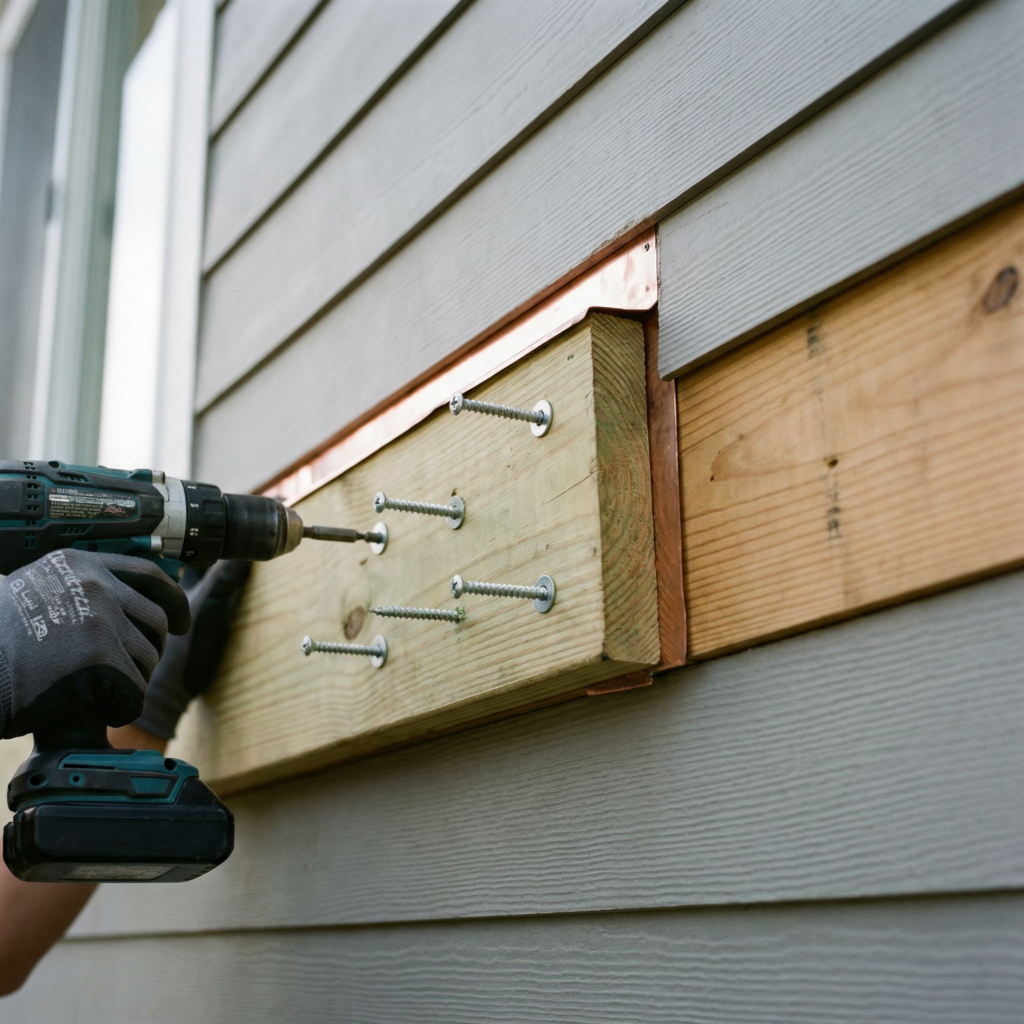
Fasteners: Minimum 1/2″ diameter lag screws or carriage bolts with washers. Nails are prohibited as the sole attachment method. All fasteners must be hot-dipped galvanized (G-185 or better) or stainless steel when used with ACQ lumber. Approved engineered fasteners such as LedgerLOK may substitute with manufacturer-specified spacing.
The table below shows minimum fastener spacing based on joist span, drawn from Iowa county deck handouts and IRC Table R507.9.1.3(1). Always verify requirements with your local building department, as individual Iowa jurisdictions may amend the baseline code.
| Joist Span | 1/2″ Lag Screw (on-center) | 1/2″ Carriage Bolt (on-center) |
|---|---|---|
| 6′ or less | 30″ | 36″ |
| 6’1″ to 8′ | 23″ | 36″ |
| 8’1″ to 10′ | 18″ | 34″ |
| 10’1″ to 12′ | 15″ | 29″ |
| 12’1″ to 14′ | 13″ | 24″ |
| 14’1″ to 16′ | 11″ | 21″ |
| 16’1″ to 18′ | 10″ | 19″ |
Source: Johnson County Iowa Deck Handout, Linn County Deck Guidelines (IRC Table R507.9.1.3(1))
Fasteners must be placed at least 2 inches from the top edge of the ledger, at least 3/4 inch from the bottom edge, and at least 2 inches from each end. They must be staggered, not installed in a single row.
Flashing: Siding must be removed before the ledger is installed. Attaching over siding is a code violation and the primary path for water infiltration. Flashing must be corrosion-resistant and compatible with ACQ lumber. The table below shows what works and what fails.
| Component | Approved | Prohibited | Why It Matters |
|---|---|---|---|
| Fasteners | Hot-dipped galvanized (G-185+), stainless steel | Nails, electroplated screws, drywall screws, anything under 1/2″ diameter | ACQ lumber’s copper content corrodes standard fasteners |
| Flashing | Stainless steel, copper, UV-resistant vinyl or plastic | Aluminum, standard galvanized (prohibited in some Iowa jurisdictions) | Aluminum reacts with ACQ lumber; Linn County explicitly prohibits both |
| Joist hangers | Hot-dipped galvanized (G-185+), ZMax, Triple Zinc, stainless | Standard G-60 or G-90 galvanized | Insufficient coating fails on ACQ lumber within a few years |
| Fastener pattern | Staggered per IRC table above | Single straight row along ledger length | Straight rows split the ledger board along the grain |
Pro Tip 1: Ask your contractor which flashing material they use with ACQ lumber before signing anything. If they say aluminum, that is a problem. Stainless steel, copper, or UV-resistant vinyl are the correct choices for Iowa’s climate and Iowa’s code.
The American Wood Council’s deck connection guide is the national authority on prescriptive ledger attachment standards and a reliable resource for both contractors and homeowners. For a full look at how pressure-treated lumber, cedar, and composite materials compare in Iowa’s climate, see our guide to deck materials for Iowa weather.
The Permit and Inspection Process in Iowa
Most Iowa jurisdictions require a permit for any attached deck. Iowa’s building code is administered through DIAL (Department of Inspections, Appeals, and Licensing), with each city handling its own submission process.
The table below shows how permit requirements vary by deck type.
| Scenario | Permit Required? | Typical Threshold | Iowa Source |
|---|---|---|---|
| Attached deck (any size) | Yes | Any deck attached to the house | Johnson County |
| Freestanding deck, over 30″ above grade | Yes | 30″ above grade or 200+ sq ft | Linn County |
| Deck with roof or trellis | Yes | Regardless of height or size | Linn County |
| Small freestanding deck (under 200 sq ft, under 30″, not attached, not serving main exit) | No permit required | Does not serve as egress | Johnson County |
After a permit is issued, Iowa deck projects go through three inspections: a footing inspection before concrete is poured, a framing inspection before decking is installed, and a final inspection after all work including railings and stairs is complete.
The framing inspection is the most important one for the ledger. Once decking goes down, the inspector cannot see the fasteners or flashing. Skipping or rushing the framing inspection removes the only independent check that verifies the attachment was done correctly.
Unpermitted decks are flagged during home inspections and can delay or kill a sale. The cost to bring an unpermitted deck into compliance almost always exceeds what the permit would have cost.
You can verify any contractor’s registration status at Iowa DIAL.
Pro Tip 2: Request your permit number from your contractor before framing inspection day. If they cannot provide one, ask directly whether the permit has been pulled. A registered contractor in Iowa handles this as a matter of course.
What to Ask Before Work Starts
These questions will tell you quickly whether a contractor knows Iowa’s ledger requirements.
| What to Ask | Red Flag Answer | Right Answer |
|---|---|---|
| “How do you flash the ledger?” | “We attach over the existing siding” | “We remove the siding first and flash directly to the band joist” |
| “What flashing material with ACQ lumber?” | “Aluminum” or “standard galvanized” | “Stainless steel, copper, or vinyl” |
| “What fastener size and spacing?” | Vague or no reference to a spacing table | “1/2″ lag screws or carriage bolts, staggered per the IRC table” |
| “Will you pull the permit and schedule all inspections?” | “We usually skip the framing inspection” | “Yes, all three inspections including framing” |
| “Are you registered with Iowa DIAL?” | Hesitation or inability to provide registration number | Immediate yes, registration verifiable at dial.iowa.gov |
Note: Iowa requires registration for general contractors, not licensing. The correct term is “registered contractor.” Electricians, plumbers, and HVAC technicians hold separate state licenses. Using the wrong term is a signal that a contractor may not be familiar with Iowa’s regulatory framework.
If you are ready to talk through a deck project, our team handles deck building services in Central Iowa with permits pulled, inspections scheduled, and hardware spec’d for Iowa’s climate. For a full breakdown of what deck projects cost in Iowa and the code factors that affect price, read our guide on deck costs and Iowa code requirements.
Frequently Asked Questions
Q: Can you attach a deck ledger board with nails?
No. Nails cannot resist withdrawal forces. A deck attached with nails can pull cleanly away from the house under a dynamic load, such as a crowd of people or significant weight. Iowa’s building code has prohibited nails as the sole ledger fastener for over two decades. Only 1/2″ lag screws, carriage bolts with washers, or approved engineered fasteners are allowed. The NADRA safety guide confirms that roughly 90% of deck collapses involve ledger connection failure.
Q: What type of flashing is required for a deck ledger in Iowa?
Iowa code requires corrosion-resistant flashing compatible with ACQ pressure-treated lumber. Aluminum reacts with ACQ’s copper content and corrodes rapidly, which is why some Iowa jurisdictions, including Linn County, explicitly prohibit it. Stainless steel, copper, or UV-resistant vinyl are the right choices. Siding must be removed before the ledger is installed so flashing integrates properly with the water-resistive barrier behind it, the moisture-blocking layer installed beneath your exterior siding to keep water out of the wall assembly. Verify the specific material requirements with your city’s building department.
Q: Do I need a permit for an attached deck in Iowa?
Yes. Most Iowa jurisdictions require a permit for any deck attached to the house regardless of size. The permit process includes a framing inspection that verifies the ledger connection before it is covered by decking. Without that inspection, there is no independent verification that the attachment was done correctly. Skipping the permit also creates problems at resale and leaves you without documentation of code compliance.
Q: What is the correct spacing for ledger board lag screws in Iowa?
Spacing depends on joist span. The IRC fastener spacing table in this article shows the specific requirements. Shorter spans allow wider spacing; longer spans require fasteners closer together. Fasteners must also be staggered, not installed in a single row. Always verify requirements with your local building department, since Iowa jurisdictions may apply local amendments to the baseline code.
Q: Can a deck ledger be attached to brick or stucco?
No. Iowa code prohibits ledger attachment to masonry veneer, stone, stucco, brick, or hollow concrete block. The ledger must attach directly to the band joist of the house framing. If your home’s exterior is brick or stucco, consult your local building official before any work begins, as this requires special engineering.
Q: What happens if my contractor skips ledger flashing?
Water infiltrates behind the ledger and into the band joist. Iowa’s 45 to 84 freeze-thaw cycles per year accelerate that moisture damage significantly. The rot is invisible from outside until a bounce test or home inspection reveals soft framing. Fixing it means removing the ledger, replacing the band joist, reflashing, and reinstalling the ledger. That costs $4,000 to $12,000 or more. Proper flashing at build time costs under $200.
Key Takeaways
Why the ledger matters. The ledger board carries the entire load of an attached deck and must resist both vertical weight and horizontal forces. Roughly 90% of deck collapses trace back to ledger failure.
What Iowa code requires. Minimum 2×8 lumber, 1/2″ lag screws or carriage bolts, staggered placement per the IRC fastener spacing table, and corrosion-compatible flashing. Nails are prohibited.
Iowa’s ACQ challenge. Iowa requires ACQ pressure-treated lumber, which reacts with aluminum flashing and standard galvanized hardware. Use stainless steel, copper, or UV-resistant vinyl.
Permits and the framing inspection. Most Iowa jurisdictions require a permit for any attached deck. The framing inspection, which happens before decking goes down, is the only verification step for the ledger and flashing. Do not skip it.
Questions to ask. Ask about siding removal, flashing material, fastener size and spacing, permit status, and registration with Iowa DIAL. A registered contractor should answer all five without hesitation.
Check locally. Iowa jurisdictions may amend the baseline code. Always confirm requirements with your city’s building department before work begins.
Ready to Build a Deck That Passes Inspection?
You now know what the ledger board does, what Iowa code requires, and what separates contractors who follow the rules from those who do not.
Busy Builders has completed 1,285+ projects across Central Iowa, including Des Moines, Ankeny, Waukee, Grimes, and the surrounding communities. We pull permits on every deck project, schedule all three required inspections, remove siding before ledger installation, and use hardware rated for Iowa’s ACQ lumber requirements and to current Iowa code.
Here is what you get when you work with us:
- Free consultation to discuss your project and budget
- Permit filing and inspection scheduling handled for you
- Ledger flashing and hardware spec’d for Iowa’s climate
- A registered contractor you can verify at dial.iowa.gov
Call: 844-435-9800
Website: https://busybuildersiowa.com/
Busy Builders | Full-Service Construction and Remodeling | Serving Central Iowa Since 2020