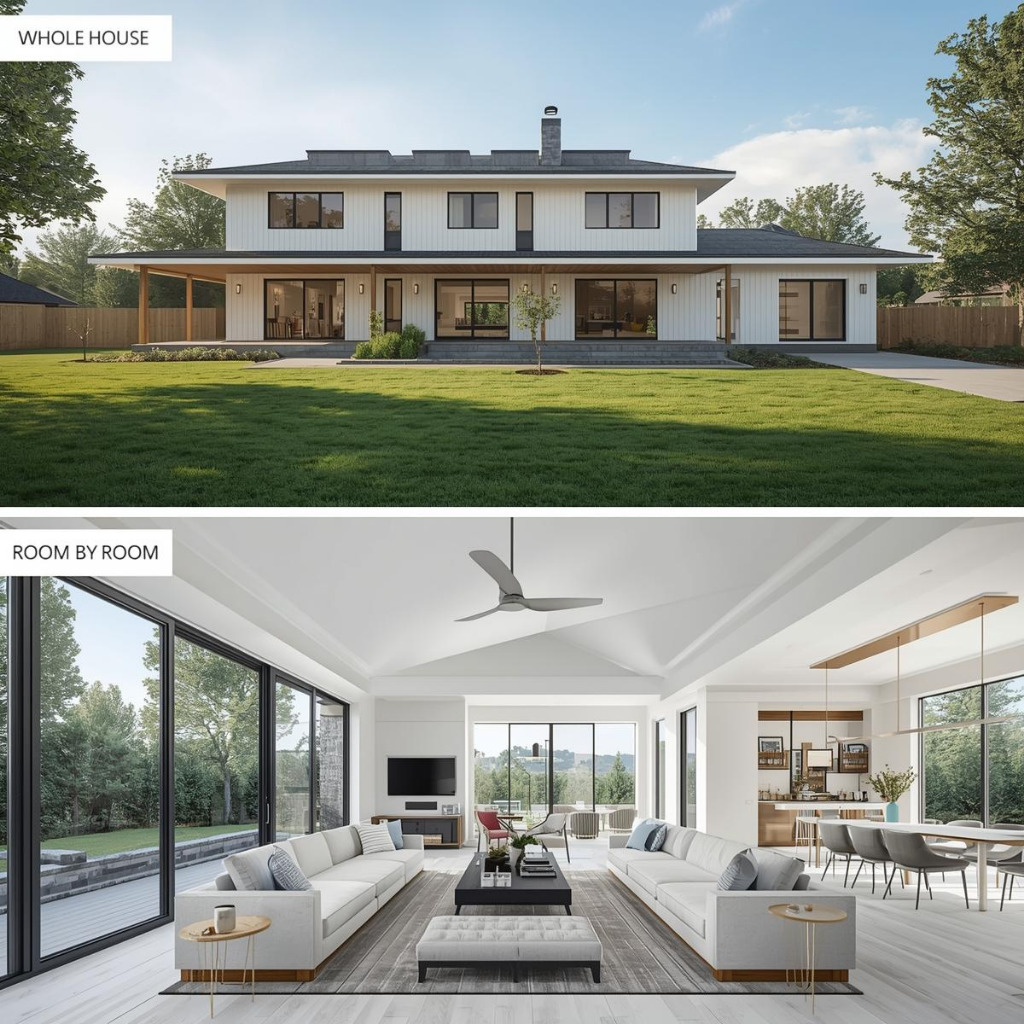
Basement Finishing doesn’t have to drain your savings account. Many Des Moines homeowners assume that transforming their unfinished basement into livable space requires $40,000-60,000, putting the project out of reach. The truth is that with smart planning, strategic material choices, and a hybrid approach mixing DIY work with professional services, you can create a beautiful, functional basement for $8,000-25,000. This guide shows you exactly how budget-conscious homeowners throughout Central Iowa are finishing their basements without sacrificing quality or safety.
You’ll learn proven strategies for cutting costs without cutting corners, discover which materials deliver the best value, understand what you can safely DIY versus when to hire professionals, and see realistic project budgets broken down by size and finish level. Whether your budget is $10,000 or $25,000, this comprehensive guide helps you maximize every dollar while creating a basement space your family will love.
TLDR: Budget basement finishing in Des Moines typically costs $7-15 per square foot for basic finishes, with complete 600-800 sq ft projects ranging from $8,000-25,000. Key money-saving strategies include DIY painting and flooring ($1,500-3,500 savings), choosing affordable materials like luxury vinyl plank and painted exposed ceilings, phasing projects over time, and using a hybrid approach where you hire professionals for electrical/plumbing but handle cosmetic work yourself. Smart planning and realistic expectations let you create stylish, functional basement space without breaking the bank.
You walk down to your basement and see nothing but concrete floors, exposed ceiling joists, and bare walls. It’s wasted space—hundreds of square feet that could be a game room for the kids, a home office where you can actually focus, or a guest suite for visiting family. You know finishing the basement would add value to your home and improve your daily life.
But then you start researching costs. You read articles saying basement finishing costs $50-60 per square foot. You calculate that your 800-square-foot basement would cost $40,000-48,000 to finish. That’s more than you have saved, more than you can comfortably borrow, and frankly more than you want to spend on a basement when you have other financial priorities.
Here’s what those generic cost articles don’t tell you: there’s a huge difference between hiring a contractor to do everything with premium finishes and taking a smart, budget-conscious approach. Thousands of Des Moines homeowners have finished their basements beautifully for $10,000-20,000 by making strategic choices about materials, doing some work themselves, and focusing on what truly matters for their family’s needs. This guide shows you exactly how they did it—and how you can too.
Understanding Budget Basement Finishing
Before we dive into specific strategies and costs, let’s clarify what “budget-friendly” actually means and establish realistic expectations.
What Makes Basement Finishing “Budget-Friendly”?
Budget-friendly doesn’t mean cheap or low-quality. It means making smart choices that maximize value while minimizing unnecessary expenses. The difference between a $40,000 basement and a $12,000 basement isn’t necessarily quality—it’s often about choices like:
- Materials: Luxury vinyl plank flooring ($2-4/sq ft) instead of engineered hardwood ($8-12/sq ft)
- Ceiling approach: Painted exposed joists ($1-2/sq ft) instead of drywall ceiling ($4-6/sq ft)
- Labor: DIY painting and flooring installation instead of paying contractors
- Features: Half bath instead of full bathroom (saves $5,000-8,000)
- Complexity: Simple rectangular layout instead of multiple rooms with complex framing
Budget-conscious finishing prioritizes function and appearance while avoiding unnecessary premium finishes that add significant cost without proportional value.
Realistic Budget Basement Costs in Des Moines
According to This Old House’s comprehensive basement guide, basement finishing costs vary widely by region and approach. Here’s what basement finishing actually costs in Central Iowa when you take a budget-conscious approach:
| Budget Level | Cost Per Sq Ft | 600 Sq Ft Total | 800 Sq Ft Total | What You Get |
|---|---|---|---|---|
| Bare Bones | $7-10 | $4,200-6,000 | $5,600-8,000 | Painted exposed ceiling, LVP floors, basic framing/drywall, DIY finish |
| Basic Budget | $10-15 | $6,000-9,000 | $8,000-12,000 | Drop ceiling, good flooring, professional drywall, decent finishes |
| Mid-Range Budget | $15-25 | $9,000-15,000 | $12,000-20,000 | Drywall ceiling, quality materials, half bath, professional finish |
| Nice Budget | $25-35 | $15,000-21,000 | $20,000-28,000 | Full bathroom, built-ins, premium materials, complete professional work |
Compare this to “standard” basement finishing at $35-60/sq ft ($21,000-48,000 for 800 sq ft) and you can see the savings potential.
Real example: A Des Moines couple with a 700-square-foot basement got quotes ranging from $38,000 to $55,000 for complete professional work. Instead, they spent $14,500 over six months doing a hybrid approach—hiring electricians and plumbers for $4,500, buying quality materials for $6,200, and handling painting, flooring, and trim work themselves. Their finished basement looks just as good as their neighbor’s $45,000 professionally finished space.
Smart Material Choices That Save Money Without Sacrificing Quality
Your material selections create the biggest opportunity for budget savings. Here’s how to choose wisely.
Budget-Friendly Flooring Options
Flooring covers hundreds of square feet, so small per-square-foot savings add up fast.
| Flooring Type | Installed Cost/Sq Ft | 600 Sq Ft Cost | Pros | Cons |
|---|---|---|---|---|
| Luxury vinyl plank (LVP) | $2-4 | $1,200-2,400 | Waterproof, durable, DIY-friendly, looks like wood | Not real wood |
| Laminate | $1.50-3 | $900-1,800 | Cheap, easy install, decent appearance | Not waterproof, less durable |
| Carpet tiles | $2-5 | $1,200-3,000 | Comfortable, warm, replaceable squares | Moisture concerns in basements |
| Painted concrete | $1-2 | $600-1,200 | Extremely cheap, modern industrial look | Cold, hard, limited comfort |
| Polished concrete | $3-8 | $1,800-4,800 | Durable, modern, low maintenance | Hard surface, expensive for “budget” |
Best budget choice: Luxury vinyl plank (LVP) offers the best balance of cost, appearance, durability, and moisture resistance for basements. Quality LVP looks remarkably like hardwood but costs 60-70% less and handles basement moisture much better.
Installation tip: LVP is one of the most DIY-friendly flooring options. Most homeowners can install 600 square feet over a long weekend, saving $800-1,500 in labor costs.
Real example: An Ankeny homeowner installed 800 square feet of LVP from a big-box store for $2,400 in materials. Professional installation quotes were $1,200-1,600 additional. By watching YouTube tutorials and renting a few tools, they installed it themselves over two weekends, saving $1,200-1,600.
Affordable Wall and Ceiling Treatments
Wall and ceiling finishes dramatically affect your budget. Here’s how costs compare:
Wall options:
- Standard drywall + paint: $1.50-3/sq ft installed
- DIY drywall + paint: $0.75-1.50/sq ft (materials only)
- Wood paneling (DIY): $2-4/sq ft
- Exposed concrete + paint: $0.50-1.50/sq ft
Ceiling options:
- Painted exposed joists: $1-2/sq ft (cheapest, industrial look)
- Drop ceiling tiles: $2-4/sq ft (hides mechanicals, easy access)
- Drywall ceiling: $4-6/sq ft (finished look, most expensive)
- Painted/sprayed joists + mechanicals: $1.50-3/sq ft (modern industrial)
Best budget strategy: Paint your exposed ceiling joists and mechanicals (pipes, ductwork) black, white, or gray. This creates a modern industrial aesthetic while costing just $1-2 per square foot. If you want better acoustics or a more finished look, drop ceiling tiles at $2-4/sq ft offer excellent value.
Tip: Painting ceiling elements yourself saves huge money. A 600-square-foot basement ceiling requires 2-3 gallons of paint ($80-120) and 12-20 hours of work. Hiring out costs $600-1,200.
Cost-Effective Lighting Solutions
Good lighting transforms a basement, but it doesn’t have to be expensive:
- LED shop lights: $30-60 each (cheapest, industrial look)
- Recessed can lights: $15-40 each plus $75-150 installation per light
- Track lighting: $80-200 per fixture
- Basic flush-mount fixtures: $20-100 each
Budget approach: Use a combination of affordable fixtures. Install a few recessed lights ($200-400 total with electrician) for general lighting, then add plug-in shop lights or track lighting you can install yourself for task lighting.
Real example: A West Des Moines homeowner spent $350 having an electrician install four recessed lights on a dimmer switch. They added four LED shop lights ($160) they mounted themselves in the workshop area and two affordable flush-mount fixtures ($80) they plugged into existing outlets using decorative cord covers. Total lighting cost: $590 versus $1,200-1,800 for all-professional installation.
Smart Insulation and Climate Control
Proper insulation saves energy costs long-term, making it worth doing right even on a budget:
- Fiberglass batts: $0.40-1.50/sq ft (cheapest, DIY-friendly)
- Rigid foam board: $1-2.50/sq ft (better R-value)
- Spray foam: $2-4/sq ft (best performance, expensive)
Budget recommendation: Use fiberglass batts in walls ($0.50-1/sq ft) and rigid foam board on basement walls ($1-2/sq ft). These materials provide good insulation at reasonable cost and can be installed DIY if you’re comfortable with it.
Don’t skimp on insulation—proper Energy Star certified insulation pays for itself within 3-5 years through reduced energy costs.
Money-Saving Strategies: Where to Cut Costs Safely
Smart homeowners know where they can save money and where they shouldn’t compromise.
What You Can DIY to Save Money
Taking on appropriate DIY projects offers significant savings:
Recommended DIY projects:
✅ Painting walls and ceilings: Saves $500-1,500
- Skill required: Low
- Time investment: 20-40 hours for 600 sq ft
- Savings: $500-1,500
- Tools needed: Brushes, rollers, drop cloths ($50-100)
✅ Installing LVP or laminate flooring: Saves $1,000-2,000
- Skill required: Moderate
- Time investment: 16-30 hours for 600 sq ft
- Savings: $1,000-2,000
- Tools needed: Circular saw, spacers, tapping block ($80-150)
✅ Installing drop ceiling: Saves $800-1,500
- Skill required: Moderate
- Time investment: 12-24 hours for 600 sq ft
- Savings: $800-1,500
- Tools needed: Laser level, snips, string line ($60-120)
✅ Trim and door installation: Saves $500-1,000
- Skill required: Moderate
- Time investment: 10-20 hours
- Savings: $500-1,000
- Tools needed: Miter saw, nail gun, level ($150-300 to buy, or rent)
✅ Basic demolition: Saves $500-1,000
- Skill required: Low
- Time investment: 8-16 hours
- Savings: $500-1,000
- Tools needed: Hammer, pry bar, trash bags ($40-80)
Total potential DIY savings: $3,300-7,000 for a 600-800 sq ft basement
Real example: A couple in their 30s with no construction experience finished their 650-square-foot basement over four months. They hired professionals for electrical ($1,800), plumbing ($900), and framing/drywall ($3,200), totaling $5,900. They handled painting ($350 materials), flooring ($1,800 materials), ceiling ($400 materials), and trim ($300 materials) themselves, spending $2,850 on materials they installed. Their total cost was $8,750 versus $16,000-22,000 quotes from contractors for the same scope.
What You Should NEVER DIY
Some work requires professionals for safety and code compliance:
❌ Electrical work
- Why: Safety hazard, code violations, insurance issues
- Risk: Fire hazard, electrocution, failed inspections
- Cost to hire: $1,200-3,000 for typical basement
- What’s included: Outlets, lighting circuits, panel upgrades if needed
❌ Plumbing
- Why: Leaks cause expensive damage, code requirements
- Risk: Water damage, mold, structural issues
- Cost to hire: $800-2,500 for half bath rough-in
- What’s included: Drain lines, supply lines, venting
❌ Structural modifications
- Why: Safety, engineering requirements, permits
- Risk: Structural failure, unsafe conditions
- Cost to hire: $500-3,000 depending on scope
- What’s included: Beam installation, post removal, load-bearing changes
❌ Gas line work
- Why: Extreme safety hazard, requires licensed professionals
- Risk: Fire, explosion, carbon monoxide
- Cost to hire: $300-1,000 for typical work
- What’s included: Line extensions, appliance hookups
❌ Critical waterproofing
- Why: Foundation integrity, prevents major damage
- Risk: Water intrusion, mold, structural damage
- Cost to hire: $2,000-6,000 for interior systems
- What’s included: Drainage systems, sump pumps, vapor barriers
Important: Attempting these projects yourself doesn’t just risk poor results—it creates safety hazards, voids insurance coverage, and causes failed inspections requiring expensive corrections.
Strategic Cost-Cutting That Works
Beyond DIY, these strategies reduce costs without compromising quality:
Phase your project: Finish the basement in stages over 12-24 months. Complete framing and mechanicals first (making space usable), then add flooring, then bathroom, then built-ins. This spreads costs over time and lets you save between phases.
Buy materials on sale: Big-box stores regularly discount flooring, lighting, and fixtures. Buying when materials are 20-40% off saves hundreds to thousands.
Use open shelving instead of cabinets: Open shelves or simple wall-mounted units cost $50-200 versus $500-2,000 for built-in cabinets.
Skip the dropped ceiling in some areas: Paint exposed joists in open areas (cheaper) and use drop ceiling only where mechanicals create visual clutter.
Choose semi-custom over custom: Semi-custom bathroom vanities and built-ins cost 40-60% less than custom work while looking similar.
Standard fixtures and trim: Builder-grade fixtures and simple trim profiles cost 50-70% less than premium options while functioning identically.
Real example: A Waukee family finished their 750-square-foot basement over 18 months in three phases. Phase 1 ($6,200): Framing, electrical, drywall, basic ceiling, making it usable. Phase 2 ($3,800): Flooring and trim, making it comfortable. Phase 3 ($4,500): Bathroom and built-ins, making it complete. Total cost: $14,500 spread over 18 months instead of $14,500 all at once.
Where You Should NOT Cut Corners
While saving money is important, some investments protect your basement long-term:
Foundation waterproofing: If your basement has moisture issues, proper waterproofing ($2,000-6,000) must happen before finishing. Skipping this leads to mold, material damage, and complete redo costs.
Proper insulation: Good insulation ($800-1,800 for 600-800 sq ft) saves energy costs for decades and makes the space comfortable. Skimping here means discomfort and higher utility bills.
Egress windows: If creating a bedroom, egress windows ($2,500-5,000) are required by code for safety. They also add natural light and ventilation.
Quality subfloor/vapor barrier: Proper subfloor systems ($1-3/sq ft) prevent moisture from below. Cheap solutions lead to mold and flooring damage.
Adequate electrical capacity: Proper circuits and outlets ($1,200-2,000) prevent overloaded circuits and safety hazards.
Realistic Budget Basement Projects: Three Examples
Let’s look at three real-world budget scenarios showing exactly what’s possible at different price points.
Example 1: $9,000 Basic Functional Finish (600 Sq Ft)
Scenario: Young couple, first home, tight budget, willing to DIY, want usable space for kids’ play area and home gym.
Budget Breakdown:
- Framing + drywall (DIY with helper): $2,400
- Painted exposed ceiling (DIY): $180
- LVP flooring (DIY): $1,500
- Lighting (4 LED shop lights + 2 ceiling fixtures): $380
- Electrical (professional – outlets + circuits): $1,800
- Insulation (DIY fiberglass batts): $450
- Paint, trim, materials: $800
- Permits: $150
- Contingency: $1,340
- Total: $9,000
Result: Clean, functional basement with industrial aesthetic. Kids’ play area with durable flooring and bright lighting. Simple gym area with rubber mat over LVP. Not fancy, but completely usable and safe.
Timeline: 3 months working evenings and weekends
DIY hours invested: 120-150 hours
Money saved versus professional: $7,000-10,000
Example 2: $16,500 Comfortable Family Room + Half Bath (700 Sq Ft)
Scenario: Family of four, moderate budget, hire some professionals, want family room and half bathroom, willing to DIY cosmetic work.
Budget Breakdown:
- Framing + drywall (professional): $4,900
- Drop ceiling: $2,100
- Carpet in family room (300 sq ft): $1,200
- LVP in bath/walkway (400 sq ft): $1,400
- Half bathroom (professional plumbing): $3,200
- Electrical (professional): $2,200
- Lighting + fixtures: $800
- Paint + trim (DIY): $600
- Permits: $200
- Contingency (used for bathroom vanity upgrade): $1,100
- Total: $16,500
Result: Comfortable family room with carpet and drop ceiling (good acoustics for TV/gaming). Functional half bath adds huge convenience. Professional drywall and electrical ensure quality. DIY painting and trim kept costs down.
Timeline: 6-8 weeks professional work + 2 weeks DIY finishing
DIY hours invested: 40-60 hours
Money saved versus all-professional: $5,000-8,000
Example 3: $24,000 Guest Suite Quality (800 Sq Ft)
Scenario: Empty nesters, comfortable budget, want high-quality finish for guest suite and home office, mostly professional work.
Budget Breakdown:
- Framing + drywall + drywall ceiling (professional): $8,000
- Quality LVP throughout (professional install): $4,800
- Full bathroom (professional): $7,200
- Electrical + lighting (professional): $2,800
- HVAC extension: $1,800
- Built-in shelving: $1,600
- Doors, trim, paint (professional): $2,400
- Egress window installation: $3,500
- Permits: $250
- Contingency: $1,650
- Total: $24,000
Result: Beautiful guest suite with private bathroom, comfortable home office, drywall ceiling throughout, quality finishes. Could pass for main-floor space. Egress window provides safety and natural light.
Timeline: 8-10 weeks professional work
DIY hours invested: Minimal (design decisions and oversight only)
Money saved versus luxury finish: $16,000-24,000 (luxury finish would be $40,000-48,000)
Iowa-Specific Basement Considerations
Des Moines basements face unique challenges that affect both costs and approach.
Climate and Moisture Management
Iowa’s climate creates specific basement concerns:
High humidity: Iowa summers bring 70-90% humidity. Basements need proper moisture management to prevent mold and musty odors.
Solutions:
- Dehumidifier ($200-400) – essential for finished basements
- Proper vapor barriers ($0.50-1.50/sq ft)
- Adequate ventilation (included in HVAC design)
Freeze-thaw cycles: Ground movement affects foundation walls, potentially causing cracks.
Solutions:
- Address foundation cracks before finishing ($500-2,000)
- Flexible materials that tolerate minor movement
- Regular foundation inspections
Water table concerns: Parts of Central Iowa have higher water tables requiring better waterproofing.
Solutions:
- Interior drainage system ($2,000-5,000)
- Sump pump installation ($800-1,500)
- Exterior waterproofing if needed ($3,000-10,000)
Radon mitigation: Iowa has elevated radon levels requiring testing and potential mitigation.
Solutions:
- Radon testing ($150-300)
- Mitigation system if needed ($800-2,500)
Building Codes and Permit Requirements
All basement finishing projects must comply with Iowa’s residential building codes, which include requirements for ceiling height, egress windows, electrical, and plumbing. Des Moines requires permits for basement finishing and specific safety standards must be met:
Egress windows: Required for bedrooms. Each bedroom needs a window meeting minimum size requirements (5.7 sq ft minimum opening).
- Cost: $2,500-5,000 per window installed
- Why required: Fire escape safety
Minimum ceiling height: 7 feet minimum for habitable spaces.
- Implication: Dropped ceilings may not work if ceiling height is already tight
- Solution: Paint exposed joists if needed to maintain height
Electrical requirements:
- GFCI outlets in bathrooms
- Adequate outlet spacing
- Proper circuit capacity
- Cost: Included in electrical work ($1,200-3,000)
Plumbing codes:
- Proper venting
- Adequate drainage
- Backflow prevention
- Cost: Included in plumbing work ($800-3,500)
Permits in Des Moines:
- Cost: $100-300 depending on scope
- Required for: Electrical, plumbing, structural changes
- Process: Submit plans, get approval, schedule inspections
- Timeline: 1-2 weeks for approval
Tip: Professional contractors handle permitting as part of their service. DIYers must obtain permits themselves, which requires plan submissions and coordinating inspections.
Local Material Availability and Costs
Des Moines material costs run 5-15% lower than coastal markets but 10-20% higher than national averages quoted in generic guides.
Where to find budget materials locally:
- Menards (West Des Moines, Ankeny) – competitive pricing on lumber and flooring
- Home Depot (multiple locations) – good for flooring and fixtures
- Lowe’s (multiple locations) – lighting and cabinets
- Habitat ReStore (Des Moines) – discounted fixtures, doors, materials
- Local lumber yards – competitive framing lumber pricing
Timing tip: January-March clearance sales offer 20-40% discounts on flooring, fixtures, and materials as stores make room for spring inventory.
Financing Your Budget Basement Project
Even budget projects require several thousand dollars. Here are realistic financing options.
Payment Approaches for Different Budgets
Cash/savings (best for budgets under $15,000):
- Pros: No interest, no debt, no qualification required
- Cons: Depletes savings, limits emergency funds
- Strategy: Save 6-12 months before starting, or phase project over time
Home Equity Line of Credit (HELOC):
- Typical rates: 6-9% (2025)
- Pros: Lower interest than personal loans, tax-deductible interest in some cases
- Cons: Requires home equity, variable rates, fees
- Best for: $10,000-30,000 projects
Personal loans:
- Typical rates: 8-15% depending on credit
- Pros: Fixed rates, predictable payments, quick approval
- Cons: Higher interest than HELOC
- Best for: $5,000-20,000 projects
Credit cards (use carefully):
- Only for: Small purchases ($1,000-3,000) you can pay off quickly
- Why risky: High interest rates (18-25%)
- Strategy: Use 0% intro APR cards and pay off before rate increases
Contractor payment plans:
- Some contractors offer: Monthly payments over 6-12 months
- Typical terms: 5-10% interest
- Verify: Not predatory rates or terms
Budget Planning and Tracking
Successful budget projects require careful planning:
1. Set realistic total budget: Include 15-20% contingency for unexpected issues (they always occur).
2. Break down by category:
- Professional labor: 30-50% of budget
- Materials: 40-60% of budget
- Permits/fees: 2-5% of budget
- Contingency: 15-20% of budget
3. Track actual spending: Use a spreadsheet or app to track every purchase and payment.
4. Prioritize must-haves: List requirements versus nice-to-haves. Cut nice-to-haves if budget gets tight.
5. Get multiple quotes: For professional work, get 3-5 quotes to ensure fair pricing.
Real example: A Johnston family budgeted $15,000 for their basement. They broke it down: $5,000 professional labor, $7,500 materials, $300 permits, $2,200 contingency. Actual costs: $4,800 labor (saved with competitive bids), $7,900 materials (spent more on better flooring), $280 permits, $1,020 contingency used. Final cost: $14,000, staying under budget while upgrading flooring.
Maximizing Value: Design Ideas for Different Budgets
Smart design choices help you get more from your budget.
Multi-Purpose Spaces Save Money
Instead of creating specialized rooms (home theater, gym, office, playroom) that require separate framing, electrical, and finishes, create one flexible space that serves multiple purposes:
Example multi-purpose layouts:
Family entertainment space ($8,000-12,000 for 600 sq ft):
- Large open area with durable flooring
- Good lighting and outlets throughout
- One wall for mounted TV (home theater)
- Space for exercise equipment (home gym)
- Table area for games/crafts (activity center)
- Storage for all uses
Guest suite + home office ($12,000-18,000 for 500 sq ft):
- Murphy bed or sleeper sofa (guest room when needed)
- Desk and shelving (office daily use)
- Small bathroom
- Flexible furniture that serves both purposes
Kids’ zone ($6,000-10,000 for 500 sq ft):
- Durable, cleanable flooring
- Ample storage (open shelving = cheap)
- Flexible space for toys (now) and homework/hobbies (later)
- Bright lighting
- Grows with family needs
Budget-Friendly Style Approaches
Certain design aesthetics cost less to achieve:
Industrial/Modern (cheapest):
- Exposed painted ceiling joists
- Concrete or LVP floors
- Minimal trim and simple lines
- Metal shelving
- Cost: $7-12/sq ft
Minimalist (affordable):
- Clean lines, simple finishes
- Painted walls in neutral colors
- Basic trim
- Limited accessories
- Cost: $10-15/sq ft
Contemporary (moderate):
- Drywall or drop ceiling
- Quality flooring
- Simple but finished look
- Modern fixtures
- Cost: $15-25/sq ft
Farmhouse/Rustic (moderate):
- Some wood accents (DIY reclaimed wood)
- Simple trim and fixtures
- Warm, comfortable feel
- Cost: $12-20/sq ft
Traditional (more expensive):
- Detailed trim and moldings
- Multiple finish elements
- Formal fixtures
- Cost: $20-35/sq ft
Working with Busy Builders for Your Budget Basement Project
At Busy Builders, we understand that not every homeowner has $40,000 to spend on basement finishing—and you shouldn’t need that much for a beautiful, functional space.
Our Budget-Friendly Approach
Since 2020, we’ve been helping Central Iowa homeowners maximize their basement finishing budgets through:
Honest assessments: We tell you realistically what’s possible at your budget and what’s not worth attempting at lower price points.
Flexible scope options: We provide quotes for different scope levels (basic, standard, enhanced) so you can choose what fits your budget.
Hybrid work arrangements: We handle the critical professional work (electrical, plumbing, structural) while you DIY appropriate tasks, saving 25-40% versus all-professional work.
Value material recommendations: We guide you toward materials that deliver quality and durability at reasonable prices, avoiding both cheap junk and unnecessary premium finishes.
Phased project planning: We can design your project for completion in phases, allowing you to spread costs over 6-24 months.
What Sets Us Apart
Local expertise: We’ve completed numerous basement remodeling projects throughout Des Moines, Ankeny, West Des Moines, and surrounding areas. We understand Iowa’s climate challenges, code requirements, and realistic local costs.
Transparent pricing: Our estimates clearly separate professional work from DIY-possible tasks, showing you exactly where your money goes and where you can save by doing work yourself.
Code compliance focus: We ensure all work meets Iowa building codes and passes inspections, protecting your investment and preventing expensive corrections.
Realistic timelines: We provide honest project timelines accounting for material availability, inspection schedules, and realistic work pacing.
Frequently Asked Questions About Budget Basement Finishing
How much does it cost to finish a basement on a budget in Des Moines?
Budget basement finishing in Des Moines typically costs $7-15 per square foot, with complete projects ranging from $8,000-25,000 depending on size and finish level. A basic 600-square-foot finish costs $4,200-9,000, while a nicer 800-square-foot finish runs $12,000-20,000. Key factors include material choices (LVP vs. carpet, painted ceiling vs. drywall), DIY versus professional labor, and whether you include a bathroom. Using affordable materials, handling cosmetic work yourself, and phasing the project helps achieve stylish results at budget prices.
Can I finish my basement for under $10,000?
Yes, finishing a basement for under $10,000 is possible if you’re willing to DIY cosmetic work, choose budget-friendly materials, and keep the scope simple. A 500-600 square foot space with painted exposed ceiling ($180), DIY LVP flooring ($1,200-1,500), hired electrical work ($1,500-2,000), DIY framing and drywall ($2,000-2,500), and DIY painting ($400) costs $5,280-6,580 plus permits and contingency. Expanding to 700-800 square feet or adding a bathroom pushes you over $10,000. The key is maximizing DIY work and skipping premium finishes.
What’s the cheapest way to finish basement walls?
The cheapest wall finish is leaving concrete foundation walls exposed and simply painting them with waterproof masonry paint ($200-400 for 600 sq ft). However, this provides no insulation and leaves a cold, echoey space. A better budget approach is DIY framing with 2×4 studs ($300-500), insulation batts ($300-450), and drywall ($900-1,200) you install yourself, totaling $1,500-2,150 for materials only. This costs $2.50-3.50 per square foot for warm, finished walls versus $5-8 per square foot for professional installation.
Should I DIY my basement or hire professionals?
The smartest approach is a hybrid: hire professionals for electrical work ($1,200-3,000), plumbing if adding a bathroom ($800-3,500), and structural work ($500-2,000), while DIYing painting ($300-600 materials), flooring installation ($1,000-2,000 materials), and trim work ($300-500 materials). This ensures safety and code compliance for critical systems while saving $2,500-5,000 on cosmetic work. Complete DIY is risky if you lack experience—electrical and plumbing mistakes create safety hazards and expensive corrections. All-professional work costs most but ensures quality if you have the budget.
What basement improvements give the best ROI?
Basement finishing typically returns 70-75% of costs at resale, making it one of the better home improvement ROI projects. Highest-return improvements include: creating a bedroom with egress window (returns 75-80%), adding a bathroom (returns 70-75%), creating family room space (returns 65-75%), and professional finish quality (returns more than DIY appearance). Budget finishing can still provide good returns if done well—a $15,000 professional-quality finish may return $10,500-11,250 at sale, while a $8,000 DIY project might return $5,000-6,000. The key is quality results, not just low costs.
How long does DIY basement finishing take?
DIY basement finishing typically takes 100-200 hours of actual work spread over 2-6 months depending on project size and your available time. A 600-square-foot basic finish (framing, drywall, painting, flooring) takes about 120-150 hours for two people working together. Working 10-15 hours per weekend means 8-15 weekends or 2-4 months. Working only evenings (2-3 hours) extends this to 4-6 months. Hiring professionals for the same work takes 3-6 weeks. Consider your available time, patience, and skill level realistically before committing to extensive DIY work.
Do I need permits for budget basement finishing in Des Moines?
Yes, Iowa building codes require permits for basement finishing regardless of budget level, with fees typically ranging from $100-300. Permit costs cover electrical work, plumbing installations, and structural modifications. Even if doing DIY work, you must obtain permits before starting and schedule inspections at required stages (rough-in electrical/plumbing, insulation, final). Skipping permits to save $200 creates problems when selling your home—inspectors identify unpermitted work, buyers may walk away, and you’ll pay thousands to bring work up to code and re-inspect. Always permit your basement project.
What’s the cheapest basement flooring option?
The absolute cheapest flooring is painted concrete at $1-2 per square foot, but it’s cold, hard, and uncomfortable. The best budget flooring is luxury vinyl plank (LVP) at $2-4 per square foot installed, or $1.50-2.50 DIY. LVP looks like hardwood, handles moisture well, installs easily, and costs 60-70% less than real wood. Laminate ($1.50-3 per square foot) costs slightly less but isn’t waterproof. Carpet tiles ($2-5 per square foot) provide warmth and comfort but risk moisture problems in basements. For budget projects, LVP offers the best combination of cost, appearance, durability, and moisture resistance.
Can I finish my basement in phases to spread out costs?
Yes, phasing your basement project is an excellent budget strategy. Phase 1 (make it usable): Frame walls, run electrical/plumbing rough-ins, install subfloor, add basic lighting ($4,000-7,000). Phase 2 (make it comfortable): Install drywall, paint, add flooring, complete lighting ($3,000-6,000). Phase 3 (make it complete): Add bathroom, built-ins, trim, final touches ($4,000-8,000). This spreads $11,000-21,000 over 12-24 months instead of paying all at once. Each phase creates a usable improvement while you save for the next phase. Just ensure rough-ins are complete early so you’re not tearing out finished work later.
What should I never skip to save money in basement finishing?
Never skip these critical elements: proper foundation waterproofing if you have moisture issues ($2,000-6,000 prevents $10,000+ future damage), adequate insulation ($800-1,800 saves energy costs for decades), egress windows for bedrooms ($2,500-5,000 required by code for safety), quality vapor barriers under flooring ($300-600 prevents mold and moisture damage), professional electrical and plumbing work ($2,000-5,500 ensures safety and code compliance), and required permits ($100-300 protects resale value). These investments protect your basement long-term and prevent expensive problems. Cut costs through material choices, DIY cosmetic work, and simplified designs—not by skipping essential safety and protection elements.
Key Takeaways
Budget basement finishing is absolutely possible
- Realistic budget range: $7-15 per square foot for basic to mid-range finishes
- Complete 600-800 sq ft basements: $8,000-25,000 depending on materials and labor approach
- Key strategy: Hybrid approach mixing professional critical work with DIY cosmetic work
- Smart material choices create biggest savings without sacrificing quality
Strategic material selection maximizes value
- Best flooring choice: Luxury vinyl plank ($2-4/sq ft) balances cost, appearance, moisture resistance
- Most economical ceiling: Painted exposed joists ($1-2/sq ft) creates modern industrial look
- Smart wall approach: DIY framing and drywall ($2.50-3.50/sq ft materials) saves $2-5/sq ft versus professional
- Budget lighting: Mix of affordable fixtures ($200-600 total) plus DIY installation where possible
Know what to DIY and what to hire out
- DIY these for $3,000-7,000 savings: Painting, flooring installation, drop ceiling, trim work, demolition
- Always hire professionals for: Electrical work, plumbing, structural changes, critical waterproofing, gas lines
- Hybrid approach saves 25-40% versus all-professional while ensuring safety and code compliance
- Realistic DIY time: 100-200 hours over 2-6 months for typical basement
Iowa-specific requirements affect costs
- Permits required in Des Moines: $100-300, covers electrical, plumbing, structural work
- Egress windows for bedrooms: $2,500-5,000 each, required by code for safety
- Climate considerations: Dehumidifier ($200-400), proper vapor barriers, radon testing/mitigation ($800-2,500 if needed)
- Minimum ceiling height: 7 feet for habitable space affects ceiling treatment options
Smart strategies reduce costs without sacrificing quality
- Phase projects over 6-24 months to spread costs
- Buy materials during sales for 20-40% discounts
- Use multi-purpose spaces instead of specialized rooms
- Choose budget-friendly design aesthetics (industrial, minimalist)
- Skip premium finishes that add cost without proportional value
- Open shelving costs $50-200 versus $500-2,000 for built-in cabinets
Never compromise on these essential elements
- Foundation waterproofing if moisture issues exist
- Proper insulation for energy efficiency and comfort
- Professional electrical and plumbing work for safety
- Required egress windows for bedrooms
- Adequate vapor barriers and subfloor protection
- Permits and inspections for code compliance and resale protection
Transform Your Basement on Your Budget
Creating a beautiful, functional basement doesn’t require unlimited funds—it requires smart planning, strategic choices, and realistic expectations. Whether your budget is $8,000 or $25,000, you can transform your unfinished basement into valuable living space your family will use and enjoy for decades.
Busy Builders specializes in helping Central Iowa homeowners maximize their basement finishing budgets. Since 2020, we’ve completed numerous projects throughout Des Moines, Ankeny, West Des Moines, and surrounding communities, working with homeowners at every budget level.
When you work with Busy Builders on your basement finishing project, you receive:
- Honest budget assessments showing what’s realistically possible at your price point
- Flexible scope options at different budget levels so you choose what fits your finances
- Hybrid work arrangements where we handle critical professional work while you DIY appropriate tasks
- Value-focused material recommendations that balance quality, durability, and cost
- Phased project planning that spreads costs over time if needed
- Complete code compliance ensuring your investment passes inspections and protects resale value
- Transparent pricing showing exactly where your money goes and where you can save
Ready to transform your basement without breaking your budget? 📞 Call us today, ✉️ email us, or 🌐 visit busybuildersiowa.com to schedule your free consultation. Let’s discuss your vision, your budget, and create a realistic plan that delivers the basement space you need at a price you can afford.
Busy Builders | Full Service Remodeling and Construction Done Right | Serving Central Iowa Since 2020