Iowa has one of the highest concentrations of residents 65 and older in the country, and most Iowa homes were built before accessibility was part of standard design. A targeted bathroom remodel is the single most impactful aging-in-place project a homeowner can do. This guide walks through the modifications that actually matter, honest Iowa cost ranges, permit requirements, and Iowa-specific resources, all framed around reducing fall risk rather than promising prevention.
TLDR: Iowa aging-in-place bathroom remodels typically run $500 for a grab bar package up to $30,000 or more for a full accessible bathroom. A zero-threshold walk-in shower, professionally installed grab bars, a comfort-height toilet, and non-slip flooring are the highest-impact upgrades. Iowa labor runs about 15 percent below national averages. Any project involving plumbing, subfloor, or electrical work requires a permit, and grab bars must be anchored into studs or blocking rated for 250 pounds minimum.
You or a parent wants to stay in the home. The bathroom is where most falls happen. You want to know what to change, what it costs in Iowa, and what is actually worth doing versus what is marketing. This guide answers those questions directly, with real Iowa cost ranges and honest language about what modifications can and cannot do.
Why Iowa Bathrooms Need Aging-in-Place Thinking
About 17 to 18 percent of Iowa’s population is 65 or older, which puts Iowa in the top 10 states by senior population share. Seventy-seven percent of adults 50 and older tell AARP they want to stay in their current home as they age. At the same time, bathroom falls cause roughly 234,000 emergency room visits per year in the United States, and falls are the leading cause of injury-related death among adults 65 and older. The bathroom is the single highest-risk room in the house for the population that most wants to stay home.
Targeted remodeling can reduce that risk meaningfully. The right modifications are designed to improve safety, support balance, and preserve independence. They cannot guarantee that a fall will never happen. A homeowner or family member who understands that distinction makes better decisions. Pro Tip 1: Before choosing modifications, consider an assessment from an occupational therapist or a Certified Aging in Place Specialist. They evaluate the specific individual, not a generic checklist, and they help prioritize what actually matters for that person’s mobility and daily routine.
The Most Impactful Aging-in-Place Bathroom Upgrades
Not every modification has the same impact, and the highest-cost upgrades are not always the highest-value. The table below lists upgrades in Iowa cost order, with notes on what each one actually does.
| Upgrade | What It Does | Iowa Cost Range | Notes |
|---|---|---|---|
| Handheld showerhead on slide bar | Flexible direction, seated or standing use | $50 to $400 | No permit typically required |
| GFCI outlets and improved lighting | Reduces shock risk, better visibility | $50 to $350 per outlet | Required in Iowa bathrooms |
| Grab bars at shower, toilet, tub | Handhold for balance | $100 to $400 per bar installed | Must anchor into studs or blocking |
| Comfort-height toilet | Easier sit-to-stand, 17 to 19 in. seat | $150 to $800 installed | Simple swap in most Iowa bathrooms |
| Fold-down or built-in shower bench | Allows seated bathing | $100 to $600 installed | Teak or solid surface |
| Non-slip flooring | Reduces slip-and-fall risk | $1 to $15 per sq ft materials | Look for COF 0.6 or higher |
| Widened doorway, 32 to 36 in. clear | Walker or wheelchair access | $500 to $2,500 | Permit required for framing change |
| Walk-in tub | Door entry, seated soaking | $3,000 to $10,000+ installed | Plumbing permit required |
| Walk-in or zero-threshold shower | Eliminates step-over curb | $3,000 to $20,000+ | Zero-threshold requires subfloor work; permit required |
These are planning estimates. Iowa construction labor runs roughly 15 percent below national averages, which keeps Central Iowa projects at the lower end of national ranges. Actual costs depend on existing plumbing location, subfloor condition, finish choices, and current material pricing. Get a written, itemized estimate for your specific bathroom. Pro Tip 2: Start with the safety package, not the gut remodel. Grab bars, a comfort-height toilet, non-slip flooring, and a handheld showerhead can be installed for $2,000 to $4,000 in one to two days. That package addresses the highest-impact risk points without the disruption of a full remodel. Pro Tip 3: If a full remodel is planned, build in the blocking for future grab bars during framing even if the bars do not go in right away. Adding blocking later means opening walls; adding it during an active remodel is nearly free.
Walk-In Shower or Walk-In Tub, Which Is Right?
This is the single most common question for this audience, and the honest answer is that they serve different needs. A zero-threshold walk-in shower is more universally accessible, especially for anyone using a walker or wheelchair. A walk-in tub suits people who want to preserve a soaking option for joint or arthritis relief and who do not use mobility devices.
| Feature | Walk-In Shower, Zero-Threshold | Walk-In Tub |
|---|---|---|
| Iowa cost range | $3,000 to $20,000+ | $3,000 to $10,000+ installed |
| Step-over eliminated | Yes, completely | Yes, door entry |
| Wheelchair or walker accessible | Yes with 60-inch wide shower | No |
| Standing bathing option | Yes | No |
| Soaking option | No | Yes |
| Wait time | None | Must fill after entry, drain before exit |
| Permit required in Iowa | Yes, subfloor and plumbing | Yes, plumbing |
| Best for | Most Iowa homeowners 65+; mobility device users | Those wanting soaking option; joint relief |
Pro Tip 4: If the homeowner currently uses a walker or plans to in the next few years, a zero-threshold shower wins clearly. If the goal is simply eliminating tub step-over risk while keeping the option to soak, a walk-in tub or a low-threshold tub-to-shower conversion may fit better. Pro Tip 5: Walk-in tub wait times are a real daily factor. The door cannot open while the tub holds water, so you sit through the fill on entry and the drain on exit. This matters for someone with low cold tolerance or limited patience. Ask for a demonstration before buying.
Grab Bars, the Highest-ROI Safety Upgrade
Grab bars deliver the highest safety-per-dollar of anything on the list. Three professionally installed bars, one in the shower, one next to the toilet, and one at the tub, typically cost $600 to $1,200 total in Iowa. The ADA-inspired guidelines that work well in private homes call for 42 inches of horizontal bar on the shower side wall, 36 inches on the back wall, and bars mounted 33 to 36 inches above the floor with a 250-pound load rating minimum.
Installation matters more than the bar itself. Grab bars must anchor into wall studs or into solid blocking installed behind the drywall. Drywall anchors alone fail under fall-scale load, which is exactly when the bar needs to hold. A DIY grab bar mounted in drywall gives false confidence, which is worse than no bar at all. Pro Tip 6: If your studs are not in the right spots for where the grab bar needs to go, a contractor can add plywood blocking behind the drywall during a small repair. It costs more than a DIY install but it is the difference between a bar that holds and one that rips out. Pro Tip 7: Grab bars are home improvements designed to improve safety and support balance. They follow ADA-inspired guidelines, not ADA requirements, because ADA applies to commercial and public accommodations rather than private residences. The guidelines still work well in homes; the legal framing is just different.
Iowa Permit Requirements for Bathroom Accessibility Projects
The permit question depends entirely on scope. Grab bars, a new toilet swap, a handheld showerhead, and new flooring typically do not require a building permit in Iowa. Anything that moves plumbing, changes electrical circuits, alters the subfloor, or involves a structural framing change does require permits.
| Project | Permit Required in Iowa? | Notes |
|---|---|---|
| Grab bar installation | No (typically) | Into studs or blocking; no trade work |
| Comfort-height toilet swap | No (typically) | If plumbing location unchanged |
| Handheld showerhead or slide bar | No (typically) | If existing supply is reused |
| Non-slip flooring replacement | No (typically) | Cosmetic only |
| New GFCI outlet or circuit | Yes | Electrical permit |
| Bathroom exhaust fan upgrade | Yes | Electrical or mechanical |
| Tub-to-shower conversion | Yes | Building + plumbing permits |
| Zero-threshold shower | Yes | Building, plumbing, subfloor structural |
| Doorway widening | Yes | Building permit, structural |
| Walk-in tub installation | Yes | Plumbing permit |
Iowa code requires GFCI protection for all 125-volt receptacles installed anywhere in a bathroom, not just those close to water. Receptacles located outside the bathroom but within 6 feet of a bathtub or shower stall also require GFCI protection. A registered Iowa contractor pulls the building permit, coordinates trade permits through licensed electricians and plumbers, and schedules all required inspections. Pro Tip 8: A zero-threshold shower is not a cosmetic project. It involves waterproofing the subfloor, relocating the drain, pitching the floor to drain, and often relocating supply lines. Skipping the permit on this kind of work creates structural and moisture problems that may not show up for years and that title companies and insurers take very seriously at resale. Always pull the permit.
Does Aging-in-Place Remodeling Add Home Value in Iowa?
Mid-range bathroom remodels currently return about 80 percent of cost at resale nationally, the highest figure since 2007. Accessibility features are increasingly valued by a wide buyer demographic, not just seniors. Zero-threshold showers, lever handles, and wider doorways read as modern and universal design rather than as medical equipment. In Iowa specifically, with 17 to 18 percent of the population 65 or older, accessible homes are increasingly competitive at resale.
National ROI data is not a guarantee. Iowa and Central Iowa results vary by neighborhood, home price point, and market timing at listing. Pro Tip 9: If resale is part of the calculation, lean toward modifications that look like upgrades to any buyer, a curbless shower with a teak bench reads as spa-inspired; grab bars integrated into a matching finish set read as thoughtful design. Keep specialty equipment that a future buyer may not need easy to remove.
Financial Assistance Resources for Iowa Seniors
Several programs may help cover aging-in-place modification costs for eligible Iowa homeowners. Availability, eligibility criteria, and funding levels change every year, so treat this section as a starting point and verify current programs directly.
| Program | Who It Serves | What It May Cover | How to Contact |
|---|---|---|---|
| Iowa Area Agencies on Aging | Seniors 60+, income-eligible | Varies by agency and funding | Search online for your local AAA or call Iowa HHS |
| Iowa HHS HCBS waiver | Medicaid-eligible Iowans | Home and community-based supports | Iowa HHS |
| IEDA CDBG Architectural Barrier Removal | Iowa homeowners in cities under 50,000 population at or below 80% area median income | Home accessibility modifications | Contact city housing department or local AAA |
| USDA Section 504 Loan/Grant | Very-low-income rural Iowa seniors | Grants up to $10,000 lifetime; loans up to $40,000 at 1% fixed; loan and grant combinations up to $50,000 total for eligible applicants | USDA Rural Development |
| HUD Title I Property Improvement | Homeowners meeting lender criteria | Accessibility and modification loans | HUD-approved Iowa lender |
Every program listed has income limits, eligibility requirements, and application windows that change. No one qualifies automatically. Always contact the program directly before planning your project around its funding. Pro Tip 10: Your local Area Agency on Aging is the best first call. It is free, it connects you with programs you would not find on your own, and staff can often tell you within one conversation whether other programs are worth pursuing. Pro Tip 11: Medicare generally does not cover home modifications as a standard benefit, though an occupational therapist assessment may be covered through a physician referral. That assessment is independently valuable even if it does not unlock funding, because it produces a specific, personalized modification plan.
How to Hire the Right Iowa Contractor
Iowa does not license general contractors. The state requires active registration with the Iowa Department of Inspections, Appeals, and Licensing, known as DIAL, for any general contractor earning more than $2,000 per year. Electricians, plumbers, and HVAC technicians hold separate Iowa state licenses. A registered general contractor pulls your building permit, coordinates trade permits through licensed professionals, schedules every required inspection, and stands behind the workmanship. A Certified Aging in Place Specialist (CAPS), if available in your area, brings additional training from the National Association of Home Builders specifically on accessibility design and modification planning.
Pro Tip 12: Verify your contractor’s active DIAL registration at dial.iowa.gov before signing anything. Ask for proof of general liability insurance and workers’ compensation. Request three references from similar aging-in-place projects. A contractor who cannot produce current DIAL registration, insurance certificates, and references is not the one to hire.
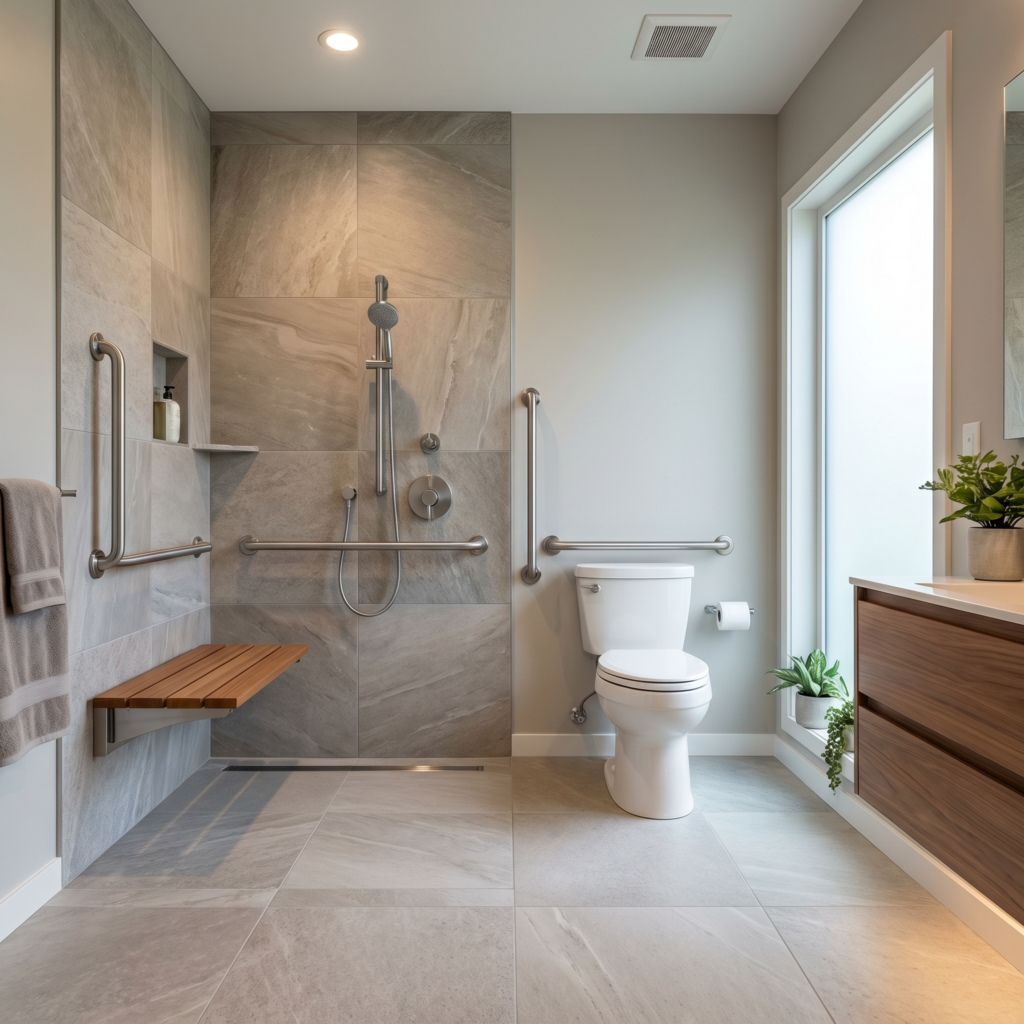
Illustrative scenario: An Ankeny homeowner in her early 70s plans a targeted bathroom remodel. The project includes removing the existing tub, installing a zero-threshold shower with a fold-down teak bench and two grab bars, replacing the toilet with a comfort-height model, installing non-slip luxury vinyl plank flooring, and upgrading the vanity lighting with a GFCI outlet. Total project estimate: approximately $14,000 to $22,000. Building and plumbing permits pulled. Three inspections scheduled. Timeline: roughly 4 to 5 weeks from demo to final inspection. Illustrative planning example only, not a verified Busy Builders project.
Frequently Asked Questions
Q: How much does an aging-in-place bathroom remodel cost in Iowa? Costs range from $500 for a basic grab bar package to $30,000 or more for a full accessible bathroom remodel. A targeted upgrade, zero-threshold shower with grab bars, a comfort-height toilet, and non-slip flooring, typically runs $6,500 to $15,000 in Central Iowa. Professionally installed grab bars typically run $100 to $400 per bar. Iowa labor runs about 15 percent below national averages, which helps. Always get a written, itemized estimate for your specific bathroom.
Q: Do I need a permit for aging-in-place bathroom modifications in Iowa? It depends on scope. Grab bars alone typically do not require a permit. Tub-to-shower conversions, zero-threshold showers, doorway widening, new GFCI outlets, and any plumbing relocation all require permits in Iowa. A registered Iowa contractor pulls the permit, coordinates licensed electricians and plumbers, and schedules inspections. Grab bars installed into studs or blocking rated for 250 pounds do not typically require a permit.
Q: What is the most important aging-in-place bathroom upgrade? Grab bars professionally installed into studs or blocking deliver the highest safety-per-dollar and are the lowest-cost first step. For comprehensive mobility support, a zero-threshold walk-in shower is the single highest-impact upgrade, especially for anyone using a walker or wheelchair. Most Iowa homeowners benefit from combining both, starting with grab bars and planning a zero-threshold shower when budget allows.
Q: Is a walk-in tub or walk-in shower better for seniors in Iowa? A zero-threshold walk-in shower is more universally accessible, especially for walker or wheelchair users, and it eliminates the door-open wait time that walk-in tubs require on entry and exit. A walk-in tub better suits homeowners who want to preserve a soaking option for joint or arthritis relief and who do not use mobility devices. Both require plumbing permits in Iowa. The right choice depends on the individual’s mobility and preferences, not a universal rule.
Q: Are there grants or financial assistance programs for aging-in-place bathroom remodels in Iowa? Yes, several programs may help eligible Iowa homeowners: Iowa Area Agencies on Aging, Iowa HHS Home and Community Based Services waiver programs, the Iowa Economic Development Authority CDBG Architectural Barrier Removal program for smaller Iowa cities, USDA Rural Development Section 504 grants and loans for very-low-income rural seniors, and HUD Title I Property Improvement Loans. All programs have income limits and eligibility requirements that change. Contact your local Area Agency on Aging or Iowa HHS to verify current availability before planning your project.
Q: Do grab bars need to be installed into studs? Yes. Grab bars must anchor into wall studs or into solid blocking behind the drywall, rated for 250 pounds minimum. Drywall anchors alone are not sufficient and can fail under the exact load the bar is supposed to handle. If your existing studs are not in the right position, a contractor can add plywood blocking during a small repair or as part of a larger remodel. Professional installation verifies proper anchoring before the bar goes up.
Key Takeaways
Start Here
- Grab bars, comfort-height toilet, non-slip flooring, handheld showerhead
- Basic safety package: $2,000 to $4,000 in one to two days
Cost in Iowa
- Full aging-in-place bathroom remodel: $6,500 to $30,000+
- Professionally installed grab bars: $100 to $400 per bar
- Iowa labor runs 15 percent below national average
- Get a written, itemized estimate
Permits
- Grab bars and fixture swaps: typically no permit
- Zero-threshold shower, doorway widening, plumbing or electrical changes: permits required
- GFCI required for all 125-volt receptacles in Iowa bathrooms
Safety Framing
- Modifications can reduce fall risk and support independence
- They do not prevent all falls
- ADA guidelines are voluntary best practices for private homes, not legal requirements
Resources
- Contact your local Iowa Area Agency on Aging first
- Consider a CAPS professional or occupational therapist assessment
- Verify DIAL contractor registration at dial.iowa.gov
Ready to Plan a Safer Iowa Bathroom?
Busy Builders has completed more than 1,285 projects across Central Iowa since 2020. We work throughout Des Moines, West Des Moines, Waukee, Ankeny, Johnston, Grimes, Urbandale, and Ames. Every project starts with a free consultation, a line-item written estimate, and a registered contractor who pulls permits and coordinates all required inspections. For the full scope of our bathroom work, see our bathroom remodeling services page. If the project you are considering involves adding a main-floor bathroom or expanding into adjacent space, our home additions page covers room additions that work well alongside aging-in-place planning.
Call: 844-435-9800 Website: https://busybuildersiowa.com/
We would rather give you an honest, phased plan than sell you a full remodel you do not need this year. Reach out whenever you are ready.
Legal Disclaimer
All cost figures in this article are general planning estimates based on Iowa construction data and national averages. Actual costs vary by project scope, site conditions, existing plumbing and electrical, materials, current labor and material pricing, and permit fees. Get a written, itemized estimate for your specific project. Aging-in-place modifications are home improvements designed to improve safety and support independence. They can reduce fall risk but do not prevent all falls or injuries. The Americans with Disabilities Act applies to public accommodations and commercial facilities; it does not govern private single-family home remodeling. ADA-inspired guidelines in this article are voluntary best practices, not legal requirements for private residences. This article is not medical, legal, financial, or occupational therapy advice. Consult a physician, occupational therapist, or Certified Aging in Place Specialist for guidance specific to an individual’s mobility and daily needs. Financial assistance program eligibility, income limits, and funding levels change; verify current program availability directly with Iowa HHS, your local Area Agency on Aging, the Iowa Economic Development Authority, USDA Rural Development, or HUD-approved lenders before planning your project around any program. Permit requirements vary by city and change over time; always verify current rules with your local building department. Illustrative scenarios are planning examples, not verified Busy Builders projects. Consult a DIAL-registered Iowa contractor and, where applicable, licensed electricians and plumbers for any structural, electrical, or plumbing work.
Busy Builders | Full-Service Construction and Remodeling | Serving Central Iowa Since 2020