Building a custom home in Central Iowa is exciting, but understanding how to pay for construction often feels confusing. Unlike buying an existing home, custom builds require special financing that works differently than traditional mortgages. This guide walks you through construction loans simply: how the money flows, what everything costs in 2026, and what to expect from your first lender meeting to move-in day. Whether you’re planning a $350,000 starter home or a $600,000 custom build, you’ll finish this guide knowing exactly how construction financing works.
TLDR: Construction loans in Iowa cost 6.5% to 9.5% APR in 2026 and require 10% to 25% down. You pay interest only during building, typically $1,500 to $3,000 monthly depending on project size. Most homeowners spend $15,000 to $35,000 total in interest and fees during their 8 to 12 month build. Two main paths exist: construction-to-permanent loans offer simplicity, while standalone loans offer flexibility if rates drop.
You’ve found the perfect lot. You’ve sketched your dream floor plan. You’re ready to break ground. But one question keeps nagging: “How do I actually pay for this while it’s being built?”
Traditional mortgages don’t work for homes that don’t exist yet. Banks won’t lend $400,000 on a vacant lot. This is where construction loans come in, and understanding them can save you thousands of dollars and months of stress. Let’s break down everything Central Iowa homeowners need to know about financing a custom build in 2026.
What Is a Construction Loan and How Does It Work?
A construction loan is short-term financing that covers building costs. The key difference from a mortgage? You receive money in phases called “draws” as your builder completes work, not all at once.
Here’s how the money actually flows:
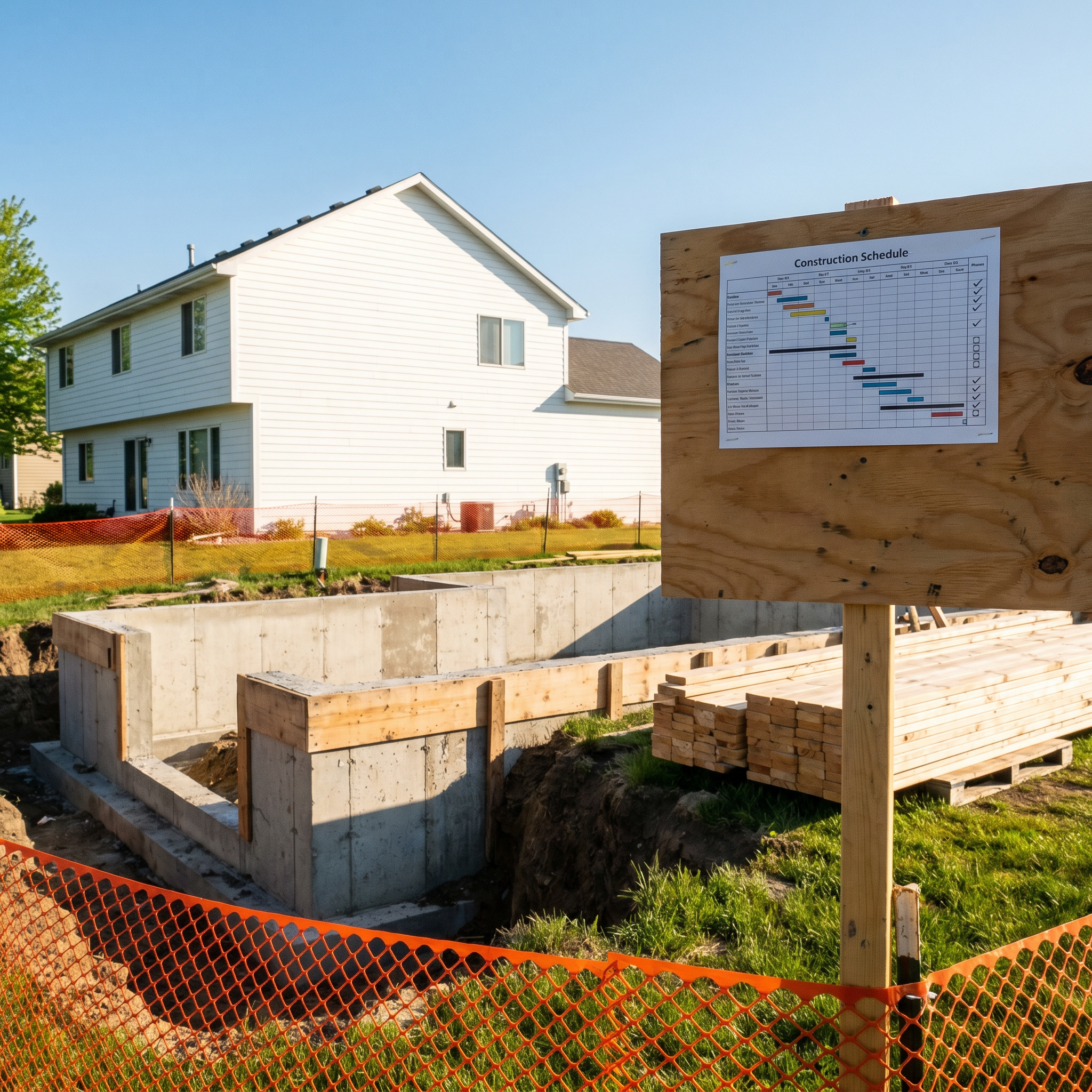
- Your builder completes a construction phase (foundation, framing, etc.)
- Builder requests a draw from your lender
- Lender inspects the completed work
- Lender pays your builder directly
- You pay interest only on money that’s been drawn
This draw system protects everyone. You don’t pay interest on the full loan amount from day one. Your builder gets paid for completed work. The lender verifies progress before releasing funds.
Illustrative scenario: A West Des Moines family built a $450,000 custom home. Over 10 months, they received 8 draws ranging from $15,000 to $80,000. Their monthly interest payment started at $875 and peaked at $2,400 near project completion. Total interest during construction: $18,500. They never touched the money directly because it flowed from lender to builder.
Pro tip: Ask your builder for a detailed draw schedule before signing any contract. Busy Builders provides this to every client so you know exactly when payments happen.
What Construction Loans Cost in 2026
Let’s cut through vague estimates with real 2026 numbers Central Iowa homeowners can expect.
Current Interest Rates
Construction loans in Iowa currently range from 6.5% to 9.5% APR. Your exact rate depends on several factors:
| Factor | Lower Rate Range | Higher Rate Range |
|---|---|---|
| Credit Score | 740+ gets about 6.75% | Below 680 gets 8.5%+ |
| Down Payment | 20%+ down lowers rate | 10-15% down raises rate |
| Loan Amount | $300K-$400K standard | $600K+ slightly higher |
| Builder Experience | Established builders help | First-time builders cost more |
Traditional mortgages today run 6.25% to 7.25%. Construction loans cost 1% to 2% more because lenders take on more risk during the unfinished build.
Real Cost Examples for 2026
| Loan Amount | Interest Rate | Monthly Payment (Build) | Total Interest (10 months) | Fees | Total Financing Cost |
|---|---|---|---|---|---|
| $280,000 | 7.0% | $1,633 | $8,165 | $5,600 | $13,765 |
| $400,000 | 7.25% | $2,417 | $12,085 | $7,400 | $19,485 |
| $500,000 | 7.5% | $3,125 | $15,625 | $9,500 | $25,125 |
| $600,000 | 8.0% | $4,000 | $20,000 | $11,200 | $31,200 |
These examples assume average credit (700-739), standard 20% down payment, and 10-month construction timeline.
Illustrative scenario: An Ankeny couple built a $420,000 home with a $336,000 construction loan at 7.25%. Their average monthly payment during the 11-month build was $2,100. Total interest paid: $13,200. With $6,800 in origination and closing fees, their total financing cost was $20,000. They compared this to waiting 2 years to save more cash and realized building now made sense.
Down Payment and Qualification Requirements
Most homeowners underestimate what lenders require. Here’s the reality.
Down Payment Expectations
| Down Payment Level | Impact on Your Loan |
|---|---|
| 10-15% | Minimum accepted; higher rates |
| 15-20% | Sweet spot for most borrowers |
| 20-25% | Locks in best rates available |
| 25%+ | Maximum savings on rate |
For a $500,000 project, that means $50,000 to $125,000 down. Many Central Iowa families use these sources:
- Savings accounts (most common)
- Sale of current home equity
- HELOC on existing property (often at lower rates)
- Family gifts (with proper documentation)
What Lenders Actually Require
According to the Consumer Financial Protection Bureau, construction loan qualification requires:
- Credit score: Minimum 640 to 680; 720+ for best rates
- Debt-to-income ratio: Maximum 43% in most cases
- Detailed builder contract: Full specifications, timeline, cost breakdown
- Complete architectural plans: Not sketches, but appraiser-ready drawings
- Builder verification: Lender checks your builder’s track record
- As-completed appraisal: Lender appraises what the finished home will be worth
Tip: Check your debt-to-income ratio 6 months before applying. Every $100/month in debt you eliminate improves your approval odds and rate.
Illustrative scenario: A Des Moines couple had excellent credit (745) and $85,000 saved. But they carried $1,400/month in car and credit card payments. On their $5,500/month income, the 43% debt-to-income cap left little room for a construction loan payment. They spent 4 months paying off $12,000 in high-interest debt. Their debt dropped to $700/month, and they qualified easily at 7.0% instead of the 8.25% they would have received before.
Two Main Financing Paths: Which Works for You?
Path 1: Construction-to-Permanent Loan
This is the most popular choice for Central Iowa homeowners. One loan covers both construction and your permanent mortgage.
How it works:
- Close once at project start
- Pay interest only during construction
- Loan automatically converts to 30-year mortgage at completion
- Rate locked from beginning
Pros: Simple process, one closing, rate certainty, less paperwork
Cons: Locked into your rate even if rates drop during construction
Path 2: Standalone Construction Loan Plus Refinance
Separate construction financing that you refinance into a permanent mortgage at completion.
How it works:
- Close on construction loan
- Build home over 8-12 months
- Refinance into new permanent mortgage at completion
- Get whatever market rate exists at that time
Pros: Benefit if rates drop, flexibility to choose permanent lender
Cons: Two closings, more fees ($2,500-$4,000 extra), rate risk if rates rise
| Factor | Construction-to-Permanent | Standalone + Refinance |
|---|---|---|
| Number of Closings | 1 | 2 |
| Rate During Construction | Locked upfront | Same |
| Permanent Rate | Same as construction | Market rate at completion |
| If Rates Drop | No benefit | You benefit |
| If Rates Rise | Protected | Pay higher rate |
| Total Closing Costs | $7,500-$10,000 | $10,000-$14,000 |
| Best For | Risk-averse homeowners | Those expecting rate drops |
According to Fannie Mae guidelines, construction-to-permanent loans must convert to permanent financing once construction completes and can include manufactured housing in eligible situations.
Pro tip: Most Busy Builders clients choose construction-to-permanent for simplicity. In uncertain rate environments, paying slightly more for certainty often makes sense.
Real Central Iowa Financing Scenarios
Scenario 1: Young Family in Ankeny
- Project: $400,000 custom home
- Down payment: $80,000 (20%)
- Loan amount: $320,000
- Credit score: 735
- Rate secured: 7.0%
- Monthly interest payment during build: About $1,870
- Total financing cost: $18,200
They started lender conversations 5 months before groundbreaking and compared 4 different lenders. Shopping saved them 0.5% on their rate.
Scenario 2: Professional Couple in Urbandale
- Project: $525,000 custom home
- Down payment: $78,750 (15%)
- Loan amount: $446,250
- Credit score: 705
- Rate secured: 7.75%
- Monthly interest payment during build: About $2,880
- Total financing cost: $33,400
Their lower down payment and moderate credit score meant higher costs, but they budgeted for this and completed their dream home without financial stress.
Scenario 3: Retirees Building Forever Home
- Project: $350,000 custom home
- Down payment: $105,000 (30%) using HELOC on current home
- Loan amount: $245,000
- Credit score: 755
- Rate secured: 6.75%
- Monthly interest payment during build: About $1,380
- Total financing cost: $14,100
Their strong position (high down payment, excellent credit, low existing debt) earned them the best available rate.
Five Financing Mistakes That Cost Thousands
Mistake 1: Starting Too Late
Beginning lender conversations 4 weeks before groundbreaking causes delays. Approval typically takes 4 to 6 weeks.
Fix: Start financing conversations 5 to 6 months before your target groundbreaking date.
Mistake 2: Not Shopping Lenders
Accepting your first quote without comparison costs money. The National Association of Home Builders reports significant rate variation between lenders.
Illustrative scenario: A Johnston family got their first quote at 8.0%. They almost accepted. We encouraged them to call two more lenders. Final rate secured: 7.25%. Savings: $2,400 during construction plus $95/month on their permanent mortgage.
Fix: Get written quotes from at least 3 lenders. Compare apples to apples.
Mistake 3: Ignoring Contingency
Building a $400,000 home with zero buffer leads to stress when unexpected costs hit.
Fix: Build 10% to 15% contingency into your loan request. You don’t spend it if not needed.
Mistake 4: Overlooking Debt-to-Income
Great credit and savings mean nothing if existing debt pushes you over the 43% threshold.
Fix: Pay down high-interest debt aggressively 6 to 9 months before applying.
Mistake 5: Choosing Rate Without Understanding Fees
A 7.0% rate with 3% origination fees often costs more than 7.25% with 1% fees.
Fix: Ask lenders: “What’s my total cost over 10 years?” Compare total expenses, not just rates.
Construction Loan Timeline
| Timeline | Action |
|---|---|
| 6 months before | Start shopping lenders; get 3-5 quotes |
| 5 months before | Choose lender; submit full application |
| 4 months before | Lender orders appraisal; underwriting begins |
| 3 months before | Final approval; all conditions met |
| 2 months before | Rate lock signed (60-90 days) |
| 1 month before | Final preparations; document review |
| Groundbreaking week | Close on construction loan; funds transfer |
Pro tip: Busy Builders requires clients to be pre-approved before finalizing builder contracts. This protects everyone from design work that financing can’t support.
FAQ: Construction Loan Questions Homeowners Ask
Q: Can I get a construction loan if I’m self-employed? A: Yes, but expect stricter requirements. Lenders want 2 years of tax returns, profit-and-loss statements, and often ask for higher down payments. It’s doable with proper documentation.
Q: What if construction costs go over budget? A: You have options: cover overruns with personal funds, request a contingency draw if budgeted, or reduce scope. This is why 10% to 15% contingency matters.
Q: Do I pay property taxes during construction? A: Typically no. Your lender usually carries property tax burden during construction. You start paying with your permanent mortgage. Confirm with your specific lender.
Q: What happens if my builder goes bankrupt during the build? A: Rare but possible. Your lender has a lien on the property and controls fund releases. The draw system protects you because only completed work gets paid. Choose established builders like Busy Builders with 1,000+ completed projects.
Q: Can I use my current home’s equity for a down payment? A: Yes, through a HELOC or cash-out refinance. HELOC rates often run lower than construction loan rates, making this a smart strategy for many homeowners.
Q: When do I make my first mortgage payment? A: Typically 30 days after loan conversion. During construction, you pay interest only. Your first principal-plus-interest payment comes about a month after moving in.
Key Takeaways
Understanding the Basics
- Construction loans provide money in phases called draws
- You pay interest only on amounts drawn during building
- Lenders verify completed work before releasing funds
2026 Costs
- Rates range from 6.5% to 9.5% depending on your qualifications
- Budget $15,000 to $35,000 in total financing costs during construction
- Down payments of 15% to 20% hit the sweet spot for most borrowers
Choosing Your Path
- Construction-to-permanent offers simplicity and rate certainty
- Standalone plus refinance offers flexibility if rates drop
- Most Central Iowa homeowners prefer construction-to-permanent
Avoiding Mistakes
- Start financing conversations 5 to 6 months early
- Shop at least 3 lenders
- Build 10% to 15% contingency into your loan
- Pay down existing debt before applying
Ready to Understand Your Financing Options?
You now understand how construction loans work, what they cost, and how to qualify. The next step is talking with professionals who understand Central Iowa custom home building and can guide you through lender selection.
Busy Builders has helped over 1,000 Central Iowa homeowners since 2020. We bring transparency, expertise, and integrity to every project. Here’s what we offer:
- Free consultation to discuss your budget and financing strategy
- Guidance on lender selection and rate shopping
- Coordination with your lender throughout the build
- Transparent draw schedules so you always know what’s happening
- Experience with hundreds of construction financing situations
Ready to move forward?
Call: 844-435-9800
We serve Des Moines, West Des Moines, Ankeny, Waukee, Urbandale, Ames, and all Central Iowa communities. Schedule your free consultation today.
About Busy Builders: This guide was created by Busy Builders, a full-service remodeling and construction company serving Central Iowa since 2020. With over 1,000 custom homes completed across Des Moines, West Des Moines, Ankeny, and surrounding communities, we’ve worked with hundreds of homeowners through the construction financing process. We understand lender requirements, draw schedules, and the importance of starting financing conversations early to keep builds on track.
Busy Builders | Full-Service Construction and Remodeling | Serving Central Iowa Since 2020